

Stacking Rings With Arthritis: Comfort and Style Combined
You can still wear a ring stack with arthritis - if the rings are light, smooth, and easy to remove. The main issue is usually fit: swollen knuckles, day-to-day swelling, and sore joints can make fixed stacks feel tight fast.
Here’s the short version:
- Pick rings that adjust as your fingers swell
- Keep stacks light with 1–2 rings per finger
- Choose low-profile bands with smooth edges
- Use nickel-free metals if your skin gets irritated
- Size for your most swollen fit, not your smallest fit
- Stop wearing any stack that leaves marks, numbness, or pain
A few numbers matter here. Thin bands around 1–2 mm usually add less pressure. A main band around 3–4 mm can still give you that stacked look without too much bulk. And finger size can shift by about 0.25 ring size in one day, so a ring that fits at 9:00 AM may feel tight by late afternoon.
If I were building a stack for arthritic fingers, I’d keep it simple:
- Low-swelling day: one main ring + one or two thin bands
- Medium-swelling day: one adjustable ring + one thin band on a less sore finger
- High-swelling day: one loose open ring, or switch to silicone
The Adjustable Ring Shank | Perfect For People With Arthritis Or A Broken Finger ☝🏼
sbb-itb-9da40c1
Quick Comparison
| Need | What I’d look for | What I’d avoid |
|---|---|---|
| Swollen knuckles | Open bands, hinged rings, adjustable styles | Fixed tight bands |
| Sore joints | Light rings, low settings, smooth interiors | Heavy stacks, tall stones |
| Skin irritation | Nickel-free silver, 18K gold, titanium, platinum | Nickel mixes |
| Daily swelling | Loose fit, easy removal, simple stack | 3–4 tight rings on one finger |
The goal is simple: a stack that goes on without force, feels fine through the day, and comes off just as easily.
Why Standard Ring Stacks Can Be Uncomfortable With Arthritis
Arthritis can change both the shape and size of your fingers. And that makes fixed rings hard to wear.
A ring might slip over the knuckle, then feel loose at the base. Or it may fit fine at the base but refuse to slide over swelling. That's the main issue: stackable rings need to work with changing finger size, not fight it.
How Swelling and Knuckle Size Affect Daily Ring Fit
The core problem is a fit mismatch.
With arthritis, knuckles are often much wider than the base of the finger. So a ring sized to pass over the knuckle can end up feeling loose, unstable, and prone to shifting once it's on. But a ring sized for the base may not clear the knuckle at all. And when swelling gets worse, it can become stuck.
Swelling can also shift during the day. A ring that feels fine in the morning may feel tight by the afternoon. With a stack of bands, that effect adds up fast.
How Tight or Bulky Stacks Create Pressure on Arthritic Fingers
Each ring in a stack adds more pressure, more friction, and more contact with the skin. One band may feel okay on its own. But three or four bands together can form a tight belt around the finger.
That extra pressure can limit how much the finger bends. And when joints are already stiff and sore, even small tasks can feel harder.
Profile and edge shape matter too. High-profile rings, rough edges, and raised settings can press into swollen tissue and catch on bony joints. If a band rotates, a seam, edge, or stone may rub against a tender spot. That's why stackable rings should have features that adjust to swelling instead of adding more pressure.
Ring Features That Make Stacking Easier With Arthritis
Some ring details make a big difference when you have arthritis. The right design can ease pressure, fit better, and make everyday wear less of a hassle. Adjustability matters most, because finger size often shifts through the day.
Adjustable Bands and Open Rings for Fingers That Change Size
Arthritic fingers can swell and shrink over the course of a day. An adjustable band helps you respond to that change. You can loosen or tighten the ring as needed, which makes it easier to get past a swollen knuckle and then settle it more securely at the base of the finger.
A few styles stand out:
- Hidden-adjustable bands look the most like standard rings
- Hinged designs are the easiest to slip on
- Open shanks give you the simplest sizing range
Fit is only part of the picture. The inside shape of the ring matters just as much.
Comfort-Fit Interiors, Low Profiles, and Smooth Edges
A rounded interior spreads pressure more evenly and cuts down on rubbing. Smooth edges also help, especially when fingers feel sore or hand movement is limited. In a stack, small details like these matter even more. Every ring adds another point of contact, so rounded interiors and smooth edges across the whole stack can keep friction under control.
For stones and settings, low-profile and bezel-set styles tend to work better. They sit closer to the finger, so they're less likely to snag on fabric or press into nearby fingers when you close your hand. Thin accent bands, usually 1–2 mm wide, add style without much bulk or weight. A good setup is one slightly wider focal ring, around 3–4 mm, paired with two or three slim bands. You still get a polished stack, but it stays light and easier to wear.
After pressure and friction, skin irritation is usually the next issue.
Hypoallergenic Metals for Sensitive or Inflamed Skin
Inflammation can make the skin around the joints more sensitive than usual. Nickel-free metals can help cut down on irritation, which makes them a smart pick for daily wear.
| Material | Allergy Risk | Weight | Resize Flexibility | Durability |
|---|---|---|---|---|
| Nickel-Free Sterling Silver | Low | Light | High | Moderate |
| 18K Gold | Very Low | Moderate | Moderate | High |
| Titanium | Extremely Low | Ultra-Light | Low | Very High |
| Platinum | Extremely Low | Heavy | Low | Very High |
Silicone can also make sense as a temporary option on high-swelling days, when metal rings just don't feel good.
Once the material is set, the next step is figuring out how many rings to wear and where each one should go. A better-fitting ring is a strong start, but the stack also needs to stay light and balanced through the day.
How to Build a Ring Stack That Looks Good and Feels Comfortable
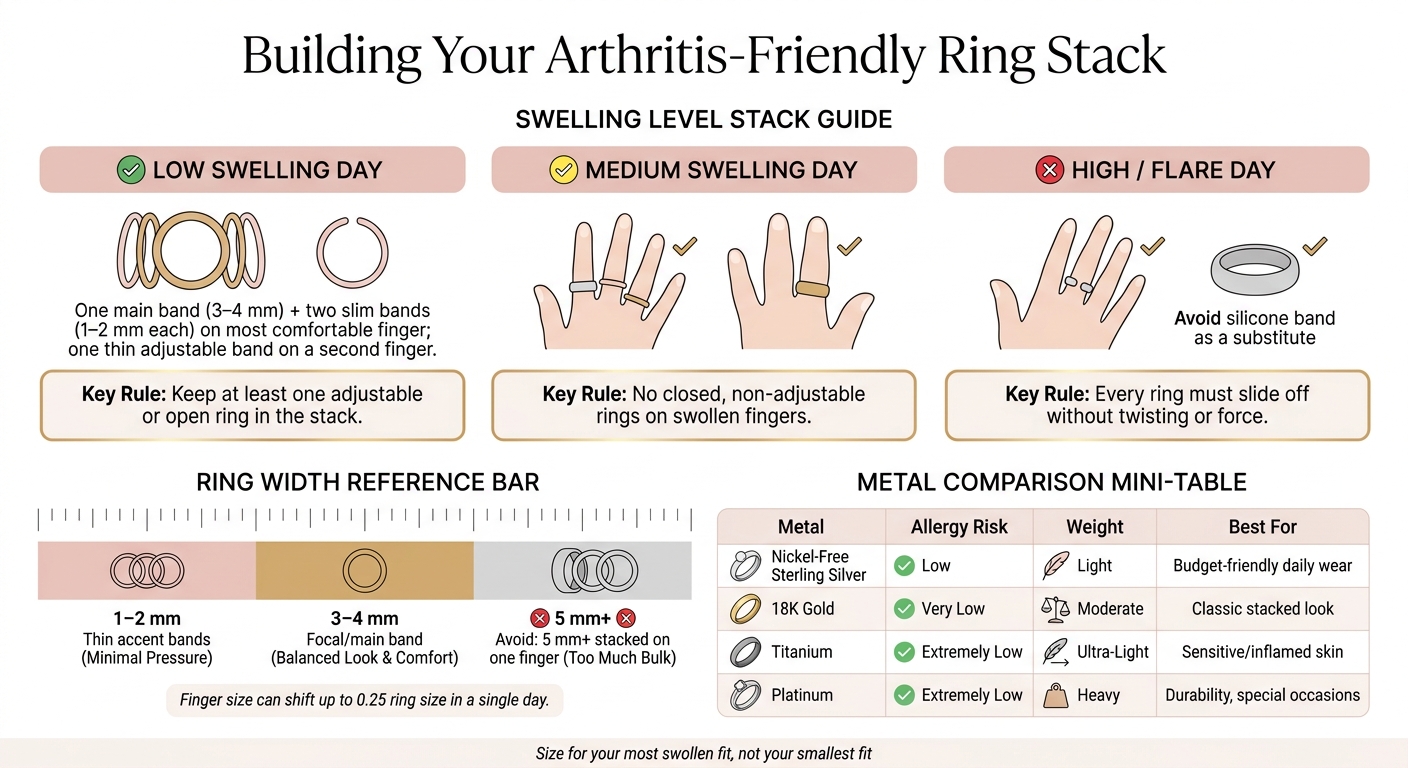
Ring Stacking With Arthritis: Daily Swelling Guide & Stack Combinations
Once you know which ring details cut down on pressure, the next step is putting them together in a way that still feels easy to wear.
Use Fewer Rings, Mix Widths, and Spread Weight Across Fingers
Keep your stack to 1–2 rings per finger. Fewer bands usually mean less pressure and less stiffness. A simple place to start is one main ring on the finger that feels best, then one slim 1–2 mm band next to it.
If you want the stack to look a bit more styled, don’t pile everything onto one finger. Move that second band to a nearby finger instead. That way, your hand still looks put together, but the weight isn’t all sitting on one joint.
You can also mix finishes to make the stack feel more intentional. For example, a plain polished band next to a lightly hammered band tends to look pulled together, not random.
Once the basic stack is in place, adjust the number of rings based on how much your fingers are swelling that day.
Stack Combinations for Low-, Medium-, and High-Swelling Days
| Swelling Level | Suggested Stack | Key Rule |
|---|---|---|
| Low | One main band (3–4 mm) + two slim bands (1–2 mm each) on your most comfortable finger; one thin adjustable band on a second finger | Keep at least one adjustable or open ring in the stack |
| Medium | One adjustable band + one thin accent ring on a less affected finger; one ring max on any puffy finger | No closed, non-adjustable rings on swollen fingers |
| High / Flare | One open or adjustable ring on your least affected hand, worn slightly loose; silicone band as a substitute if needed | Every ring must slide off without twisting or force |
On low-swelling days, a fuller stack can work. The big rule is simple: every ring should still slide off easily. On flare days, less is safer.
Use the stack to deal with the fit issue that shows up most often.
Match Your Stack to the Problem You Are Trying to Solve
Start with the main fit problem, then build around the ring feature that helps with it most.
| Problem | Ring Feature | Stack Strategy | Why It Helps |
|---|---|---|---|
| Fluctuating size | Adjustable or open ring | One adjustable main ring + 1–2 thin bands | Loosens or tightens as fingers swell or shrink |
| Swollen knuckles | Open shank or bypass design | One looser ring that clears the knuckle; slim bands only if tolerated | Extra room lets the ring pass the knuckle without digging in |
| Finger pain | Lightweight bands (1–3 mm); low-profile settings | One light main ring + one thin band; no tall stones or heavy designs | Reduces downward pressure on the joint |
| Rings hard to remove | Adjustable or open rings; silicone bands | Keep stacks loose enough to twist off one-handed; no more than two rings on any problem finger | Provides an exit if swelling increases unexpectedly |
| Skin irritation | Hypoallergenic metals | Build stacks from nickel-free metals only | Use nickel-free metals and keep rings dry |
Next, ring sizing and wear checks help keep that stack comfortable day to day.
Buying and Wearing Tips for Day-to-Day Comfort
How to Measure Your Ring Size for Arthritic Fingers
Size the ring for your most swollen fit, not the smallest your finger ever gets. A ring that slips on in the morning can feel tight and miserable by evening.
Measure later in the day, when swelling is more likely to show, and check more than once if your size tends to change. Finger size can shift by up to a quarter size during a single day, so one reading doesn't always show how the ring will feel during normal wear. If you're between sizes, go with the larger one.
Measure the exact finger that will wear the stack, and make sure the ring can pass over the knuckle without force. That part matters more than people think.
Also, measure for the widest stack you plan to wear, not just a single band. Several rings worn together often feel tighter than one ring on its own, so a size that seems fine for one band may feel too snug once the full stack is on.
What to Check Before Wearing a Ring Stack Every Day
Once you've sized the rings, test the full stack during normal movement. Wear it while typing, driving, using your phone, carrying items, washing your hands, and opening containers. The goal is simple: see if the rings pinch, rub, slide around, or land in spots that start to hurt.
By the end of the day, check how the stack feels coming off. It should remove easily. Look for redness, deep indentations, numbness, tingling, or any sense of pressure. If a ring leaves a clear mark or takes force to remove, it's not a good day-to-day option for arthritic fingers.
Pay attention to spinning, too. If a ring keeps turning into a sore area, that repeated friction can wear on you over time.
When shopping online, read the product details closely. Check:
- Band width
- Thickness
- Weight
- Inner shaping
- Metal content
If your skin is sensitive or inflamed, choose nickel-free or hypoallergenic options. And before you click buy, review the seller's return or exchange policy. A ring can feel fine for a few minutes and very different after a full day of wear.
Conclusion: A Ring Stack That Fits Your Fingers and Your Style
Arthritis can make fixed ring stacks tough to wear. Swelling and changes in the knuckles can shift the fit from one part of the day to the next. The good news is that the right ring features can fix that without forcing you to give up your look.
Features like adjustable bands, open rings, comfort-fit interiors, and low-profile designs with smooth edges help take pressure off the fingers, make movement easier, and reduce irritation. Lightweight rings and nickel-free metals such as titanium, platinum, or gold can help too. Once you have those basics in place, the next step is simple: decide how many rings to wear and which fingers feel best.
It helps to build a small set of rings you can swap as swelling changes through the day or week. On easier days, a few slim bands across different fingers may feel good. On days with more swelling, one adjustable or open ring may be the better call. That kind of flexibility helps keep your stack comfortable on flare-up days and easy days alike.
With the right pieces, you can still wear rings that match your personal style without letting discomfort get in the way.
FAQs
Can stacking rings make arthritis pain worse?
Yes. Traditional fixed-size rings can make arthritis pain worse. Swelling, stiffness, and joint enlargement can make a ring feel too tight or cause it to press unevenly on sore joints.
That pressure may lead to discomfort, irritation, or temporary numbness. Adjustable or flexible stacking rings can help because they shift with day-to-day changes in finger size and put less pressure on tender areas.
Which ring style is easiest to put on and take off?
For people with arthritis, hinged rings and stretch rings are often the easiest options to wear.
Hinged rings open all the way, so you can put them on without forcing them over swollen knuckles. Stretch rings expand to fit sore or swollen joints, then settle into a more comfortable fit at the base of the finger.
How loose should stacking rings feel with arthritis?
Stacking rings should feel secure, not snug. They should sit in place without sliding around or spinning, but still feel comfortable if your fingers swell a bit during the day.
If you have arthritis, that matters even more. Swelling can make rings harder to get over sore knuckles. Adjustable bands can make that process easier, then sit more comfortably once the ring is at the base of your finger.


