

Gold Vermeil vs Gold Filled vs Gold Plated: What You're Actually Buying
Most gold-tone jewelry is not built the same. If I want the short answer: gold filled lasts the longest, gold vermeil sits in the middle, and gold plated is the lowest-cost option but wears out the fastest.
Here’s the part I’d want to know before buying:
- Gold plated has a very thin gold layer, often around 0.1 to 2 microns
- Gold vermeil must use 925 sterling silver under at least 2.5 microns of 10K+ gold
- Gold filled must contain at least 5% gold by weight in the U.S., and it usually lasts far longer
- For daily-wear rings, lifespan can range from weeks or months for plated, 1–3 years for vermeil, and 10–30 years for gold filled
- A low price like $20–$40 can look good at first, but friction, hand washing, and resizing can wear thin finishes fast
If I’m buying a ring I’ll wear often, I’d put it this way: gold filled first, gold vermeil second, gold plated last. If I’m buying a gift, fashion piece, or something for light wear, plated can still make sense.
Quick Comparison
| Type | Base metal | Gold layer | U.S. rule | Wear life | Common price |
|---|---|---|---|---|---|
| Gold plated | Brass, copper, or stainless steel | Thin | No set minimum in many cases | Shortest | $10–$40 |
| Gold vermeil | Sterling silver | 2.5+ microns | Must be silver + 10K+ gold | Middle | $50–$300 |
| Gold filled | Usually brass core | Thick bonded gold | At least 5% gold by weight | Longest | $80–$300+ |
That’s the whole decision in one glance: base metal, gold thickness, wear time, and price per wear.
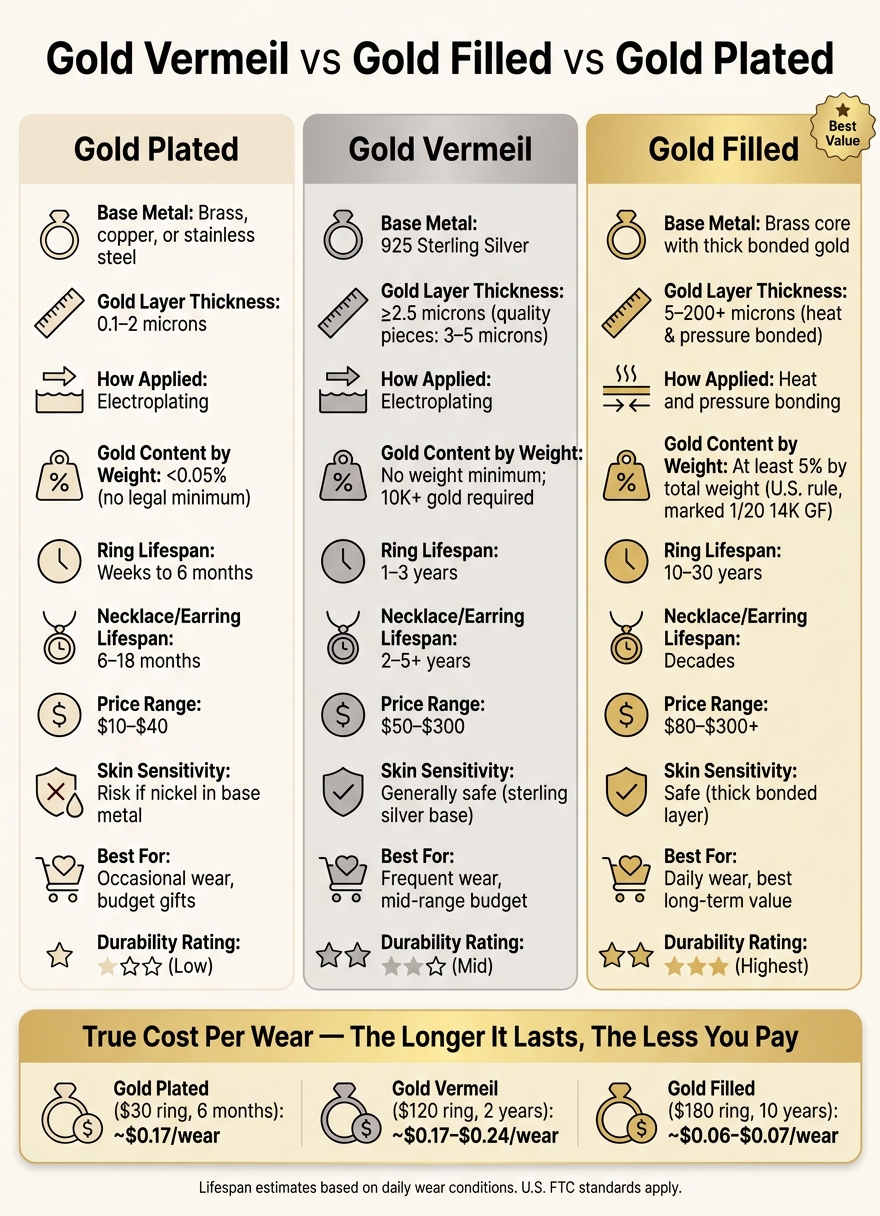
Gold Vermeil vs Gold Filled vs Gold Plated: Full Comparison Chart
Gold Plated vs Gold Filled vs Gold Vermeil
sbb-itb-9da40c1
Gold Vermeil vs Gold Filled vs Gold Plated: Core Differences
These three options can look similar at first glance, but the way they’re made is very different.
What gold plated means
Gold plated jewelry has a thin layer of gold added through electroplating over a base metal such as brass, copper, or stainless steel. Standard plating is usually about 0.17 to 0.5 microns thick, while heavier plating can reach about 2.5 microns.
Because it uses a small amount of gold and lower-cost base metals, it’s usually the least expensive choice. The downside is wear. Once that thin gold layer rubs off, the metal underneath can tarnish or leave green marks on your skin.
What gold vermeil means
Gold vermeil uses a 925 sterling silver base, at least 10K gold, and a gold layer of at least 2.5 microns on major surfaces. That gives it better wear and a higher material value than basic gold plating.
And if the gold layer starts to wear down over time, the exposed metal is still sterling silver. That’s a much nicer outcome than brass or copper showing through.
What gold filled means
Gold filled jewelry is made by bonding a thick layer of real gold - often 14K - to a brass core using heat and pressure. In the U.S., the gold must make up at least 5% of the item’s total weight, which is why you’ll often see marks like 1/20 14K GF. That process creates a gold layer often in the 50 to 100+ micron range.
This bonded layer holds up well against peeling, flaking, and the kind of friction rings and bracelets deal with every day. For daily wear, gold filled acts much more like solid gold than either gold plated or gold vermeil.
| Gold Plated | Gold Vermeil | Gold Filled | |
|---|---|---|---|
| Base Metal | Brass, copper, or stainless steel | 925 sterling silver | Brass |
| Gold Layer | Very thin plating | Thicker plated layer | Much thicker bonded layer |
| How Gold Is Applied | Electroplating | Electroplating | Heat and pressure bonding |
| Gold Content | Very little | 10K minimum gold | Highest gold content by weight |
| Durability | Lowest | Mid-range | Highest of the three |
These build differences affect thickness, how long the finish lasts, and what you’ll pay.
Gold Thickness, Lifespan, and Price: A Side-by-Side Look
Thickness and metal content
Once you know what the labels mean, the next thing to look at is how much gold is actually on the piece. That’s what often separates jewelry that wears down in a few months from jewelry that stays in good shape for years.
Microns measure the thickness of the gold layer. Standard gold plated jewelry usually has about 0.1–0.5 microns for flash plating and up to about 0.5–2 microns for standard plating. That’s usually best for occasional wear. Gold vermeil has stricter rules: it must use a sterling silver base and, in the U.S., at least 2.5 microns of 10K+ gold. Many better-made pieces fall in the 3–5 micron range or more. Gold filled is different from basic electroplating because the gold layer is bonded to the base metal. That bonded layer often starts around 5–10 microns and can reach 50–200 microns in higher-quality pieces.
Gold content by weight tells the same story in a different way. Gold plated pieces often contain less than 0.05% gold by weight. Gold filled jewelry, by contrast, must contain at least 5% gold by total weight under U.S. rules. Gold vermeil doesn’t have a minimum weight percentage. Instead, the rule is about the materials: a sterling silver base plus at least 2.5 microns of 10K+ gold.
How each finish holds up on rings, necklaces, and earrings
Placement matters just as much as finish. Rings go through the most wear because they deal with friction, hand washing, and constant contact with hard surfaces.
A standard gold plated ring can start to show wear in weeks or months. A gold vermeil ring with 2.5–5 microns of gold will often hold up for 1–3 years with daily wear before the color change becomes easy to spot. A gold filled ring can last 10–30 years under those same conditions.
Necklaces and earrings usually have an easier life. They don’t scrape against sinks, counters, and doorknobs all day. Because of that, a gold plated necklace can still look good for 6–18 months. Gold vermeil earrings can last 2–5+ years. Gold filled necklaces are often described as lasting decades with basic care.
Cost per wear in U.S. dollars
The sticker price only tells part of the story. Cost per wear gives a better sense of what you’re paying over time.
A $30 plated ring worn for 6 months works out to about $0.17 per wear. A $120 vermeil ring worn for 2 years lands at about $0.17–$0.24 per wear. A $180 gold filled ring worn for 10 years drops to about $0.06–$0.07 per wear.
| Type | Base Metal | Gold Thickness | Gold Content by Weight | Typical Daily Lifespan | Relative Price Range (USD) |
|---|---|---|---|---|---|
| Gold Plated | Brass, copper, or stainless steel | ~0.1–0.5 µm (flash) to ~0.5–2 µm (standard) | Often <0.05% (no legal minimum) | Rings: ~2 weeks–6 months; earrings/necklaces: ~6–18 months | ~$10–$40 |
| Gold Vermeil | 925 sterling silver | ≥2.5 µm (FTC minimum); quality pieces ~3–5 µm | No weight minimum; thicker layer than plated | Rings: ~1–3 years; earrings/necklaces: ~2–5+ years | ~$50–$300 |
| Gold Filled | Brass or other base metal with thick bonded gold layer | Commonly ~5–10 µm minimum; higher-quality pieces ~50–200 µm | At least 5% (1/20) by weight; some 10% (1/10) | Rings: ~10–30 years; earrings/necklaces: decades | ~$80–$300+ |
These ranges reflect common U.S. pricing and wear estimates for each finish.
Next, the bigger question is how each finish performs on skin, in daily wear, and in pieces you wear most often.
Sensitive Skin, Tarnish, and Choosing the Right Finish for How You Wear Jewelry
Which finish works better for sensitive skin
Comfort matters here too. When plating wears down, the metal underneath can start touching your skin. And in most cases, that base metal is what causes the reaction, not the gold on top.
A lot of plated jewelry uses brass or mixed alloys, and those can contain nickel. That’s a problem for many people. The North American Contact Dermatitis Group reported that 16.7% of patients tested were sensitized to nickel.
Gold vermeil and gold filled are often better picks for sensitive skin because they keep the base metal covered for longer. Gold vermeil is usually gentler because it uses sterling silver under a thicker layer of gold. Gold filled is also a strong option because its thick bonded layer helps keep the base metal away from skin.
If you already know you react to certain metals, check for pieces labeled nickel-free and confirm the base metal before you buy. That small step can save you a lot of hassle later.
Which finish fits everyday wear, gifting, or a tighter budget
For day-to-day use, gold filled is the best pick for rings and bracelets. Gold vermeil works well for frequent wear. Gold plated makes the most sense for occasional use or gift pieces.
Gold plated jewelry is the lowest-cost option, which is why it’s so common for gifts or pieces you won’t wear all the time. It can look great out of the box. But there’s a catch: with frequent use, it may start to fade within a year.
Vermeil sits in the middle. It has a polished look, uses a better base metal, and lasts longer than standard plating without the higher upfront price of gold filled. If you want something that looks a bit more upscale without jumping to the top end of the price range, this is often the sweet spot.
For everyday rings and bracelets, gold filled gives you the best long-term value.
Here’s the quick match-up:
| Type | Best for Everyday Rings | Best for Occasional Wear | Best for Sensitive Skin | Best for Budget Gifts | Main Tradeoff |
|---|---|---|---|---|---|
| Gold Plated | No | Yes | Only if nickel-free base | Yes | Gold layer fades fastest; base metal exposure risk |
| Gold Vermeil | Yes (moderate wear) | Yes | Yes (sterling silver base) | No | Can tarnish if layer wears thin |
| Gold Filled | Yes (best choice) | Yes | Yes (thick bonded layer) | No | Higher upfront cost |
If your budget is tight but your skin is picky, focus first on a nickel-free base and a thicker gold layer instead of just going for the lowest price.
What This Means for Satinski Adjustable Rings and Key Buying Takeaways
Best finish choices for adjustable and resizable rings
Adjustable rings bend at the band, so the finish tends to wear down faster than it does on fixed-size jewelry. That gap matters more here because the same spots flex again and again. If a ring gets resized often, the finish at that bend point takes the hit first.
For that reason, gold filled and gold vermeil usually last longer than standard gold plating on adjustable rings. They handle repeated bending and day-to-day rubbing better. And when a ring is adjusted often, a thicker gold layer generally holds up better where the band flexes.
Put simply: on adjustable rings, more gold content and a stronger base metal matter most at the stress point.
| Satinski Jewelry Type | Recommended Finish | Why It Works | Wear Consideration |
|---|---|---|---|
| Everyday band | Gold filled | Bonded gold resists wear from repeated resizing | Best for rings adjusted and worn all day |
| Stacking ring set | Gold filled or gold vermeil | Thicker layer resists metal-on-metal contact between stacked rings | Store separately and avoid abrasive cleaners |
| Engagement-style adjustable ring | Gold vermeil over sterling silver | 18K gold over a hypoallergenic silver base offers a durable, skin-friendly finish for regular wear | Good for daily wear with moderate care |
| Comfort-fit ring | Gold filled or gold vermeil | Supports frequent micro-adjustments while keeping a smoother, more durable surface | Useful when finger size changes during the day or seasonally |
| Occasional gift ring | Gold plated | Lower upfront cost for pieces not worn or adjusted daily | Expect cosmetic wear sooner at stress points |
There’s also a practical point here for people dealing with arthritis, swollen knuckles, or pregnancy-related finger changes. In those cases, rings often need more frequent adjustment than usual. That makes gold filled or gold vermeil the smarter pick for day-to-day use.
Conclusion: How to choose the right gold finish
In day-to-day use, the right finish comes down to two things: how often the ring is adjusted and how often it’s worn. For adjustable rings, choose gold filled first, gold vermeil second, and gold plated only for occasional wear.
FAQs
How can I tell if jewelry is really gold vermeil or gold filled?
Check the stamp and the product description. Gold vermeil means gold over 925 sterling silver. And “925” is the big clue that the base metal is sterling silver.
If a listing only says GP or GEP, or it never mentions a sterling silver base, it’s probably gold plated. Vermeil should also mention a thicker layer of gold. Plain plating usually wears off sooner, especially with frequent use and contact with water, lotion, perfume, and other chemicals.
Can gold vermeil or gold filled be repaired or replated later?
Sometimes. But gold-plated jewelry is much harder to fix than solid gold.
Why? Because resizing or soldering can wear through the thin gold layer and expose the base metal underneath. Once that happens, the piece can lose its look fast.
In some cases, a jeweler can replate the item as the surface starts to wear down. That said, the process is complex and usually doesn’t last as well as a repair on solid gold jewelry.
Which option is best if I wear my jewelry in water?
Solid gold is the best pick for wearing in water because it naturally stands up to moisture, humidity, and corrosion. Unlike gold plated or gold vermeil jewelry, it won’t tarnish or fade from water exposure.
You should avoid wearing gold plated or gold vermeil jewelry in water, since regular moisture, swimming, and showering can wear it down faster and thin out the gold layer. Even so, it’s still a good idea to take off any jewelry before swimming or showering.


