

Titanium and Tungsten Bands: Why Resizing Isn't an Option
If you buy a tungsten or titanium ring in the wrong size, you usually can’t resize it later. That’s the short answer.
I’d sum it up like this:
- Tungsten carbide is very hard but also brittle, so it can crack instead of bend.
- Titanium is strong and light, but it doesn’t respond well to standard jeweler tools, heat, or soldering.
- Gold and platinum are easier to resize because they can be cut, stretched, and joined again.
- Even a 1/4-size change can affect comfort.
- Most sellers rely on 30–90 day exchanges instead of resizing.
- Temporary ring adjusters can help if a ring is only a little loose, often for $5–$20.
- Some lifetime size-exchange plans charge about $20–$40, plus shipping.
If your finger size changes with heat, cold, salt, weight, or age, this matters even more. A ring should go over your knuckle with slight resistance, then sit snug at the base of your finger. If it spins, it’s too loose. If it’s hard to remove, it’s too tight.
Quick Comparison
| Ring Material | Can It Be Resized? | Why | Best Backup Option |
|---|---|---|---|
| Tungsten carbide | No | Too hard and can crack | Exchange |
| Titanium | Usually no | Too strong for standard resizing; rejoining is hard | Exchange or minor interior grind in some cases |
| Gold | Yes, in many cases | Softer and easier to rework | Resize |
| Platinum | Yes, in many cases | Ductile enough for bench work | Resize |
So before you order, I’d focus on accurate sizing, band width, and the store’s exchange policy. That’s the main takeaway from this article.
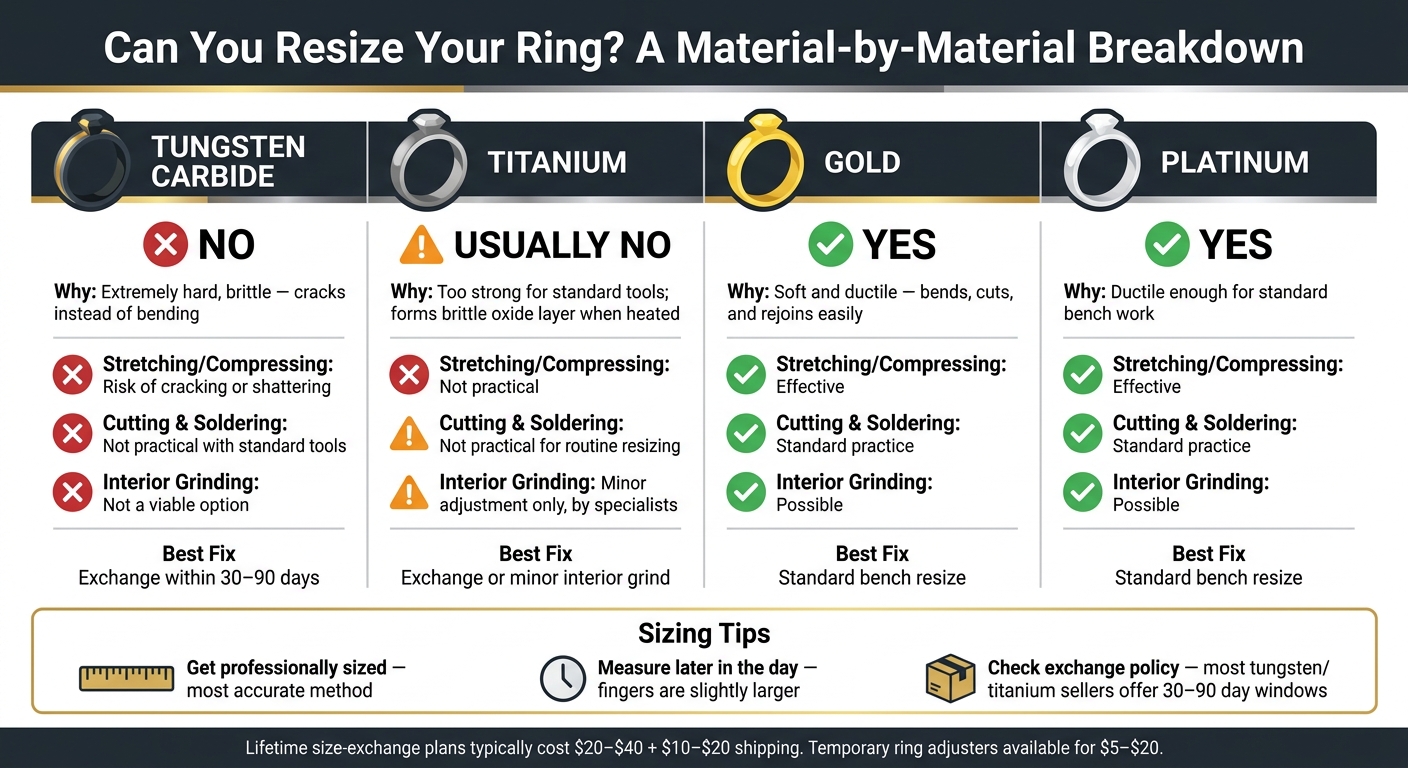
Can You Resize It? Titanium vs. Tungsten vs. Gold vs. Platinum
Can You Make a Wedding Ring Bigger? (Resizing Info)
sbb-itb-9da40c1
The material properties that make resizing impossible
The issue comes down to the metal itself. A ring can only be resized if it can change shape without breaking. That means the metal has to handle stretching, compression, cutting, and rejoining. Tungsten carbide and titanium don't behave that way, so the usual resizing methods hit a wall.
Tungsten carbide: hard but too brittle to bend or rework
Tungsten carbide rings are made from a bonded carbide material sintered with a cobalt or nickel binder. That manufacturing process fixes the ring's shape and leaves the material with a ceramic-like structure and almost no ductility. In plain English, it's extremely hard, but it doesn't like to bend.
Push hard enough on a softer metal and it changes shape. Push that same way on tungsten carbide and it tends to crack or shatter instead.
Titanium has a different makeup, but it leads to the same problem.
Titanium: strong and light, but not suited to standard resizing
Titanium is much stronger than gold and resists reshaping. Heat adds another problem. When titanium is heated, it forms a brittle oxide layer that makes dependable soldering hard, and most jewelry torches can't reach the temperatures needed to rework it.
A jeweler can cut titanium with specialized tools, but putting it back together is another story. Rejoining it usually calls for advanced welding equipment.
How gold and platinum compare
Gold and platinum are softer and more ductile, so jewelers can often resize them with standard stretching, cutting, and rejoining methods.
That's the whole split: once hardness goes up and flexibility drops, standard resizing stops being an option. At that point, getting the fit right before purchase matters a lot more.
Why standard resizing methods do not work on these bands
Once you factor in the material limits, the usual resizing methods fall apart. That’s why the standard bench approach that works for gold or platinum stops here.
Stretching and compressing only work on softer metals
Jewelers use ring stretchers and mandrels to apply controlled pressure until a band changes shape and keeps that new form. That method works with metals that are ductile enough to bend without cracking.
Tungsten carbide doesn’t behave that way. It cracks instead of yielding. Titanium has the opposite issue: it’s too strong for standard jeweler’s tools to change safely.
Cutting and soldering are not options for tungsten or titanium
Cutting runs into the same wall. On gold and platinum, cutting and soldering are standard bench work. On tungsten carbide and titanium, they’re not.
Tungsten is hard to cut cleanly, and routine soldering won’t repair it. Titanium also resists ordinary soldering because of its high melting point and reactive surface.
Limited adjustments that may still be possible
Titanium is the only metal here with a narrow exception. Some titanium rings can be adjusted with minor interior grinding by specialist jewelers, but tungsten carbide has no similar option. These are comfort tweaks, not full resizes.
Here’s the practical difference at a glance:
| Method | Gold / Platinum | Titanium | Tungsten Carbide |
|---|---|---|---|
| Stretching / compressing | ✅ Effective | ❌ Not practical | ❌ Risk of cracking or shattering |
| Cutting and soldering | ✅ Standard practice | ⚠️ Not practical for routine resizing | ❌ Not practical with standard jewelry tools |
| Interior grinding | ✅ Possible | ⚠️ Minor adjustment only, by specialists | ❌ Not a viable option |
When resizing isn’t an option, getting the size right before you buy matters most.
What to do when the fit is wrong
When resizing isn't an option, size accuracy and the exchange policy become your main safety net.
How to get an accurate size before ordering
If a ring can't be resized, the best move is simple: get the size right before you buy.
The most reliable starting point is professional sizing in person. Stop by a local jeweler and ask them to measure your finger with a jeweler's ring sizer. It also helps to get measured later in the day, when fingers tend to be a bit larger.
Band width matters too. Wide bands usually fit more snugly than narrow ones. For 8–10 mm tungsten bands, many jewelers suggest going up by about half a size.
If getting to a jeweler isn't possible, a plastic ring gauge sent by the retailer can get pretty close when you use it the right way. Try it at different times of day before placing the order. A printable PDF sizer can help too, but only if it's printed at 100% scale on U.S. letter paper. Check the scale with a ruler before trusting the result.
| Method | Accuracy | Best Use |
|---|---|---|
| Professional jeweler sizing | Highest | First step for any non-resizable band |
| Plastic ring gauge | High | Good cross-check, especially for wide bands |
| Printable PDF chart (100% scale) | Moderate | Useful backup; verify with a ruler |
Using at least two methods and comparing the results gives you the best shot at getting the size right before the ring ships.
Exchange programs and temporary fit aids
If the fit still ends up wrong, you're usually down to two paths: exchange it or use a short-term fit fix.
Before buying, read the seller's exchange policy closely. Most U.S. retailers offer size exchanges for titanium and tungsten bands within a 30–90 day window because these rings can't be resized. Some brands also offer a lifetime size-exchange program, but that often comes with a flat processing fee - usually $20–$40 - plus return shipping, which can add another $10–$20 based on the service you choose. In many cases, the ring must be unworn and in its original condition. And if you've added custom engraving, that can make the ring ineligible for exchange altogether.
If the ring is only about one U.S. size too loose, a temporary ring adjuster may buy you some time. Silicone adjusters, coil-style guards, and soft inner liners make the inside of the band smaller without changing the ring for good. You can find them online for about $5–$20, and they're a solid short-term fix if your finger size shifts with temperature or day-to-day activity. But they won't solve everything. If the ring is much too big, or too tight getting over the knuckle, an exchange is usually the safer move.
Use the exchange window fast. Once that window closes, your choices shrink in a hurry.
And if your ring size changes often, a fixed-size band may just not be the best long-term pick.
Long-term alternatives and key takeaways
When resizing isn't an option, you're usually down to two paths: replace the ring or choose one that can change with your finger.
Adjustable rings for changing finger sizes
If your finger size shifts often, an adjustable ring makes more sense over time than a fixed titanium or tungsten band.
That matters because frequent size changes can turn a fixed ring into a headache. An adjustable design sidesteps the issue. Satinski's adjustable rings use a hidden adjustment mechanism inside the shank, tucked beneath the finger when worn, so the ring still looks like a standard solid band from the outside. The inner band adjusts the fit without cutting or soldering. These rings are made in sterling silver 925 and 18K gold, and they cover U.S. sizes 5 to 9.
What U.S. buyers should remember
Titanium and tungsten bands are durable, but there's a catch: the size you buy is usually the size you keep. If your finger changes by even one full U.S. size, you'll usually need a replacement or exchange instead of a standard resizing. The same structural limits that make these metals hard to bend are also why a bench jeweler can't reshape them later with normal methods.
Put simply, titanium and tungsten are fixed-size options. Adjustable precious-metal rings can shift with changing fingers.
If your size stays steady, titanium or tungsten can work well. If it changes, go with an adjustable ring.
FAQs
Can titanium rings be resized at all?
No. Titanium rings generally can’t be resized.
The metal is very strong and hard. That makes it a good pick for daily wear, but it also means standard resizing methods, like stretching or cutting, usually won’t work.
Because of that, it’s important to know your exact ring size before you buy. If your finger size changes a lot over time, replacing the ring is usually the only option.
How much should I size up for a wide band?
There’s no set rule for how much to size up for a wide titanium or tungsten band. Since these metals usually can’t be resized, getting your exact finger size before you buy is a big deal.
The simplest move is to use precise sizing tools first. If that’s an option, you can also go with an adjustable ring.
What if my finger size changes over time?
Titanium and tungsten bands are very hard, but that comes with a trade-off: they usually can't be resized with standard jewelry methods. They're also more brittle than metals like gold or platinum. So if your finger size changes a lot over time, the ring will often need to be replaced.
To lower the odds of that happening, use accurate sizing tools before you buy. You can also look at Satinski’s adjustable ring options, including the Allring collection.


