

Tension Set Rings: Beautiful, and Impossible to Resize
If you buy a tension set ring, assume you will not be able to resize it later. That is the short answer.
I’d put it this way: the band holds the stone by exact pressure, so even a small size change can weaken that grip. In many cases, the fix is not a resize at all. It is a full remake, which can cost far more than a standard ring sizing job.
Here’s what matters most:
- Tension rings are built for one exact size
- Heat, cutting, or reshaping can loosen the stone
- Many U.S. jewelers will not resize them
- Finger size can shift by about 1/4 size day to day and up to 1/2 size with the seasons
- Common causes include weight change, pregnancy, swelling, and arthritis
- Prong and bezel rings are usually easier to size later
- Before you buy, ask about remake policy, warranty, and whether the stone can be reused
A simple way to think about it: a normal ring can often be sized up or down with a basic bench job. A tension ring usually cannot, because the band and setting are the same part.
| Ring style | Can it usually be resized? | Main issue |
|---|---|---|
| Tension set | No, not in most cases | Stone can loosen if pressure changes |
| Prong solitaire | Yes, in small changes | Prongs or band can shift |
| Channel set | Sometimes, in small changes | Side walls can warp |
| Full eternity | Rarely | Stone layout must be rebuilt |
If you want the floating-stone look, I’d say get sized by a jeweler first, then double-check the maker’s remake rules before you order. That one step can save you a lot of trouble later.
⚠️ Tension Set Engagement Rings: Pros, Cons & What To Know
sbb-itb-9da40c1
What a Tension Set Ring Is and Why People Love the Look
A tension set ring holds its gemstone in place with carefully engineered pressure from the metal band itself, not prongs or a bezel. The band is shaped to grip the stone at two points, and it's made for one exact stone size and shape. That tight fit makes tension settings different from most ring styles. It’s also what gives the ring that floating-stone look.
How the Stone Appears to Float Between Two Sides of the Band
Because there are no prongs or bezel around the gem, the stone seems to float between the open ends of the band. Nothing gets in the way of the view, so more light can enter the stone. That often makes diamonds look brighter and even a bit larger. With colored stones, the extra side light can make the color look richer from certain angles.
A lot of people love this style for one simple reason: the center stone gets all the attention. The low-metal design keeps the focus right where it should be. But there’s a catch. Only hard stones tend to work well in tension settings - usually diamonds, sapphires, or rubies - because softer gems can crack where the band presses against them.
Real Design Examples
Niessing's Spannring is one of the best-known tension-set designs. It uses a continuous band that opens just enough to hold the diamond at two contact points, leaving the stone visible from almost every angle.
Danhov's Voltaggio collection uses the same idea in engagement rings, with the center stone suspended by the ring itself. Voltaggio rings come in white gold, yellow gold, and other precious metals. The bands range from angular and architectural to smooth and minimal.
That same precision is also what leads to the resizing issue covered next.
Why Tension Set Rings Cannot Be Resized
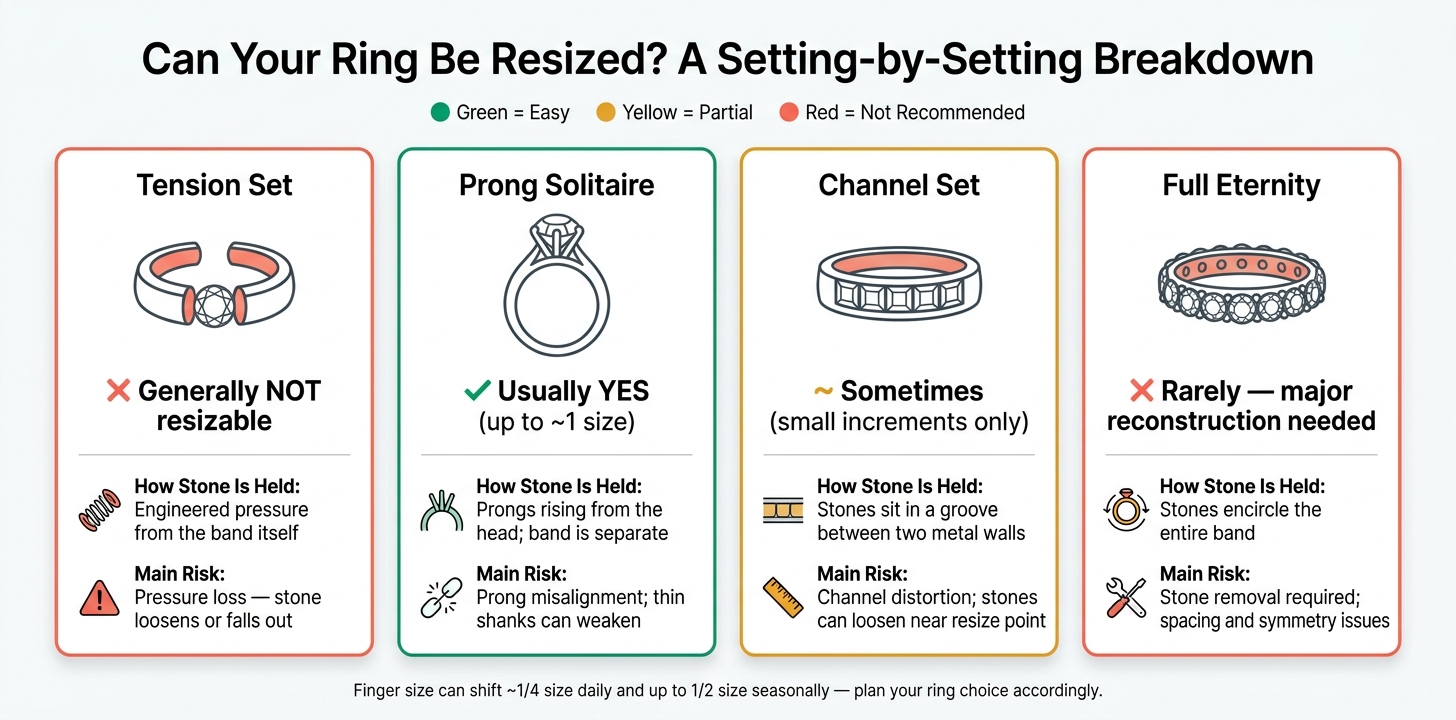
Ring Setting Resizability Comparison Chart
The trouble starts as soon as the band is changed.
A standard ring can usually be resized because the band and the setting are two separate parts. With a tension ring, that’s not the case. The band itself is the setting. So if a jeweler cuts it, heats it, or reshapes it, that changes the built-in pressure that holds the stone in place.
Put simply: a tension ring is made for one exact size. It isn’t meant to be adjusted later.
You can see that more clearly when you compare it with other ring settings:
| Setting Type | How the Stone Is Held | Typical Resizability | Main Risk |
|---|---|---|---|
| Tension | Engineered pressure from the band | Generally not safely resizable; usually requires a full remake | Pressure loss; stone loosens or falls out |
| Prong solitaire | Prongs rising from the head; band is separate | Easy, up to about one size | Prong misalignment; thin shanks can weaken |
| Channel-set | Stones sit in a groove between two metal walls | Partially resizable in small increments | Channel distortion; stones can loosen near the resize point |
| Full eternity | Stones encircle the entire band | Usually not resizable without major reconstruction | Stone removal required; spacing and symmetry issues |
Why Even a Small Size Change Can Loosen the Stone
Even a minor size change can alter the band’s shape and flex. And that small shift can weaken the ring’s grip on the stone.
There’s also the heat used during resizing. That heat can soften the metal and reduce the force the band uses to clamp the stone. Once that happens, the stone may start to twist, rock, or loosen during normal wear.
That doesn’t mean the ring was poorly made. It means the resize works against the way the ring was built in the first place.
Why Jewelers Turn Down These Resizing Requests
Most U.S. jewelers say no to this kind of job for a simple reason: after normal resizing work, they can’t confirm that the original pressure is still correct. If the stone comes loose later, they may be the ones blamed for it.
Many tension ring makers also say that any third-party change voids the original warranty. So even if a size adjustment can be done, it usually means a full remake by the original maker. That allows them to re-machine the band and re-tension the setting to the right specs for the new size.
That’s why the ring size needs to be correct before you buy it.
Why a Ring You Cannot Resize Becomes a Problem Over Time
A tension set ring is made for one exact size. That sounds fine at first. The trouble starts when your finger doesn't stay that size.
Even small shifts can throw off the fit. And with a ring you wear all the time, that small change can turn into a daily headache.
Common Reasons Ring Size Changes After Purchase
Finger size doesn't stay fixed. It can change by about a quarter size from day to day and by as much as half a size with the seasons. Pregnancy, weight changes, fluid-retention medications, and arthritis can all affect how a ring fits.
That may not sound like much on paper. But with a ring built to such a tight fit, a quarter size can be the difference between comfortable and stuck.
This hits hardest with rings worn every day, because you're not dealing with one-off changes. You're dealing with normal life.
Why This Risk Matters More for Long-Term Rings
This issue matters most for engagement rings and wedding bands, since people wear them for years. Over time, aging can change hand shape and reduce skin elasticity. That makes ring fit less steady and less easy to predict.
When the fit changes, a few problems can show up fast:
- The ring gets too tight to remove safely during swelling
- The ring gets too loose and won't stay centered
- The ring won't pass over the knuckle at all
Any one of those means the ring may stop being wearable. That's why size flexibility matters before you buy.
How to Avoid Resizing Problems Before and After You Buy
Tension-set rings leave almost no room for later changes. So the safest move is simple: plan for the fit before you buy.
Get an Exact Ring Size Before Ordering a Tension Setting
A tension-set ring is made for one exact size. That means you shouldn’t rely on a home sizing kit or a quick guess.
Instead, get measured by a professional jeweler, and do it more than once. Try to get sized when your body temperature is normal, since heat and cold can affect finger size. It also helps to have the jeweler check both the base of your finger and your knuckle.
If your size still isn’t fully clear, look at what happens after the sale.
Ask About Remake Policies, Warranty Terms, and Size Limits
Before you buy, ask the maker about:
- the remake window
- warranty limits
- whether the original stone can be reused
Many makers only give a short remake window. After that, a full remake is usually the only practical fix.
Consider Adjustable or Easier-to-Resize Rings If Fit Flexibility Matters
If your ring size may change over time, it makes sense to pick a setting with more give. Prong and bezel settings are easier to resize. Adjustable rings give you even more room to deal with future fit changes if that matters more to you than the look.
If fit flexibility is a big concern, choose a different setting before you buy.
Conclusion: Pick a Tension Set Ring for the Look, Not for Sizing Flexibility
A tension set ring stands out for its clean, stone-suspended look. That look comes with a hard limit.
The same calibrated pressure that holds the stone in place also makes resizing risky. Even a small change to the band can loosen the stone or damage the setting. Tension settings look beautiful, but resizing usually isn't a practical choice.
The safest move is simple: check your ring size carefully before you buy, and ask about remake policies, warranty terms, and sizing limits. If the ring no longer fits later, the usual fix is a full remake in the right size, or a remake in a prong or bezel setting.
If you think your finger size may change over time, or you want a ring you can adjust later, it makes sense to choose a more flexible design from the start. If fit flexibility matters, pick a different style before you buy.
FAQs
Are tension set rings secure enough for everyday wear?
Yes, tension set rings can be secure enough for everyday wear, especially when they're made from tough metals like platinum.
The big tradeoff is sizing. These rings are generally not resizable because changing the band can mess with the pressure that keeps the gemstone in place.
If size flexibility is a big deal for you, an adjustable ring or a different setting may be the better pick.
What happens if my tension set ring no longer fits?
If your tension set ring no longer fits, resizing usually isn't an option, or it's a risky one. These rings rely on exact pressure to keep the gemstone in place, so changing the band can weaken that hold.
To avoid that headache, double-check your finger size before you buy. If you want more room for changes later, look into custom-fit options or adjustable ring settings.
Which gemstones work best in a tension setting?
Durability and hardness matter most in a tension setting because the gemstone has to handle the pressure that holds it in place.
Diamonds are the usual pick because they’re so hard and hard-wearing. Moissanite is also a strong choice. It offers high durability and resists chipping well, which makes it a good fit for this kind of setting.


