

Sizing Beads vs Hinged Retrofit vs Adjustable Band: Real Cost Comparison
If I had to boil this down to one line: sizing beads are cheapest upfront, a hinged retrofit is for large knuckles, and an adjustable band is often the lowest-cost pick when your size keeps changing.
When I compare these three fixes, I don’t just look at the first bill. I look at what you may spend later in repairs, checkups, refinishing, and comfort tradeoffs.
Here’s the short version:
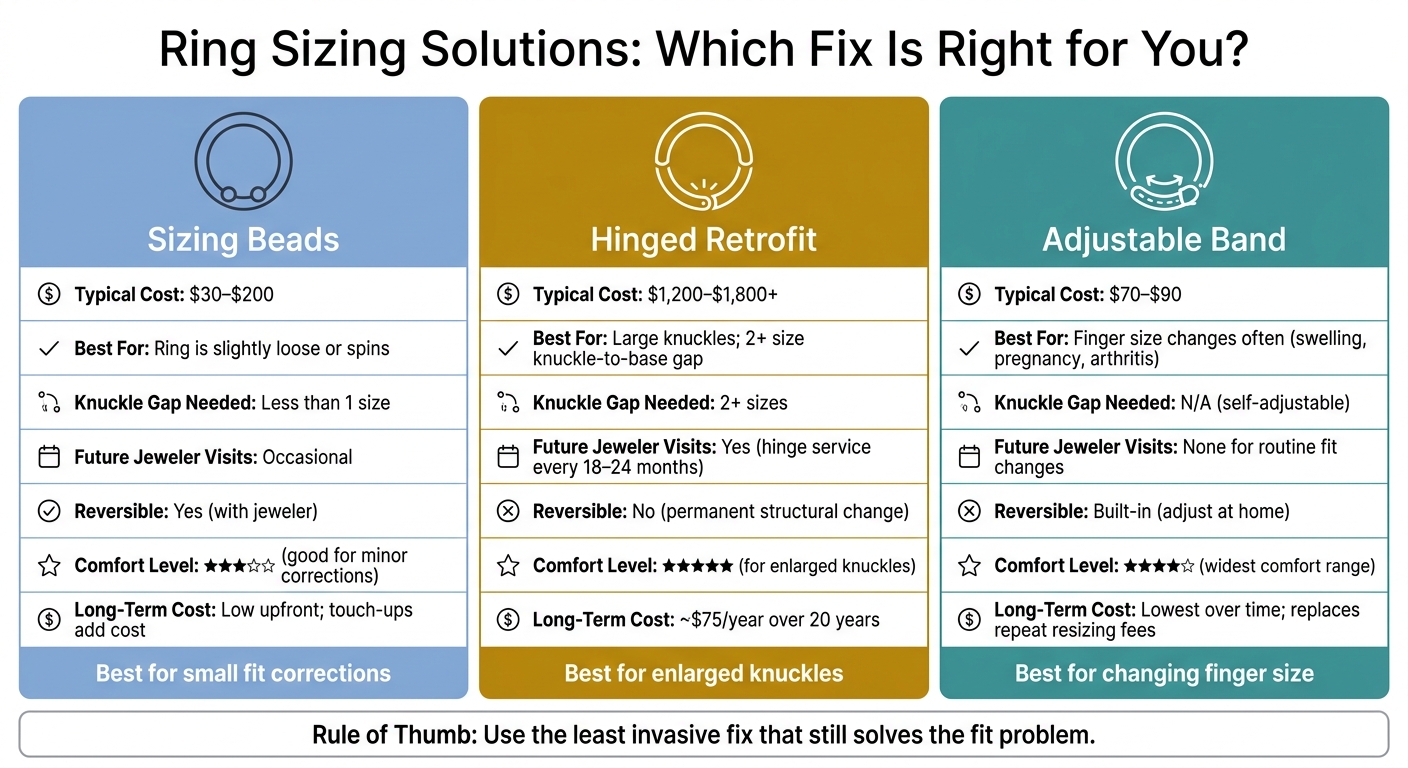
- Sizing beads: usually about $30 to $200; best when a ring is only slightly loose
- Hinged retrofit: usually about $1,200 to $1,800+; best when the knuckle is much larger than the base of the finger
- Adjustable band: usually about $70 to $90; best when your ring size changes often from swelling, weight shifts, pregnancy, or arthritis
I’d judge them on six points:
- Upfront cost
- Jeweler visits later
- Wear and repair risk
- Daily comfort
- How much the fit can change
- How much the original ring is changed
Bottom line: if you need a small fix, beads often cost the least. If your knuckle-to-base gap is about 2 sizes or more, a hinged shank can be worth the high price. If your finger size moves up and down, an adjustable band can cut out repeat resize fees.
Sizing Beads vs Hinged Retrofit vs Adjustable Band: Cost & Fit Comparison
How Much Does It Cost To Resize Your Ring | Jewelers Mutual Group
sbb-itb-9da40c1
Quick Comparison
| Option | Typical Cost | Best Use | Main Tradeoff | Long-term Cost Pattern |
|---|---|---|---|---|
| Sizing Beads | $30–$200 | Ring is a bit loose or spins | Can press into the finger; not much help for large knuckles | Low at first, but touch-ups and plating can add cost |
| Hinged Retrofit | $1,200–$1,800+ | Large knuckles; hard on/off fit | High first cost; hinge parts may need service later | High first bill, then checkups over time |
| Adjustable Band | $70–$90 | Finger size changes often | Mechanism needs cleaning; depends on ring design | Lower over time if it replaces repeat resizing |
If you want the short answer before reading more, use the least-altering fix that still solves the fit problem.
Sizing beads: lowest upfront cost, limited flexibility
Sizing beads are often the first fix a jeweler brings up when a ring is only a bit loose. The reason is simple: they usually cost less upfront than other ring-fit fixes. If the ring just needs a small adjustment, beads can be a practical starting point.
U.S. pricing, upkeep, and comfort tradeoffs
In the U.S., basic sizing-bead work usually costs $30 to $60, but metal type, finishing, and rhodium re-plating can push the total to about $35 to $200. Platinum and high-karat gold need more skilled soldering and finishing, and white gold may need rhodium re-plating after the work is done.
The main long-term cost to watch is rhodium re-plating. Soldering can burn off the rhodium finish near the repair area, so getting that even bright-white look back often means paying for another service. If the bead work needs touch-ups later, those finishing charges can add up.
Comfort is the other tradeoff. Because sizing beads sit as raised bumps inside the band, some people feel pressure from them, especially when the correction is bigger, fingers swell, or the wearer has sensitive skin. That’s why beads are usually best for small fit changes. They don’t do much for rings that fit over a large knuckle but then spin or slide too much once they’re on.
When sizing beads are the most cost-effective choice
Sizing beads make the most sense in a pretty narrow range of cases. They tend to work well when a ring is about half to one full size too large - loose enough to slip or spin, but not so loose that beads can’t make up the difference.
A common example is a solitaire ring with a heavy setting. The ring may still go over the knuckle just fine, but the top-heavy setting keeps rotating. In that case, two small beads inside the lower shank can add enough friction to help keep the setting upright, with little visible change to the ring itself.
They’re also a good fit for sentimental or structurally complex rings that shouldn’t be cut, such as:
- antique bands
- full-eternity pavé designs
- heirloom pieces where the owner doesn’t want the original metal changed
In those situations, beads offer a reversible fix because a jeweler can remove or reshape them later if the fit changes.
When the issue is a large knuckle or a ring that’s much too loose, the next step is usually a hinged retrofit.
Hinged retrofit: higher upfront cost for enlarged knuckles and hard-to-fit rings
Sizing beads stop helping when the knuckle is the main issue. In that case, a hinged retrofit works very differently.
Instead of trying to squeeze a ring over a large or swollen knuckle, a jeweler replaces part of the lower band with a new lower shank that includes a hinge and clasp. You press the clasp open, swing the band around the finger, and snap it shut at the base. The ring gets past the knuckle without forcing, then sits snugly on the smaller part of the finger. Some hinged designs open nearly flat.
Initial jeweler fees, repair risk, and lifetime maintenance
A hinged retrofit is the most expensive common sizing fix. On a standard 2.5–4 mm gold shank, installation usually costs $1,200–$1,600. Some systems average $1,400–$1,800, depending on the metal, band width, and whether the ring needs shank repair first.
Costs climb with platinum or wide-band rings. Some jewelers quote $1,900 or more for engagement rings that need extra custom work so the new shank blends into the old design. And if the original shank is thin or worn down, the ring may need a half- or three-quarter-shank replacement before the hinge goes in. That can add another $175–$375+.
This isn’t simple bench work. The installation usually calls for precise laser welding, and the jeweler may also need to hand-engrave or polish the new shank so it matches the rest of the ring.
Then there’s upkeep. With years of daily wear, the hinge pin and clasp can loosen or fall out of alignment. That means periodic tension adjustments, replacement of worn hinge parts, and re-polishing around the mechanism are normal costs to expect. If the ring is worn every day, plan for at least one major hinge service over 10–20 years.
The total cost is higher, but it’s still fairly easy to map out. At $1,500 upfront spread across 20 years, the cost works out to about $75 per year. For many people, that’s less than paying for repeated resizings, temporary ring guards, and later shank repairs.
When a hinged shank is worth the higher price
A hinged retrofit makes the most sense when the gap between the knuckle and the finger base is about two U.S. sizes or more. Say someone has a knuckle that measures a U.S. size 9, but the base of the finger is a size 6. A standard resize can’t solve both problems at once. A hinge can.
This option tends to help people with arthritis, joint damage, or enlarged knuckles the most. The ring goes on and off without painful forcing, then fits the finger base once it’s closed. That can help keep the setting upright and cut down on wear to the prongs and setting over time.
It’s also a smart pick for sentimental or high-value rings that the owner doesn’t want to replace or change much. A ring sized loosely enough to clear a large knuckle is easier to lose, especially when hands are cold or wet. A hinged retrofit keeps the original top design, stones, and visible details in place while giving the ring a secure and comfortable fit. For many owners, paying $1,200–$1,800 to keep a cherished engagement or wedding ring wearable for decades makes good sense.
Skip the hinged shank if the size gap is small or the wearer only needs a short-term fix. In those cases, sizing beads or another lower-cost option is often enough. And if finger size is likely to keep changing, an adjustable band may cost less over time.
Adjustable band: best long-term value for a changing finger size
When your finger size keeps changing, the issue isn’t just repair anymore. It’s flexibility.
Sizing beads and hinged retrofits can fix a ring that’s off by a set amount. But they don’t do much if your finger runs small in the morning, swells in the afternoon, or shifts over time. An adjustable band handles that problem in a different way. Instead of locking you into one fit and hoping it stays right, it lets you resize the ring at home whenever you need to - no jeweler trip required.
Upfront price and total cost of ownership
The upfront cost sits in the middle. Adjustable bands often start at about $70 for simpler styles and $90 for engagement styles, based on the metal and how the ring is made. They cover U.S. sizes 5–9.
That one purchase can save money over time. It may replace repeated $50–$150 resizing fees and help you avoid repeated cutting and soldering.
Comfort, adjustability range, and best-fit lifestyles
Adjustable bands use a hidden mechanism inside the band. From the outside, the ring still looks like a standard solid band. There are no visible gaps and no bulky hardware. You can change the fit yourself in seconds, with no tools and no jeweler visit.
That setup makes sense for people whose finger size shifts in patterns they already know well, such as:
- Daily swelling from heat or activity
- Seasonal changes
- Weight fluctuation
- Pregnancy
- Arthritis flare-ups
If your size changes during the day, a fixed-size ring can turn into a repeated expense.
One upkeep note: clean the mechanism weekly with warm water and mild dish soap. That helps prevent buildup that can make the mechanism stiff.
Direct comparison table and final verdict by scenario
Side-by-side cost and usability comparison
Once you look at price, upkeep, and day-to-day wear, the tradeoff is pretty straightforward:
| Factor | Sizing Beads | Hinged Retrofit | Adjustable Band |
|---|---|---|---|
| Typical Initial Cost (USD) | About $30–$200 | About $1,200–$3,500+ | About $70–$90 (built-in fit mechanism) |
| Future Jeweler Visits | Yes (soldering; occasional check if beads loosen) | Yes (major structural modification; periodic hinge service) | No for routine fit changes |
| Maintenance | Minimal | Occasional cleaning, lubrication, and checkups every 18–24 months | Low; occasional cleaning and wear checks |
| Comfort | Good for minor corrections; some people notice them when putting the ring on or off | High for enlarged knuckles; opens to clear the knuckle | High; widest comfort range, though some designs add slight bulk |
| Durability | Good; no moving parts | Good, but moving parts add stress points over time | Good; moving parts wear over time |
| Reversibility | More reversible than structural changes, though removal still takes jeweler work | Difficult; usually a permanent structural change | Built into the ring; changes fit without a new resizing job |
| Best For | Slightly loose rings and stopping spin | Enlarged knuckles and large knuckle-to-base gaps | Ongoing size fluctuation, swelling, and daily wear |
Which option wins for weight changes, enlarged knuckles, and sentimental rings
The best pick comes down to why the ring doesn’t fit, not just what the repair costs.
For weight fluctuation or daily swelling: an adjustable band gives you the best long-term value if your finger size changes a lot.
For enlarged knuckles: a hinged retrofit makes sense when the knuckle-to-base gap is about two sizes or more and a standard resize won’t solve the problem.
For sentimental or heirloom rings: the answer depends on how much of the original ring you’re willing to alter. Sizing beads are the least invasive fix for a small correction. A hinged retrofit permanently changes the original metal and shank structure, which can matter a lot with antique pieces or rings you want to keep as close to the original build as possible.
Use the least invasive fix that still solves the fit issue.
FAQs
How do I know which ring fix is right for my fit problem?
Think about why the ring doesn’t fit and how the ring is made. Adjustable bands and hidden sizing features work best when your finger size shifts from day to day because of temperature, activity, or health issues like arthritis.
If you have a detailed heirloom with engravings and want a permanent, fixed fit, professional resizing is usually the best option because it helps preserve the design.
Will any of these options damage or permanently change my ring?
It comes down to one thing: do you want to keep the ring in its original state?
With standard professional resizing, a jeweler cuts the band and adds or removes metal. That changes the ring for good. Over time, it can also leave a visible seam or make the band a bit weaker.
Sizing beads and adjustable options work differently. They’re non-permanent, so the ring’s original structure stays intact while still giving you some room for finger size changes.
Which option saves the most money if my finger size keeps changing?
If your finger size changes a lot, adjustable rings with hidden mechanisms are often the best long-term buy. They usually start at about $70, which is more up front. But that price can save you from paying for repeat professional resizing, which often runs $50 to $150 per session.
Less expensive short-term fixes like sizing beads, ring guards, or silicone inserts often cost under $20. They can work well for small, occasional changes.
But if your ring size keeps shifting over time, adjustable rings tend to give you better long-term value.


