

Designing a Custom Ring for Someone With Arthritis
If a knuckle is about 1.5 to 2 ring sizes larger than the finger base, a standard ring often won’t fit well. That’s why I’d start with the fit problem first, not the style. The best ring for arthritis should clear the knuckle, sit securely at the base, and stay comfortable when swelling changes during the day.
Here’s the short version:
- I’d measure the knuckle and the finger base
- I’d track swelling for at least 1 week
- I’d pick a structure based on the size gap:
- Hinged ring for large knuckles
- Open-shank ring for day-to-day swelling changes
- Comfort-fit band if the size gap is small
- Sizing beads if the ring spins
- I’d use a low-profile setting like a bezel or flush setting
- I’d choose a metal that feels good now and can be changed later, such as 14K or 18K gold
- I’d plan for fit checks once a year and jeweler inspections every 6 months
A few details matter more than most people think. For example, a 4 mm to 8 mm band can spread pressure better than a very thin band. And adding sizing beads to a ring often costs about $35 to $100 in 14K gold or platinum.
Adjustable Ring for Arthritis / Converting an Existing Ring for Arthritis
sbb-itb-9da40c1
Quick Comparison
| Option | Best for | Main upside | Main drawback |
|---|---|---|---|
| Hinged shank | Large knuckles | Easy to put on and secure when closed | Needs periodic checks |
| Open-shank adjustable | Daily swelling changes | Can open or tighten as needed | May feel less steady |
| Comfort-fit fixed band | Small size gap | Smooth feel and low upkeep | Still has to pass over the knuckle |
| Sizing beads | Loose ring that spins | Helps keep ring in place | Doesn’t deal with swelling |
In other words: I wouldn’t treat an arthritis-friendly ring like a standard custom ring. Fit, comfort, and ease of wear come first. Style comes after that.
Step 1: Assess the Wearer's Hands, Routine, and Comfort Needs
Start with fit, pain, and daily wear. Those three things shape every design choice that comes next.
Measure the Knuckle, Finger Base, and Swelling Range
Take two measurements:
- The widest part of the knuckle
- The base of the finger where the ring will sit
Write down both. The ring should clear the knuckle without pinching the base of the finger.
Timing matters too. Measure on different days and at different times, because swelling can change with inflammation, activity, and temperature. A finger that feels fine on a good morning can feel much tighter later in the day or during a flare-up. Size for the finger's largest normal measurement, not its smallest.
It also helps to track swelling for at least a week before locking in the size. One quick measurement can miss the bigger pattern.
Identify Pain Points, Skin Sensitivities, and Daily Activities
Ask where the pain is worst and when it shows up. Morning stiffness, end-of-day swelling, and pain after gripping or pinching each point to different design needs. Pain can sharply reduce grip strength in hand osteoarthritis, so even a small pressure point can feel like a big deal.
Fine motor tasks matter too. If the wearer has trouble with small clasps or twisting motions, that can rule out ring parts that need careful finger movement.
Check for skin sensitivity early. Ask if the wearer has reacted to nickel, plated metals, costume jewelry, or cleaning products. Then look at daily use. Someone who types all day will usually want a low-profile ring that won't snag. A caregiver or cook may need smooth edges that won't catch on clothing or skin.
Set Priorities Before Choosing the Design
Once you have the measurements and a clear picture of pain patterns and daily routine, decide what matters most. Common priorities include:
- Easy on and off
- Secure fit
- Light weight
- Low bulk
- Style
Doing this first helps you avoid a common problem: making a ring that looks great but isn't comfortable to wear.
A short written brief can make this much easier. For example: "Clear a larger knuckle, tolerate afternoon swelling, avoid pressure on tender joints, and stay flat enough for typing."
That says more to a jeweler than a long list of vague likes and dislikes. It also makes tradeoffs easier. Maybe a slightly wider band gives better stability than a thinner band that feels lighter but spins around. Those priorities help decide if the ring needs hinges, adjustability, or a wider comfort-fit band.
Step 2: Choose a Ring Structure That Makes the Ring Easier to Wear
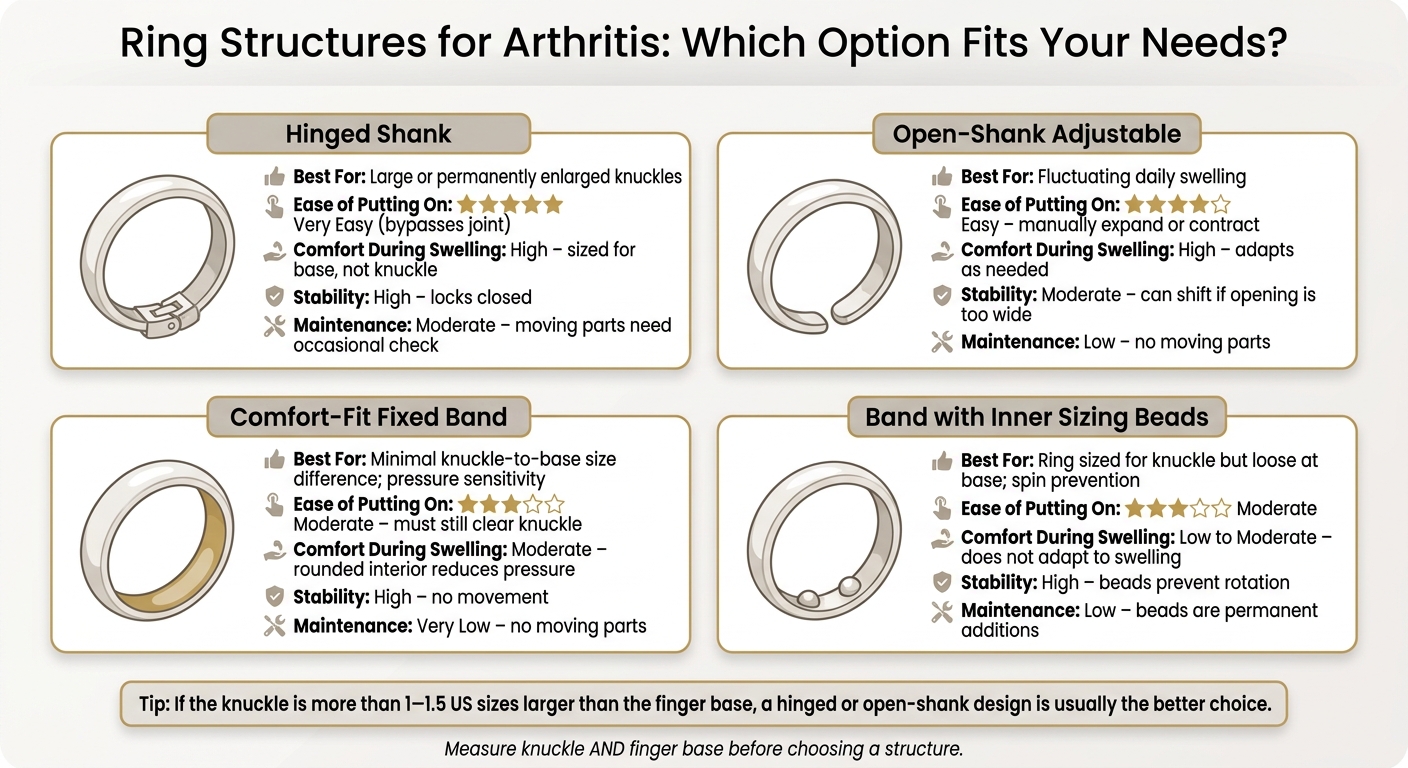
Ring Structures for Arthritis: Which Option Fits Your Needs?
Once you know what’s causing the fit issue, pick a ring structure that deals with it. In many cases, the ring’s shape and how it works matter more for daily comfort than the metal or gemstone.
Hinged and Adjustable Rings for Swollen Knuckles
If there’s a big size gap between the knuckle and the base of the finger, hinged or adjustable shanks can solve the problem.
A hinged ring opens like a tiny door, slips past the knuckle, and then closes snugly at the base of the finger. Some hinged styles open wide enough to clear the knuckle and then lock once the ring is in place. That makes them a strong pick when the knuckle is much larger than the finger base and the ring still needs to feel secure and look polished.
Open-shank designs work differently. The band has open or overlapping ends, so it can be widened or tightened a bit when needed. This style makes sense when finger size changes during the day.
There’s a trade-off here. Hinged rings usually feel more secure and polished, but the moving parts may need an occasional check. Open-shank rings are simpler and lighter, but they can feel less steady if the opening is too large during day-to-day tasks.
Comfort-Fit Bands, Wider Profiles, and Anti-Spin Features
If the knuckle isn’t much larger than the base of the finger, a comfort-fit fixed band is often the better choice. The rounded inner surface spreads pressure more evenly and can ease irritation at the joint. A 4–8 mm band usually spreads pressure better than a very thin band without feeling bulky. Very wide, flat, or knife-edge profiles are best avoided because they can pinch or twist arthritic joints during movement.
One common issue comes up when a ring has to be sized to get over the knuckle: it may end up a little loose at the base and start spinning. That’s where inner sizing beads can help. These are small metal bumps placed inside the band. They help keep the ring from rotating without making the full ring tighter.
They’re best used as a fine-tuning fix, not as a full sizing solution. Still, they can make a clear difference in daily wear. Adding sizing beads to an existing ring usually costs about $35–$100 for 14k gold or platinum.
Comparison Table: Which Ring Structure Fits Which Arthritis Pattern
| Ring Structure | Best Use Case | Ease of Putting On | Comfort During Swelling | Stability | Maintenance |
|---|---|---|---|---|---|
| Hinged shank | Large or permanently enlarged knuckles | Very easy (bypasses joint) | High (sized for base, not knuckle) | High (locks closed) | Moderate (moving parts need occasional check) |
| Open-shank adjustable | Fluctuating daily swelling | Easy (manually expand or contract) | High (adapts as needed) | Moderate (can shift if opening is too wide) | Low (no moving parts) |
| Comfort-fit fixed band | Minimal knuckle-to-base size difference; pressure sensitivity | Moderate (must still clear knuckle) | Moderate (rounded interior reduces pressure) | High (no movement) | Very low (no moving parts) |
| Band with inner sizing beads | Ring sized for knuckle but loose at base; spin prevention | Moderate | Low to moderate (doesn't adapt to swelling) | High (beads prevent rotation) | Low (beads are permanent additions) |
After choosing the structure, match the setting and metal to the same comfort goals. Once the structure is set, the next step is picking a low-profile setting and a metal that holds up well in daily wear.
Step 3: Select Settings, Stones, and Metals for Comfort and Daily Wear
Once the ring’s structure is set, the next move is choosing a setting and metal that feel good every day. The aim is simple: a ring that doesn’t get in the way when fingers are sore, stiff, or swollen.
Use Low-Profile Settings and Smooth Stone Placement
For arthritic hands, low-profile settings help cut down on snagging and pressure during everyday tasks. Bezel settings, which wrap the stone in a smooth metal rim, and flush settings, where the stone sits level with the band, are especially useful. They keep the surface smooth and leave fewer raised points to catch on clothing or mobility aids.
GIA notes that flush settings create a smooth, low-profile design that is
"smooth and less likely to snag."
Lower settings also sit closer to the hand, which tends to work better for gripping. That lower height can make tasks like gripping and opening jars a bit easier.
It’s smart to skip tall solitaires with exposed prongs and full eternity bands. Full eternity bands can rub against neighboring fingers and are hard to resize later. A half-eternity band is usually the better pick.
Pick Metals That Balance Durability, Weight, and Skin Tolerance
After the setting, metal choice affects weight, skin comfort, and how easy the ring will be to adjust later. A lighter, resizable metal can feel better now and make life easier if finger size shifts over time.
Platinum (Pt950) is very durable and naturally hypoallergenic, so it’s a strong pick for nickel sensitivity. The trade-off is weight. Platinum is dense, and that extra heft can feel like too much on tired joints.
14K or 18K solid gold is lighter than platinum, holds up well for daily wear, and is the easiest to resize as finger size changes. That said, some white gold alloys contain nickel, so they’re best avoided if skin reactions are a concern.
Sterling silver (.925) is the lightest fine metal in this group and usually feels the least intrusive on sensitive fingers. But there’s a catch: it scratches and tarnishes more easily, which matters if the ring will be worn every day.
Titanium is a good fit for people who want the lightest ring possible. It’s very strong and highly hypoallergenic, so it puts less strain on sore joints. But resizing is where things get tricky. Many jewelers can only increase a titanium ring by about half a US size, and bigger changes often mean replacing the ring entirely.
If there’s any history of metal sensitivity, stick with platinum, titanium, or nickel-free gold, and confirm the metal mark before ordering.
Comparison Table: Metal Options for Arthritic Hands
| Metal Type | Feel on Hand | Durability | Allergy Considerations | Resizing Over Time |
|---|---|---|---|---|
| Platinum (Pt950) | Heavy, substantial | Extremely high | Hypoallergenic; no nickel | Difficult; requires specialized tools |
| 18K Gold | Moderate weight | High | Hypoallergenic when nickel-free | Easy; best for future adjustments |
| 14K Gold | Moderate weight | High | Generally hypoallergenic; check alloy for nickel | Easy; practical for resizing |
| Sterling Silver (.925) | Lightweight | Moderate; prone to scratching and tarnish | Usually well tolerated if nickel-free | Easy, but repeated resizing can weaken the band |
| Titanium | Very lightweight | Extremely high | Highly hypoallergenic | Very limited; significant changes often require replacement |
For most people with arthritis, 14K or 18K gold gives the best mix of comfort, long wear, and future resizing. With the structure, setting, and metal decided, the next step is sizing the ring for swelling and thinking ahead about later adjustments.
Step 4: Finalize Sizing, Maintenance, and Long-Term Practicality
Size for Flare-Ups Without Making the Ring Too Loose
Once you've picked the structure, setting, and metal, the next job is fit. And with arthritic hands, that means planning for swelling, not just comfort on a good day.
The safest move is to size the ring so it passes over the knuckle comfortably at its largest, then use design details to limit looseness at the base. If you size only for a low-swelling day, the ring can become too tight during a flare-up.
Use those measurements to size for the largest normal day. If the knuckle is more than 1 to 1.5 US sizes larger than the base, a hinged or open-shank design is usually the better call. At that point, the final size becomes a comfort decision instead of a guess.
For closed bands, sizing beads can help cut down on spinning without making the ring feel too tight.
Plan for Care, Inspections, and Future Adjustments
After the ring is made, comfort depends on upkeep. A ring with moving parts can feel great at first, but if dirt builds up or a hinge starts to shift, small issues can turn into annoying ones fast.
For hinged or adjustable designs, check the hinge, clasp, and lock every three months. Watch for gaps, bending, or new clicking. If anything feels loose or starts catching, have a jeweler look at it before it gets worse.
The inside of the band matters too. Lotion, skin oils, and debris can build up there, especially around sizing beads. On sensitive joints, that can lead to irritation. Cleaning with mild soap, warm water, and a very soft brush once a week helps keep the surface smooth and comfortable. Skip abrasive cloths on the inside of the band. Fine scratches may seem minor, but they can make a smooth ring feel rough against swollen skin.
For shop care, plan a cleaning and inspection about every 6 months if the ring is worn daily. A jeweler can inspect prongs or bezels under magnification and make sure the hinge or adjustable parts still work the way they should.
Because arthritis can change over time, it also helps to build in a yearly fit check. If the ring gets harder to remove, starts leaving pressure marks, or spins more than it used to, that's usually a sign the fit or structure needs another look. Changing the shank or moving to a more adjustable mechanism is much easier when you deal with it early, not after the ring is already causing trouble.
Conclusion: Key Features of a Custom Arthritis-Friendly Ring
Designing a ring for arthritic hands comes down to a few smart choices in the right order: measure for swelling, choose a structure that fits the size challenge, keep the profile low and the surface smooth, and pick a metal that wears well, feels good on skin, and can be resized over time. The best custom ring fits over swelling, stays secure on normal days, and remains comfortable for the long haul.
FAQs
How do I know if a hinged ring is necessary?
A hinged ring can be a good option if swelling or enlarged joints make it tough to get a standard ring over your knuckle.
Unlike adjustable bands that help with day-to-day size shifts, a hinged ring opens all the way. That means you can place it on your finger without pushing it over stiff or sore joints, then lock it in place once it’s on.
What ring features help most during flare-ups?
During flare-ups, the most helpful features are easy adjustment and a fit that can change with swelling and stiffness. Adjustable bands, including hidden mechanisms, let you loosen the ring without taking it off.
Hinged designs make it easier to get the ring over enlarged joints. Open-band styles let you resize the fit by hand, fast and with less hassle. Lightweight materials also help, especially when paired with comfort-fit interiors and smooth, rounded edges that put less pressure on the skin and cut down on irritation.
Which metal is easiest to resize later?
For someone with arthritis, an adjustable ring design is often easier than resizing a ring later.
18K gold and sterling silver are good picks for built-in adjustable parts because they can handle small, repeated changes. Platinum is very durable, but it’s harder to work with than gold.


