

What to Do With Rings You Can't Wear During Weight Loss
If your ring slips over your knuckle with little resistance, stop wearing it loose. During weight loss, finger size can change enough to make a ring unsafe for daily wear, and many jewelers suggest waiting 3 to 6 months after your weight and fit stay steady before a permanent resize.
Here’s the short answer: I’d use a temporary ring adjuster first, wait until my size stays the same, then talk to a jeweler if the ring can be resized. If it can’t, I’d either wear it as a pendant, store it the right way, or switch to an adjustable ring for now.
What this covers:
- How I can tell a ring is too loose
- Short-term fixes like adjusters, guards, and beads
- When I should wait vs. resize
- Which rings are hard or unsafe to resize
- What I can do with rings I can’t wear on my finger
- When an adjustable ring makes more sense
| Option | Best for | Permanent change? | Good during weight loss? |
|---|---|---|---|
| Ring adjuster | Mild looseness | No | Yes |
| Ring guard | Bigger fit gap | No | Yes |
| Sizing beads | Slight looseness, top-heavy rings | Partial | Yes |
| Professional resizing | Stable finger size | Yes | Only after size stays steady |
| Pendant/redesign | Sentimental rings I can’t wear | Sometimes | Yes |
| Safe storage | Rings I want to protect for now | No | Yes |
| Adjustable ring | Size may still change | No | Yes |
Bottom line: I wouldn’t rush into resizing. A short-term fix now can help me keep the ring safe while my body - and my ring size - settles.
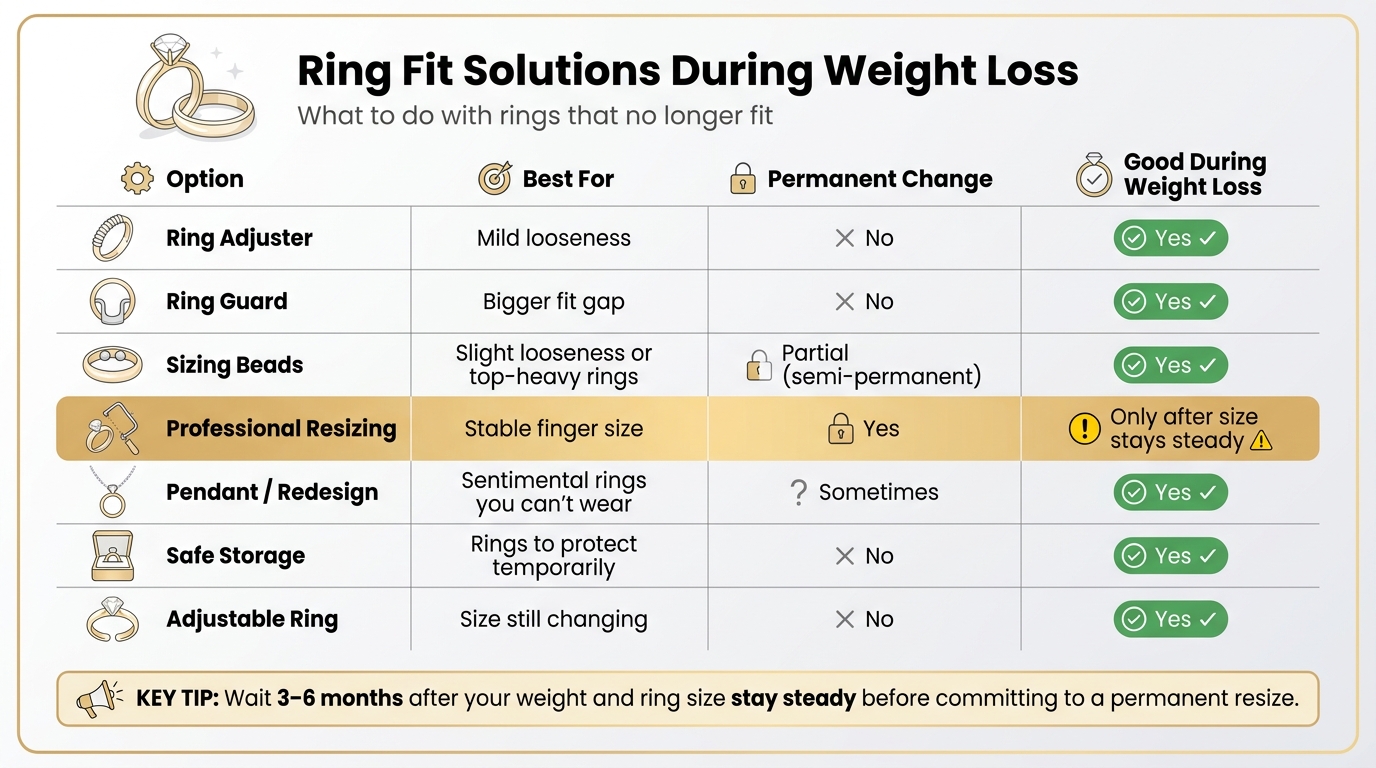
Ring Fit Solutions During Weight Loss: Quick Comparison Guide
Short-term ways to keep a loose ring wearable
Temporary fixes can keep a loose ring on your finger without changing the ring itself. If it still shifts around or feels shaky, try an adjuster, guard, or bead before moving to a permanent fix.
Ring adjusters, sizing beads, and ring guards
Clear plastic or silicone ring adjusters wrap around or clip to the underside of the band so the ring fits more snugly. They’re removable and low-cost, which makes them a smart first move. Just clean them from time to time, along with the ring, because soap and lotion can collect underneath.
Sizing beads take things a step further. A jeweler solders two small metal beads inside the shank, usually at the 4 and 8 o’clock positions, so they rest lightly against the sides of your finger. They’re often a good fit for rings with large settings that make the ring lean to one side, and for rings that are about half to one size too big. They also give you another option besides full resizing.
Ring guards are removable clips or bars that attach to the back of the ring. They can deal with bigger size gaps than adjusters, but they also add bulk and may rub against nearby fingers. It’s worth checking for scratches too, since harder metals can mark softer bands.
Skip makeshift fixes like tape, fabric bandages, or dental floss wrapped around the band. They can hold moisture and bacteria against the skin, leave residue on the ring, and may tarnish some metal alloys. Fine for a one-night emergency, maybe. Not a good plan for regular wear.
Here’s a quick side-by-side look:
| Option | Permanence | Comfort | Best Use Case |
|---|---|---|---|
| Silicone/plastic adjusters | Fully temporary | Generally comfortable | Daily wear during active weight loss |
| Sizing beads | Semi-permanent (professional) | Custom-fitted; reduces spinning | Valuable rings or rings with large settings, slightly loose |
| Ring guards | Fully temporary | Can feel bulkier | Rings significantly loose but still worn occasionally |
When stacking with another ring helps and when it does not
A snug ring stacked next to a loose one can help stop it from slipping over the knuckle. This tends to work best when the rings are meant to sit together, like a wedding band and engagement ring that nest or interlock, and when the looseness is mild. If the ring is sliding a lot, stacking usually won’t do enough.
There’s a tradeoff. Stacking adds pressure to the finger, and if the fit is already close, it can cut into circulation. Watch for redness, numbness, or marks that stick around after you take the rings off.
It can also be a bad idea for valuable rings with delicate settings, like pavé or antique work. When rings crowd each other, stones can loosen and you may not notice right away. If you spot metal wear or new scratches where the rings touch, stop stacking and switch to an adjuster or guard instead. If that still doesn’t keep the ring secure, the next step is deciding whether to wait or resize.
When temporary fixes stop doing the job, the next call is whether to resize now or wait for your size to settle.
sbb-itb-9da40c1
When to resize a ring and when to wait
If a temporary fix isn’t doing the job anymore, the next step is pretty simple: don’t resize the ring until your finger size has stopped changing. If the fit still swings from day to day, stick with a short-term fix for now. Once the size has settled, a jeweler can resize it.
What happens during professional resizing
Professional resizing is more than just making the ring bigger or smaller. A jeweler cuts the shank, adds or removes metal, solders it back together, reshapes the ring, and checks the setting.
That last part matters. If your ring has stones set close to the band or fine detail work, ask the jeweler to inspect it before any work starts. Some stones don’t handle heat well and may need to be removed during soldering. And if the size change is large, the ring can lose strength. So it’s smart to ask how many sizes the ring can safely go up or down before you commit.
Rings that are not good candidates for resizing
Not every ring should be resized. Some designs make the process risky or just not possible with normal bench work.
- Full eternity bands are unsafe to resize because there’s no plain metal section to cut and join again without affecting the spacing of the stones.
- Tension-set rings can also be a problem. Resizing changes the pressure in the band, which can affect how well the center stone stays in place.
- Tungsten, titanium, ceramic, and stainless steel rings usually can’t be resized with standard methods.
- Rings with pavé, channel settings, engraving, or filigree are harder to resize without damaging the design or affecting the stones.
A simple rule works here: if your ring size is stable and the design allows it, resizing makes sense. If not, it’s better to wait or look at redesigning the ring.
What to do when you cannot wear the ring on your finger
If resizing is still on hold, don’t let the ring sit out in the open or get lost in a drawer. For now, the best move is to either give it a new job or store it with care until your size settles.
Turn a sentimental ring into a pendant or redesign it
A jeweler can add a bail, which is a small connector loop that lets the ring hang from a chain while keeping its original look. This is a smart option for sentimental rings because you can still keep the piece close without the risk of it slipping off your finger.
If you want a more lasting change, a jeweler can reset the ring’s metal or stones into a pendant or a new setting, including a horizontal pendant setting. Heirloom pieces, engagement rings, and family rings are often strong candidates for this kind of redesign.
How to store valuable rings safely until your size settles
If you’d rather leave the ring unchanged for now, storage is the safest path. Start by cleaning it gently with mild soap and a soft brush. Rinse it well, then let it dry all the way before putting it away.
Store each ring on its own in a padded compartment or anti-tarnish pouch. Rings shouldn’t rub against each other, since harder stones and metal edges can scratch softer pieces while they’re in storage. For high-value rings, a lockable jewelry box or home safe adds another layer of security. Keep the ring in a cool, dry spot away from bathrooms and kitchens. Humidity above 60% can speed up oxidation and tarnish.
It also helps to check stored rings every 3–6 months for tarnish or loose prongs. If you use anti-tarnish strips or silica gel packets, swap them out every 6–12 months so they keep working as intended.
Consider an adjustable ring if your size may keep changing
If your ring size still isn’t stable, it may make more sense to pause permanent resizing and wear a ring that can adjust with you. That way, you still have something comfortable to wear now while your main ring stays stored.
How adjustable rings support comfort and daily wear
Adjustable rings usually use a split band or a hidden mechanism, so you can change the fit by a few sizes without making the ring look obviously adjustable. That makes them a good pick for everyday wear.
The main upside is simple: the ring moves with your finger instead of working against it. When your fingers get smaller, a fixed ring can spin around or slip off. When your fingers swell, that same ring can pinch or feel too tight. An adjustable band can handle both situations without sending you back to the jeweler each time.
That said, adjustable rings are best for moderate size changes. If your size shifts a lot, or changes fast, you may still need to store the ring for a while.
Adjustable ring options from Satinski
Satinski sells adjustable rings, resizable engagement rings, wedding bands, and stackable styles in U.S. sizes 5–9. Adjustable rings start at $70, and resizable engagement rings start at $90.
Satinski also includes a resizing stick with its rings. That tool helps you re-round the band after adjustments, so it keeps its shape over time.
Use short-term fixes while your size is still changing, then switch to an adjustable ring when you need a steady fit for daily wear.
FAQs
How loose is too loose for a ring?
A ring is too loose when it spins often, feels shaky on your finger, or seems like it could slip off during normal daily tasks. A little change in fit throughout the year is normal. Fingers can swell in heat and shrink a bit in cold weather.
But if the ring slides around a lot, slips off with little effort, or has already fallen off once, that’s a clear sign the fit isn’t right. And at that point, there’s a real chance of losing it or damaging it.
If the ring moves over your knuckle with no resistance, or you keep thinking, I might lose this, it’s smart to act now. A temporary ring adjuster can help in the short term, or you can have the ring professionally resized for a better fit.
Can all rings be resized later?
No. Not every ring can be resized later.
A lot of classic rings can be resized by a professional jeweler. But it comes down to the ring’s design, material, and construction.
Some rings are much harder to change. For example, rings with complex designs, continuous patterns, or unusual settings may be difficult - or even impossible - to resize without causing damage.
If you want more flexibility, adjustable rings can be a good non-permanent option.
Should I wear my ring as a necklace instead?
Yes. Wearing your ring as a necklace is a practical and safe option while your weight changes.
If the ring feels too loose, this can help prevent loss or damage. It also keeps the ring close, so you can still wear it while you wait until you're ready for professional resizing or another permanent, better-fitting fix.


