

Raynaud's and Rings: Managing Fit Through Circulation Changes
If I have Raynaud’s, the same ring can feel loose in the cold and tight when I warm up - sometimes within 20 minutes. That means I have to size for both ends: when my fingers shrink and when they swell.
Here’s the short version:
- Cold can make rings slip because fingers get smaller.
- Rewarming can make rings pinch as blood flow comes back.
- I should remove a ring early, before swelling builds.
- A good fit must work across the whole day, not just one moment.
- Loose rings are a risk too because numb fingers may not notice when a ring falls off.
- Stuck ring + color change + severe pain = urgent care.
A few key facts from the article:
- A Raynaud’s episode often lasts about 20 minutes, but some can last 2 to 3 hours.
- Fit should be checked in 3 conditions: normal room temperature, after slow rewarming, and during my usual swelling time.
- If one fixed size cannot stay on safely when cold and still come off when warm, I may need a ring with some size range or a different wear plan.
Quick Comparison
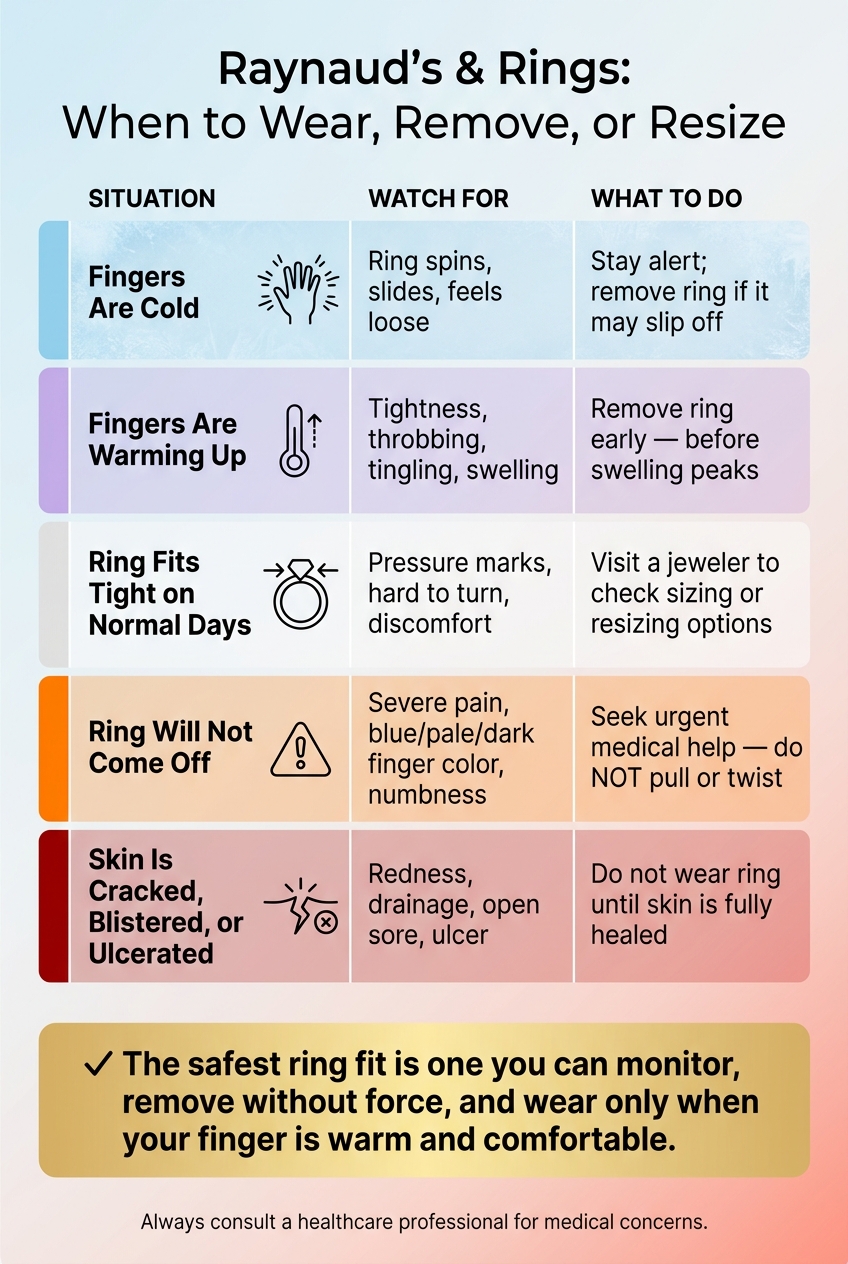
Raynaud's & Rings: When to Wear, Remove, or Resize
| Situation | What I should watch for | What I should do |
|---|---|---|
| Fingers are cold | Ring spins, slides, feels loose | Be careful; take it off if it may slip away |
| Fingers are warming up | Tightness, throbbing, tingling, swelling | Remove ring early |
| Ring fits tight on normal days | Pressure, marks, hard to turn | Check sizing with a jeweler |
| Ring will not come off | Severe pain, blue/pale/dark color, numbness | Get urgent medical help |
| Skin is cracked, blistered, or ulcerated | Redness, drainage, open sore | Do not wear the ring until skin heals |
The main idea is simple: I need a ring I can monitor, remove without force, and wear only when my finger is warm and comfortable.
sbb-itb-9da40c1
How to know when to wear, remove, or resize a ring
Raynaud's can change ring fit fast. A ring that feels fine one minute can start pinching the next. That’s why it helps to watch both your symptoms and the shape of your finger, not just whether the ring usually fits.
Remove a ring before swelling gets worse
Your best clues are fit, feeling, and color.
Take the ring off before swelling starts, or as soon as rewarming makes it feel tight, squeezed, or hard to turn. Fit can shift fast during rewarming, exercise, sleep, or hot weather.
If that moment passes, pay close attention to the warning signs below.
Signs a ring is too tight or too loose
A ring fits well when it turns a little, comes off without force, and doesn’t cause pain, numbness, tingling, pressure, or marks that stick around. Take it off right away if you notice pain, throbbing, swelling, stiffness, or a color change that lasts longer than your usual Raynaud's episode or looks worse than normal.
A ring can also be too loose. If it spins all the time, slides toward your fingertip, or feels like it might fall off when your hands are cold or wet, that’s a problem too. During a Raynaud's episode, numb fingers may not notice when a loose ring slips off.
When to resize a ring or get urgent help
If a ring feels tight on ordinary days, not just during Raynaud's episodes, the size may no longer match your usual finger changes. In that case, a jeweler can tell you if it needs resizing or a fit with more give.
Get medical help promptly if removal is no longer easy or your circulation seems affected. That includes a ring that will not come off, swelling that keeps getting worse, a finger that turns blue, pale, or dark, loss of feeling, limited movement, or severe pain. Numbness or tingling that does not go away after rewarming also needs urgent care. Do not pull or twist a stuck ring. Medical professionals can remove it safely.
Ring features that work better when finger size changes
Once you know when to take a ring off, the next step is picking one that can deal with normal size swings during the day.
Adjustable and resizable rings for day-to-day size changes
An adjustable or resizable ring can help with moderate changes, so you don’t have to switch rings every few hours. Open-band styles can be narrowed a bit when your fingers are cold and smaller, then loosened as your hands warm up or swell.
When you shop, look for a ring with a verified size range, clear metal details, band width, and an easy-to-find return or resizing policy. If you expect to adjust it often, go with a solid metal that can handle repeated reshaping without wearing down too fast.
That said, adjustability gives you some breathing room. It does not replace taking the ring off early.
Ring details that reduce pressure on sensitive fingers
Fit matters, but shape and finish matter too.
A smooth, rounded, low-profile band with a moderate width usually feels better and rubs less. A lighter, lower-profile ring also puts less pressure on the finger and tends to come off more easily. Another plus: low-profile settings are less likely to snag on gloves or clothing.
Fixed vs. flexible ring styles: a side-by-side look
These trade-offs are easier to see in a table:
| Ring style | Fit benefit | Best use case | Limitation |
|---|---|---|---|
| Fixed-size band | Stable shape; predictable appearance | Fingers that change only slightly and can be measured consistently | Least adaptable; may tighten during swelling or slip during cold episodes |
| Open adjustable band | Often easier to remove within its adjustment range | Moderate day-to-day size changes when flexibility matters more than a fully closed look | Can catch on fabric or twist; repeated bending may cause metal fatigue in some styles |
| Hidden-adjustment ring | Keeps a closed-band look with some internal flexibility, useful when a traditional style matters but some give is still needed for Raynaud's finger changes | Wearers who want an engagement-ring or wedding-band look with some give | Adjustment range is limited; the mechanism may add bulk or create pressure points |
| Stacking setup | Individual rings can be removed or rearranged as fit changes | People who want to remove one band before swelling tightens the whole set | Multiple bands increase total pressure; combined rings may be harder to remove once swelling starts |
If you wear stacked bands, keep them thin. It also helps to leave enough room so you can remove one ring first as soon as swelling begins.
How to size a ring when your fingers swell and shrink with temperature changes
Sizing a ring for Raynaud's takes more than one measurement. If you check your finger at the wrong time, you can end up with a ring that feels fine in the morning and far too tight by evening - or one that fits in a warm room but slips when your fingers get cold.
That’s why you need to size for your full daily fit range, not just one quick measurement.
Check ring fit in three conditions
Before you order or resize a ring, check the fit - or measure your finger - at three different times:
- At normal indoor temperature: After your hand has settled at a comfortable room temperature.
- After rewarming from cold exposure: If your fingers have been cold, warm them back up slowly. Use gentle rewarming, not hot water or direct heat, until color, sensation, and temperature return to normal.
- During your usual swelling time: For many people, that’s later in the day, after using their hands, or after an episode when swelling is more likely.
For each check, pay attention to what the ring actually does. Does it slide over the knuckle with slight resistance? Does it spin too easily? Does it leave a deep mark? Does it cause tingling or pain?
One number isn’t enough. You’re looking for the whole fit range.
Those three checks help you figure out whether one fixed size will work or whether the ring needs a bit more flexibility.
Do not size only for your coldest or most swollen state
Both ends of the range can steer you wrong.
If you size a ring only when your fingers are cold and narrower, it may seem fine at first. Then circulation returns, swelling kicks in, and the ring starts to feel tight or hard to remove.
If you size only during your peak swelling time, the opposite can happen. The ring may feel secure in the afternoon but spin freely and slip off during a cold episode in winter.
The goal is simple: choose a size that stays secure when your fingers are at their smallest and still comes off when they’re at their largest. If one fixed size can’t do both, go with an adjustable or resizable design.
Even with the right size, timing and temperature still change how the ring feels on your hand.
Daily habits that help you wear rings comfortably
Raynaud's can make your fingers change size during the day. That means ring comfort isn't just about sizing. Your day-to-day habits matter just as much.
Warmth, timing, and when to take rings off
Warm up before cold exposure, not after. Put on gloves or mittens before you step outside, walk into cold air conditioning, or reach into freezer aisles, since cold can trigger Raynaud's symptoms. Mittens often work better than gloves because they keep your fingers together, which helps them stay warmer.
If cold water, cold metal, or handling frozen food tends to set off symptoms, take your ring off before the activity starts. Put it back on only after your finger is warm again and its color has returned. Keep a ring case nearby so you can store it safely instead of tossing it into a pocket or loose bag. After you remove the ring, take a quick look at your skin before wearing it again.
Check skin condition after removing a ring
Each time you remove a ring, check for redness, a mark that doesn't fade, tenderness, numbness, blisters, cracks, drainage, broken skin, or an ulcer. If a mark lingers or the finger still hurts, the fit needs another look. Never wear a ring over swollen, injured, blistered, cracked, infected, or ulcerated skin. If you see an open sore or a wound that isn't getting better, contact a healthcare professional right away. Severe Raynaud's can lead to ulcers or tissue damage. If the skin looks irritated, stop wearing the ring until it heals.
Conclusion: The safest ring fit is one you can adjust and monitor
The safest ring fit is one you can adjust, keep an eye on, and remove early. Take rings off early, check the skin after removal, and wear them again only when the finger feels warm and comfortable. If a ring gets stuck, or if you notice fast-rising swelling, severe pain, a strong color change, or a wound or ulcer that doesn't improve, seek urgent medical care instead of waiting.
FAQs
Can I wear my ring every day if I have Raynaud’s?
Yes - if you choose a ring that can handle finger swelling and shrinking during the day. With Raynaud’s, fixed-size rings can feel too tight at one point and too loose later as circulation shifts.
Adjustable rings are often the best pick for daily wear. Look for a smooth, comfortable inner surface, and loosen or remove the ring early if swelling starts.
What ring style is easiest to manage with finger swelling and shrinking?
Adjustable rings are often the easiest pick for day-to-day finger swelling and shrinking. With flexible bands, open designs, or hidden mechanisms, you can loosen or tighten the fit on the spot without going to a jeweler for resizing.
If you want a more classic look, adjustable rings with hidden mechanisms give you that same flexibility while still looking like a fixed-size ring.
How do I know if my ring needs resizing or a different fit?
Pay attention to how your ring feels over the course of the day. Finger size can shift with temperature, activity, and even your general health.
If the ring feels too tight, leaves marks, feels uncomfortable, or struggles to get over your knuckle, it may need resizing.
If it slides around or spins more than you'd like, it may be too loose. When that keeps happening, measure your finger at different times of day and in different temperatures to see if a slightly more forgiving fit makes sense.


