

Postpartum Rings: The 6-12 Month Window Before You Decide Anything
If your ring fit changed after birth, I would not make a permanent decision yet. In most cases, the safest move is to wait 6 to 12 months before resizing, replacing, or retiring a ring.
Here’s the short version:
- Ring fit can shift for months after delivery
- Swelling is often worst in the first 1 to 2 weeks
- Weight, hormones, breastfeeding, heat, and daily activity can all change fit
- A tight ring should come off early
- A loose ring should be stored or worn with a temporary guard
- Permanent resizing too soon can lead to repeat work and extra cost
- Basic resize costs often start around $20 to $60, while more involved work can run $50 to $150+
- Basic ring guards can cost about $1.90 to $19.95
- Sudden one-sided swelling, pain, redness, chest pain, trouble breathing, vision changes, or a fever of 100.4°F or higher need medical care
The main idea is simple: one bad fit day does not mean your size changed for good. I’d treat the first postpartum months as a wait-and-watch period, use reversible fixes, and only think about a permanent change after your fit has stayed steady for a while.
Quick comparison
| Situation | What I’d do now | What I’d avoid |
|---|---|---|
| Ring feels tight | Remove it early, cool and elevate the hand, do not force it | Forcing it off or resizing right away |
| Ring feels loose | Use a temporary guard or store it safely | Wearing it loose during handwashing or baby care |
| Fit changes day to day | Track fit for a few months | Treating short-term changes as final |
| Fit stays stable for months | Get measured by a jeweler later in the day | Guessing your size based on one day |
| Swelling is painful, red, warm, or one-sided | Get medical help | Treating it like only a ring problem |
I’d sum it up this way: protect the ring first, protect your finger first, and wait until your body settles before making a lasting choice.
sbb-itb-9da40c1
Why a ring can feel tighter or looser after birth
Postpartum ring fit changes happen for clear physical reasons. Knowing what’s behind them can help you stay calm and avoid making a permanent choice during a short-term phase. That’s why a ring can feel different from one day to the next.
Fluid shifts, IV fluids during labor, and early swelling
During pregnancy, your body holds on to extra fluid. After delivery, that fluid starts to leave through urination and sweating, most noticeably in the first 1–2 weeks postpartum. So if your fingers felt puffy in the hospital, they may feel much closer to normal a week or two later.
If you received IV fluids during labor, that can add to the amount of fluid your body has to work through afterward. In plain English: a ring that felt fine during pregnancy may feel tighter right after delivery, not because your finger changed for good, but because there’s more fluid in the tissue. Heat, long periods of standing, and salty meals can also make that early swelling worse on a given day.
Weight changes, breastfeeding, hormones, and daily habits
The six-week checkup doesn’t mean your ring size has settled. Weight, body composition, hydration, activity, sleep, and lactation-related changes can keep shifting well past that point. As retained fluid goes down, a ring that once felt snug may start to feel looser later in the postpartum period.
Breastfeeding can affect hydration, appetite, and sleep, so ring fit may still change from day to day. Daily habits matter too. A ring that feels comfortable in the morning might feel tight by evening after activity, heat, or a salty dinner. That doesn’t mean anything permanent has happened. It’s often just normal fluid movement over the course of the day.
When swelling or fit changes need medical attention
Most postpartum swelling is normal, but some patterns need medical attention. Sudden, painful, one-sided swelling - especially in one arm or leg, with redness or warmth - can be linked to a blood clot and needs medical evaluation right away, not a jewelry adjustment.
Contact your OB or midwife promptly if you notice a severe or persistent headache, vision changes, or swelling of the face or hands. These can be warning signs of postpartum hypertension or preeclampsia. Call emergency services immediately for chest pain, trouble breathing, shortness of breath, or a fast or irregular heartbeat. A temperature of 100.4°F (38°C) or higher is also a postpartum warning sign and should prompt a call to your provider.
What to do while you wait instead of resizing right away
If your ring size is still changing, protect the ring for now instead of resizing it too soon. Fluid shifts, weight changes, and hormone changes can all affect fit. So while things settle down, reversible fixes make more sense than altering the ring.
Start with the problem in front of you: a ring that feels too tight or one that feels too loose.
If the ring feels too tight: remove it early and do not force it
Take the ring off at the first sign of swelling, pain, numbness, coldness, or color change. Do not force it over the knuckle.
If the ring is still removable but feels snug, cool and elevate your hand first. Then use a small amount of soap or lubricant and gently rock the ring free. If you feel pain or numbness, or if you notice any color change, stop right away. If the ring will not budge, or the finger turns blue, purple, white, or markedly pale, contact a jeweler or get medical care instead of trying to keep going at home.
Once the ring is off, leave it off during sleep, exercise, hot showers, and baby-care tasks. Those are the times when swelling and pressure can turn a minor fit issue into a stuck ring.
If the ring is not tight but starts slipping, the safer move is different.
If the ring feels too loose: reduce the risk of losing it
A loose ring may not seem urgent, but it can disappear fast during handwashing, lotion use, or a diaper change. Soap and water lower friction in seconds, and a ring that felt fine earlier can suddenly slide over the knuckle later in the day.
Check the fit with clean, dry hands. A safer fit:
- Does not spin freely
- Passes over the knuckle with mild resistance
- Leaves no deep mark when removed
If the ring fails any of those checks, take it off and store it in one fixed place.
Temporary options that protect the original ring
When you need a short-term fix, start with the least invasive one. If the ring is stuck, get medical help before trying any fix.
If the ring is only slightly loose and still feels comfortable, a removable silicone ring guard or coil can take up some of the space inside the band without changing it for good. You can swap these out as your finger changes. Take the guard off now and then to clean and dry both the guard and the ring underneath. Trapped moisture can irritate skin and cause tarnish.
For a steadier short-term fix, a jeweler can add sizing beads. These are two small metal beads soldered to the inside of the band. They help keep the ring in place without cutting or reshaping it. This is a semi-permanent option, and a jeweler can remove it later.
If you would rather not wear your original ring at all during this stretch, an adjustable ring can work as a stand-in. It is a stopgap, not a final answer. And it is not automatically right for every gemstone, lifestyle, or finger, so the design still needs to fit your day-to-day use.
When you store the original, protect it now so you can make a permanent call later. Keep it in a fabric-lined compartment or a labeled soft pouch, away from humidity, cleaners, and residue.
Why waiting 6–12 months can protect both the ring and your budget
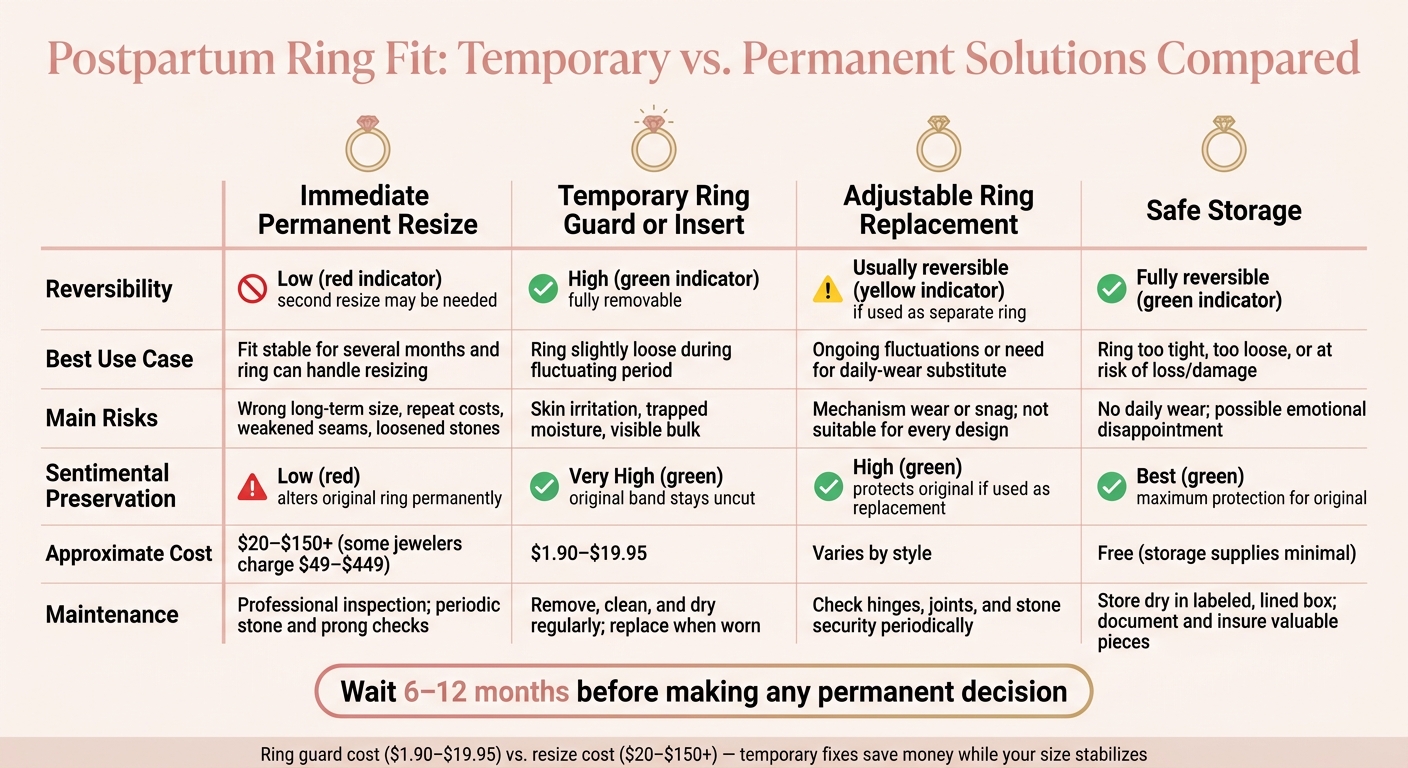
Postpartum Ring Fit: Temporary vs. Permanent Solutions Compared
Once you’ve handled the short-term fix, the next step is deciding whether the ring is ready for a permanent change. That part matters more than it may seem.
A permanent resize locks in the fit you have right now. And postpartum ring size can keep shifting for months. So if you resize too early, you might end up paying to undo that same job later.
The risks of resizing or replacing a ring too soon
If you size the ring up while swelling is still there, it may start spinning once that extra fluid goes away. If you size it down after early weight loss, it may feel too tight again later. Either way, you could end up paying for the same repair twice.
Basic resizing can cost $20–$60, while more involved work can run $50–$150 or more. Some jewelers charge anywhere from $49–$449, depending on the ring. That’s not a small range, especially if you need repeat work.
There’s also the wear on the ring itself. Repeated cutting, stretching, or torch heating can weaken delicate bands and loosen stones. This is a bigger issue for:
- Thin bands
- Antique or vintage pieces
- Engraved rings
- Rings with pavé, channel-set, or tension-set stones
Each resize involves cutting, heating, and soldering. Over time, that stress around the seam can weaken the band or loosen small stones. And if the ring has deep personal meaning, that risk hits a little harder. Some pieces just aren’t worth pushing through repeat work unless the size has plainly settled.
Temporary vs. permanent options: a side-by-side comparison
Temporary fixes help protect the original ring while your size is still moving around. Here’s how the main options compare.
| Option | Reversibility | Best use case | Main risks | Sentimental preservation | Maintenance |
|---|---|---|---|---|---|
| Immediate permanent resize | Low; a second resize may be needed later | Fit has stayed stable for months and the ring can handle resizing | Wrong long-term size, repeat costs, weakened seams, loosened stones | Alters the original ring permanently | Professional inspection; periodic stone and prong checks |
| Temporary ring guard or insert | High; fully removable | Ring is slightly loose during a fluctuating period | Skin irritation, trapped moisture, slipping if poorly fitted, visible bulk | Very high; original band stays uncut | Remove, clean, and dry regularly; replace when worn |
| Adjustable ring mechanism or replacement | Usually reversible if used as a separate ring | Ongoing fluctuations or need for a daily-wear substitute while the original is stored safely | Mechanism can wear or snag; not suitable for every design or gemstone | Protects the original if used as a replacement | Check hinges, joints, and stone security periodically |
| Safe storage | Fully reversible | Ring is too tight, too loose, or at risk of loss or damage | No daily wear; possible emotional disappointment | Best protection for the original | Store dry in a labeled, lined box; document and insure valuable pieces |
A ring guard or sizing insert usually costs about $1.90–$19.95 for basic products. That’s far less than even the simplest professional resize. When your ring size is still in flux, that price gap can make the safer short-term option a lot easier to justify.
Once your size has stayed steady for months, a permanent resize starts to make more sense.
When a permanent resize actually makes sense
Once your ring fit has stayed the same for months, it may be time to move from a stopgap fix to a permanent choice.
Signs your ring size has stabilized enough to resize
The clearest sign is steady fit over several months, not just a handful of good days. A short fit log can help you confirm that the ring feels the same on normal days, instead of seeming fine one day and off the next.
If swelling is sudden, painful, red, warm, or only on one side, get medical clearance before you resize anything. After that, have a jeweler measure your finger later in the day, when fingers are closer to their usual size.
Permanent paths: resize, modify, or choose an adjustable replacement
Once your size looks steady, use a professional measurement to pick the option that changes the ring as little as possible.
A standard resize usually works best when the ring is sturdy and your size has clearly settled. Before you approve any work, ask the jeweler to check the metal, setting, band thickness, engraving, stone security, and any past repairs.
If the fit is only slightly off, sizing beads or an inner liner may give you a better hold without doing a full resize.
If your size still changes from time to time, a resizable or adjustable replacement can let you keep wearing a ring each day without changing the original.
Postpartum ring protection: a quick checklist
Use this as a last check before you resize, modify, or keep waiting.
- Use a temporary guard or insert when the ring is a little loose and you don't want to make a permanent decision yet.
- Get medical help for sudden, painful, red, warm, or one-sided swelling.
- Consult a jeweler after several months of steady fit, and bring your fit log.
FAQs
How do I know if my ring size is finally stable?
Track your ring fit for 3–6 months when your weight is close to your maintenance range. That gives you a better read on whether your size has settled.
A ring size is likely stable when the fit feels about the same across the day. You should feel light resistance over the knuckle, but the ring shouldn’t spin around at the base.
Before you make a permanent resize, ask a jeweler to check your size at two separate visits spaced a few weeks apart. Try to do both checks at the same time of day and at room temperature. If the fit still shifts from week to week, hold off.
Can breastfeeding keep changing how my ring fits?
Yes. During the postpartum period, breastfeeding can still affect how your ring fits. Hormones, fluid retention, and shifts in body weight can keep your finger size changing for a while.
Because of that, it’s usually smart to hold off on a permanent resize until your body settles down, often sometime in the 6-12 month range. For now, temporary fixes like silicone ring adjusters or adjustable rings can make things a lot easier.
What rings should not be resized?
Some rings just aren’t good candidates for resizing. In those cases, the issue usually comes down to the ring’s design, the material, or both.
That often includes:
- Full eternity bands
- Rings made of tungsten, titanium, or ceramic
- Tension-set rings
- Rings with complex engravings or continuous patterns
Heirloom rings can also be risky. Older settings may have fragile prongs, older metal mixes, or delicate gemstones that don’t handle resizing well. Try to force a size change, and you could damage the ring.


