

Moissanite Engagement Rings in 2026: Prices, Quality, and What Changed
If I had to sum it up in one line: in 2026, most moissanite engagement rings in the U.S. sit between $500 and $2,500+, and the biggest price driver is usually the metal, not just the stone.
If you want the short answer, here it is:
- 1 ct equivalent rings often land around $500 to $900
- 2 ct equivalent rings often land around $800 to $1,800
- 3 ct equivalent rings often land around $1,200 to $2,500+
- A 1 ct equivalent moissanite ring can cost about $300 to $800
- A similar natural diamond ring can cost about $3,000 to $6,000+
That price gap is the main reason many buyers look at moissanite first.
Here’s what changed in 2026:
- Stone quality is more consistent
- Certified stones are more common
- Colorless and near-colorless options are easier to find
- More styles now exist at each budget level
- Adjustable sizing is getting more attention for online ring shopping
I’d also keep these points in mind before buying:
- 14K gold is often the best middle ground for daily wear
- Platinum costs more, but gives you a naturally white metal and strong prong security
- Silver and vermeil cost less up front, but need more care
- Solitaire rings usually cost less than halo rings
- A halo can make a ring look about 20% to 30% larger
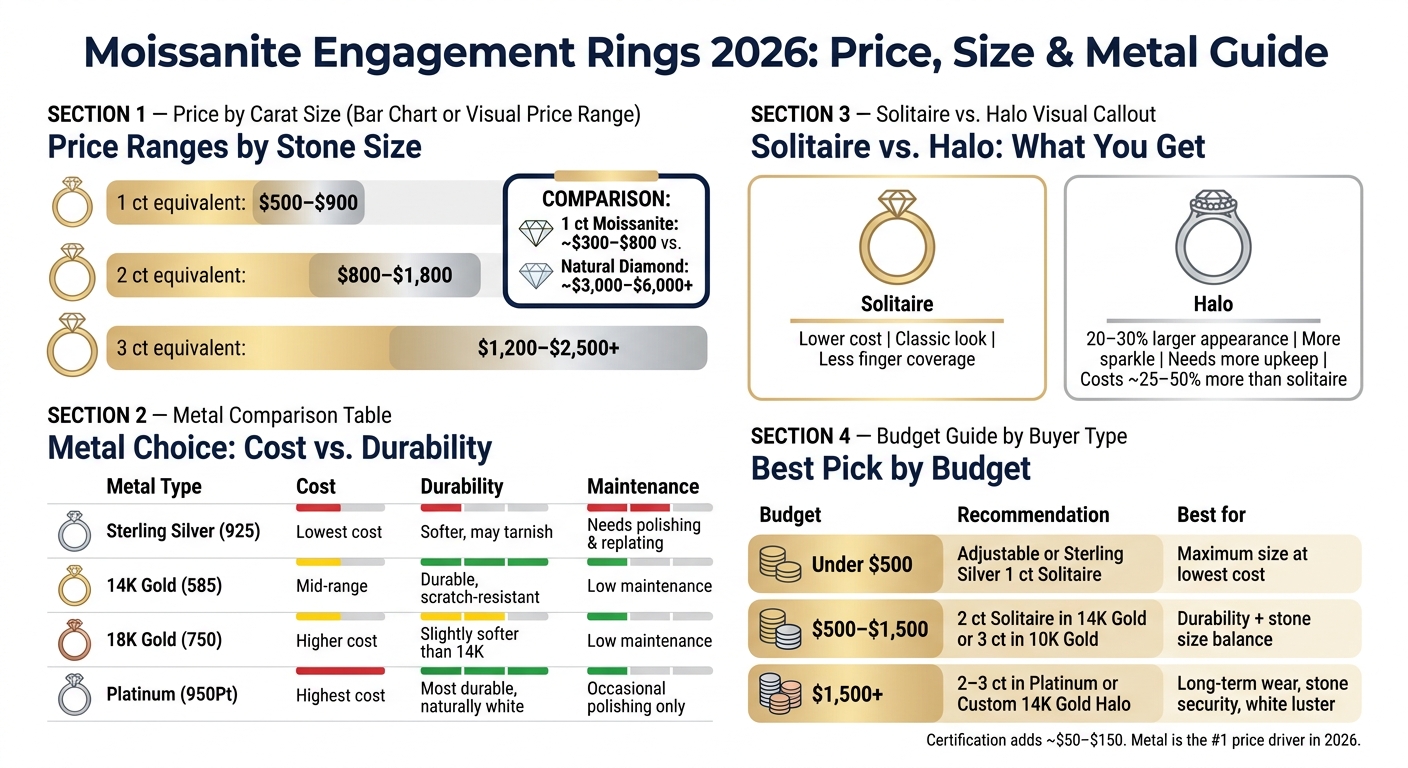
Moissanite Engagement Rings 2026: Price by Size, Metal & Style
The Top 5 Best Moissanite Rings in 2026 - Must Watch Before Buying!
sbb-itb-9da40c1
Quick Comparison
| Option | Usual 2026 Price | Best For | Main Tradeoff |
|---|---|---|---|
| Satinski adjustable ring | $150 to $1,390+ | Buyers unsure about sizing | Adjustment area may wear faster in vermeil |
| 1 ct solitaire | $500 to $900 | Classic look, lower spend | Less finger coverage |
| 2 ct solitaire | $800 to $1,800 | Bigger look for daily wear | Needs a stronger setting |
| 3 ct halo | $1,200 to $2,500+ | Maximum visual size and sparkle | More upkeep from extra stones |
| 14K gold ring | Mid-range | Daily wear | Costs more than silver |
| Platinum ring | Highest | Long-term wear, white metal | Heavier and more expensive |
My take: if you want the safest all-around pick, start with 14K gold and then choose your size. If you want the lowest up-front cost, look at silver. If you want the biggest look for the money, 3 ct halo styles stand out fast.
Below, I break down how price, cut, color, clarity, certification, setting style, and metal choice shape what you get in 2026.
1. Satinski Adjustable Moissanite Engagement Rings
Satinski's adjustable moissanite engagement rings deal with one of the biggest headaches in online ring shopping: sizing. The hidden Allring mechanism fits about US sizes 5–9 (EU 49–59), stays out of sight, and helps cut down on spinning and sliding. That built-in range also affects the prices below.
Price
In 2026, price mostly comes down to three things: metal type, center-stone size, and how detailed the setting is. Sterling silver and gold vermeil styles start in the mid-$100s and go up to about $250. 14K solid gold models sit at about $990 to $1,390, while 18K solid gold starts around $1,390.
Bigger stones and more detailed settings push the price up. If you're trying to keep costs down, vermeil is the entry point. But there’s a trade-off: the plated layer can wear down near the adjustment area. Solid gold holds its color and finish much better over time.
Stone Quality
Price matters, but stone quality still plays a huge role in sparkle and how the ring looks after years of wear. Higher-end styles may include certified moissanite, with center stones usually ranging from about 0.25 ct to 1.0 ct equivalent.
When you're checking the specs, focus on the basics that make the biggest difference:
- Color
- Cut
- Clarity
- Consistent optical performance
The easiest way to verify this is to look for the Certified label in the product details.
Setting and Metal
Once you get past the stone, the setting and metal shape the day-to-day wearing experience. Satinski offers styles like solitaire, pavé, infinity, twisted band, and olive leaf. Most are made in 925 sterling silver with rhodium plating, with some lines available in 18K gold vermeil or solid gold.
Each ring also comes with a Resizing Stick for at-home adjustments, which helps the band keep its shape during resizing. The materials are hypoallergenic and nickel-free.
2026 Value
This kind of ring makes a lot of sense if you’re buying for a proposal, planning to travel, or dealing with size shifts from pregnancy, arthritis, or even day-to-day temperature changes. It takes a lot of the guesswork out of sizing.
For daily wear, 14K solid gold is the better long-term pick. Vermeil works better for temporary use or tighter budgets, especially since it may need replating every one to three years at a cost of about $30 to $100 per service.
2. 1 ct Equivalent Moissanite Solitaire Ring
After fit flexibility, the next thing people look at is size. And at this point, 1 ct is the clean middle ground.
It’s the standard moissanite solitaire pick in 2026: classic, easy to notice, and still far below premium pricing. So once you land on 1 ct, the main things that shape the final cost are the metal and the stone grade.
Price
At the 1 ct level, metal choice does most of the heavy lifting on price.
A sterling silver ring, often finished in 18K gold vermeil, starts at about $250. An 18K solid gold version with a certified center stone comes in around $1,390.
Stone Quality
For a 1 ct solitaire, focus on three things: cut precision, a near-colorless look, and eye-clean clarity. Certification matters too, because it shows the stone matches the listed grade.
Setting and Metal
At 1 ct, metal choice affects both how the ring wears day to day and what it offers over time.
| Metal | Purity Stamp | Cost | Durability | Color | Maintenance |
|---|---|---|---|---|---|
| Sterling Silver | 925 | Lowest cost | Softer; prone to scratching | White; may tarnish | Requires polishing and replating |
| 14K Gold | 585 | Mid-range | Durable and scratch-resistant | Yellow, white, or rose | Low |
| 18K Gold | 750 | Higher | Slightly softer than 14K | Higher purity, richer color, and a premium feel | Low |
| 950 Platinum | 950Pt | Highest | Very durable | Naturally white, tarnish-resistant, and highly secure for stones | Lowest |
If you want a white metal with less upkeep, platinum stands out. It stays white without rhodium plating and holds stones securely.
2026 Value
For online orders and proposals, an adjustable band helps lower sizing risk without changing the 1 ct look. After this point, the tradeoff leans more toward visual presence and price as carat size goes up.
3. 2 ct Equivalent Moissanite Solitaire Ring
At 2 ct, a solitaire starts to look a lot larger on the hand. That extra size changes the conversation. In 2026, buyers at this range aren’t just looking at price. They’re also thinking about fit, setting security, and how the ring feels after months or years of daily wear.
Price
A 2 ct equivalent solitaire usually falls between $800 and $1,800 in 2026, with sterling silver on the lower end and platinum at the top. In plain terms, metal choice is the main thing moving the price up or down.
At this size, the decision often shifts away from “What can I spend?” to “What will hold up well every day?”
Stone Quality
At 2 ct, small issues are harder to hide. Cut precision, symmetry, and a secure mount matter more because flaws are easier to spot and the stone tends to sit higher on the finger.
That’s why the setting matters almost as much as the stone. A good stone can still feel less polished if the ring doesn’t hold it well.
Setting and Metal
For a 2 ct solitaire, platinum and 14K gold tend to make the most sense for daily wear. They offer a strong mix of security, wear resistance, and comfort.
| Metal | Purity Stamp | Best Use at 2 ct | Durability |
|---|---|---|---|
| Platinum | 950Pt | Most secure stone setting; naturally white | Highest |
| 14K Gold | 585 | Strong balance of durability and cost | High |
| 18K Gold | 750 | Richer color; slightly softer than 14K | Moderate |
| Sterling Silver | 925 | Most affordable; requires regular cleaning | Lower |
2026 Value
For everyday use, an adjustable band can help keep a 2 ct stone centered and cut down on spinning. That small detail can make a big difference, especially with a larger center stone that has more weight up top.
This is also the point where many buyers start to think more carefully about wearability, because once you move up to 3 ct, the visual jump is hard to miss and halo settings start to look like a better fit.
4. 3 ct Equivalent Moissanite Halo Ring
Moving up from 2 ct, 3 ct is the point where a halo starts to make a clear visual difference. The size jump is easy to notice, and a halo can make the center stone look about 20%–30% larger. On the finger, that means the ring feels bigger right away. That’s a big reason halo and hidden halo styles still show up so often in this size range.
Price
Prices cover a pretty wide spread.
- Budget halo rings in silver, 10K gold, or vermeil usually start around $150–$400.
- Mid-range rings in 14K gold from moissanite-focused sellers often land between $1,100 and $1,600.
- Premium styles with more detailed halos, designer names, or platinum settings can hit $3,100 or more.
The halo itself adds to the total. In most cases, expect to pay about 25–50% more than you would for a similar solitaire at the same carat size because of the extra accent stones and added labor.
Stone Quality
At 3 ct, stone quality gets harder to ignore. Small differences that might slide by at lower sizes tend to stand out more here, so DEF colorless, VVS clarity, and strong cut precision matter more.
Cut is a big deal. A well-cut stone gives off strong brilliance and fire. A poorly cut one can look glassy or even dark in the middle, and the halo can make that stand out instead of hiding it. Round brilliant and oval cuts stay popular for halo settings because they push sparkle well.
Setting and Metal
Halo style changes both the look and the price. A single classic halo is usually the lowest-cost option and works well in both budget and mid-range rings. A hidden halo sits under the center stone and adds sparkle from the side. It’s especially popular in 2026 and often shows up in 14K gold or designer settings. Double halos and vintage-inspired designs with milgrain or baguette details tend to land in the upper mid-range or premium end.
For metal, the tradeoff is pretty simple: platinum gives you the most wear resistance, while 14K gold gives the best mix of strength and price.
| Metal | Best For | Durability | Relative Cost |
|---|---|---|---|
| Sterling Silver / 10K Gold / Gold Vermeil | Tight budgets | Lower | Lowest |
| 14K Gold | Everyday wear, best value | High | Mid-range |
| Platinum | Maximum durability, luxury feel | Highest | Highest |
2026 Value
Halo rings need a bit more attention over time. The small accent stones should be checked now and then, since halos need more prong inspections than solitaires to help avoid stone loss. If you want the biggest size effect for the money, a halo does a lot of visual heavy lifting. The tradeoff is upkeep, which makes the metal choice matter even more.
5. 14K Gold Moissanite Engagement Ring
When attention moves from stone size to metal, 14K gold is a smart everyday starting point in 2026.
Price
After you pick the stone size, the metal becomes the next big factor in cost. In 2026, 14K gold lands in the middle of the metal price range. It costs less than platinum and 18K gold, but more than silver or vermeil. In most cases, the setting design is what changes the price the most.
Metal and Wear
14K gold is 58.3% pure gold and is often stamped 585. It holds up well for daily wear. It also resists tarnish and corrosion better than sterling silver, which helps keep upkeep low. You can find it in yellow, white, and rose gold. Many people with sensitive skin also lean toward 14K gold.
2026 Value
For long-term value, 14K gold stays one of the best picks in 2026. It’s durable enough for everyday use and costs less than platinum or 18K gold. If you care more about extra toughness and a brighter white finish than price, platinum is the next move up.
6. Platinum Moissanite Engagement Ring
Platinum is the premium move for buyers who want a naturally white setting metal that’s built to last.
Price
Platinum pushes the final price up at every size level. A 1 ct equivalent platinum solitaire usually lands around $1,100–$1,800, while a 2 ct equivalent is often $1,600–$2,500+. For 3 ct equivalents, expect about $1,800–$3,000+ for simpler styles. Detailed or custom designs can go higher.
If you upgrade the same ring from gold to platinum, that usually adds about $400–$700. And that extra cost isn’t just for looks. It shows up in day-to-day wear, prong security, and long-term color stability.
Setting and Metal
Most fine-jewelry platinum is Pt950. It’s a dense white metal that doesn’t need rhodium plating. That alone is a big draw for people who don’t want the extra upkeep that can come with white gold.
When platinum gets scratched, the metal shifts rather than wearing away. In plain English, it tends to hold onto its metal over time, which helps keep prongs secure. It’s also denser than gold, so it has a heavier feel on the finger. Some people love that. Others notice it right away.
Maintenance is pretty simple:
- Occasional polishing
- Periodic prong checks
Those are a few of the main reasons platinum is getting more attention in 2026.
2026 Value
In 2026, platinum stands out less for sparkle and more for durability, weight, and color stability. One U.S. retail trend report found that 76% of retailers planned to increase platinum inventory investment in 2026.
Buyers who choose platinum are paying more upfront for stronger long-term wear. They get a naturally white finish, a hypoallergenic metal, and a setting that holds up without replating.
Quality, Pricing, and What Changed in 2026
No matter which ring style you look at, the same three things keep shaping price: stone quality, metal choice, and how the ring is sized.
In 2026, moissanite quality still comes down to the basics: color, cut, clarity, and certification. The big shift isn’t a new grading system. It’s consistency. Premium stones are now more often certified and more reliably colorless.
| Quality Factor | Price Impact | Matters Most At | 2026 Note |
|---|---|---|---|
| Color (D-E-F colorless) | High | 1 ct: moderate; 3 ct: critical | More consistent D-E-F colorless color |
| Cut (precision) | Very High | 1 ct: high; 3 ct: critical | - |
| Clarity (eye-clean) | Moderate | 1 ct: low; 3 ct: moderate | - |
| Certification | +$50–$150 | All sizes | Standardized certified reports now more common |
Certification usually adds about $50 to $150 to the cost of a certified stone.
Metal choice drives the rest of the budget. In 2026, solid gold and platinum settings cost more at the start, but they tend to wear better over time. On the sizing side, old-school resizing still costs more than adjustable sizing, and it also puts extra wear on the band over the years.
Fit is where things have shifted the most. Adjustable bands help cut sizing mistakes and lower resizing costs. That matters because getting the wrong size is more common than many buyers think. One ring can now cover several common U.S. sizes, which helps avoid the usual back-and-forth of standard resizing.
There’s a tradeoff, though. The adjustment point tends to wear out first. That’s why 14K solid gold tends to last better there than vermeil over time.
For buyers who want a premium metal, platinum still stands out for its natural whiteness and strong stone security.
These price and wear differences lead straight into the buyer-type breakdown next.
Pros and Cons by Buyer Type
These trade-offs make more sense when you look at what the buyer wants most.
| Buyer Type | Best Option | Pros | Cons |
|---|---|---|---|
| Budget-First | Satinski Adjustable or Sterling Silver 1ct Solitaire | Lowest upfront cost; avoids standard resizing; bigger look per dollar | Silver needs regular cleaning to prevent tarnish |
| Maximum Sparkle | 3ct Equivalent Moissanite Halo Ring | Extreme brilliance; halo adds visible size; strong visual impact | More visible fire than a diamond |
| Closest to a diamond look | 1ct or 2ct Solitaire in 14K White Gold or Platinum | Most convincing diamond alternative; classic, clean look; durable metal | Higher cost for precious metal settings; smaller visual footprint than halo styles |
| Largest stone for less | 3ct Equivalent Solitaire in 10K Gold | Maximizes gem size for the price; 10K gold holds up well for daily wear | 10K gold has a slightly paler tone than 14K or 18K |
If your main goal is to spend as little as possible, the Satinski Adjustable or a Sterling Silver 1ct Solitaire gives you the lowest entry price. You also skip standard resizing, which can save money up front. The catch is simple: silver looks good, but it needs regular cleaning so it doesn’t tarnish.
If you want the most sparkle, the 3ct Equivalent Moissanite Halo Ring stands out right away. Moissanite throws a lot of light, and the halo makes the center stone look even larger. That extra fire is part of the appeal for some buyers, but if you want a look that stays closer to a diamond, it may feel a bit too flashy.
For buyers who want something that looks closest to a diamond, a 1ct or 2ct Solitaire in 14K White Gold or Platinum is usually the better fit. The shape is classic, the setting looks clean, and the metal helps sell that polished fine-jewelry feel. You’ll pay more for those metals, though, and a solitaire won’t look as large on the hand as a halo design.
If stone size matters most, a 3ct Equivalent Solitaire in 10K Gold gives you a lot of visual impact without the jump in price you’d get with higher-karat gold. It’s a smart middle ground for daily wear. Just note that 10K gold can look a little paler than 14K or 18K.
Budget also changes the best pick pretty fast.
| Budget Range | Recommended Ring Type | Primary Benefit |
|---|---|---|
| Under $500 | Satinski Adjustable or Sterling Silver 1ct Solitaire | Maximum stone size and immediate fit at the lowest upfront cost |
| $500–$1,500 | 2ct Solitaire in 14K Gold or 3ct Solitaire in 10K Gold | Best balance of durability and stone size for daily wear |
| $1,500+ | 2ct–3ct Moissanite in Platinum or Custom 14K Gold Halo | Stronger stone security, hypoallergenic metal, and lasting white luster |
Under $500, the best move is usually simple: go for the biggest look at the lowest starting price. That points to the Satinski Adjustable or a Sterling Silver 1ct Solitaire.
In the $500–$1,500 range, you start getting better metal options without giving up too much stone size. A 2ct Solitaire in 14K Gold or 3ct Solitaire in 10K Gold often hits the sweet spot for daily wear.
At $1,500+, the focus shifts more toward metal quality, stone security, and long-term wear. That’s where 2ct–3ct Moissanite in Platinum or a Custom 14K Gold Halo starts to make more sense.
Conclusion
Moissanite engagement rings in 2026 offer strong value across a broad budget range.
When you compare size, setting, and metal, one thing becomes clear: the metal has the biggest effect on both price and day-to-day wear. Silver is the lowest-cost pick. 14K gold gives you the best middle ground between price, wear, and look. Platinum sits at the high end and is a smart choice for daily wear if you want more durability and steadier color over time.
Stone size changes the overall look more than anything else. A 1 ct stone feels classic. A 2 ct stone has a bolder presence. And 3 ct halo styles make the biggest visual statement.
Before you buy, check the hallmark: 585 or 14K for gold, 950Pt or Plat for platinum, and 925 for silver. If you want the fastest way to line up your budget with wear and finish, start with the metal choice.
FAQs
How do I choose the right metal for daily wear?
Choose based on your lifestyle, skin sensitivity, and how much wear the piece will get. Platinum is highly durable, hypoallergenic, and keeps its white luster, so it’s a strong pick for daily wear.
Gold is classic and flexible: 18K gives you a good mix of purity and durability, while 14K is harder and more scratch-resistant. If you want a more affordable everyday option, sterling silver is durable and hypoallergenic, and titanium offers exceptional strength.
Is certified moissanite worth the extra cost?
Yes - certified moissanite can be worth the extra cost if you want more peace of mind about quality and responsible sourcing.
A certificate confirms key quality details like cut, clarity, and color. It also gives you more confidence in the stone’s stated value and the standards used to grade it.
Should I choose a solitaire or halo setting?
It comes down to the look you want. A solitaire puts all the attention on the center stone, which makes it a great fit for a classic, clean style.
A halo brings in extra detail and can make the center stone appear larger. That makes it a strong pick if you want more sparkle. A hidden halo gives you a softer touch of shine without pulling focus from the main stone.


