

Choosing a Men's Ring Width: How It Changes the Fit
The short answer: the same ring size can feel tighter or looser based on band width. If I pick a ring at 8 mm, 10 mm, or more, it will usually feel tighter than a 4 mm or 6 mm ring in the exact same size.
Here’s what I’d keep in mind before I buy:
- Thin bands usually feel lighter and easier over the knuckle.
- Mid-size bands often feel balanced for daily wear.
- Large bands press on more skin, so they can feel snug at the same size.
- If my finger swells during the day, fit can shift by about 0.5 size from morning to evening.
- For bands 8 mm and up, I’d often start by checking half a size larger.
This also means I shouldn’t judge fit by size number alone. I need to check how the ring goes over the knuckle, how it sits at the base, and whether the exact band width changes the feel.
Quick Comparison
| Band width | How it often feels | Best for |
|---|---|---|
| 4 mm | Light, easier fit, less pressure | Slim fingers, first ring |
| 6 mm | Balanced feel | Daily wear |
| 8 mm | Snugger, more noticeable | Bigger look, firmer fit |
| 10 mm+ | Most size-sensitive | Bold look, larger hands |
Bottom line: when I choose a men’s ring, I should match size + width at the same time, not one after the other.
sbb-itb-9da40c1
Why Wider Men's Rings Feel Tighter
Wider bands feel tighter for a simple reason: they cover more of your finger, even when the size stays the same.
A wider band touches more skin and leaves less room for the soft tissue on your finger to shift around. You tend to notice this most at the knuckle, where the ring has to get over the widest part of your finger.
More Surface Contact Means More Pressure
An 8 mm band covers more of the joint at one time, so it creates more drag as you slide it over the knuckle.
That’s why, in the same size, 8 mm and wider bands often feel noticeably tighter than narrow bands. Nothing changed about the ring size itself. The feel changes because more metal is pressing against more of your finger at once.
Knuckle Fit and Base Fit Are Not the Same
For a lot of men, the knuckle is wider than the base of the finger. That can make ring fit a little tricky.
With a narrow band, it’s often easier to deal with that difference. The ring can slip over the knuckle with a quick twist, then sit comfortably at the base, even if it feels a bit loose once it settles.
A wider band changes that. Because it spans more of the knuckle during entry, it has to compress more skin and tissue at the same time. So even if the ring fits well at the base, it may still feel tighter when you put it on or take it off.
Once the ring clears the joint and rests at the base, it may feel secure and comfortable. So when you judge fit, look at both parts of the experience:
- How the ring slides over the knuckle
- How it feels once it rests at the base
This matters even more with 8–10 mm bands. Width tends to magnify the gap between your knuckle and your finger base. The bigger that gap, the more obvious the difference feels when you move from a narrow band to a wider one.
That’s why the same size can feel different across 4 mm, 6 mm, 8 mm, and wider bands. Next, compare how common widths change that feel in real use.
Common Men's Ring Widths and How Each One Feels
Most men's bands fall between 4 mm and 10 mm. And here's the part many people miss: the same ring size can feel very different when the width changes. A wider band usually feels snugger, even if the diameter stays the same.
Use the chart below to get a quick sense of how width affects day-to-day wear.
| Width | Typical Fit Feel | Visual Presence | Commonly Chosen For |
|---|---|---|---|
| 4 mm | Light, low-profile, very forgiving | Subtle, minimal | Slim fingers, first-time wearers, low-profile fit |
| 6 mm | Balanced, comfortable, secure | Classic, moderate | Most everyday wear, balanced fit |
| 8 mm | Snugger, more noticeable on the finger | Bold, traditional | Broader hands, firmer feel |
| 10 mm+ | Tightest-feeling, most size-sensitive | Very bold, statement-making | Larger hands, very bold fit |
4 mm to 6 mm: Lighter Feel and Easy Daily Wear
A 4 mm band feels light and easy to wear. It usually slides on with less resistance and sits low on the finger, which makes it a good pick for slimmer fingers or anyone who wants a ring that stays out of the way.
A 6 mm band lands right in the middle. It has enough presence to be noticed, but it usually doesn't feel bulky. For many men, this is the sweet spot for everyday wear.
8 mm to 10 mm and Up: Heavier Feel and More Size Sensitivity
At 8 mm, the ring starts to feel heavier and a bit tighter going on. You may notice it more when gripping something, typing for long periods, or making a fist. That extra width changes the feel in a very direct way.
At 10 mm and above, the band makes a much bolder statement. It also becomes more sensitive to small fit changes, especially when your finger swells during the day. That's why width and ring size should be picked together, not as two separate choices.
When to Size Up and How to Pick the Right Width-Size Combination
Once you know how ring width feels on your finger, the next step is simple: decide whether to stick with your measured size or go a bit larger. Then match that size to the width you want.
A Simple Sizing Rule for Narrow, Mid-Width, and Wide Bands
A simple rule works well here:
- Under 4 mm: usually stay true to size.
- Around 6 mm: usually do a half-size check - test your measured size in the exact width you want.
- At 8 mm and above: start with a half size up. A comfort-fit interior can ease that tighter feel, while a flat interior may feel more restrictive at the same size.
Width isn't the whole story. Your finger shape and how you wear the ring day to day matter too.
How Finger Shape and Daily Use Affect the Right Choice
Finger shape changes the way a band feels. Broader hands and thicker fingers often suit wider bands better, while slimmer fingers often feel better in 4 mm to 6 mm bands.
Daily wear also changes things. Typing, lifting, and other repeated hand movements can make a snug wide band feel like more on the hand. That's why a slightly larger size for 8 mm and wider rings is often the better everyday pick. If you wear your ring on active days or in warm weather, your fingers can swell. That's another good reason to lean toward the larger size for wider bands.
If your finger size tends to change, an adjustable or resizable ring can make the choice easier.
When Adjustable or Resizable Rings Can Remove the Guesswork
If your finger size shifts because of swelling, arthritis, weight changes, or a large knuckle, adjustable or resizable rings can take a lot of the guesswork out of sizing. Very wide bands in harder materials are often hard to resize, or can't be resized at all, so getting the right width-size mix from the start matters.
Fit Checks to Run Before You Buy
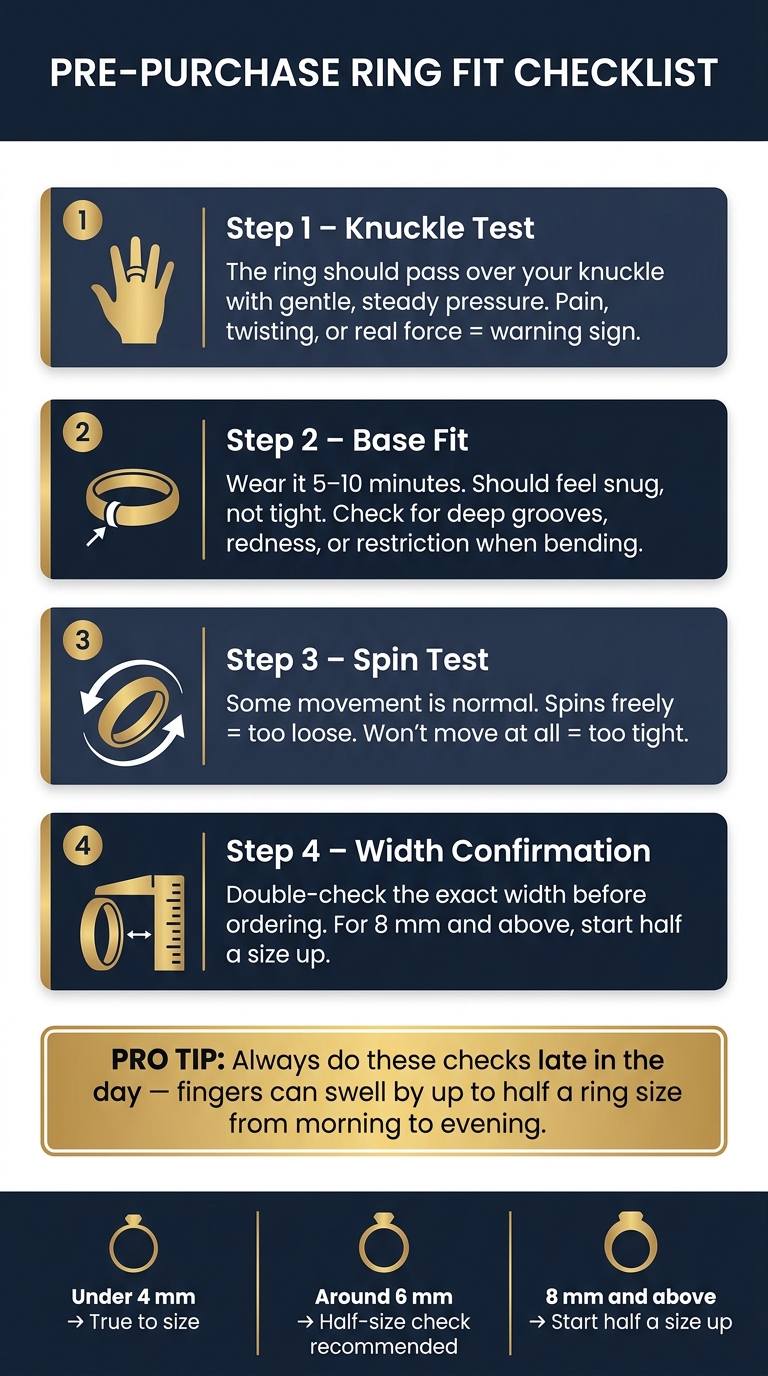
Men's Ring Width Fit Guide: Size Up the Right Way
Once you’ve picked the width and size, do one last fit check before you buy.
A Short Pre-Purchase Fit Checklist
Do these checks late in the day, when your fingers are usually at their largest. Finger size can shift by about half a ring size from morning to evening, so a test done first thing in the morning can give you the wrong read.
This matters even more with wider bands, where small sizing mistakes tend to feel much bigger.
Go through these four checks in order:
- Knuckle test - The ring should pass over your knuckle with gentle, steady pressure. If taking it off takes pain, twisting, or real force, that’s a warning sign.
- Base fit - Wear it for 5–10 minutes. It should feel snug, not tight. Check for deep grooves, redness that lingers, or any sense of restriction when you bend and straighten your finger.
- Spin test - Try turning the ring a bit. Some movement is normal. If it spins around with no resistance, it’s too loose. If it won’t move, it’s too tight.
- Width confirmation - Double-check the exact width you’re ordering before you buy.
If one of these checks throws up a problem - painful removal, nonstop spinning, or pressure marks - fix the size before you order. With wider bands, that often means going up about a half size.
FAQs
Should I size up for an 8 mm ring?
Usually, yes. Wider bands tend to feel tighter than thinner rings in the same size.
Here’s why: an 8 mm ring covers more skin and puts more pressure on your finger. So even if the listed size is the same, the fit can feel snugger.
If you're buying a fixed-size ring, it often makes sense to go up a size for comfort. If you choose a Satinski adjustable ring, you can tighten or loosen it as needed for a secure, comfortable fit.
Does comfort fit change how a wide ring feels?
Yes. Width has a big effect on how a ring feels, and wider bands often feel tighter than narrower ones in the same ring size.
Why? A wider ring covers more of your finger. That extra contact can make it feel snugger and a bit more restrictive, even when the listed size is the same.
If you're picking a wider band, it often makes sense to consider going slightly larger for day-to-day comfort.
What if my knuckle is much larger than my finger base?
If your knuckle is larger than the base of your finger, a fixed-size ring can be tough to wear. It often needs to be big enough to get over the knuckle, but that can leave it loose or spinning once it sits at the base.
An adjustable or resizable band can make things easier. It can open a bit more to move over the knuckle, then sit more snugly at the base for better comfort and a more secure fit.


