

Wedding Band and Engagement Ring Don't Sit Flush - How to Fix It
If your rings don’t sit flush, the fix usually comes down to shape, band style, or fit. In most cases, I’d start with the least permanent option first: try a curved or contoured band for shape issues, a thin spacer for rubbing, or a fit adjustment if the rings spin. Since fingers can change by about 0.25 to 0.5 ring sizes during the day, even a small shift can create a visible gap.
Here’s the short version:
- If the engagement ring setting sticks out: I’d look at a curved, contoured, notched, or shadow band.
- If the rings rub or leave a small even gap: I’d use a slim spacer band.
- If the rings spin or drift apart: I’d check ring size, shank shape, or a guard.
- If nothing else works: I’d ask a jeweler about resetting the setting, resizing, reshaping, or soldering.
- If the band is wide or tall: I’d test a slimmer band first, since 3–4 mm bands often hit settings sooner.
My rule: find the cause first, then use the smallest fix that solves it. That gives you a set that looks better, wears better, and puts less stress on prongs and band edges over time.
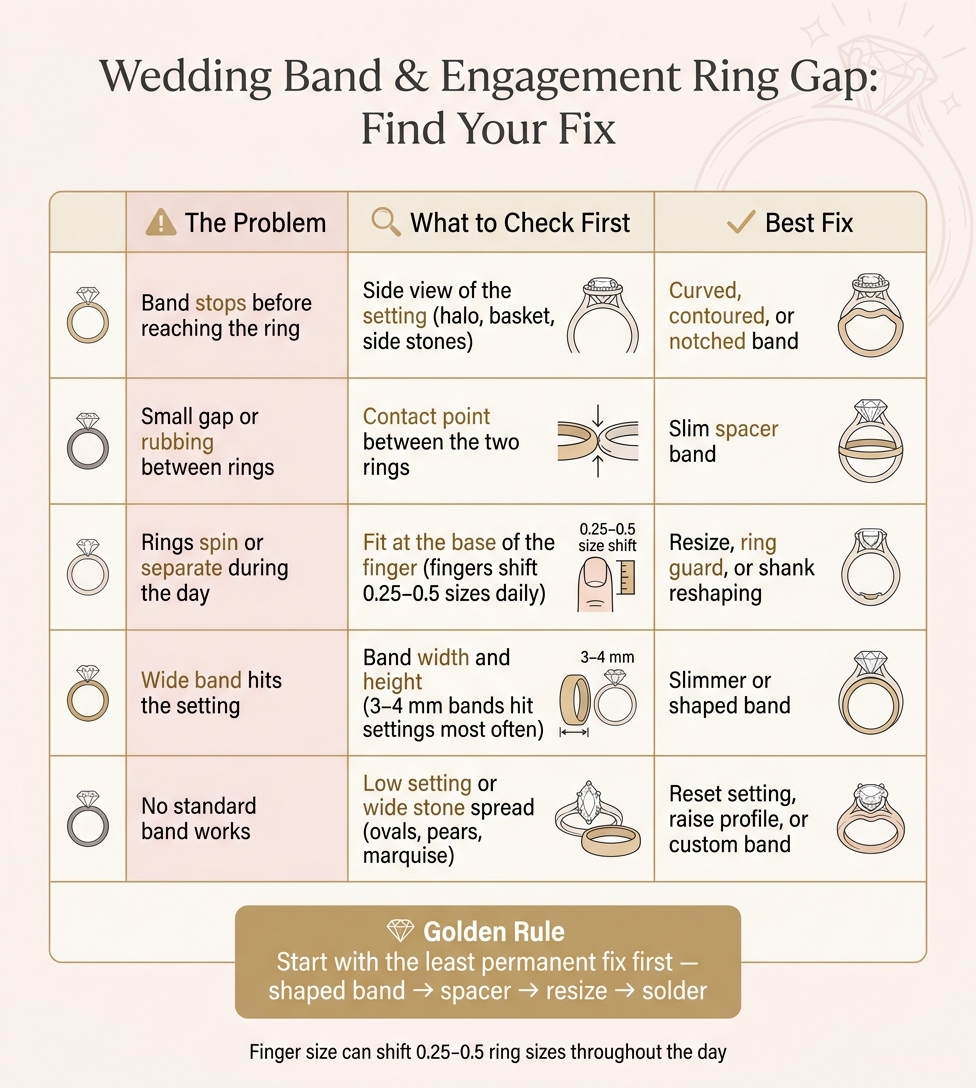
Wedding Band Gap Fix: Problem vs. Solution Cheat Sheet
My solution for two rings that don’t fit together
sbb-itb-9da40c1
Quick comparison
| Problem | What I’d check first | Common fix |
|---|---|---|
| Band stops before it reaches the ring | Side view of the setting | Contoured or notched band |
| Small gap but no major blocking | Contact point between rings | Slim spacer band |
| Rings spin or separate during the day | Fit at the base of the finger | Resize, guard, or shank work |
| Wide band hits the setting | Band width and height | Slimmer or shaped band |
| Straight band won’t work at all | Low setting or stone spread | Reset, higher setting, or custom band |
If I wanted a simple plan, I’d inspect the setting from the side, test a thinner band, and watch how the rings move through the day before making any permanent change.
Step 1: Find out why the rings do not sit together
Start by figuring out what's causing the gap. In most cases, it comes down to one of three things: the setting, the band, or the fit. Once you know which one is at fault, it's much easier to pick the right fix, whether that's a shaped band, a spacer, a custom band, or a ring adjustment.
Look at the engagement ring setting from the side
Hold your engagement ring at eye level and check it from the side. You're looking for any part of the setting that sticks out past the shank. If something extends outward, a straight wedding band may not be able to sit flush against it.
Common blockers include a low-set basket, halo, hidden halo, side stones, three-stone design, or cathedral shoulder. Stone shape matters too. Large or elongated center stones - ovals, pears, marquise cuts - often spread farther across the finger than round stones. And if the center stone sits low, or the prongs around the tips sit close to the band line, a straight band will stop short almost every time.
Here's an easy test: slowly slide a thin stacking ring up your finger toward the engagement ring. If it stops against metal or stones instead of sitting neatly beside the shank, the engagement ring profile is likely the main problem.
Check the wedding band shape, width, and height
If the setting doesn't seem to be the issue, look at the wedding band.
A straight, flat band runs directly into any part that sticks out. A shaped band curves around those areas instead. Width also plays a big role. A band that's 3–4 mm wide covers more area, so it's more likely to hit prongs, halo edges, or shoulders before it can slide into place. Height matters as well. A taller or thicker band sits farther off the finger, which can push the engagement ring upward and leave a visible gap even if the size is right.
A simple side-by-side check can help here. Try a slim ring in the same spot as your wedding band. If the slim ring sits closer, then the width or height of the band is what's making the gap.
Watch for movement, spinning, and finger size changes
Sometimes the problem isn't the design at all. It's the fit.
If the rings spin, slide, or shift during the day, that movement can pull them apart. This often happens when a ring is sized to get over a larger knuckle but ends up a bit loose at the base of the finger. Then the rings drift, tilt, or separate without much effort. A heavy setting makes it worse because the weight pulls the ring toward the palm.
Finger size changes matter more than most people expect. Your fingers can shift by 0.25–0.5 sizes with temperature and season. That may sound small, but it's enough to turn a snug set into one that gaps and wobbles by the middle of the day.
Before you visit a jeweler or order a custom band, take a few clear photos:
- one straight down from the top
- one from the side showing the full profile
- one close-up of the exact spot where the band stops against the engagement ring
Those photos make it much easier to spot the cause fast and match it to the right fix.
Once you know what's causing the gap, you can go with the fix that changes the least.
Step 2: Fix the gap by changing the wedding band
Start with the band. In many cases, that alone fixes the gap and lets you leave the engagement ring as-is. Use the side profile, width, and movement clues from Step 1 to pick the right fix. The goal is simple: match the band style to the blockage you found in Step 1.
Use a curved, contoured, notched, or shadow band
A curved or contoured band has a shaped profile that wraps around the engagement ring's basket, halo, or side stones instead of running straight into them. It's made for a specific profile, so check the fit before you buy - especially if you might reset the engagement ring later.
A notched band stays mostly straight but has a small cut-out to clear a halo that sticks out or another raised detail.
A shadow band follows the outline of the engagement ring and leaves a controlled gap between the two rings. That space helps protect delicate pavé, milgrain, or fine prongs from grinding against each other. Shadow bands work well for high-detail or vintage-style settings. Contoured bands tend to fit modern solitaires and halos better.
Try ring guards, enhancers, or a slim spacer band
If the issue is movement, not shape, a guard can help steady the set. A ring guard sits on both sides of the engagement ring's shank to keep it centered and cut down on rotation. This is especially helpful when a top-heavy setting pulls the ring toward the palm.
Ring enhancers wrap around the engagement ring and add stones or metalwork to build a larger set. The downside is more metal and more crevices, which means you'll need to clean the set more often.
A slim spacer band is the easiest fix. It's a thin, plain band worn between the two rings to stop rubbing, protect pavé and milgrain, and turn a small gap into a neat, even space. Spacers are also easy to swap if your finger size changes.
Consider adjustable or custom-fit bands from Satinski
Satinski's adjustable bands let you fine-tune the fit without soldering or resizing the original ring. An internal adjustment changes the band size without changing the outside look. These bands are available in sterling silver and 18K gold.
If the band still leaves a gap, the next step is to change the engagement ring or adjust the overall fit.
Choose contoured bands for a near-flush look, shadow bands for delicate settings, guards for spinning rings, and slim spacer bands when you want protection with very little visual change.
Step 3: Fix the gap by changing the engagement ring or overall fit
If a curved band, spacer, or guard still leaves a gap, the next step is to adjust the engagement ring itself. At that point, the problem usually comes from the setting, the shank, or the ring size. These fixes take more work, but they deal with the cause instead of just hiding the space.
Lift or reset the setting to create clearance
When the setting sits very low, a straight band can run into it head-on. In that case, lifting the setting is often the cleanest fix. A jeweler can raise the setting or reset the stone in a higher-profile mount so a straight band can sit closer.
That said, there are trade-offs. A higher setting can snag more often and change how the ring looks on your hand. And some low settings simply can't be raised safely without weakening the ring. When that happens, a contoured band or a full reset may be the only option that makes sense.
Resize, reshape the shank, or solder the rings together
If the gap is caused by movement rather than shape, fit fixes usually work better than switching bands.
A precise resize can cut down on spinning and help the rings line up better. The aim is simple: snug enough to stay in place, but not so tight that it won't pass the knuckle. Many plain gold or platinum rings can be resized by about 1–2 U.S. sizes without much risk. Go much past that, and the shank may weaken or start to look uneven.
If the lower part of the ring is bent or worn, reshaping or re-shanking can help straighten it so both rings sit more evenly next to each other.
Soldering is another option. It joins the two rings together and helps stop shifting. But this fix comes with some downsides. Resizing a soldered set is harder, cleaning between the bands gets trickier, and you give up the option to wear the rings separately or add another band later.
If the ring still moves after those repairs, a jeweler should check whether the setting or shank needs more structural work.
Know when to take the rings to a professional jeweler
Structural ring work is not a DIY job. Thin bands - usually under about 1.7 mm - plus pavé, micro-pavé, halo settings, and rings with loose stones or worn prongs carry more risk during resizing, reshaping, or soldering. A professional jeweler has controlled heat, specialty tools, and magnification to protect both the metal and the stones. That's why this kind of repair belongs in a shop, not at the kitchen table.
A simple way to think about it:
- Choose lifting or resetting if the gap comes from the ring's shape.
- Choose resizing or reshaping if the gap comes from fit.
- Choose soldering if you want the rings to stay together full-time.
Book a professional evaluation if the rings still spin, rub, or show worn prongs or loose stones.
Conclusion: Choose the fix that works for your ring, hand, and daily routine
Start with the cause. If the setting is blocked, you're dealing with a shape issue. If the ring spins or tilts, it's a fit issue.
If a shaped band fixes the blockage, that's usually the best place to stop. A curved, contoured, or shadow band is often the cleanest first move. And if the problem is rubbing or a small gap, a slim spacer band can do the job without changing the whole look.
If your finger size shifts during the day, or your ring has an unusual profile, an adjustable or custom-fit band from Satinski may make more sense.
When the gap comes from movement or size swings, fit-based fixes are the next step. If fit is the problem, resizing or reshaping the shank can help the rings line up better. Soldering is the most permanent choice.
The aim is simple: a ring set that looks intentional, stays secure, feels good on your hand, and stands up to daily wear.
FAQs
Can rings that do not sit flush damage each other?
Yes. Rings that don’t sit flush can wear each other down through constant friction and rubbing.
If the rings have different hardness levels, the harder metal can scratch or wear away the softer one. That contact can also affect settings, prongs, or stone mountings. Over time, stones may loosen, small details can get damaged, and the ring’s structure can start to wear.
Should I choose a contoured band or a spacer band?
It comes down to what matters more to you.
A contoured band is made to curve around your engagement ring, so both rings sit closer together and look more neatly paired.
A spacer band is a thin ring worn between the two. Its main job is to cut down on rubbing and metal wear, which can help if your setting is large or sits low. It can also make the stack feel better on your finger. That said, it won't always get rid of the gap.
When should I see a jeweler instead of trying a simple fix?
See a professional jeweler if you need a major size adjustment, especially if the issue goes beyond normal day-to-day finger swelling or shrinkage. A jeweler should also look at heirloom rings or rings with complex settings, since a DIY fix can cause permanent damage.
Get medical or professional help if your ring feels VERY tight or very loose and you notice sharp pain, numbness, tingling, or discoloration.


