

Wearing Your Wedding Ring Again After Cancer Treatment
You can wear your wedding ring again after cancer treatment only if it fits safely. If your finger is swollen, numb, painful, red, or the ring is hard to remove, I’d stop and ask a doctor before trying.
Here’s the short version:
- Do not force the ring on
- Check skin, swelling, and circulation first
- Start with short wear times: 15 to 30 minutes
- Take it off right away if you see pain, tingling, color change, deep marks, or worse swelling
- Wait on resizing until your finger size has stayed the same for several months
- Use a temporary option if your size still changes day to day
Cancer treatment can change ring fit in a few common ways. Swelling after lymph node surgery or radiation can make a ring too tight. Chemo and radiation can leave skin dry, cracked, sore, or easy to irritate. Numbness from peripheral neuropathy can also make it harder to notice pressure early.
A safe plan is simple: check the finger, test the fit at home, wear it for short periods, and watch it closely. If your ring still does not fit well, I’d look at a ring guard, an adjustable band, or safe storage until things settle.
| Option | Best time to use it | Main point |
|---|---|---|
| Wear original ring | Finger feels normal and ring slips on/off easily | Start with short test periods |
| Temporary ring or adjustable band | Finger size still changes | Lets you wear a ring without changing the original |
| Professional resizing | Size has stayed the same for months | Better long-term fit if your care team has no concern |
| Store the ring for now | Swelling, skin damage, or numbness is still a problem | Safer than forcing wear |
For many people, this is not just about jewelry. It can feel like a small step back into daily life. But comfort and safety come first.
Check comfort and safety before putting your ring back on
These checks help you protect what the ring means without putting your recovery at risk. Never push a ring onto a finger that’s swollen, painful, numb, or irritated. A band that’s too tight can limit circulation and lymph flow after treatment. The aim is simple: wear the ring safely, not too soon.
If it still feels tight after these checks, look at fit-adjustment options instead of forcing it on.
This is general information, not personal medical advice.
Signs your ring is too tight or unsafe to wear right now
Take the ring off right away if you notice pain, tingling, numbness, redness, warmth, or color change. A deep mark that stays after removal, swelling above or below the band, or a ring that won’t rotate easily are also clear signs to stop. And don’t wear the ring over broken or irritated skin.
If the ring is stuck and your finger is turning discolored, cold, or more swollen, get medical help promptly instead of trying to yank it off yourself. Forceful removal can badly injure swollen or fragile skin.
If treatment has caused peripheral neuropathy, don’t rely only on how the finger feels. Check it visually. Peripheral neuropathy can dull pressure, heat, and pain signals in your hands. Look at the finger at regular times for indentation, color changes, or swelling, and ask your care team if ring wear makes sense until sensation improves.
If swelling is new, doesn’t go away, gets worse, or feels heavy and tight, especially after surgery or radiation that involved lymph nodes, contact your oncology team before changing the ring fit. They can decide whether you need a lymphedema evaluation first.
Basic precautions for sensitive skin and swelling
Wash the finger gently and dry it all the way before putting the ring on. Pay close attention to the skin under and around the band. Moisture trapped under jewelry can lead to irritation and skin damage, and even small cracks or blisters can become entry points for infection, especially in an area affected by lymphedema.
Take your ring off before sleep, bathing, swimming, exercise, and hot weather exposure. Then keep it in one safe place so you’re not hunting for it later.
Sometimes a ring feels fine in the morning and turns tight later in the day. If that happens, remove it as soon as you notice the change. Make a note of what came before it, like heat, activity, or a treatment-related symptom, and tell your oncology team if it keeps happening.
| Situation | Recommended approach |
|---|---|
| Comfortable fit | Try brief wear and monitor closely; it should rotate and slip off easily. |
| Mild or fluctuating swelling | Avoid a snug traditional ring; ask your care team about temporary options |
| Ongoing swelling | Pause wear and contact your oncology team or lymphedema specialist |
| Broken or irritated skin | Leave the finger bare; seek medical guidance |
| Ring stuck or difficult to remove | Seek professional medical help promptly; do not force removal |
If your fit keeps changing, the next step is choosing a resize, an adjustable setting, or a temporary option.
sbb-itb-9da40c1
Pick the right ring solution for where you are in recovery
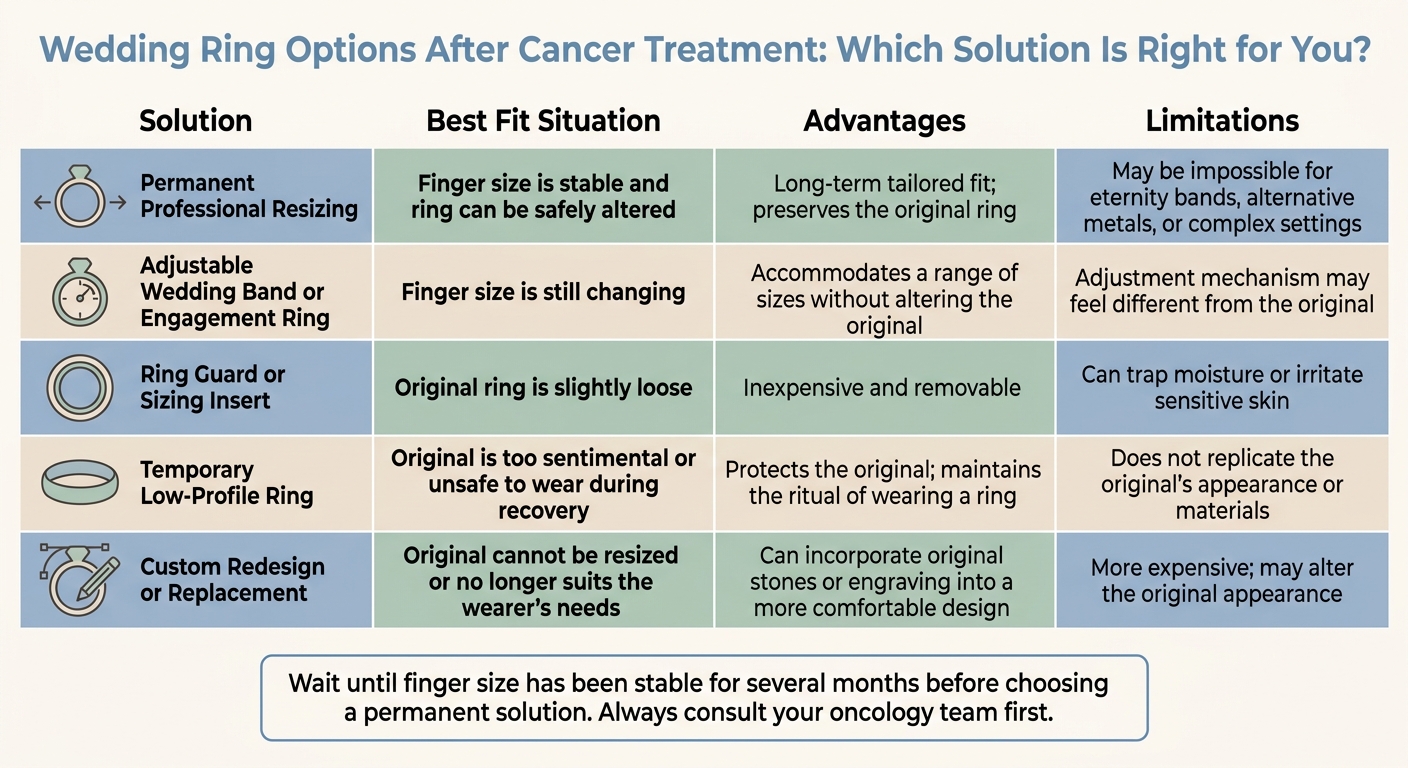
Wedding Ring Options After Cancer Treatment: Which Solution Is Right for You?
The best choice usually comes down to three things: whether your finger size has settled, how much it matters to leave the original ring untouched, and how your skin is reacting to swelling or sensitivity.
If your size is still shifting, start with a temporary fix. That keeps you from making a permanent change too soon and helps you choose something that fits where recovery stands right now.
When permanent resizing is the right call
Permanent resizing makes the most sense when your finger has stayed the same size through normal day-to-day conditions and your oncology or lymphedema-care team doesn’t think the swelling needs more review.
Before any work starts, a jeweler should inspect the ring itself. The metal, setting, engraving, and stones all matter, because some rings just can’t be resized safely. Eternity bands and alternative metals such as tungsten or titanium may not be resizable.
Ask for:
- a written estimate
- a plain-English explanation of what the alteration involves
That way, you know exactly what you’re approving before anything changes.
If your size still isn’t steady, a temporary or adjustable option usually makes more sense than a permanent alteration.
When an adjustable ring or temporary option works better
An adjustable ring can be a good middle ground. You still get to wear a ring that matters to you, but you don’t have to alter the original while your size is changing.
A ring guard or sizing insert works well when the original ring is only a little loose. It’s low-cost and reversible. The tradeoff is comfort: it can trap moisture against sensitive skin. Because of that, take it off on a regular basis so you can clean it and check the skin underneath.
A temporary low-profile band is also worth a look when the original ring feels too sentimental to risk, or when its structure is too complex to wear during active recovery. It lets you keep the habit and meaning of wearing a ring while the original stays stored safely.
Use the table below to match the fix to the problem.
| Solution | Best fit situation | Advantages | Limitations |
|---|---|---|---|
| Permanent professional resizing | Finger size is stable and the ring can be safely altered | Long-term tailored fit; preserves the original ring | May be impossible for eternity bands, alternative metals, or complex settings |
| Adjustable wedding band or engagement ring | Finger size is still changing | Accommodates a range of sizes without altering the original | Adjustment mechanism may feel different from the original |
| Ring guard or sizing insert | Original ring is slightly loose | Inexpensive and removable | Can trap moisture or irritate sensitive skin |
| Temporary low-profile ring | Original is too sentimental or unsafe to wear during recovery | Protects the original; maintains the ritual of wearing a ring | Does not replicate the original's appearance or materials |
| Custom redesign or replacement | Original cannot be resized or no longer suits the wearer's needs | Can incorporate original stones or engraving into a more comfortable design | More expensive; may alter the original appearance |
Next, the focus shifts to comfort features, skin protection, and ways to keep your original ring safe while your size changes.
Balance comfort, skin tolerance, and the meaning of your ring
If a permanent resize isn't the right move yet, focus on ring details that make everyday wear easier on your finger.
Ring features that make daily wear easier during recovery
If your finger is still swollen or tender, pay close attention to design details that reduce pressure and rubbing. Swelling can change over the course of the day, so even a ring that feels fine in the morning may not feel fine later.
Start with the inside of the ring. A smooth interior and rounded comfort-fit edges can cut down on friction when skin feels sore. Rough seams or uneven finishing can irritate a tender finger fast, so it's best to avoid them.
The setting matters too. A low-profile setting is often easier to live with because it doesn't catch as easily. Tall prong settings can snag on clothing, gloves, or medical equipment. A bezel setting sits closer to the finger, which makes snagging less likely. If your ring has prongs, ask a jeweler to check that they're smooth and secure before you start wearing it again.
Weight also plays a part. Go with the lightest ring that still feels steady on your hand. If the ring has an adjustment feature, make sure that part is rounded and enclosed, with no exposed ends or open gaps that could pinch the skin.
Nickel-free metals are usually easier on sensitive skin.
Take the ring off right away if you notice itching, burning, redness, swelling, or blisters. If those symptoms don't settle after removal, or if you also have pain, numbness, or color change, contact your oncology team or a dermatologist.
How to protect your original ring while your finger size changes
If the ring still means a lot to you but your finger size keeps shifting, protect the original until the fit settles down.
Store it in a safe place while your size is still changing. That gives the ring a better chance of staying in good shape until wearing it again feels realistic. Keep it in a fabric-lined box or pouch, away from moisture and anything that might scratch it. It also helps to photograph the ring, record the size, and keep appraisal or insurance papers with it.
Before you put it back into regular wear, have a jeweler clean and inspect it. Ask them to check for loose stones, worn prongs, thinning metal, and rough interior edges that could irritate your skin.
If wearing a ring each day still matters to you, an adjustable replacement can work as a middle step. A hidden adjustment mechanism gives you extra room while keeping a classic look. Solid 14K or 18K gold usually handles repeated adjustment better than plated metal.
And if a plain temporary band feels too generic, a custom design can carry the meaning forward without forcing the old fit. You might reuse an engraving, stone, or silhouette in a design built more for comfort.
Conclusion: Build a gradual plan for wearing your ring again
After you’ve picked the safest fit, ease back into wearing your ring bit by bit. This isn’t something to rush. It’s a gradual process, not a deadline.
Never force the ring onto a finger that’s swollen, painful, numb, or irritated. If your finger size is still changing, use a temporary option for now. For a permanent resize, wait until your finger size has stayed the same for several months and your care team has no concerns about ongoing swelling or lymphedema. Until then, store the original ring somewhere safe.
Start with short wear periods and check often
Once the fit seems steady, test it in short, controlled periods at home. Put the ring on for 15 to 30 minutes at a time, ideally when swelling is usually at its lowest. Check your finger as soon as you put it on, again after 10 to 15 minutes, and once more when you take it off.
Watch for signs that the fit isn’t right, including:
- Pressure marks
- Redness
- Pain
- Tingling
- Numbness
- Color changes
- Worse swelling
If everything looks and feels okay, try again on another day and slowly add more time. Check the fit at different times during the day, since fingers can change from morning to evening. Only add more wear time when the ring stays comfortable all day. Hold off on wearing it during sleep, exercise, or any task that involves heat, chemicals, or heavy gripping until the fit has stayed steady for several days.
FAQs
How long should I wait before resizing my wedding ring?
You don’t need to wait if you choose a resizable option, since you can change it at home as your finger size shifts.
Traditional professional resizing is permanent and can weaken the metal over time, so it’s usually a better fit once your finger size has settled. If your size is still changing, resizable options give you more room to adjust.
Can lymphedema make my ring unsafe to wear?
Yes. A tight ring on a swollen finger can be unsafe. It can hurt, cut off circulation, and even injure your finger if you leave it on too long.
If your ring feels painful or your finger starts to look discolored, don't wear it at that time. Temporary options like silicone bands or adjustable rings can give you a safer fit while your finger size changes.
What temporary ring is best during recovery?
The best temporary ring comes down to your budget and how often your fit changes.
Silicone rings are a flexible, low-cost pick for active lifestyles. They usually cost $10–$30 and tend to work well if you want something simple and easy to wear.
If your ring size only changes once in a while, ring guards or sizing beads can be a cheap fix, often costing under $20.
If you deal with swelling often and need something you can tweak day to day, adjustable rings are usually the most practical option for long-term wear.


