

Chemo Neuropathy and Rings: Why a Numb Finger Can't Feel Danger
If chemo has made your fingers numb, a ring can become unsafe before you feel a problem. I’d treat numbness as a warning to rely on visual checks, not comfort alone.
Here’s the short version:
- CIPN can dull pain and pressure, so a ring may get too tight without clear warning.
- Swelling can change ring fit within hours, especially with heat, exercise, travel, or repeated hand use.
- A deep ring mark, color change, broken skin, or a ring that won’t slide off means it’s time to remove it and check the finger.
- Loose-ring tools and fixed-size rings are not the same thing. A ring guard may help a loose ring, but it can make swelling problems worse.
- If the finger turns pale, blue, or white, or the ring is stuck, get medical help right away.
The main idea is simple: when feeling is less reliable, sight matters more. I’d check the skin before wearing a ring, while wearing it, and after taking it off. If the fit changes during the day, I’d stop wearing it.
Simple Strategies: Chemo-Induced Peripheral Neuropathy Tips
sbb-itb-9da40c1
Quick comparison
| Option | Best use | Main risk |
|---|---|---|
| Fixed-size ring | Stable finger size | Can get stuck if swelling starts |
| Adjustable ring | Finger size changes day to day | Costs more up front |
| Ring guard / sizer | Loose ring only | Can add pressure and trap moisture |
One more point: if a ring leaves a deep mark that stays, that’s not a small issue. It’s a sign the ring is too tight, even if the finger does not hurt.
The main dangers of wearing rings on numb fingers
Pressure, swelling, and skin damage
Swelling can cause a ring to press into the skin before you notice anything is wrong. If you have chemo neuropathy, that shift may happen silently because your fingers may not send clear warning signals. Watch for redness, blisters, or skin pushing up over the band.
Pain isn't always the first sign. With CIPN, pain can be dulled, so your skin may show the problem before you feel it. Even a small break in the skin can increase the risk of infection, especially if your immune system is weakened.
Circulation problems and a stuck ring
If a ring starts getting hard to remove, take it off or get help right away. Don't wait and hope it loosens later. A tight ring can cut into the finger and reduce blood flow.
If the ring won't come off, get medical help promptly. In some cases, a ring cutter may be needed.
Risks from heat, cold, and physical activity
Heat, cold, travel, and repeated hand use can make finger size change fast. When numbness makes sensation harder to trust, you might not notice those changes until the ring is already too tight.
That's what makes this tricky: the warning signs are easy to miss. Daily fit checks matter, especially on days when you've been active or the temperature shifts.
Safer daily ring habits during chemotherapy
Check the finger before and during wear
Before you put on a ring, take a close look at your finger and the skin around the band. Check for redness, swelling, cracked skin, or moisture. Then check again while the ring is on, and one more time after you take it off.
That quick habit can help you catch small problems before they turn into painful ones.
Use a simple fit test
One easy sign matters a lot: if the ring leaves a deep mark that sticks around, it’s too tight.
Watch for any of these signs:
- Ring leaves a deep, lasting indentation
- Finger looks larger
- Skin under the band is red, cracked, or moist
If you notice any of them, stop wearing the ring for the day. If the ring won’t come off, get help right away.
If your finger size changes often, fixed-size jewelry can be much harder to deal with.
Ask for help when sensation is unreliable
If you can’t trust what your finger is telling you, be extra careful. It may make more sense to choose jewelry that can change with your finger size.
That’s why flexible-fit options can be safer when swelling shifts from one day to the next.
Jewelry options that work better with changing finger size
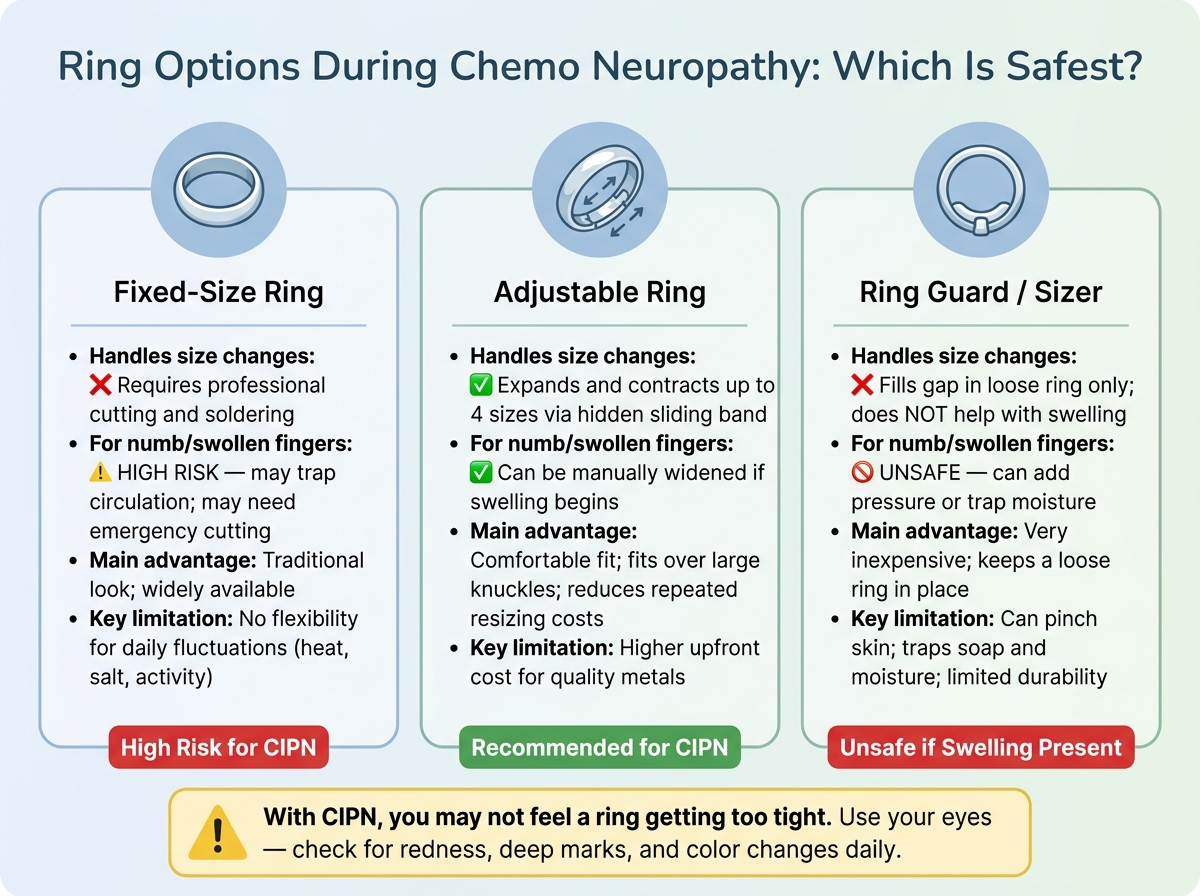
Fixed Ring vs. Adjustable Ring vs. Ring Guard: Safety Guide for Chemo Neuropathy
When swelling changes finger size, a fixed ring can go from fine to too tight in no time. That’s why flexible-fit jewelry is often the more practical move. If chemo neuropathy is part of the picture, it’s safer to use jewelry that can shift with the finger instead of counting on feel alone.
How adjustable rings can reduce fit problems
Adjustable rings are made to expand and contract as your finger size changes. In plain terms, they move with swelling instead of pressing harder when your hands puff up. That can help cut down on pressure during the day.
These designs are made in materials such as 925 sterling silver, 18K gold vermeil, and 14K or 18K solid gold.
When a ring guard helps and when it does not
If a ring is loose, not tight, a guard can help steady the fit. It fills the extra space and can stop the ring from spinning around your finger.
But there’s a catch. A ring guard does not solve swelling. It can add pressure or trap moisture, so it should come off if the fit gets tighter or the ring stops sliding off easily.
Fixed-size ring vs. adjustable ring vs. ring guard: a side-by-side comparison
Here’s the simplest way to compare the three options.
| Feature | Fixed-Size Ring | Adjustable Ring (Satinski) | Ring Guard / Sizer |
|---|---|---|---|
| Handles size changes | Requires professional cutting and soldering | Expands and contracts up to 4 sizes via a hidden sliding band | Fills the gap in a loose ring; does not help with swelling |
| For numb or swollen fingers | High risk of trapping circulation; may need emergency cutting | Can be manually widened if swelling begins | Unsafe: Can add pressure or trap moisture |
| Main advantage | Traditional look; widely available | Comfortable fit; fits over large knuckles; can reduce repeated resizing costs | Very inexpensive; helps keep a loose ring in place |
| Key limitation | No flexibility for daily fluctuations such as heat, salt, or activity | Higher upfront cost for quality metals | Can pinch skin; traps soap and moisture; limited durability |
When to remove a ring and get medical help
Remove, inspect, report
If your daily fit check shows any change, stop wearing the ring and deal with it right away. Take the ring off as soon as you can, then look closely at the skin under and around it.
Look for:
- Redness
- Deep marks
- Broken skin
- Any change in skin color
Use your eyes, not your fingers. That matters because CIPN can make it harder to notice pressure or pain.
If the skin looks irritated or broken after you remove the ring, contact your oncology team promptly.
Signs that need urgent attention
At this point, the ring has gone from annoying to unsafe. Seek urgent care if you notice any of the signs below:
| Warning Sign | Action |
|---|---|
| Skin turns pale, blue, or white | Blood flow is being blocked - get help immediately |
| Sudden, dramatic swelling overnight | Possible injury or rapid swelling - seek same-day care |
| Deep marks that linger after the ring comes off | Remove the ring and contact your care team |
| Ring cannot be removed by hand | Get medical help right away |
| Open skin or bleeding | Do not put the ring back on - contact your oncology team |
| New or worsening pain or throbbing | Seek same-day evaluation |
Conclusion: safer ring wear starts with visual checks and a flexible fit
CIPN can hide pressure, which is why a quick visual check each day matters so much. Watch for swelling, color change, and skin damage, and remove any ring that starts to feel tight or won’t slide off.
FAQs
Can I still wear my ring with chemo neuropathy?
Yes, but safety and comfort come first.
Chemo neuropathy can dull sensation in your fingers, so you might not notice when a ring is too tight. That can lead to swelling, reduced circulation, or skin damage.
If you want to wear rings, adjustable styles are usually the safer pick. It also helps to check your fingers often for pressure marks, redness, or irritation. If you notice any swelling, take the jewelry off right away.
How do I know if my ring is too tight?
A ring may be too tight if it leaves marks on your skin or starts to dig in. Another sign is when it becomes hard to take off.
If you have chemotherapy-related neuropathy, this can be easy to miss. You may not feel the usual pressure or discomfort, even when the ring is too snug. That’s why it helps to check your fingers often for swelling, marks, or tightness.
A ring that’s too restrictive can affect circulation. If it’s difficult to remove, get urgent help.
When should I get help for a stuck ring?
Get urgent medical attention immediately if your finger turns blue or white or has complete numbness.
If home removal doesn’t work, symptoms get worse, or you have pain, contact a jeweler or medical provider right away to help prevent injury. A jeweler can often remove a stuck ring safely for about $20.00 to $50.00.


