

How Long Does Ring Resizing Actually Take? Jeweler Timelines Explained
Most ring resizing jobs take anywhere from same day to about 2 weeks. If I’m dealing with a plain band, I’d expect a much shorter wait. If the ring has pavé stones, an eternity design, platinum, or has to be shipped out, I’d plan on 1–3+ weeks.
Here’s the short version:
- Plain gold or silver bands: often same day to 3 business days
- Solitaires or rings with side stones: often 3–7 business days
- Pavé, halo, and multi-stone rings: often 1–2 weeks
- Eternity bands and tension-set rings: often 2–4 weeks if a jeweler will do them at all
- Chain store or off-site repair: often 2–3 weeks or more
What changes the timeline?
- Ring style
- Metal type like gold vs. platinum
- How many sizes the ring needs to go up or down
- Stone settings and prong work
- Ring condition like thin shanks or old damage
- Whether the store does the work in-house or ships it out
A few facts stand out:
- A plain band may need only 30–60 minutes of bench work
- White gold often needs rhodium plating, which adds time
- Full eternity bands, tension settings, tungsten, and titanium are often hard to resize or not resizable
- Holiday periods, Valentine’s Day, and wedding season can add days or even weeks
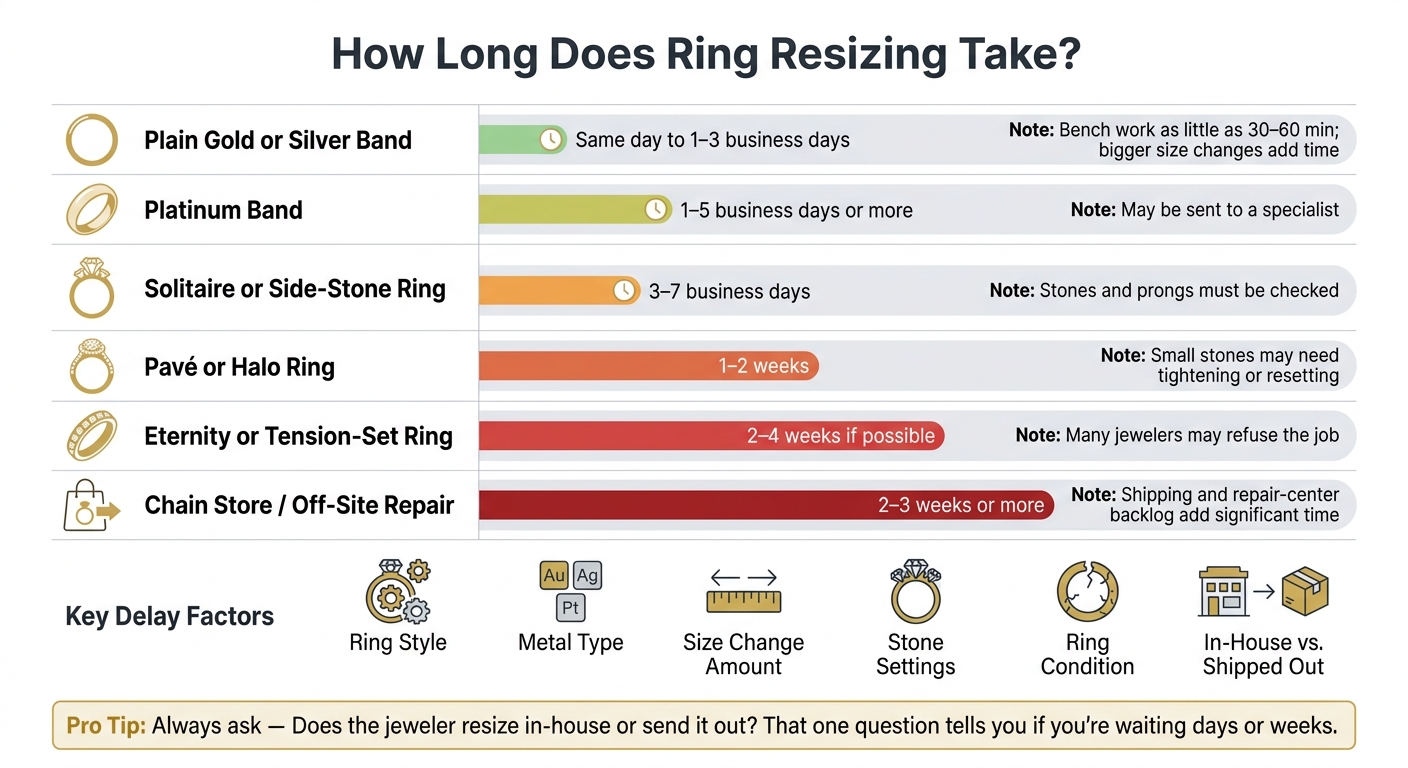
Ring Resizing Timeline by Ring Type
What happens to your ring when you have it resized #jewelry #jewelrytutorial #howitsmade #how
sbb-itb-9da40c1
Quick comparison
| Ring type | Usual turnaround | What to watch for |
|---|---|---|
| Plain gold or silver band | Same day to 1–3 business days | Bigger size changes can add time |
| Platinum band | 1–5 business days or more | May be sent to a specialist |
| Solitaire or side-stone ring | 3–7 business days | Stones and prongs must be checked |
| Pavé or halo ring | 1–2 weeks | Small stones may need tightening or reset work |
| Eternity or tension-set ring | 2–4 weeks if possible | Many jewelers may refuse the job |
| Chain store repair | 2–3 weeks or more | Shipping and repair-center backlog |
If I needed a ring back by a certain date, I’d ask one thing first: “Do you resize it here, or do you send it out?” That one question usually tells me whether I’m looking at days or weeks.
How long resizing takes by ring type
Here’s how those timelines usually break down by ring style.
Plain gold, sterling silver, and simple wedding bands
Plain bands are usually the fastest to resize. A simple yellow gold, white gold, rose gold, platinum, or sterling silver band with no stones can often be done the same day. In some cases, it takes as little as 30 to 60 minutes of bench work when the jeweler handles it on-site.
Smaller changes tend to move fastest. If the ring only needs to go up or down by a quarter size to one full size, the job is often pretty straightforward. Bigger changes usually add 1–3 business days because the jeweler has to add or remove more metal.
Platinum often takes longer. It’s denser and harder to work with, so even a plain platinum band may need a jeweler who has the right tools and experience.
Engagement rings, pavé bands, and rings with side stones
Once stones are involved, the timeline usually gets longer. The jeweler has to check the prongs and make sure the stones are secure both before and after the resize. A standard solitaire often takes 2–5 business days, even if the hands-on bench work only takes a few hours.
Pavé bands are a different story. These rings often need stones removed near the cut, prongs rebuilt, and stones reset after the size change. That can push the turnaround to 5–10 business days or more. If the ring has to be sent to a specialist, or if any stones need tightening or replacement, the wait can stretch to 1–2 weeks.
Eternity bands, tension styles, and rings that are hard to resize
Some rings are much harder to resize, and some can’t be resized in the usual way at all.
Full eternity bands and tension-set rings are often difficult or impossible to resize. Full eternity bands have stones all the way around the shank, so there’s no plain section of metal to cut and join safely. Changing the size can throw off the stone spacing and weaken the setting. Tension-set rings work by holding the stone in place with carefully measured pressure from both sides of the band. Change the size, and you change that pressure too, which can make the setting unsafe.
When jewelers do take on these styles, the work usually goes to a specialist or back to the original designer. Timelines are often in the 2–4 week range because the ring may need exact measuring, partial remaking, and testing after the work is done. Most jewelers simply avoid resizing these styles.
Tungsten carbide and titanium usually can’t be resized with standard methods, so replacement is often the only path.
These timelines make more sense once you look at what happens behind the bench. That’s why the next step matters: how jewelers actually resize a ring.
Next, the resizing process itself explains why two rings with the same size change can take very different amounts of time.
What jewelers do during a ring resize
Ring resizing is a bench job with a few moving parts, and each one adds time. The schedule depends on what happens at the workbench from start to finish.
Inspection, sizing, and deciding if the ring can be resized
Before the jeweler touches a saw or torch, they check the basics. They measure your finger, see how the ring fits, and look over the band for thinning, cracks, wear, or signs of older repair work. Stones and prongs are also checked under magnification to spot anything loose or damaged. For a simple ring, this usually takes 5–15 minutes. If the ring has several stones, a detailed setting, or older repair work, it can take longer.
This first check can also decide whether a resize is even possible. That matters because it can change the timeline before the main work starts. If the shank is too thin or worn, the ring may need reinforcement or a full shank replacement instead of a standard resize. If everything looks good, the jeweler moves on to cutting and soldering. If not, the job shifts into repair work first.
Cutting the band, soldering, and reshaping
Once the jeweler knows the plan, the bench work starts. Sizing down means removing a small section of metal. Sizing up means adding metal, then soldering the band back together.
For a plain 14K yellow gold band, this cutting-and-soldering stage can take about 30–60 minutes of hands-on bench time. More detailed rings often take longer. A ring with side stones or patterned metalwork needs extra care, since the jeweler has to shield nearby stones from heat and keep the design looking right around the cut.
After soldering, the ring is shaped back into a clean circle so it sits well and feels comfortable on the finger.
Polishing, cleaning, and final checks
Once the size and shape are set, the jeweler files and smooths the solder seam. Then they polish the full ring so the resized spot blends in with the rest of the band. If the ring is white gold, it will usually need rhodium plating too. That adds 15–30 minutes and makes same-day pickup less likely.
From there, the jeweler cleans the ring, checks the seam, tests stone security, and smooths out any rough edges before handing it back. The last inspection also confirms the final size on a sizing form.
Those are the core steps. After that, most extra delays come down to the metal, the stone setting, and whether the work is done in-house.
What can delay a ring resize
Two rings can be resized by the same amount and still have very different timelines. The reason is pretty simple: the bench work is only one part of the job.
Metal type, size change amount, and ring condition
Gold and sterling silver are usually the fastest to work with. Platinum often takes longer because it needs more specialized labor. A lot of local jewelers send platinum rings to a specialist instead of handling them in-house, which can add shipping time and put your ring into a longer queue.
The size change itself also makes a big difference. Going up or down by half a size is usually a small adjustment. Going up or down by two full sizes or more is a bigger repair. The jeweler may need to cut out or add a larger piece of metal, reshape the band, and in many cases strengthen the setting too.
The ring’s condition matters just as much. If the band is worn down, has a thin shank, visible cracks, or signs of an older resize, the jeweler may need to rebuild or strengthen part of the ring before resizing it safely. That extra repair work can add days.
Stone settings can slow things down too.
Stone settings, design details, and jeweler workload
Some rings are just more finicky. Pavé, channel-set, and halo designs usually take longer because resizing changes the tension and angle of the settings. When the metal is opened or compressed, small pavé stones can loosen. So after the resize, the jeweler has to check and tighten each one.
Decorative details can add more bench time as well. Engraved or milgrain bands don’t just need the size fixed. The pattern has to be restored across the resized seam, and that may mean bringing in a specialty engraver.
Then there’s workload. This catches a lot of people off guard. U.S. jewelers tend to get slammed during the winter holidays, Valentine’s Day, and summer wedding season. If the bench is backed up, even a simple resize can take much longer than usual. Calling ahead to ask about the current turnaround for a ring like yours can save a lot of hassle.
If the ring leaves the store, timing can stretch even more.
In-house work vs. sending the ring to a specialist
Logistics can matter just as much as the repair itself. Many mall and chain jewelers batch repairs and ship them to a regional facility once or twice a week. So if you drop off your ring right after the weekly pickup, it may sit in the store for several days before it even goes out.
After that, the clock keeps running. There’s shipping both ways, intake and paperwork at the repair center, plus the bench queue. All of that can stack up fast, even if the resize itself only takes an hour or two.
For platinum or more detailed designs, specialist timelines can stretch quite a bit once you factor in transit, check-in, and backlog. Before you hand over the ring, ask one direct question: Does it stay in-house, or does it ship out?
If timing is tight, the next question is whether standard resizing is the best fix.
Choosing the right sizing solution and next steps
If you're on a short timeline, step back for a second and make sure resizing is even the right move.
When standard resizing is the right choice
Standard resizing makes sense when your finger size is stable and the ring can handle a permanent change. It works best when the fit issue happens all the time, not just on hot days, after exercise, or when your fingers swell.
For a ring you wear every day, a proper permanent resize means you don't have to keep adjusting anything or swap out parts later.
When temporary fixes or adjustable rings make more sense
If your finger size is still changing, a temporary fix can save you from paying for a resize that may stop working soon. Pregnancy, recent weight changes, arthritis, and medical treatments that cause swelling can all change your size. A plastic ring adjuster, ring guard, or sizing beads can usually fix about half a size and often work right away. They don't cost much and they're fast, but they can feel bulky and usually aren't a great fit for long-term daily wear.
For swollen knuckles, or when your knuckle is much larger than the base of your finger, adjustable rings deal with a different issue. They can fit fingers that change shape or are hard to size without doing repeat resizes.
Here’s a quick side-by-side look:
| Solution | Timeline | Best Use Case | Limitations |
|---|---|---|---|
| Standard Resizing | Same day to about 2 weeks | Permanent fix for rings with a stable finger size | Not suitable for eternity bands, tension settings, or hard metals like tungsten or titanium; repeated resizing can weaken the ring |
| Temporary Sizing Aids | Immediate or same day | Fluctuating sizes, special events, or rings that shouldn't be resized yet | Less durable, can feel bulky, and may not be comfortable for long-term daily wear |
| Adjustable/Resizable Rings | Immediate if already owned; about 1 to 2 weeks for custom orders | Swollen knuckles, arthritis, or size changes that keep happening | Limited to certain designs and size ranges; higher upfront cost |
Conclusion: How to estimate your own resizing timeline
Once you know which option fits your ring, the timeline gets easier to judge. Start with the ring type, then call before drop-off to confirm whether the work is done in-house and whether your ring is a good candidate.
FAQs
How much can a ring be safely resized?
A ring can usually be resized up or down by about 1 to 2 sizes without putting too much strain on its structure.
Go past that range, and things get riskier. Cutting and soldering the band can leave behind a weak spot, which may make the ring more likely to bend, crack, or wear down over time.
If size changes happen often, Satinski’s adjustable ring mechanisms offer a different path. Instead of relying on repeated resizing, they change the fit without permanently cutting the ring’s structure.
Will resizing affect a ring’s value or warranty?
Resizing can affect a ring’s long-term structural value, especially if it happens more than once. In a standard resize, the jeweler cuts the band and either adds or removes metal. Over time, that process can leave weak spots and make the ring less sturdy.
That said, a properly done resize by an experienced jeweler usually doesn’t cause major immediate damage. But if you expect your ring size to change again and again, an adjustable design can be a smarter route. It may help you avoid repeat work that can wear on the ring’s durability and value.
Can I wear my ring right after it’s resized?
Yes. If the ring was resized the right way, you can usually wear it as soon as you pick it up.
That said, the new fit may feel a little different at first. Give it a few days, wear it regularly, and pay attention to how it feels. When you drop it off, ask the jeweler how long the job should take so you’re not caught off guard by any delays.


