

Can You Resize an Engagement Ring Before the Wedding? Timeline Guide
Yes - in most cases, you can resize an engagement ring before the wedding. If the ring is made from gold, platinum, or sterling silver, many jewelers can do a standard resize in 3–7 business days. But rings with pavé stones, engraving, or eternity designs often take 1–2 weeks or more, so I’d plan early.
Here’s the short version:
- Check the fit 8–12 weeks before the wedding
- Leave the ring with the jeweler 6–8 weeks out
- Pick it up 2–3 weeks before the ceremony
- Most rings can be changed by 1–2 U.S. sizes
- Gold and platinum are often resizable; tungsten and ceramic usually are not
- If the wedding is less than 2 weeks away, a temporary ring adjuster may be the safer move
A few things can slow the job down: stone-heavy settings, added metal when sizing up, hand-restored details, and rings that need outside shop work. Some styles, like full eternity bands and certain tension-set rings, may not be good candidates for resizing at all.
| Situation | What I’d expect |
|---|---|
| Plain gold solitaire | Often the easiest case |
| Ring down 1 size | Often faster than sizing up |
| Platinum pavé ring | More bench time |
| Full eternity band | May need a remake instead |
| Wedding very close | Temporary fix first |
Bottom line: if you want the least stress, start the process 2–3 months before the wedding and leave time for a follow-up fit check if needed.
Ep 18: When To Resize Your Ring
sbb-itb-9da40c1
Check Whether Your Ring Can Be Resized
Whether a ring can be resized comes down to three things: the metal, the design, and how much the size needs to change. A quick check now gives you a clearer sense of how much time you still have before the wedding. It also helps you figure out whether a standard pre-wedding resize window will work or if you need a faster backup plan.
Metals and Ring Styles That Can Usually Be Resized
Most rings made from 14K gold, 18K gold, platinum, and sterling silver can be resized. Tungsten carbide and ceramic usually can't. Titanium sits in the middle and may be limited.
When a ring can be resized, the jeweler usually cuts the band, adds or removes metal, then solders and polishes it. Plain bands and classic solitaires are usually the easiest jobs. They're simple, direct, and less likely to need extra repair work afterward.
Design Details That Can Slow Down or Limit Resizing
Even if the metal itself can be resized, the ring design can make the job harder. Full eternity bands are a common example. Because the stones go all the way around, there's no plain section of metal to cut into. In many cases, eternity bands need to be remade instead of resized.
Other styles can slow things down too:
- Pavé, micro-pavé, and channel-set rings often take more time because cutting and bending the band can affect tiny prongs or throw off stone alignment.
- Tension settings need extra care because changing the ring's circumference can affect how tightly the center stone is held.
- Inside engraving is usually manageable, but exterior details like milgrain may need to be restored by hand after the resize.
This is where a ring that looks simple at first glance can turn into a more involved bench job.
How Many Sizes Up or Down Is Realistic
Most jewelers resize a ring by 1 to 2 U.S. sizes. That's the range where the work is usually more straightforward, and the ring's structure is less likely to be affected.
Going smaller is often faster and costs less than going bigger. Going bigger usually takes more work because extra metal has to be added. Once you get past 2 sizes, it becomes a case-by-case call. At that point, the turnaround may be longer, and the ring may need a different fix altogether.
If your ring needs a bigger size change, move it to the top of your wedding to-do list. More time gives the jeweler more room to handle problems if they come up.
Once you know where your ring fits, you can use the timeline in the next section to plan the work.
A Resizing Timeline to Follow Before the Wedding
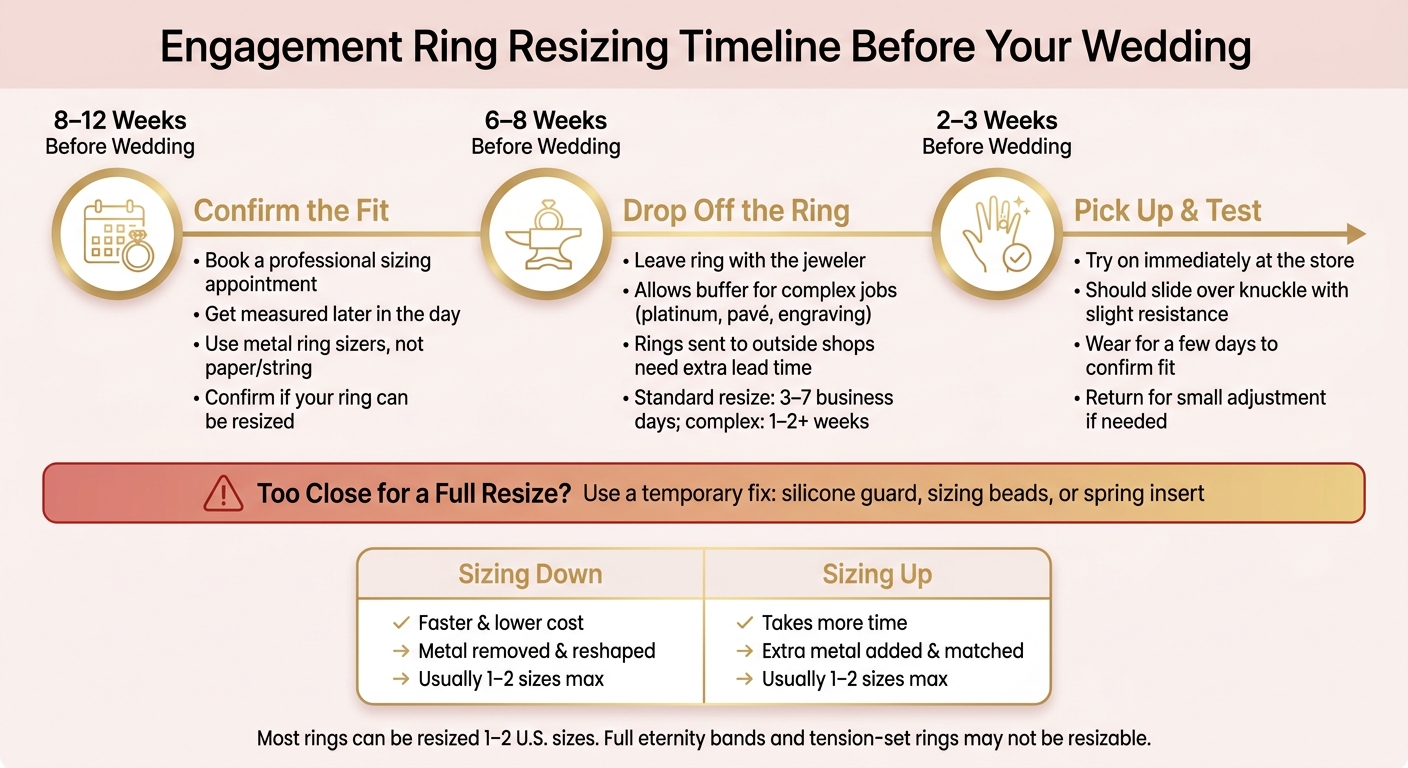
Engagement Ring Resizing Timeline Before Your Wedding
Once you've confirmed the ring can be resized, the next step is timing. The simplest way to plan this is to work backward from the wedding date: check the fit 8–12 weeks out, leave the ring with the jeweler 6–8 weeks out, and keep 2–3 weeks for pickup and any last small adjustment.
8–12 Weeks Out: Confirm the Fit
Book a sizing appointment with a jeweler instead of trying to measure at home. It’s a small step, but it can save a lot of stress later. Go later in the day, when your fingers are closer to their usual size, and get measured at normal room temperature so heat or cold doesn’t throw things off. Jewelers often use metal ring sizers and a ring mandrel to check fit more accurately. Paper strips and string sound easy, but they’re too hit-or-miss for a pre-wedding resize. This timing also gives the jeweler enough room to handle the work without squeezing the rest of your schedule.
6–8 Weeks Out: Drop the Ring Off With the Jeweler
This is the safest window to hand over the ring. Dropping it off now helps keep everything on track and gives you some breathing room if the job takes longer than expected. That can happen with platinum work, pavé or halo settings, engraved bands, or rings that need to be sent to an outside workshop.
2–3 Weeks Out: Pick Up and Test the Ring
When you pick up the ring, try it on right there at the store. It should slide over the knuckle with slight resistance and then sit snugly without spinning. After that, wear it for a few days before deciding the fit is done. If it feels a bit tight or a bit loose, take it back for a small adjustment.
Factors That Affect How Long Ring Resizing Takes
Three things shape the timeline: metal, setting, and finish. Once you know how each one affects the work, it’s much easier to tell whether 6–8 weeks is enough or if you should plan for the full 8–12 weeks.
Metal Type, Stone Setting, and Surface Details
Platinum usually takes more time than gold because it’s harder to cut and finish. That extra labor can slow things down, especially if the ring also has a lot going on in the design.
Stone-heavy settings can add more time too. The jeweler often needs to inspect the stones after resizing and make sure everything is still secure. Decorative surface details, like engraving or other finishes, may also need to be restored after the size change.
Sizing Up vs. Sizing Down
Sizing down is usually the faster, simpler job. In many cases, the jeweler removes a small section of metal and reshapes the band.
Sizing up tends to take longer. More metal has to be added, matched to the original material, and finished so the ring still looks right when the work is done. Put plainly, making a ring larger is often more work than making it smaller.
Easy, Delayed, and Not-Recommended Resizing Cases
For planning, it helps to think in three buckets.
A plain gold solitaire that only needs to go down a little is the easiest case. There are no side stones to check, no delicate finish to repair, and less risk during the job.
A platinum pavé halo ring with engraving is slower. That kind of ring usually needs the full 8–12 week window so the jeweler has time for stone checks and surface repair.
Some rings are poor candidates for resizing at all. Full eternity bands and tension-set rings usually should not be resized. In that case, a temporary fix or another fit option is often the safer move before the wedding.
What to Do If the Wedding Date Is Too Close for a Full Resize
If the resize window has already passed, don't rush into a permanent change. When the wedding is less than two weeks away, it's usually better to use a temporary fix, as long as the ring is only a little off.
Temporary Fixes for a Slightly Loose Ring
If your ring is about 0.5 to 1 size too big, a temporary fix can do the job.
- A silicone guard or plastic insert can make the ring fit more snugly.
- Sizing beads - two small metal beads soldered inside the band - can slightly reduce the inner circumference and help stop the ring from spinning.
- If you have larger knuckles and a slimmer finger base, a spring insert for larger knuckles can help the ring stay secure while still sliding over the knuckle.
The jeweler-installed options usually wear better through a full wedding day. Still, test the fit before the event. A ring can feel fine for 10 minutes and then start shifting once you're moving around, greeting people, or dancing.
If your fit is still changing, don't lock in a permanent size yet.
When Finger Size May Change Again Soon
Finger size can shift for all sorts of reasons: heat, swelling, hormonal changes, or recent weight changes. If that sounds like your situation, pause before making a permanent change.
After pregnancy, wait 3–6 months postpartum before getting a permanent resize. In the meantime, sizing beads or a spring insert for larger knuckles can help bridge the gap without cutting the band.
Adjustable Ring Options for Long-Term Fit Flexibility
If you need fit flexibility for the long haul, an adjustable ring design is often a cleaner choice than resizing the same ring again and again.
Satinski's patented ALLRING™ system lets a ring adjust at home across U.S. sizes 5–9, with no jeweler visit and no cutting involved. That's a strong option if your size is still shifting or if your setting makes more cutting a bad idea. It helps protect the ring's structure and keeps its look intact over time.
Conclusion: The Best Time to Resize Before the Wedding
Most engagement rings can be resized before the wedding, but the timing depends on the ring’s metal and setting. Once you’ve checked the fit and know the ring’s size limits, the next piece is simple: timing matters. A plain band is usually more straightforward. A ring with a more detailed design can take longer.
A good rule of thumb is to confirm the fit 8–12 weeks before the wedding, leave the ring with the jeweler 6–8 weeks out, and do a final wear test 2–3 weeks before the ceremony. That gives you enough time for a standard resize and any small follow-up tweak. It also gives you some breathing room if setting work, polishing, or outside repair slows things down.
If a full resize doesn’t fit the timeline, temporary ring adjusters can help keep the ring secure until after the wedding. And if your finger size is still changing, an adjustable ring design may give you more flexibility over time without cutting the band.
Start early, plan around the ring’s design, and keep a backup option in place.
FAQs
Will resizing change how my engagement ring looks?
It can, at least a little.
Standard resizing usually means cutting the band and either adding or removing metal. If the ring has stones, a jeweler may take them out for a short time during the work.
After that, the ring is polished and finished so it looks like itself again. Even so, slight marks or small structural changes can still appear, especially after multiple resizings or when the ring has complex stone settings.
Hidden adjustable mechanisms offer another option. They can change the fit without cutting or remodeling the ring, which helps keep the original design intact.
Can I wear my ring right away after it’s resized?
Yes. After a professional resizing, you can usually wear your ring right away.
Try it on first and make sure it feels comfortable. Then wear it for a few days so the new fit starts to feel normal.
If you chose a Satinski adjustable ring, you can wear it immediately. It’s made to be resized at home with the provided tool.
How do I know if I need a resize or just a temporary adjuster?
A temporary adjuster is often enough when your finger size shifts from day to day and the ring is close to fitting, but still doesn’t feel secure. The best time to check the fit is in steady conditions: late afternoon or early evening, with hands that aren’t cold, and not right after exercise or a salty meal. It also helps to check it a few times, not just once.
If the ring needs a permanent change - especially if it’s off by more than 1–2 sizes - a jeweler’s resize assessment is the safer move.


