

Diabetes and Ring Fit: What to Watch For
If you have diabetes, a ring that suddenly feels tight, loose, or rough on your skin is a health check cue - not just a jewelry issue. I’d watch for swelling, numbness, color changes, skin damage, and day-to-day fit shifts, because diabetes can affect feeling, blood flow, skin dryness, and healing.
Here’s the short version:
- Take the ring off early if you see swelling, redness, pain, warmth, or a deep mark.
- Get urgent help if the ring won’t come off, or if the finger turns blue, gray, pale, or very cold.
- Check the skin by sight, not just by feel, since nerve damage can make pressure or injury harder to notice.
- Don’t resize too fast if the fit change is new. Measure first when your finger is back to normal.
- Use short-term fixes with care, like inserts only on healthy skin and only when the ring is not tight.
- Think about smoother, adjustable styles if your finger size changes during the day.
A few facts stand out. Heat, exercise, and fluid buildup can change finger size within hours. Diabetes can also lead to numbness, tingling, dry skin, and slower healing, which means a small sore under a ring can turn into a bigger problem if it’s missed.
| What I’d check | What it can mean | What to do |
|---|---|---|
| Ring feels tight | Swelling, pressure, poor fit that day | Remove it, lift your hand, recheck later |
| Ring feels loose | Friction, snagging, loss risk | Remove it for work, exercise, water, and recheck skin |
| Numbness or tingling | Nerve or blood flow issue | Remove it at once and watch for return of feeling |
| Pale, blue, gray, or cold finger | Blood flow problem | Get emergency care |
| Redness, blister, crack, drainage | Skin injury or infection | Leave ring off and get medical care if it spreads or doesn’t heal |
I’d treat fit changes as early warning signs. The goal is simple: protect the skin, avoid pressure, and act fast if anything looks off.
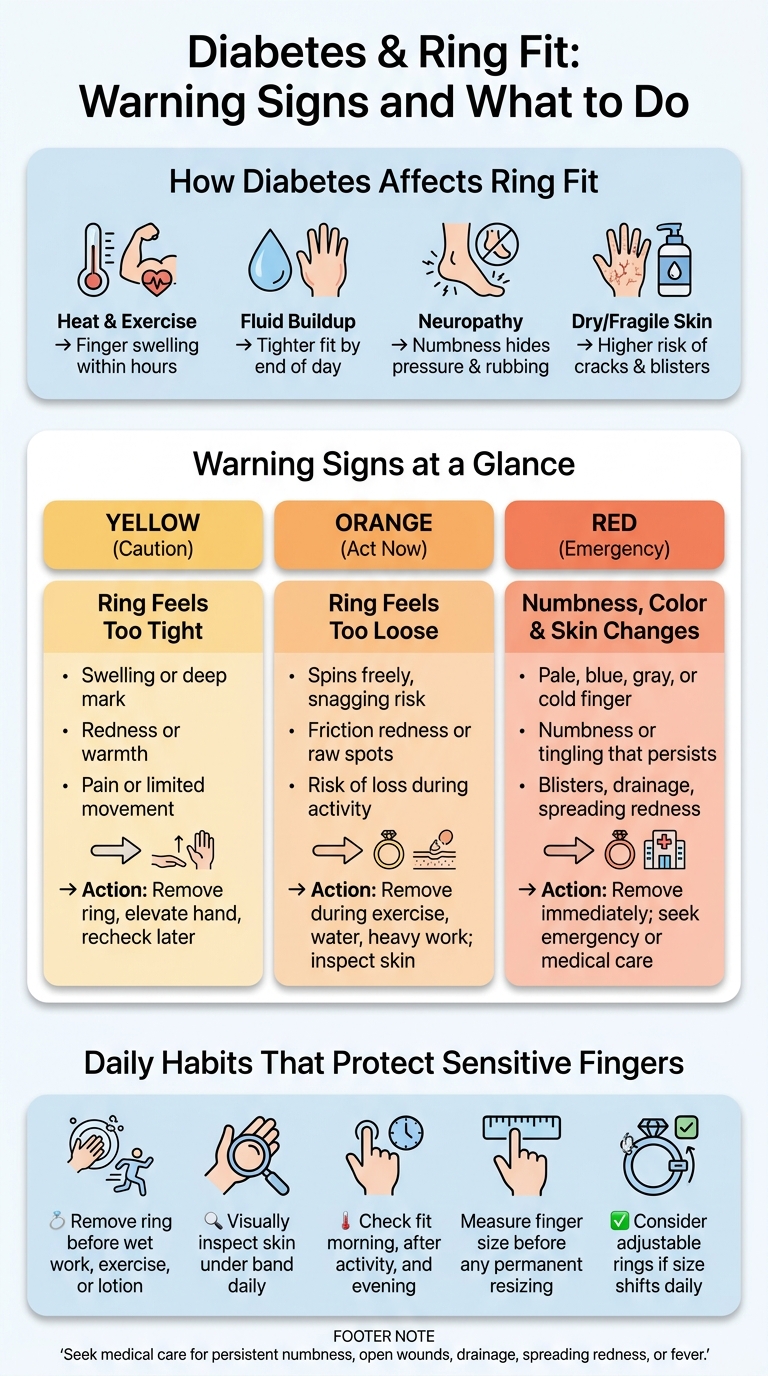
Diabetes & Ring Fit: Warning Signs and What to Do
How Diabetes Can Affect Ring Fit Day to Day
Finger size can shift over the course of a single day. Heat, movement, and fluid buildup can all change how a ring feels, especially if your hand stays below heart level for a while. So a ring might feel fine in the morning, then start to feel tight, loose, or annoying just a few hours later.
Swelling, Circulation Changes, and Hand Stiffness
Heat makes blood vessels widen, which sends more blood to the skin and can make fingers swell. That means a ring that goes on with no trouble in the morning might feel much tighter after a hot day or a long shift outside. Standing for long periods or keeping your hand below heart level for hours can also let fluid build up in the tissues, which can make fingers look and feel fuller by the end of the day.
Exercise can do something similar in the short term. More blood flows to the hands and fingers, so a ring may feel snug right after a workout or other physical activity. Later, once your body cools down, it may loosen again. That's why it helps to check fit at a few points during the day:
- In the morning
- After activity
- Late in the day
The ADA notes that diabetes can cause limited joint mobility syndrome, where the skin on the backs of the hands becomes tight and thick. Even if you don't notice swelling, that stiffness can make a ring harder to turn or remove.
This isn't only about ring size. These shifts can also change how easy it is to notice pressure, rubbing, or skin injury.
Reduced Sensation and More Fragile Skin
Diabetic neuropathy can affect the hands and lead to tingling, burning, numbness, or weakness in the fingers. When sensation is reduced, pressure and friction may go unnoticed. A ring can seem fine even while it's already leaving a red mark or indentation.
High blood glucose can also dry out the skin, which makes it more likely to rub against a band edge, prong, or the small repeated movements of the ring itself. The ADA also reports that diabetic blisters can develop on the backs of fingers and hands, especially in people with neuropathy. A small crack or blister may not be felt at all, so each time you take the ring off, look at the skin closely.
Use the checks below to catch fit changes before they turn into irritation.
| Situation | Effect on Ring Fit | What to Inspect |
|---|---|---|
| Warm weather or long work shift | Ring may feel tighter; harder to rotate or remove | Indentation, redness, difficulty removing |
| Cooler conditions or after rest | Ring may feel looser or spin freely | Repeated snagging, skin irritation from movement |
| Neuropathy present | Pressure or rubbing may go unnoticed | Check skin visually, not by feel alone |
| Dry or cracked skin | Increased friction even without size change | Cracks, peeling, blisters, redness beneath the band |
sbb-itb-9da40c1
Warning Signs to Watch For and What to Do Next
A sudden fit change is a warning sign, not just a sizing problem. When a ring starts feeling different out of nowhere, treat that as a signal to pay attention.
When a Ring Feels Too Tight
Take the ring off at the first sign of swelling, a deep mark, pain, redness, warmth, or less movement. Then elevate your hand and wait until the finger looks normal again before checking the fit.
Don’t force it off. Don’t twist or drag it across swollen skin. That can make things worse in a hurry. If the ring won’t come off safely, get urgent help from a healthcare professional, emergency department, or emergency service. If you have diabetes, reduced sensation can hide damage, so early action matters.
If the fit changes all of a sudden, stop wearing the ring until the finger both looks and feels normal again.
When Numbness, Color Changes, or Skin Damage Appear
Take the ring off right away if you notice numbness, tingling, burning, unusual coldness, or skin that looks pale or bluish. Those signs can point to blood flow or nerve trouble. With diabetic neuropathy, pain and temperature changes may be harder to notice, which means damage can already be further along than you think.
If feeling doesn’t come back after removing the ring, get medical care soon. If a finger turns blue, gray, or very cold, or you can’t move it normally, that needs emergency evaluation.
Broken skin is a separate issue. A crack, blister, open sore, drainage, spreading redness, or fever calls for prompt medical care. For minor surface damage, wash the area with soap and water, cover it with sterile gauze, and leave the ring off.
When a Ring Suddenly Feels Too Loose
A loose ring can be just as much of a problem. It may spin all day, rub the same area over and over, catch on clothing or equipment, or slip off without you noticing.
Take it off during:
- Exercise
- Heavy work
- Swimming
- Bathing
- Any activity where rubbing, catching, or loss is more likely
Before you put it back on, check the skin underneath. Look for circular redness, raw spots, or blisters. A loose ring can cause the same kind of friction injury as a tight one, and it’s easy to miss.
Don’t rush into permanent resizing. Wait until your finger size is steady, then talk through any major or unexplained change with your diabetes-care clinician.
If the looseness is new, measure before you resize.
Safe Fit Checks and Temporary Solutions
After the finger settles, use these checks to figure out whether the ring needs resizing, a temporary insert, or a more flexible everyday fit.
How to Measure Fit With a Ring Mandrel or U.S. Sizing Chart
Once the ring is off and your finger is back to its usual size, use a mandrel, sizing chart, or insert to tell whether the size change was temporary or something more lasting.
A ring mandrel is a tapered tool marked with U.S. ring sizes. Slide the ring down the mandrel gently until it rests where it naturally stops. Then read the size at the ring’s inside edge. This gives you the ring’s approximate U.S. size, but it doesn’t factor in swelling, band width, or the shape of your knuckle. The Gemological Institute of America notes that mandrel markings match specific inside-diameter measurements in millimeters, which can help you check your result against an online sizing chart.
If you’re using a printable sizing chart, print it at 100% scale and turn off “fit to page.” Then match the ring’s inside edge to the chart. If the ring lands between sizes, go with the larger one.
Try to measure when your finger is at its usual size. If your size shifts from day to day, check it on at least two separate days at about the same time and use the result that shows up most often.
Temporary Inserts and Short-Term Size Changes
For a short-term fix, a sizing insert can help with slight looseness while you keep an eye on your finger. Keep the insert clean and dry. Take it out right away if you notice redness, moisture, itching, or rubbing.
Don’t use inserts if the finger is still swollen, has broken skin, or already feels tight with the ring on.
When an Adjustable Ring Is the Better Everyday Option
If your size changes keep happening, an adjustable ring may make more sense for daily wear than resizing again and again. A band that loosens or tightens in small increments can help when your finger size shifts throughout the day.
Satinski's adjustable rings come in sterling silver and 18K gold-plated silver and are made to fit U.S. sizes 5–9. Look for smooth, low-profile settings and rounded edges so the ring is less likely to rub. And don’t push the band past its intended range. If it won’t stay in place or starts to feel sharp, stop using it that way.
Ring Features and Daily Habits That Protect Sensitive Fingers
Materials and Settings That Reduce Rubbing and Snagging
After sizing is sorted out, the next thing to watch is friction. Finish matters just as much as fit. If sensation is reduced and skin is fragile, a ring can rub for hours before you notice there's a problem.
A smoother ring is usually easier on the skin. Look for a smooth interior, rounded comfort-fit edges, and a low-profile setting to cut down on rubbing and snagging. When you check a ring, run a clean fingertip along both the inside and outside of the band. You're looking for rough seams, exposed prong tips, or any edge that might press into the skin.
Small design details matter too. If a ring has tight crevices, it can hold onto lotion, soap, and moisture. Over time, that buildup can irritate the skin. It's better if decorative parts still leave enough room to rinse and dry the ring well.
Sterling silver and 18K gold are common picks for daily wear, but skin reactions vary from person to person. If you notice itching, redness, scaling, or a rash where the ring sits, take it off. Get medical care if the reaction lasts, spreads, blisters, oozes, or becomes painful.
Daily Habits That Help Protect Sensitive Fingers
Even a ring with a good shape can still bother the skin if moisture and residue collect underneath it. With diabetes, that kind of irritation may slip by unnoticed until damage has already begun. That's why day-to-day habits matter so much.
A few simple habits can help:
- Remove rings before wet work, chemicals, exercise, or lotion.
- After washing or any wet activity, dry both the finger and the ring fully before putting it back on.
- If you've used lotion, wait until it has absorbed before wearing the ring again.
- Check the skin under the band for indentation, redness, warmth, or tenderness.
- Use that same daily visual check on your fingers.
This doesn't need to take long. Think of it like checking your shoes before a walk - small trouble is much easier to deal with before it turns into a sore spot.
Conclusion: Catch Fit Changes Early and Choose Flexible Solutions
If ring fit changes, treat it as a signal, not just a jewelry problem. Use a ring mandrel or a U.S. sizing chart to record the size change before making any permanent adjustment. It's usually smarter to start with reversible options, like a properly fitted adjustable ring or a temporary insert used only on healthy, unbroken skin, until you know whether the change will last.
Seek medical care for persistent numbness, an open or nonhealing wound, drainage, spreading redness, warmth, marked swelling, worsening pain, or fever. Diabetes can affect healing and the body's response to infection, so even a small wound or an unexplained skin change under a ring calls for prompt attention - not just another sizing fix.
FAQs
Can high blood sugar make my ring fit differently?
Yes. High blood sugar and related health issues can change how your ring fits. Sometimes the change is short-term. Heat, exercise, or salty foods can make your fingers swell for a while. Other times, blood sugar or metabolic shifts can lead to longer-lasting changes in finger size.
If your ring often feels tight, loose, or uncomfortable, your finger size may be changing. Adjustable rings can help because they let you tweak the fit without permanent resizing.
How do I know if a ring issue is a medical problem?
Track your finger size for a few weeks. Day-to-day swelling from heat, exercise, or what you eat often settles down on its own.
But if the swelling sticks around, gets worse, or shows up with joint pain, stiffness, or fatigue, it may point to a medical issue.
Get medical help right away if you have numbness or your finger turns white or blue. You should also check with a doctor if a new medication or an ongoing health condition might be changing how your ring fits.
Should I resize my ring if the fit keeps changing?
If your ring fit keeps changing, skip repeated standard resizing. Doing it again and again can weaken the band and put the setting at risk.
For small or short-term fit changes, use silicone adjusters, ring guards, or spacer bands. If your ring size shifts often because of weight loss, arthritis, or swelling, an adjustable ring usually makes more sense over time. It’s smarter to think about permanent resizing only after your finger size has stayed stable for 3 to 6 months.


