

Eternity Bands and Resizing: Why They Can't Be Sized (and What to Do)
If you buy a full eternity band, assume the size is final. That’s the short answer.
I’d put it this way: a full eternity ring usually can’t be resized without risk because stones cover the whole band. There’s no plain metal spot to cut, add, or remove. Even a ½-size change can affect stone spacing, prongs, and the ring’s shape.
Here’s what matters most:
- Full eternity bands: often not safe to resize
- Half-eternity bands: may allow small size changes
- Plain bands: usually the easiest to resize
- If the fit is off: a remake with the original stones is often the safer path
- If the problem is minor: ring guards, sizing beads, or inserts may help
- Before buying: get sized in person, and if you’re between sizes, go a bit larger
This comes down to one simple idea: the more of the ring covered in stones, the harder it is to change the size later.
Quick Comparison
| Ring type | Can it usually be resized? | Risk | Best use case |
|---|---|---|---|
| Full eternity | Usually no | High | If you know your exact size and want stones all the way around |
| Half-eternity | Sometimes, for small changes | Medium | If you want some room for future sizing |
| Plain band | Usually yes | Low | If fit flexibility matters most |
If I were shopping for one, I’d treat a full eternity band like a final-fit purchase, not a ring I could fix later.
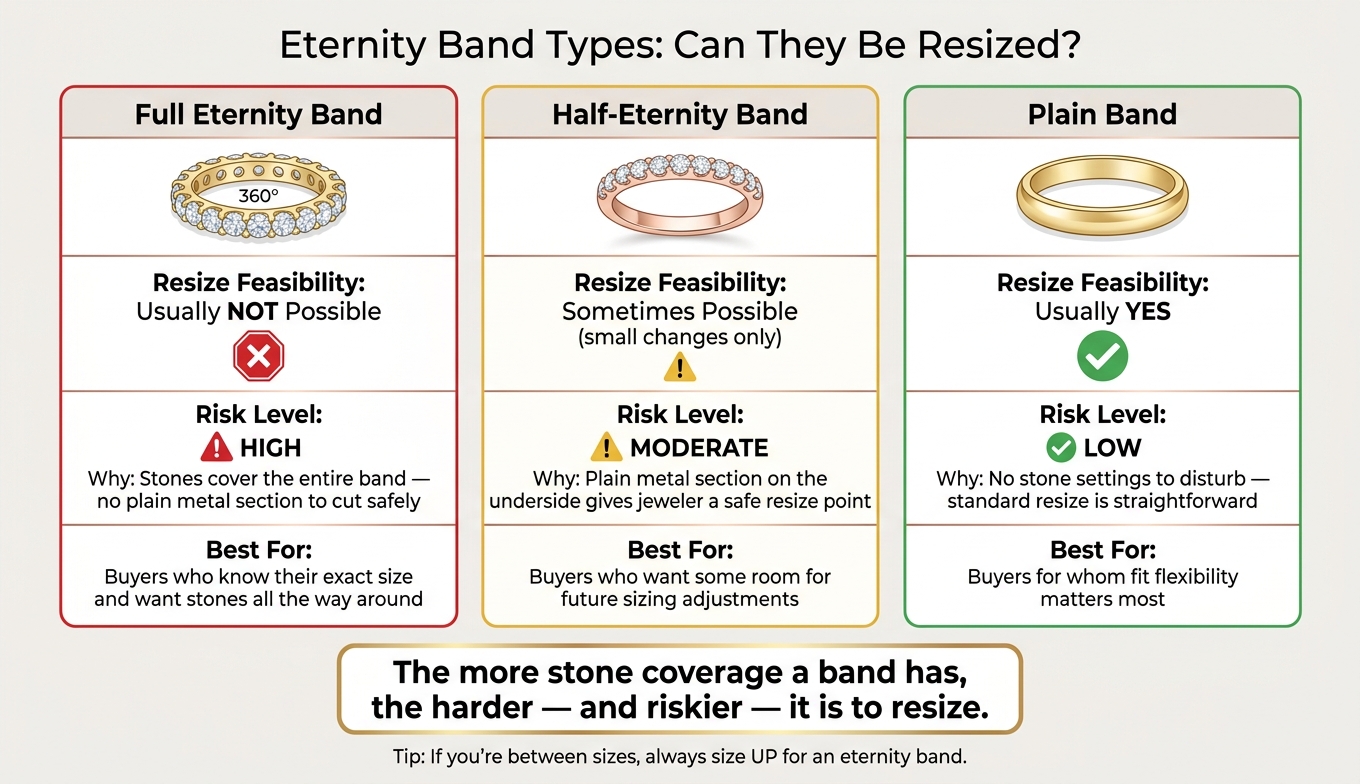
Eternity Band Types: Resizing Feasibility at a Glance
How to Size Down a Full Eternity Ring Mount
sbb-itb-9da40c1
Why eternity bands usually cannot be resized
A full eternity band is stone-set all the way around, so there’s no plain metal section for a standard resize. Put simply, there’s no safe place to make the cut.
Full-circle stone settings leave no safe point for adjustment
Standard resizing works on most rings because there’s usually a plain metal area at the bottom of the band - the part that rests under your finger. A jeweler cuts that section, removes or adds a small piece of metal, then solders and polishes the ring without bothering the stones.
A full eternity band doesn’t have that plain section. Every part of the ring is tied to the stone setting, no matter which setting style it uses. So any cut goes straight through the setting itself. That can loosen or damage the stones near the cut and leaves no clean, metal-only seam to solder back together.
Even a small size change can affect symmetry and band strength
Because the setting runs through the whole ring, even a minor size change affects the full circle. If the band is compressed, the stones get crowded. If it’s stretched, gaps start to appear. Either way, spacing turns uneven, prongs can shift away from their proper contact points on the stone girdles, and the ring can lose its smooth, continuous look.
There’s also the metal itself to think about. Cutting and soldering can weaken the setting and loosen or damage nearby stones. And that can happen even with a small adjustment. That’s why jewelers put tight limits on resizing attempts.
When a jeweler tries anyway, the risks tend to show up fast.
What happens when a jeweler tries to resize an eternity band
A full eternity band's design turns resizing into a repair job, not a simple size tweak. In most cases, resizing a full eternity band becomes a partial remake. The jeweler often has to remove stones before changing the band. After cutting the ring and changing its circumference, those stones need to be set again so the pattern stays even and the settings stay secure. That rebuild adds several spots where things can go wrong.
Common damage risks during the resizing process
Heat can put stress on the metal. Cutting and reshaping the band back into a circle can warp it. Prongs can bend or loosen stones. Stone seats can crack, and stones can come loose - or fall out altogether - during or after the work.
Then there's the look of the ring. Eternity bands are prized for that continuous, unbroken design. Even a ½-size change can throw off prong alignment or leave a visible seam where the stone pattern no longer flows the way it did before. The ring may fit better, but it often won't look quite the same.
Cost matters too. Since the job may involve stone removal, resetting, polishing, and a final inspection, the price can come close to a custom remake.
Full eternity, half-eternity, and plain bands compared
Here's how the main band styles compare:
| Ring Type | Resize Feasibility | Risk Level |
|---|---|---|
| Full eternity band | Usually not practical; may require stone removal, resetting, or a full remake | High |
| Half-eternity band | Often resizable due to the plain metal section on the underside | Moderate |
| Plain band | Generally the easiest to resize | Low |
The pattern is pretty simple: the more stone coverage a band has, the harder and riskier it is to change the size. When resizing isn't much of an option, the choices usually narrow to small adjustments or a full remake.
When limited resizing may be possible
Some eternity-style rings can be resized a little. It mostly comes down to how much of the band is covered in stones. With partial eternity rings, that small plain-metal section is the part that gives a jeweler at least some room to work.
Ring styles that sometimes allow minor size changes
Half-eternity and three-quarter eternity rings have a plain-metal section on the bottom of the band. That area can serve as the resize point.
Even then, the setting style still matters. Pavé, channel, and shared-prong settings can make resizing harder because there’s not much room for heat or cutting. Band thickness matters too. Very thin bands can warp under heat. In day-to-day shop work, these rings usually allow only small changes. If the adjustment is larger, a remake is often the better route.
Limited resizing versus remaking the ring
If you only need a small fit change and the ring has enough plain metal, limited resizing may make sense. But when the size gap is bigger, or the setting is too delicate to handle safely, a custom remake using the original stones is often the smarter move.
The best option depends on how much the size needs to change.
| Option | Fit Flexibility | Alteration Risk | When It Makes Sense |
|---|---|---|---|
| Half/three-quarter eternity | Moderate | Low to medium; depends on setting style and band thickness | For minor size changes of 1 to 2 sizes or less |
| Custom remake | High | Low; ring is rebuilt using the original stones | When the size change is too large for a standard resize |
A jeweler needs to inspect the ring before saying yes to any adjustment. Two rings can look almost the same and still have very different limits. That’s why the exact piece has to be checked in person. If you’re not sure, ask directly whether your ring can be changed by a half size, one size, or not at all before assuming the job is simple.
What to do if your eternity band no longer fits
If resizing is no longer safe, the next step is picking the option with the lowest risk. Start by figuring out whether the fit issue is temporary or permanent. A ring that feels a bit snug only in summer is one thing. A ring that leaves a deep mark every time you wear it or won’t pass over the knuckle is a different issue.
Get the right size before purchase or remake the ring with the original stones
For a full eternity band, get your finger sized by a jeweler before you order, and make sure they account for knuckle clearance too.
If the ring is already off by more than a small amount, a custom remake with the original stones is usually the safest fix. The jeweler removes each stone with care, checks the stones, and makes a new band in the correct size.
Consider half-eternity or adjustable ring styles for long-term flexibility
If you’re replacing the ring, it helps to pick a style that gives you more room if your size changes later.
A half-eternity band has a plain metal section on the bottom, which gives a jeweler space for limited resizing without disturbing the setting. If your fingers swell often or you have large knuckles, adjustable ring styles can give you more flexibility. These styles use a hidden mechanism to handle small size changes while still looking like a standard ring.
Use temporary sizing aids for minor fit problems
For minor fit issues, sizing beads, ring guards, or removable inserts can help. They’re temporary aids, not a fix for a ring that’s much too tight or too loose.
If a tight ring gets stuck and causes numbness or discoloration, get medical help right away.
If you’re still shopping, the best move is to get the size right before you buy.
How to avoid sizing problems before you buy
With a full eternity band, getting the size right before you order is a big deal. These rings leave very little room for later fixes, so it's smarter to prevent the problem than hope it can be fixed after the fact.
Check your ring size in person before ordering a full eternity ring
Your safest move is to visit a jeweler and get sized in person with a ring mandrel and proper sizing tools. For a full eternity band, that extra trip is worth it. Once the ring is made, there may not be a safe way to correct the size later.
Timing also matters more than most people think. Fingers are usually smallest in the morning and largest in the afternoon. Skip sizing right after exercise, a salty meal, or cold exposure, since each of those can shift your finger size by about half a U.S. size either way.
Buying for someone else? Don't wing it. Borrow a ring they already wear on that same finger and ask a jeweler to measure it. With a full eternity ring, a bad guess may lead to a full remake instead of a simple resize.
If you're between sizes, choose the larger one. A ring that's a little loose is much easier to deal with than one that's too tight and can't be adjusted safely. And if your finger size may change later because of pregnancy, weight shifts, or other health issues, it's smart to pick a style with more give from the start. Half-eternity rings or adjustable styles can make life much easier down the road.
Conclusion: Know the limits before you buy
The takeaway is pretty simple: full eternity bands don’t give you much room for repair. Because stones wrap around the entire ring, there’s usually no safe area for resizing. Try to alter it, and you may put both the stones and the band at risk.
As stone coverage goes down, your options open up. Half-eternity bands are easier to work with because the plain section on the underside gives jewelers space to make changes. If sizing flexibility matters, it’s smart to pick a different style before you buy. If the ring already exists and no longer fits, a remake is often the next move.
When a full eternity band stops fitting, a custom remake using the original stones is often the safest fix. If the issue is only slight looseness, sizing beads, ring guards, or silicone adjusters may help.
If you want some built-in give from day one, adjustable rings with hidden mechanisms can be a practical option for hands that swell or shift in size.
For a full eternity band, getting the size right before purchase is usually the safest move.
FAQs
Can any full eternity band be resized at all?
No. Full eternity bands usually can't be resized.
The reason is simple: the gemstones go all the way around the ring. That leaves no plain metal for a jeweler to cut, remove, or add without risking damage to the settings or weakening the band itself.
Trying to resize one can also throw off the stones' placement. If you want more room for size changes later, an adjustable design is often a better pick than trying to resize a full eternity band.
When is a remake better than a resize?
A remake makes more sense when the band can’t be changed safely to fit the new size. That’s often the case with full-circle eternity rings, where stones run all the way around the band. Cut or reshape a ring like that, and you can damage the settings or the stones.
It’s also the better path when the size change is big enough that a resize could weaken the ring over time. If resizing isn’t workable, or if it puts the design at risk, go with a custom remake or an adjustable redesign instead.
How do I choose the right size before buying?
Measure your finger at its widest point. For the best read, skip sizing when your hands are cold or just after exercise or a salty meal, since swelling can throw things off.
Already have a ring that fits well? Measure its inner diameter and compare it with a size chart. Another option is to wrap a strip of paper or string around your finger, measure the circumference, and match that number to the chart.
One small thing that matters: wider bands usually feel tighter. So if you're choosing a thick band, you may want to go slightly larger.


