

Will People Know It's Moissanite? An Honest Answer
Most people in the U.S. will not know it’s moissanite from a normal glance. If your ring is well cut, set well, and worn in everyday light, most people will just see a bright stone.
Here’s the short version:
- At normal distance: most people can’t tell moissanite from diamond
- Big clue: moissanite shows more rainbow fire
- Best at blending in: stones around 0.75 to 2 carats
- More likely to stand out: stones above 1.5 carats, and even more above 3 carats
- Strong light matters: sunlight, LED spotlights, and flash make differences easier to see
- Who can tell: jewelers, gemologists, and people who know stones well
- Why pros know: they use a 10x loupe and testers, not just their eyes
One number explains a lot: moissanite’s dispersion is 0.104, while diamond’s is 0.044. That means moissanite throws about 2.4x more rainbow fire. In plain English, it can look more colorful, while diamond often looks whiter and sharper.
If I were boiling the whole article down to one point, it would be this: moissanite usually passes in daily life, but large stones and harsh lighting can give it away.
| What people notice | Moissanite | Diamond |
|---|---|---|
| First impression | Bright, sparkly, often assumed to be diamond | Bright, sparkly |
| Fire | More rainbow flashes | More white sparkle |
| In home or office light | Often looks very similar to diamond | Often looks very similar to moissanite |
| In direct sun or spotlights | Color flashes stand out more | Looks crisper and less rainbow-heavy |
| Easy for most people to identify? | No | No, unless compared side by side |
So if you want a ring that looks natural day to day, I’d focus on cut, size, and setting more than anything else. That’s what shapes what people see first.
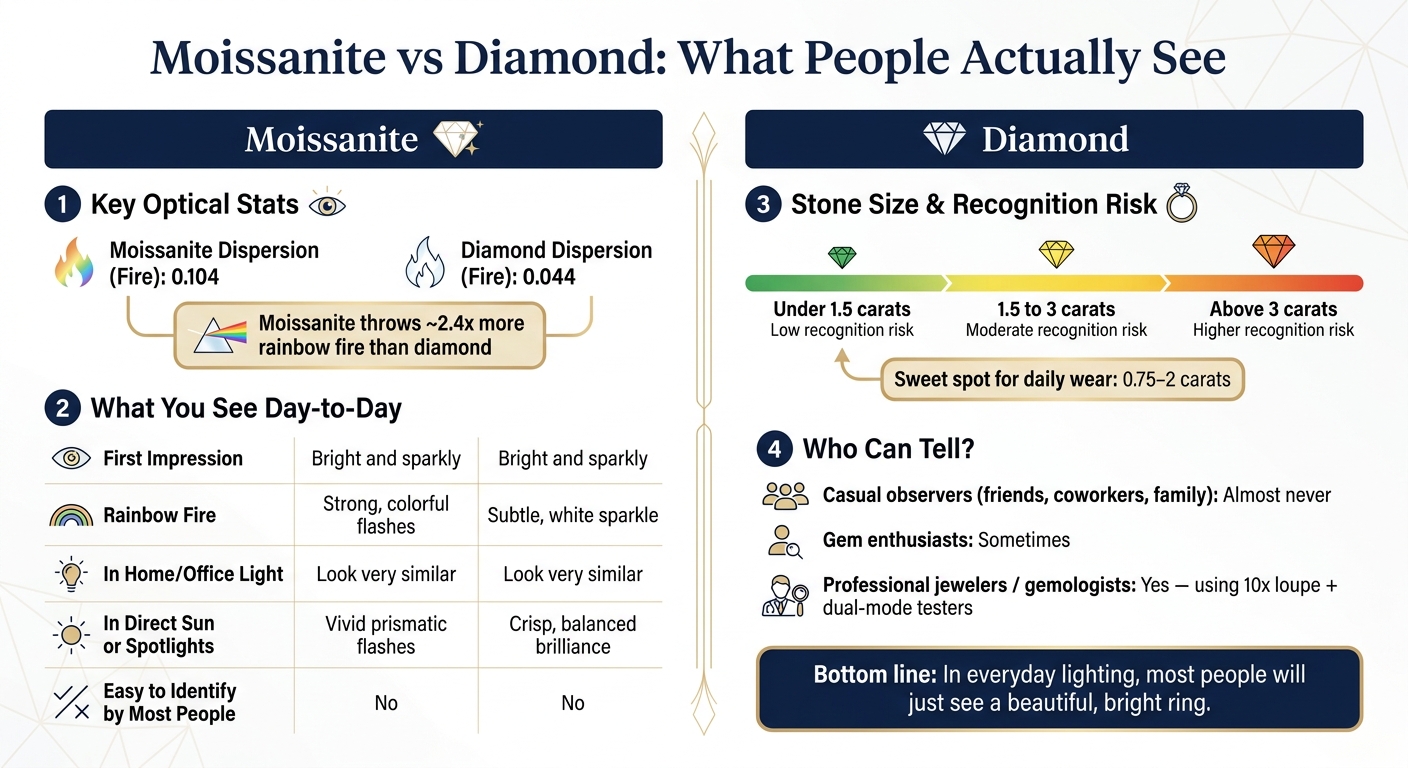
Moissanite vs Diamond: What People Actually See
Round lab #diamond vs #moissanite 👀 can you spot the difference?
sbb-itb-9da40c1
How Moissanite Looks Compared to Diamond in Daily Life
In daily wear, the main difference comes down to fire. Moissanite throws more rainbow flashes, while diamond tends to look whiter and crisper.
Sparkle, Rainbow Fire, and Clarity Day to Day
The easiest difference to spot is fire. Moissanite's dispersion is about 0.104, while diamond's is 0.044 - about 2.4 times higher. Put simply, moissanite gives off more rainbow-colored flashes. Diamond, by contrast, gives back more white, restrained sparkle.
Clarity usually isn't what gives moissanite away. Good moissanite is often eye-clean, which means you won't see inclusions without magnification. In day-to-day wear, most people won't notice flaws in moissanite at all. If something stands out, it's usually the colorful fire, not cloudiness or spots.
| Trait | Moissanite | Diamond |
|---|---|---|
| Sparkle (brilliance & sparkle pattern as the stone moves) | Very bright; broad, dynamic flashes | Very bright; whiter, crisper flashes |
| Rainbow fire | Strong; more colorful, especially in direct light | More restrained; subtler color mixed with white |
| Clarity | Usually eye-clean; inclusions rarely visible | Varies by grade; lower grades can show visible flaws |
Those differences can stand out more or less depending on stone size, cut, and setting style.
How Lighting Changes What People See
Lighting changes a lot. In home, office, and evening settings, which is where most people see your ring, moissanite and diamond can look very similar. Both look bright and clear, and moissanite's extra rainbow fire is often subtle enough that people just see a pretty ring.
The gap gets easier to notice in direct sunlight, under LED spotlights, or with camera flash. In those settings, moissanite can throw off strong prismatic flashes that look extra colorful. Diamonds also show fire in the same light, but the look stays more balanced between white brilliance and color. Photos can make this stand out even more. Moissanite may produce bright rainbow flares on camera that read as intense sparkle, even if people don't immediately read it as a different stone type.
In everyday wear, most people simply see a bright ring. The extra rainbow flashes tend to show up most in strong light.
When People Are More Likely to Recognize Moissanite
People are more likely to notice moissanite in larger stones, under harsh lighting, and in less precise cuts. The same sparkle that looks beautiful at a glance can stand out more when the stone is bigger, the cut isn’t as tight, or the lighting puts every flash on display.
Stone Size, Cut Quality, and Setting Style
Stone size matters most. For stones under about 1.5 carats, the chance of recognition is low. Most casual observers just see a bright, sparkly stone and move on.
Once you get into the 1.5 to 3 carat range, moissanite’s extra rainbow fire starts to stand out more. And above 3 carats, those intense flashes, along with slight body color, can make experienced observers more likely to wonder if the stone is a diamond.
Cut quality and setting matter just as much. A well-cut stone tends to look balanced, while a poor cut can look less lively and invite doubt. The setting plays a role too. A clean, polished, well-finished setting usually looks more convincing. A thin or rough setting, on the other hand, can draw the eye in the wrong way.
Who Is Likely to Notice and Who Is Not
At that stage, recognition depends less on a casual glance and more on who’s doing the looking. Coworkers, friends, and family who aren’t gem experts usually pay attention to the overall look of the ring - its size, sparkle, and how it looks on you - rather than the stone’s optical behavior.
The people most likely to notice are professional jewelers, gemologists, and gem enthusiasts who’ve seen moissanite and diamond side by side many times. People comparing rings next to each other in store lighting are also more likely to spot the difference.
Jewelers usually notice the same visual clues first, then confirm what they’re seeing with loupes and testers.
How Professionals Tell Moissanite from Diamond
At close range, jewelers stop relying on first impressions and start using tools.
Loupes, Facet Doubling, and Testing Tools
One of the first tools they reach for is a 10× jeweler's loupe. It's a small magnifying lens, usually priced around $12–$25, and it's a standard part of jewelry work.
Under that magnification, a trained jeweler looks for facet doubling. This is one of the clearest optical signs of moissanite. Moissanite is doubly refractive, which means light splits into two paths inside the stone. As a result, some facet edges can appear doubled. Diamonds are singly refractive, so those same edges look sharp and single.
To spot it, jewelers usually look through the crown at a slight angle and tilt the stone slowly. They're checking for doubled facet junctions, especially near the culet.
If the loupe doesn't settle it, the next step is a tester. This is where things can get tricky. A basic thermal tester can mistake moissanite for diamond because moissanite conducts heat in a similar way. That's why skilled jewelers use dual-mode testers instead. These devices test both thermal and electrical conductivity, which gives a much more reliable read.
Even then, the process isn't casual. The stone needs clean contact, and the tester has to be handled with a steady hand.
That matters when you're choosing a ring, because what you see in the store needs to keep looking good in daily wear.
What This Means When Choosing a Moissanite Ring
For most buyers, the takeaway is pretty simple: pick a ring that looks natural in everyday light. In day-to-day wear, the details that matter most are the ones that shape how the ring comes across at a glance.
Picking the Right Size, Setting, and Fit
For daily wear, a round or oval stone in the 0.75 to 2-carat range usually hits the sweet spot between size and subtlety. Once the stone gets larger, moissanite’s extra fire tends to stand out more, especially in direct sunlight.
A solitaire, petite halo, or simple three-stone setting tends to work well for most people. These styles keep the focus on the stone and give the ring a clean, polished look without feeling overdone.
A hidden adjustable band can make the fit more flexible without changing how the ring looks from a normal viewing distance. If you plan to wear the ring every day, 14K solid gold is the better pick for an adjustable band because repeated adjustment can wear down plating faster.
Conclusion: Most People Will Just See a Beautiful Ring
The goal isn’t to hide the stone. It’s to choose a ring that feels natural and easy to wear. A well-cut moissanite in a quality setting reads as fine jewelry. Most people will simply see a bright, beautiful ring.
FAQs
Does moissanite look fake in person?
Not necessarily. Moissanite is its own gemstone, not a diamond copy, even if the two can look similar at a glance.
In person, moissanite usually looks different. It has more brilliance and stronger rainbow fire, which some people see as stunning. Others feel it looks less classic than a diamond.
With larger stones, you may also notice slight yellow or green tones in some lighting.
What moissanite size looks most natural?
Smaller moissanite stones - usually 0.25 to 0.8 carats - often look the most natural.
Moissanite has more brilliance and more rainbow flash than diamond, and those traits usually stand out more as the stone gets larger. Sticking with a lower carat weight tends to keep the look closer to the classic, understated sparkle many people expect.
Can a jeweler tell moissanite right away?
Yes. A jeweler can usually tell moissanite from a diamond pretty fast.
Moissanite has a higher refractive index, so it gives off more brilliance and stronger rainbow-like flashes. A diamond, by contrast, tends to have a more restrained sparkle.
Add in the difference in crystal structure, and those clues usually make moissanite easy for a trained professional to spot.


