

Post-Surgery Swelling and Your Wedding Ring: A Recovery Guide
If your finger is swollen after surgery, don’t force your ring on or off. A tight ring can block blood flow, and signs like blue, white, or purple skin, numbness, coldness, or severe pain mean you should get medical help right away.
Here’s the short version:
- I should put my finger first and the ring second
- I can try elevation for 5 to 20 minutes
- If my surgeon allows it, I can use a wrapped cold pack for 10 to 15 minutes
- I should only try soap, oil, or petroleum jelly with light pressure
- If that fails, I can try the floss wrap method once, gently
- If my finger changes color, feels cold, or goes numb, I should stop and go to urgent care or the ER
- If the finger is still pink, warm, and has normal feeling, a jeweler may be able to help
- I should not wear the ring again until it slides on and off without resistance
That’s the core message: lower the swelling, watch blood flow, and stop early if the ring is stuck. In many cases, a ring can be cut, repaired, or resized later. A finger cannot.
A few facts matter here. Cold packs are often limited to 10 to 15 minutes, and hand elevation may help in as little as 5 minutes. Many adjustable ring options cover about four sizes, often around US 5–9, but sizing fixes should wait until swelling is gone.
Below, I’ll walk through when home care is okay, when a jeweler makes sense, how to store the ring during recovery, and when it’s safe to wear it again.
4 Tips for How to Get a Ring Off a Swollen Finger
sbb-itb-9da40c1
How to Reduce Swelling and Remove the Ring Safely at Home
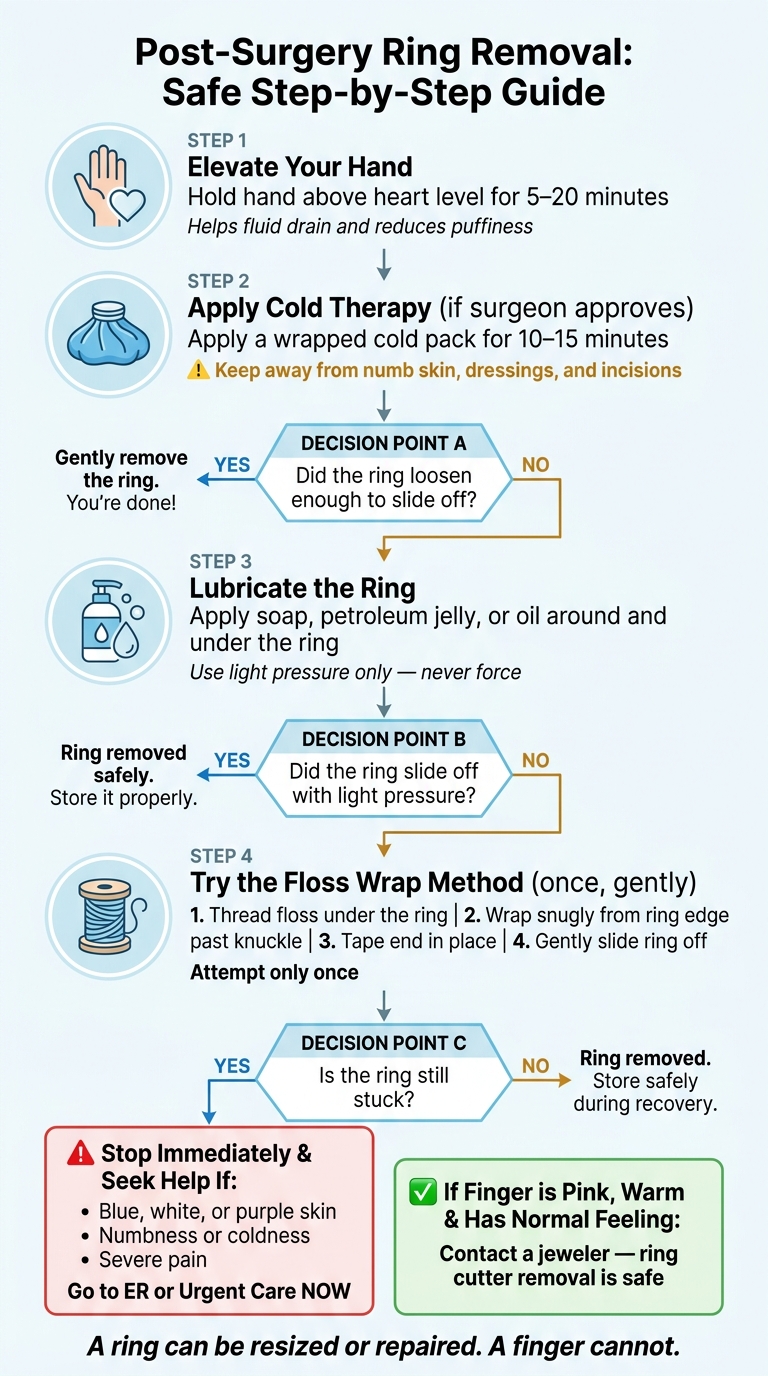
Post-Surgery Ring Removal: Safe Step-by-Step Guide
If none of the warning signs above are present, start by bringing the swelling down before you try to remove the ring.
A Safe Home Sequence for Mild Swelling
Hold your hand above heart level for 5 to 20 minutes. That simple step can help fluid drain and make the finger less puffy. If your surgeon said cold therapy is okay, use a wrapped cold pack for 10 to 15 minutes. Keep it away from numb skin, dressings, and incisions.
Sometimes that's enough. Once the swelling drops a bit, the ring may slide off without much effort.
If the finger still feels tight, move on to lubrication and a gentle removal attempt.
How to Try Gentle Ring Removal Without Force
Put a small amount of soap, petroleum jelly, or oil around and under the ring. Then try to slide it off with light pressure only.
If it still won't budge, you can try the floss wrap method:
- Thread floss under the stuck ring.
- Wrap the floss snugly around the finger, starting at the ring edge and working up past the knuckle.
- Tape the end in place.
This helps compress the finger so the ring can get past the knuckle.
If the ring still doesn't move, stop and get help from a medical or jewelry professional.
When to Stop Home Removal Attempts
Don't keep trying if the ring starts putting circulation at risk. Stop at once if the ring still won't move or if any warning signs show up. Call your surgeon, doctor, or urgent care. If needed, they can remove the ring with ring cutters in a safe way.
If it still won't come off, contact medical or jewelry help right away.
When to Get Professional Help Before the Ring Becomes a Bigger Problem
If home removal doesn’t work, the next step depends on how your finger looks and feels. If swelling is still mild and the finger seems healthy, a jeweler may be able to remove the ring without trouble.
When a Doctor Should Remove the Ring
Go to the ER or urgent care right away if the finger turns blue or white, feels numb, or becomes severely painful. Do not wait.
When a Jeweler Can Help Safely
If the finger is pink, warm, and has normal feeling, call a jeweler. They can remove the ring with a ring cutter and tell you if resizing or repair may still be an option.
Decision Table: Self-Care vs. Medical Care vs. Jeweler Help
| Situation | Best Next Step | What NOT to Do |
|---|---|---|
| Mild snugness; no discoloration | Continue gentle home care. | Don't pull forcefully - it increases inflammation. |
| Persistent tightness; home methods fail | Visit a jeweler for safe removal with a ring cutter. | Don't use household pliers or hardware cutters. |
| Blue/white skin; numbness; severe pain | Go to the ER or urgent care immediately. | Don't delay - circulation is at risk. |
| After healing; ring no longer fits | Consult a jeweler about resizing after recovery. | Don't try to "stretch" the ring at home. |
Put finger safety first. A ring can often be resized or repaired. A finger can’t.
If the ring comes off, store it in a safe place until the swelling fully goes down.
How to Store the Ring and Use Temporary Wear Options During Recovery
How to Store the Ring During Recovery
Once the ring is off, clean and dry it. Then place it in a labeled ring box or a soft pouch, along with its appraisal and insurance records.
It also helps to take a few clear photos before you put it away. Note the engravings, stones, and any visible damage. That way, the ring stays protected, and you have a clear record of its condition.
Wearing the Ring on a Chain Without Creating New Risks
If you want to keep the ring close while your finger heals, wearing it on a necklace is a simple option. It keeps the ring off your finger but still nearby.
Use a sturdy chain made from sterling silver, solid gold, or platinum, and make sure the clasp closes securely. An 18- to 20-inch chain usually keeps the ring at chest level, where it’s less likely to shift around too much.
A few things matter here:
- Keep the ring away from incisions, dressings, and medical devices.
- Don’t wear it while sleeping.
When It Is Safe to Wear the Ring Again
Put the ring back on only after the swelling is fully gone and the ring slides on and off without resistance.
Try it once. If it feels tight or even a little hard to remove, take it off and wait longer. If the swelling hangs around longer than expected, move to adjustable or resizing options next.
Adjustable and Resizable Ring Options Once Swelling Has Settled
If your ring still feels tight after healing, switch to a sizing option instead of forcing it.
Adjustable Rings, Resizing, and Temporary Sizing Aids
Once swelling has gone down all the way, pick a sizing fix that matches your finger in its recovered state.
Professional resizing is the most permanent choice, but it makes the most sense after swelling has fully settled. Resizing a ring again and again can weaken the band over time. And some rings - like full eternity bands, tension settings, or rings made from tungsten or titanium - usually can’t be resized at all.
Temporary sizing aids can work for small gaps, but they should never sit over a healing incision or irritated skin.
Adjustable rings can make sense if your ring size is still changing. They use a hidden slider or an open-back design and usually cover about four sizes, often US 5–9. For the best fit, measure your finger at the end of the day, when fingers tend to be largest. If you expect to adjust the ring often, 14K or 18K solid gold tends to hold up better than gold vermeil, which can wear down along the inside surface and expose the base metal underneath.
How Satinski Fits Into Post-Recovery Planning
If your ring size still shifts after healing, Satinski's adjustable rings can give you a steady long-term fit. Their adjustable wedding bands and engagement rings come in sterling silver or 18K solid gold.
The Safest Recovery Checklist
- Never force a tight ring onto or off a swollen finger.
- Keep temporary sizing aids and adjustable rings away from any healing incision or irritated skin.
- Once your size stays the same, revisit resizing or a permanent fit choice with your jeweler.
FAQs
How long can swelling last after surgery?
Post-surgery swelling can look a little different from person to person. It also depends on the type of procedure you had. In many cases, it starts to ease with rest and cooling. That said, it can stick around longer than expected or flare back up with physical activity, hot weather, or certain health issues.
If the swelling doesn’t go away, gets worse, or shows up along with joint pain or stiffness, talk to a doctor. They can check for other medical problems that may be causing it.
Can a tight ring cause permanent finger damage?
Yes. A ring that’s too tight can hurt both your finger and the ring. It can limit blood flow, cause discomfort, and turn painful if you leave it on too long.
If the swelling is bad or doesn’t go down, the ring can get stuck. At that point, you may need professional removal to avoid more injury. And if your finger is swollen, don’t force the ring on or off.
Should I resize my ring if my finger size keeps changing?
If your finger size changes a lot, standard professional resizing usually isn’t the best long-term fix. Cutting, stretching, or heating a ring over and over can weaken the band, harm small design details, or affect gemstone settings.
A better option is an adjustable ring. It can expand and contract with natural changes caused by temperature, activity, or health conditions, so the fit stays more comfortable and flexible.


