

Men's Signet Rings: Tradition, Meaning, and Modern Fit
A signet ring is no longer just a seal. Today, I’d buy one based on meaning, shape, metal, where I’ll wear it, and how it fits day after day.
If I want the short answer, it’s this:
- Choose the engraving first: crest, initials, monogram, or a personal mark
- Match the face shape to the design: oval for crests, square for simple marks, cushion for a middle-ground look
- Pick metal for wear and upkeep: sterling silver costs less, 14K gold is stronger for daily use, 18K gold has richer color but is softer
- Think about finish: polished faces show more scratches, while brushed, satin, and matte finishes hide light wear
- Wear it where it fits your style: pinky is the old-school choice, index feels more current, ring finger works if it doesn’t clash with other rings
- Get the fit right: signet rings often need extra care because they must pass over the knuckle but still sit snug at the base
A few numbers matter too. Wide signet bands, especially 6 mm+, often fit about 0.5 U.S. size larger than narrow bands. A face that covers about 70% to 85% of the finger width near the nail often looks balanced, while the band usually looks right at about 50% to 70% of the face’s shortest side.
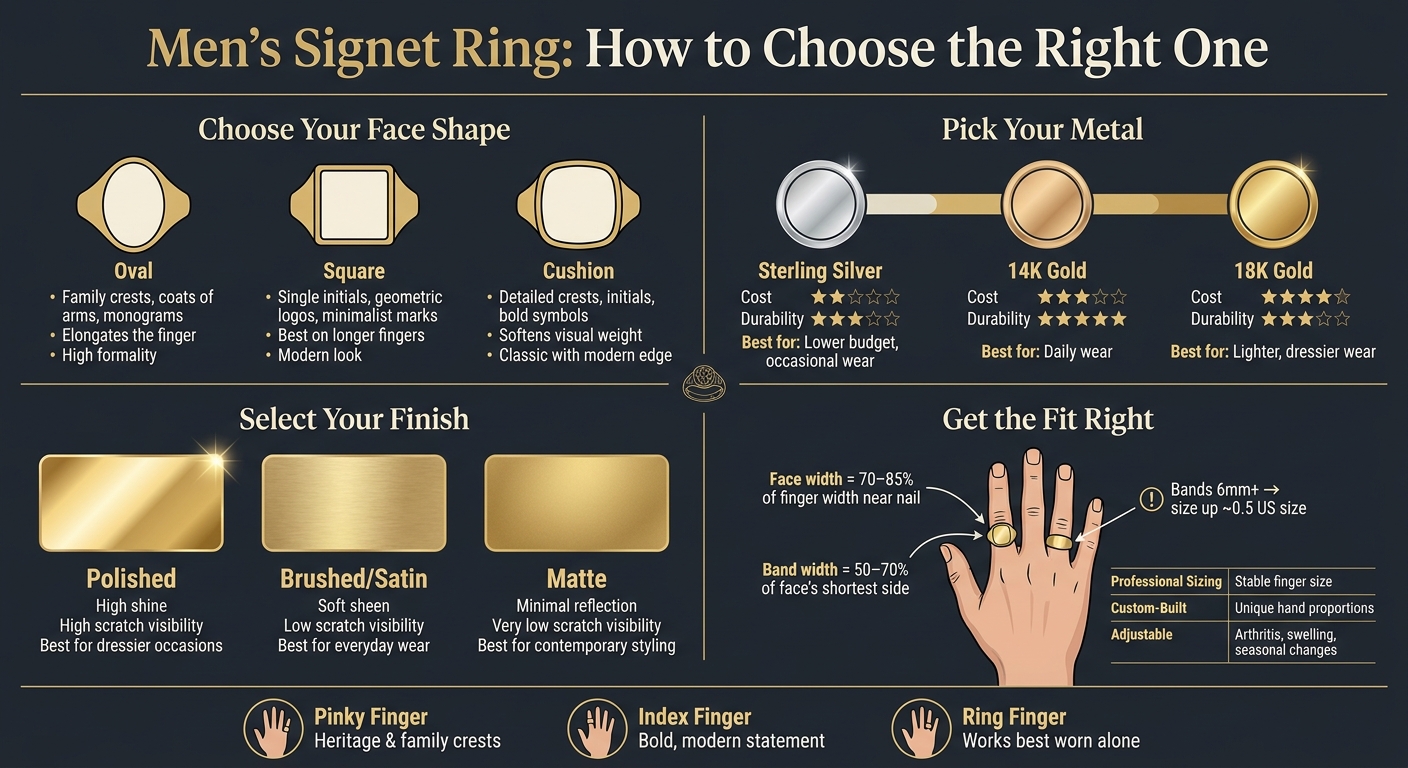
Men's Signet Ring Buying Guide: Shape, Metal, Finish & Fit at a Glance
Men's Signet Rings: What They Are & How To Wear Them
Quick comparison
| Area | Best simple rule |
|---|---|
| Engraving | Use initials or a simple emblem on smaller faces; use crests on larger faces |
| Face shape | Oval for crests and monograms, square for single letters and clean marks, cushion for both |
| Metal | Sterling silver for lower cost, 14K gold for daily wear, 18K gold for lighter wear |
| Finish | Polished for more contrast, brushed/satin/matte for fewer visible scratches |
| Finger | Pinky for heritage style, index for a bolder look, ring finger if worn alone |
| Fit | Professional sizing for steady size, custom build for hand proportions, adjustable if size changes |
I see signet rings as a mix of history and personal style. The right one should look clean, feel comfortable, and say something about you without trying too hard.
Common symbols, engravings, and what they mean
Family crests, initials, monograms, and personal emblems
On a signet ring, the engraving is the part that gives the ring its meaning.
A family crest or coat of arms points to ancestry and heritage. These heraldic designs often include a shield, animals, and a motto. Lions have long stood for courage and nobility, while eagles suggest authority and vision.
Initials and monograms speak to personal identity in a simpler, more everyday way. A three-letter monogram tends to feel more formal. By custom, the surname initial appears larger in the center, with the first and middle initials on either side.
Some men go beyond initials and pick symbols tied to belief, work, or membership. Fraternal marks like Masonic squares and compasses, university crests, and military insignia can show shared affiliation. Religious motifs, including crosses and fleur-de-lis, can signal spiritual identity and devotion.
Size matters here. A smaller ring face usually works best with a single initial or a simple emblem. Larger faces can handle detailed heraldic designs without losing clarity.
Once you've picked the symbol, the next step is deciding how it should be engraved.
Intaglio seal engraving vs. decorative engraving
Intaglio engraving cuts the design into the metal in a recessed, reversed form, so when it's pressed into warm sealing wax, it leaves a raised impression facing the right way. This was once used to authenticate documents and letters, and it still fits anyone who wants to use a signet ring as an actual seal.
Decorative engraving - whether raised or surface-cut - is the more common pick for modern wear. It shows the design clearly while the ring is on your hand. There is a trade-off, though. Shallow surface lines can wear down faster with frequent use, especially on softer metals like gold. Deeper cuts create stronger contrast and help the design stay readable for longer.
For day-to-day wear, decorative engraving is usually the better fit. Intaglio makes sense if you plan to use the ring to seal wax.
sbb-itb-9da40c1
Signet ring shapes and how to choose one
Oval, square, and cushion faces
Once you know the engraving, the next big call is the face shape. That choice changes how the design looks on the hand. It affects how much room you have, how much detail you can fit, and the overall feel of the ring. Put simply: the shape should fit both the symbol and what you want it to say.
The oval is the classic pick for crests and monograms. Its vertical layout works especially well for family crests, coats of arms, and monograms, and it gives the ring a refined, longer-looking profile.
Square faces give off a sharper, more modern look. Their straight edges and crisp corners suit single initials, block monograms, geometric logos, or even a plain polished face.
The cushion face lands between the two. It’s a rounded square with bowed sides, so it keeps some softness without losing presence. It also gives you more usable surface area than an oval of similar width, which makes it a good fit for detailed crests or bold motifs. It still carries a classic feel, but it reads a bit stronger than a pure oval.
How face shape affects engraving and hand balance
Face size should look balanced on your finger. On shorter or wider fingers, an oval can help draw the eye up and down the finger, which makes the hand look longer. Square faces tend to work better on longer, straighter fingers, while a large square can feel a bit boxy on shorter fingers. Cushion faces are often the easiest to wear because the rounded corners soften the outline while still giving the ring some weight.
| Face Shape | Best-Suited Engravings | Formality | Effect on the hand |
|---|---|---|---|
| Oval | Family crests, coats of arms, monograms, intaglio seal engraving | High - classic and traditional | Elongates the finger and suits most hand sizes |
| Square | Single initials, block monograms, geometric logos, minimalist surface engraving | Medium to low - modern and graphic | Best on longer, straighter fingers |
| Cushion | Detailed crests, heraldry, initials, simple symbols | Medium to high - classic with a modern edge | Adds visual weight without looking harsh |
If your engraving has detailed heraldry, oval or cushion usually makes more sense. If you want a minimal symbol or a single letter, square or cushion tends to look better.
After shape, metal and finish decide how the ring wears every day.
Metals, personalization, and how to wear a signet ring
Sterling silver, gold, finish, and durability
Metal choice comes down to four things: color, wear, upkeep, and price.
Sterling silver is more budget-friendly and has a crisp, clean look. But it tarnishes, and it’s softer than gold, so it needs a bit more attention over time.
For daily wear, 14K gold gives you the best balance of strength and warmth. 18K gold has a richer color, but it’s softer, so it’s better for lighter wear.
Finish matters too. It changes both the look of the ring and how it ages in day-to-day use. A polished finish looks bright and dressy, but flat signet faces tend to show scratches more easily. Brushed or satin finishes cut down the reflection and do a better job hiding light wear, which makes them a smart pick for everyday use.
| Finish | Look | Scratch Visibility | Best For |
|---|---|---|---|
| Polished | Formal, high-shine | High | Dressier occasions |
| Brushed/Satin | Soft, modern | Low | Everyday wear |
| Matte | Quiet, minimal | Very low | Contemporary styling |
A simple rule helps here: use polished faces when you want deeper contrast, and go with brushed or matte finishes for simpler marks.
Custom engraving and inside-the-band details
Once the face design is set, the inside of the band is the right place for extra detail. That keeps the front clean and easy to read.
Because inside-band engraving is protected from daily wear, it works well for personal details like dates, names, or short phrases. Common picks include a date in U.S. format, such as 06-21-2024, a short phrase, or a partner's name.
Pinky, ring finger, or index finger: where to wear a signet ring
After you pick the metal and engraving, finger placement is the next call.
The most classic option is the pinky finger on the non-dominant hand. That’s still the clearest choice for heritage pieces and family crests. It keeps the ring visible without fighting for space with a wedding band, and it may also help cut down on day-to-day rubbing on the face.
The index finger feels more current and gets more attention. It suits larger or bolder faces, especially geometric or gem-set designs, and it reads like a clear style move.
The ring finger works too, especially if you don’t wear a wedding band. If you do, though, the two rings can compete visually.
Pick one placement and let the ring stand on its own. After that, fit becomes the last piece of the puzzle, especially if the ring will need professional sizing or a resizable design.
Fit, sizing, and the best long-term option
Professional sizing and custom-built proportions
A signet ring needs to do two things at once: get over the knuckle and then sit snug at the base of the finger. That’s what makes it harder to fit than a plain band.
Measure the knuckle and the base of the finger separately. Do it at different times of day and in different temperatures, and make sure you’re measuring the exact finger you plan to wear the ring on. Wide signet bands, especially 6 mm and up, usually fit about half a US size larger than narrow bands. If standard sizing still doesn’t feel right, custom proportions usually fill the gap.
With a custom-built ring, the jeweler can tune the face width, band thickness, and engraving area to your hand. That matters most if you have pronounced knuckles or finger shapes that aren’t even from base to joint. A good target is a face that measures about 70–85% of the finger width at the base of the nail, with band width at 50–70% of the face’s shortest dimension.
Adjustable and resizable signet rings for changing finger size
If your finger size shifts because of swelling, arthritis, or the seasons, adjustable signet rings can make more sense. These rings use an overlapping back band that opens to pass over the knuckle and then closes snugly at the base. When finger size changes over time, a fixed ring may stop being the right pick.
If you expect to adjust the ring often, 14K solid gold tends to wear better than plated metal. The sliding contact point creates friction over time, and solid gold won’t expose a different-colored base metal underneath the way vermeil can. Standard resizing can work for a one-time fix, but repeated heating and stretching may weaken the metal after 1–2 changes.
Conclusion: Bringing meaning, design, and comfort together
The best option comes down to one thing: how much your finger size changes.
| Fit Option | Comfort | Permanence | Flexibility | Best For |
|---|---|---|---|---|
| Professional Sizing | High (when size is stable) | Fixed | Low | One-time correction; known, stable finger size |
| Custom-Built | Excellent (tailored proportions) | Fixed | Low | Matching face, band, and engraving to the hand |
| Adjustable/Resizable | High (adapts to changes) | Medium | High | Arthritis, swelling, seasonal size fluctuation |
If your size stays steady, go with professional sizing. If proportions are the main issue, a custom build gives a better match. If your finger size moves around, an adjustable design gives you more room to live with the ring comfortably.
FAQs
Can I wear a signet ring every day?
Yes. You can wear a signet ring every day, but durability matters. Rings deal with constant friction, hand washing, and regular contact with desks, doorknobs, and other hard surfaces.
Metals like 14K solid gold or platinum hold up well against wear and tarnish. Gold-filled and gold vermeil can also work for frequent use, but solid gold is usually the best pick for daily wear.
What ring size should I order for a signet ring?
If you choose one of our adjustable signet ring designs, you won’t need to choose a set size. These rings usually fit US sizes 5 to 9 and can be gently opened or closed for a comfortable, secure fit.
If you’d rather go with a fixed-size ring, make sure you get an accurate measurement from a professional.
How do I choose a signet ring that suits my hand?
Choose a signet ring that fits your style and feels good on your finger. Popular bezel shapes range from the classic Oxford Oval to the sharper Octagon and the timeless Cushion style.
No matter which shape you pick, the ring should feel comfortable and stay in place without slipping off. If your finger size tends to change during the day because of heat, cold, or activity, an adjustable design can make life a lot easier and help you get a secure fit without needing professional resizing.


