

Maintenance Phase: When Is Your Ring Size Finally Stable?
Your ring size is usually stable only when the fit stays the same for weeks or months under normal conditions. A hot day, a salty meal, exercise, travel, pregnancy, weight change, medication, or arthritis can all change fit without meaning you need a resize.
Here’s the short answer:
- Wait if the fit problem shows up only with a clear trigger, like heat, swelling, travel, or a workout.
- Track it for 1–2 weeks under normal conditions before you make any choice.
- Think about resizing only if the ring feels too tight or too loose most of the time for 3–6 months.
- After weight change, wait until your weight has stayed about the same for 3–6 months.
- After pregnancy, many people should wait until at least 6 weeks to 3 months postpartum, and often 4–6 months if breastfeeding.
- Use a temporary fix like a ring guard, silicone adjuster, or sizing beads if your size is still shifting.
- Pick a ring with more give if swelling, large knuckles, or arthritis keep changing the fit.
A few numbers matter here: finger size can shift by about 2%–3% during the day, and short-term swelling can change fit by up to half a size or more. Pregnancy can change fit by 1–2 full sizes, while a lasting adult change often comes from weight shifts, aging, menopause, or joint changes.
If I boil the whole article down to one point, it’s this: a stable ring size is not one exact number - it’s the fit that keeps showing up under normal life.
Should you resize your engagement ring more than once? #engagementrings #diamonds #jewelry
sbb-itb-9da40c1
Short-Term Factors That Change How Your Ring Fits
Before you assume your ring size has changed for good, start with the day-to-day stuff. A lot of fit issues come from short-term swelling or shrinking, not a permanent change.
How Temperature and Season Affect Finger Size
Temperature has a big effect on finger size. Heat makes blood vessels near the skin widen, while cold makes them narrow. That means fingers often swell in warm weather and shrink in cold weather. In some cases, the same ring can feel up to half a size tighter in August than in January.
In many parts of the U.S., summer heat in the 80s or 90s°F - especially with heavy humidity - can make a ring leave light marks, feel tougher to turn over the knuckle, or seem snug after you've been outside for a while. Then winter rolls around, temperatures drop into the 40s°F or lower, and that same ring may spin more easily or drift toward your palm.
That's why one hot day or one freezing day doesn't tell you much by itself. If you only check fit at the weather extremes, you may get the wrong read on your size.
Travel can also throw things off. Moving from a cool place to a hot, humid one often leads to short-term swelling. If your ring feels tight during a trip, give it about a week after you're back home before you judge the fit. If the problem shows up only in one season or one climate, wait for your usual conditions before deciding on a resize.
Time of Day, Exercise, Salt, and Hydration
Finger size also shifts over the course of a normal day. Most people are slimmest in the morning, after lying down overnight while fluid is more evenly spread through the body. As the day goes on, mild swelling is common. By late afternoon or evening, finger size can increase by about 2–3%.
That small change is enough to make a ring feel different.
A few common triggers can also make fingers swell for a short time:
- Exercise
- Salty meals
- Alcohol
- Dehydration
These can lead to swelling that lasts anywhere from a few hours to a few days. So if your ring feels off for one day, that usually points to fluid retention, not a permanent size shift. It's smart to wait a day or two, eat normally, and hydrate before checking again.
Swelling from Illness, Medication, or Injury
Sometimes the cause is less obvious. Illness, allergic reactions, infection, and hand injuries can all lead to swelling that sticks around for days or even weeks. Minor injuries like jammed fingers, sprains, small fractures, or soft-tissue bruising can leave the finger puffy and stiff for quite a while, even after the swelling looks like it's fading.
Medication can play a part too. Some blood pressure drugs, steroids, hormonal treatments, and antidepressants may cause fluid retention. If your ring started feeling tighter around the same time you began a new prescription, it's worth asking your doctor if swelling is a known side effect and how long it usually lasts.
If swelling starts, take the ring off early and store it somewhere safe. Waiting too long can make removal much harder. And if your finger has been swollen, give it several weeks of normal fit before you treat the change as permanent or move ahead with resizing.
If the fit still seems different after several normal days, the next step is to look at whether the change may be longer term.
Life Stages That Can Shift Your Ring Size Over Time
Once you’ve ruled out day-to-day swelling, the next step is simple: figure out whether a bigger life-stage change has moved your baseline ring size. Some shifts stick around much longer than a hot day, salty meal, or hard workout. This section looks at the life stages most likely to change how a ring fits over time.
Growth, Adult Stability, and Weight Change
During the teen years, finger size can change fast. As bones lengthen and thicken, fingers may shift by ½ to 1 full ring size within just a few months. For most people, hand size settles down by the early to mid-20s, as long as weight and health stay fairly steady.
Weight change can affect ring fit too. A gain or loss of 10–20 lb or more, held for several months, can shift ring size by about ½ size or more. Smaller changes, like 5 lb or less, usually don’t move the needle much. If your weight is still going up or down, your ring size may be doing the same. It’s smart to wait until your weight has been steady for 3–6 months before treating a new measurement as your baseline.
Pregnancy and the Postpartum Period
Pregnancy is a different story because the shift can be much bigger than normal adult change. Swelling during pregnancy, especially in the third trimester, can increase finger size by 1–2 full ring sizes. If a ring starts feeling tight during pregnancy, take it off and store it somewhere safe. Waiting too long can turn a minor hassle into a stuck-ring problem.
After delivery, many people return to their pre-pregnancy fit between 6 weeks and 3 months postpartum. That said, a lasting increase of about ½ size is common. If you’re breastfeeding, it’s best to wait at least 4–6 months after delivery before resizing a valuable or heirloom ring.
Aging, Menopause, Arthritis, and Larger Knuckles
Later in life, ring fit often changes in a less obvious way. Knuckles and finger tissue don’t always change together. Some people notice more puffiness by the end of the day. Others find that their rings suddenly feel loose, even though getting them on is still a chore.
A common issue is a knuckle-to-base mismatch. Osteoarthritis can make the knuckles larger while the base of the finger stays the same or even gets slimmer. So the ring may be tight at one spot and loose at another. If you’re having a hard time getting a ring over a swollen knuckle on a regular basis, talk with a jeweler about fit options made for that exact problem.
Use these patterns to help sort out whether the change looks temporary or whether your baseline has shifted. Next, check whether the change is temporary or permanent before you resize.
How to Tell If Your Size Change Is Temporary or Lasting
What matters most isn't one odd day. It's the pattern.
A ring that feels tight on a hot afternoon doesn't mean much by itself. A ring that stays too tight or too loose across normal days and normal weather is a different story. You're not looking for a one-off change. You're looking for repetition.
Signs the Fit Problem Is Probably Temporary
The biggest clue is a clear trigger.
Fingers can shift by about half a ring size under certain conditions. So if your ring feels off only after a workout, on a hot day, after a salty meal, during travel, or at another easy-to-spot moment, that usually points to a short-term change.
If the ring goes back to normal once that trigger passes, hold off on resizing. In that case, the smart move is to watch the pattern a bit longer. If you can't tie the fit issue to one clear cause, then it makes more sense to check whether your normal size has changed.
Signs Your Baseline Size Has Likely Changed
Here, consistency is the main thing.
A fit change is more likely to last when the ring stays off across normal days, normal times, and normal weather for several weeks. There isn't one event you can blame. It just feels tight or loose most of the time.
That's the difference. Temporary swelling comes and goes. A baseline change keeps showing up under ordinary conditions.
A Normal-Condition Fit Check Before You Commit
Before you resize, check the ring 3 to 4 times over 1 to 2 weeks under normal conditions: room temperature, normal hydration, and no recent workout, salty meal, alcohol, or travel.
Think of this as your last gut check before you make a change.
At each check, pay attention to a few simple things:
- Does the ring slide over your knuckle with gentle resistance?
- Does it sit snugly without throbbing or leaving deep marks?
- Does it stay put without spinning or shifting too easily?
It also helps to jot down a quick note about how the ring felt and what was going on that day. Nothing fancy. Just enough to spot a pattern. If the ring feels off in most of those checks, that's probably your baseline.
Use this quick pattern check to read what the fit is telling you:
| Pattern you notice | Meaning |
|---|---|
| Tight or loose only when a clear trigger is present | Temporary swelling - recheck under normal conditions before resizing |
| Loose in cold weather or first thing in the morning, normal later | Normal fluctuation - wait for a consistent pattern across neutral checks |
| Tight or loose across most days, times, and seasons | Likely a baseline change - get a professional fit check and discuss resizing |
| Postpartum fit still off after recovery | Likely new baseline - confirm weight and fluid status have stabilized before resizing |
| Illness or new medication | Temporary fluid retention - wait for health status to stabilize |
That quick read helps you decide whether it's time to resize now or go with a more flexible ring.
When to Resize Permanently and When to Choose a Flexible Ring
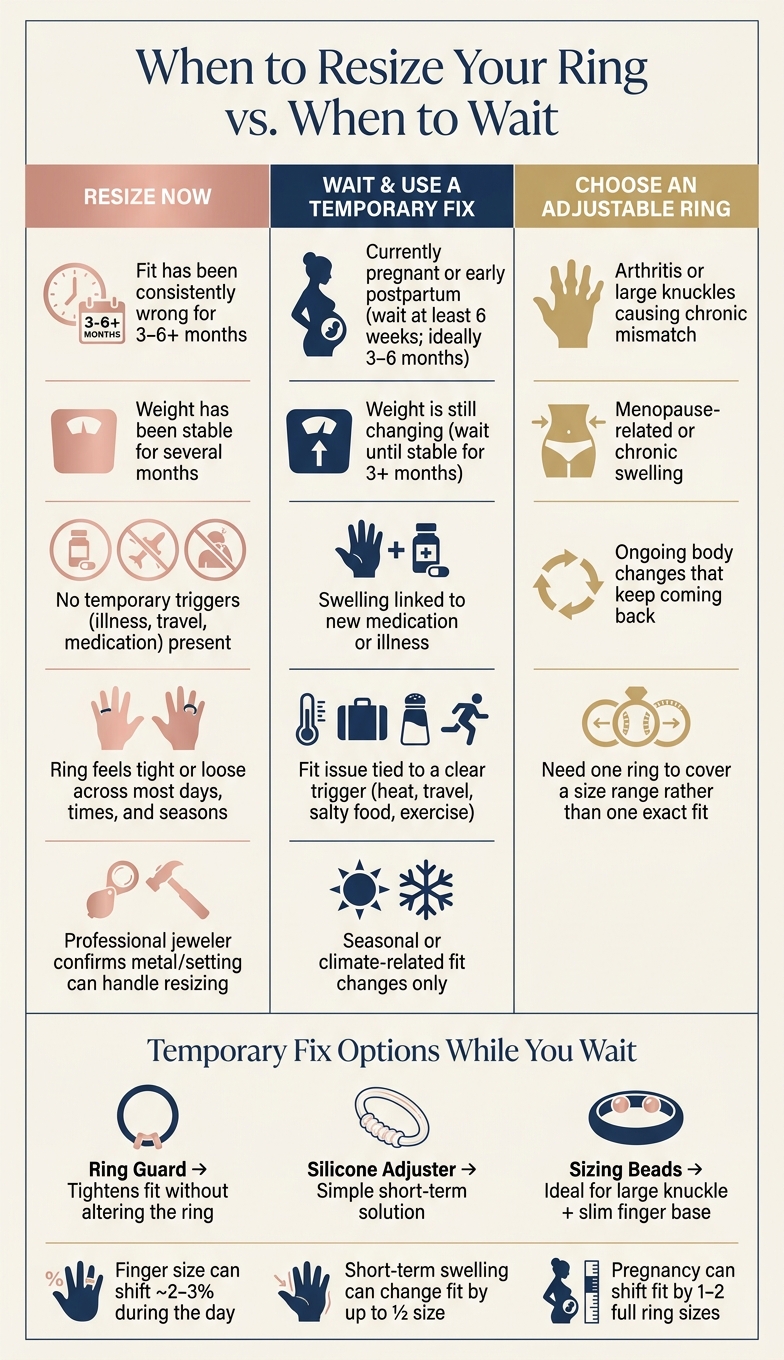
When to Resize Your Ring vs. When to Wait: A Quick Decision Guide
If your ring keeps feeling off during normal day-to-day life, go with the least permanent fix that fits the problem.
When Permanent Resizing Makes Sense
Permanent resizing makes sense when the fit has been consistently wrong for at least 3–6 months under normal conditions, and your weight has stayed steady for several months. In plain English: if nothing temporary is going on and the ring still doesn’t fit, resizing may be the right move.
Before you book anything, ask your jeweler two simple things:
- Can this ring’s metal and setting handle resizing?
- How large a size change is needed?
Most plain gold, silver, or platinum bands can often be resized by about one U.S. size. Rings with more complex settings may need more involved repair work.
When to Wait or Use a Temporary Fix
If your finger size is still shifting, resizing now may just set you up to resize again later.
Pregnancy and the first few months after birth are the clearest cases where waiting makes more sense. Most guidance says to avoid permanent resizing during pregnancy and to wait at least 6 weeks after birth. In many cases, 3–6 months postpartum is a better window, once fluid retention and hormone changes have settled.
The same idea applies to weight change. If your weight is still moving up or down, hold off until it has been steady for at least 3 months before making a permanent change.
While you wait, temporary tools can do the job:
- Ring guards tighten the fit without changing the ring itself.
- Silicone adjusters are a simple short-term option.
- Sizing beads help a lot if you have a large knuckle and a slimmer finger base. The ring can slide over the knuckle, then sit more snugly once it’s in place.
When an Adjustable or Resizable Ring Is the Better Choice
Sometimes the best fix isn’t resizing at all. It’s choosing a ring built to move with your finger size.
If you deal with arthritis, menopause-related swelling, chronic swelling, or other body changes that keep coming back, an adjustable design can make more sense than repeated resizes.
Adjustable and resizable rings are often the best long-term pick when fit changes don’t stay put. They work well when one ring needs to cover a size range instead of one exact fit.
Use the table below to match the fix to your situation.
| Your situation | Best approach |
|---|---|
| Stable fit issues for 3–6+ months and weight has been steady | Permanent resize |
| Pregnant or in the early postpartum period | Wait; use a ring guard or temporary adjuster |
| Ongoing weight change | Wait until stable for 3 months |
| Arthritis, large knuckles, or chronic swelling | Adjustable or hinged ring |
| Seasonal, travel, or climate-related changes | Adjustable ring or temporary adjuster |
| Medication-related swelling | Wait for health status to stabilize |
Conclusion: A Stable Ring Size Is a Range, Not a Single Number
Your ring size isn’t one fixed number. It’s more like a small range, and it can shift with normal day-to-day changes. So the main issue isn’t whether your size changes. It’s whether that size has settled into a clear pattern.
Once you spot that pattern, the next step gets a lot easier. Brief, obvious swelling usually means you should wait. A steady fit issue with no clear cause usually points to resizing. If a ring has felt consistently wrong for 3 months or more during ordinary daily life, that’s a strong sign of a lasting size change.
If your body is still changing - during pregnancy, while your weight is still moving, after starting a new medication, or during arthritis flare-ups - it’s usually smarter to hold off on permanent metal work. In that case, a temporary fix makes more sense.
Before you buy, ask about comfort-fit interiors or resize-friendly designs.
If a ring feels comfortable most of the time and stays secure on your finger, it’s doing what it should. Resize it only when the pattern has clearly changed.
FAQs
How long should I wait before resizing my ring?
Before committing to permanent resizing, pay attention to how your ring fits for a few weeks in different temperatures and at different activity levels.
Finger size can shift with hydration, exercise, and heat. If that change keeps happening over time - because of weight changes, pregnancy, or age - it may be lasting and worth having a jeweler resize the ring. If your size tends to swing back and forth, an adjustable ring can be a smart, practical option.
Can my ring size change without weight gain?
Yes. Your ring size can change even if your weight stays the same.
A lot of things can affect how a ring fits, including temperature, daily activity, hormonal shifts, pregnancy, menopause, your menstrual cycle, water retention, arthritis, and aging. Sometimes the change is temporary, like swelling from heat or fluid buildup. Other times, like aging or joint changes, it can last much longer.
What if my ring fits differently each day?
That’s completely normal. Finger size can shift during the day and from one season to the next. Temperature, hydration, exercise, salty foods, and even stress can all play a part. In warm weather, fingers often swell. In cold weather, they can get smaller.
If that leads to regular discomfort, an adjustable ring might be a good fix. It can expand or contract with your finger, which means you may not need to get it professionally resized as often.


