

Why Jewelers Say Don't Resize Until Your Weight Stabilizes
If your weight or swelling is still changing, I’d wait to resize the ring. A permanent resize too soon can lead to a second repair bill, and in many cases that means another $20 to $100+, or more for some metals and ring styles.
Here’s the short version:
- Finger size can shift by about 0.5 size or more from heat, cold, salt, exercise, and morning swelling.
- A body-weight change of 10 to 15 lb can change ring fit for many people.
- Many jewelers suggest waiting until your weight stays within about 5 lb for a few months before making a permanent change.
- During pregnancy or after birth, many people wait 3 to 6 months postpartum before resizing.
- Repeat resizing can add cost and put more stress on the band, solder points, and stone settings.
- A ring guard, sizing beads, or a spring insert can help while your size is still moving.
If the ring is painful, stuck, or cutting off circulation, I would not wait. Get help right away. But if the fit changes from week to week, the main point is simple: use a temporary fix now, then resize once after your size settles.
| Option | Best When | Cost Pattern | Main Tradeoff |
|---|---|---|---|
| Resize now | Finger size has stayed the same for months | One-time cost if fit stays stable | May need another resize if size changes again |
| Temporary fix | Weight, swelling, or hormones are still shifting | Lower short-term spend | Fit may not feel as exact as a resize |
| Wait, then resize once | Size has been steady within about 5 lb | Often lowers total spend | You need patience for a few months |
I see the issue like this: the goal is not just to make the ring fit today. The goal is to avoid paying twice and putting extra wear on the ring for a size that may change again.
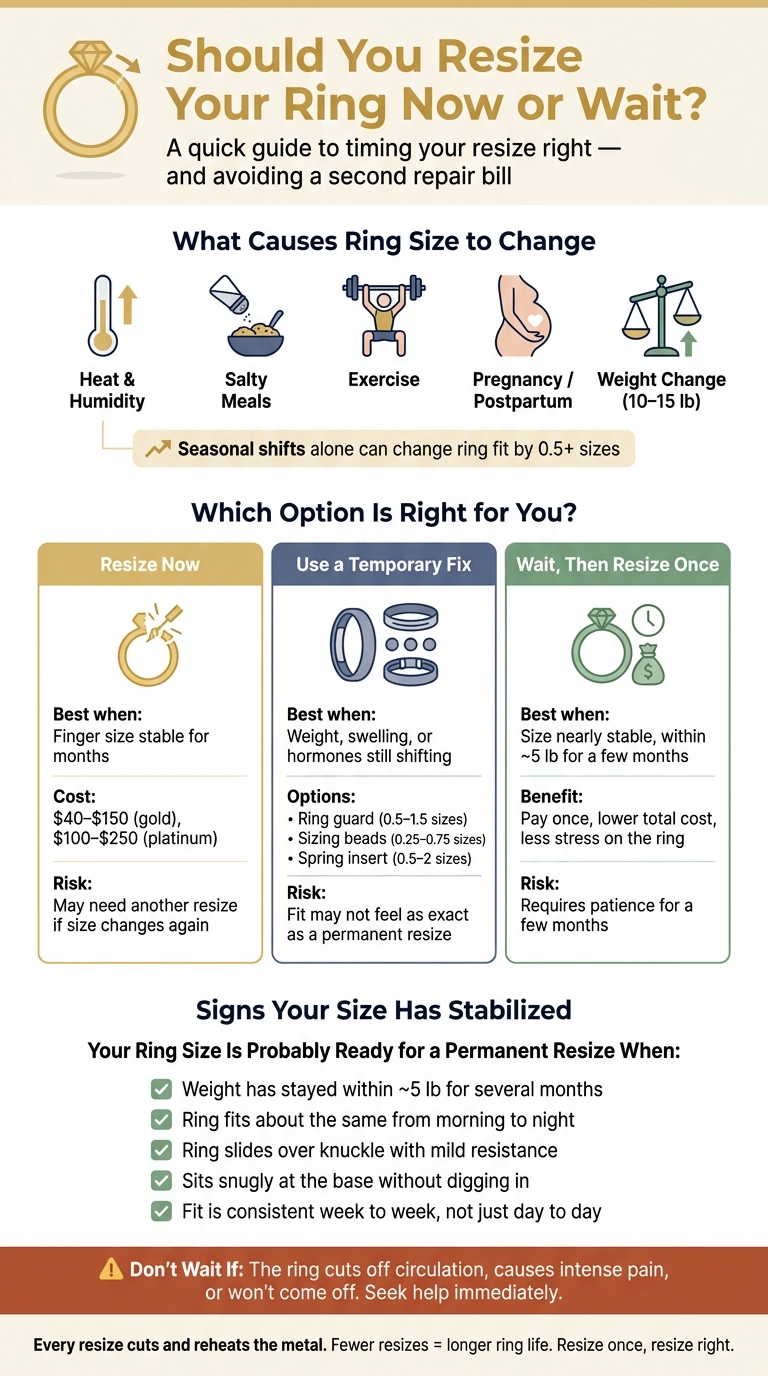
Ring Resizing vs. Temporary Fix: When to Wait and When to Act
Ep 18: When To Resize Your Ring
sbb-itb-9da40c1
How Weight Changes Affect Finger Size
Finger size changes with fluid shifts and longer-term body changes. That’s why timing matters so much. The main issue isn’t just whether your ring fits today. It’s whether it will still fit once your body stops changing.
Short-Term Changes: Swelling, Temperature, Salt, and Exercise
Short-term changes are the main reason a ring can feel tight one day and totally fine the next.
Warm weather and humidity can make fingers swell, which makes rings feel tighter. Cold winter weather does the opposite. Blood vessels narrow, fingers get slimmer, and a ring that fit well in July may spin in January. Seasonal changes can shift ring fit by half a size or more.
Time of day matters too. Fingers are often a bit puffier in the morning after you’ve been lying flat overnight. As the day goes on, they may loosen up.
A few common triggers can change ring fit for a short time:
- Heat and humidity
- Salty meals
- Exercise
- Morning fluid retention
If your ring feels tight only after a workout or after eating something salty, then feels normal again by the next morning, that’s usually just normal fluctuation. It’s not a clear sign that you need a resize.
Long-Term Changes: Weight Loss, Pregnancy, Postpartum, and Health Conditions
Long-term weight changes are different. They can make a size change stick.
That’s why engagement rings, wedding bands, and heirloom pieces often need temporary fixes during weight loss, pregnancy, or major fitness changes. As body weight changes, the soft tissue in your fingers can change too. Many jewelers say that a shift of around 10 to 15 lb is enough for many people to notice a steady change in ring fit, especially once that new weight has held for a few months.
Pregnancy can cause some of the biggest short-term changes. In the third trimester, fluid retention can make rings dangerously tight. Many obstetric providers tell patients to remove rings before swelling gets worse. After delivery, weight and swelling can still keep changing for months, especially during breastfeeding. That’s why most U.S. jewelers suggest waiting 3 to 6 months postpartum before choosing a permanent resize, unless the ring is causing pain or cutting off circulation.
Health conditions can make things more complicated. Rheumatoid arthritis and osteoarthritis can enlarge the knuckles through inflammation and bone changes. That can leave you stuck with a ring that’s hard to get over the joint but loose once it reaches the base of the finger. Hypothyroidism can also cause general puffiness from fluid retention, and that may improve after hormone levels are treated and stable. In cases like these, jewelers usually wait until the change has settled before doing a permanent resize.
What a Stable Ring Size Actually Looks Like
A stable ring size usually means your weight has stayed within about 5 lb for several months, and the ring fits about the same from morning to night.
Here’s what that fit should look like:
- The ring slides over the knuckle with mild resistance
- It sits snugly at the base without digging into the skin
- Fit stays fairly steady week to week
Some change on very hot or very cold days is normal. What you want to avoid is a fit that keeps swinging with the seasons or changes from week to week. If the ring has fit the same way for months, resizing may make sense. If not, a temporary fix is usually the safer move.
Why Repeated Resizing Costs Money and Can Weaken a Ring
Every resize changes the ring a little. A jeweler has to cut the band, adjust the metal, and reheat the ring to close it back up. So even when the work is done well, each resize alters the piece. That’s why repeat sizing can turn a simple fix into another bill.
How Multiple Resizes Affect Metal, Prongs, and Stone Settings
Each resize removes some metal and reheats the joint. Over time, that can thin the band and make prongs or stone settings less secure. After a few resizes, the risk of damage goes up.
This matters even more for styles that don’t leave much room for adjustment. With channel-set bands, pavé rings, and eternity rings, repeat resizing can shift stones out of line or create gaps in the channels.
How Waiting Can Lower Your Total Cost
In the U.S., a resize often costs $40 to $150 for gold and $100 to $250 for platinum. Sizing up also tends to cost more than sizing down.
If your finger size is still changing, those charges can stack up fast. And if a repeat visit leads to more repair work, the total can climb even higher. Waiting until your size has stayed the same for a few months makes it more likely that you’ll pay once instead of getting stuck in a repeat repair cycle.
When to Get Help Right Away Even If Size Is Still Changing
Some cases shouldn’t wait. If the ring cuts off circulation, causes intense pain, or won’t come off, get help right away.
A jeweler or medical professional can remove it safely, and the ring can be repaired later.
If the ring is still safe to wear, the next step is figuring out whether the fit issue is temporary or permanent.
How to Tell If the Fit Problem Is Temporary or Ready for a Permanent Fix
A ring fits well when it slides over the knuckle with slight resistance and then sits snug at the base without spinning around. If it spins more than a quarter turn while your hand is at rest, it’s too loose. On the flip side, if it feels painful, is hard to take off, or leaves a deep mark after removal, get it checked right away.
Signs the Fit Issue Is Probably Temporary
Sometimes the problem isn’t the ring. It’s your finger.
If the ring feels tight only after workouts, salty meals, travel, hot weather, or hormonal shifts, the change is probably temporary. In that case, don’t rush into resizing. If the fit is still fine on most days, it’s smarter to wait and use a temporary fix for now.
Signs It May Be Time for a Permanent Resize
A permanent resize makes more sense when the fit issue shows up day after day under normal conditions, no matter the weather or time of day. This often happens during weight loss, postpartum recovery, and fitness changes. If the fit stays the same across normal days and your weight has been stable, a permanent resize is usually the right move.
That line between temporary and permanent matters. If your finger size is still shifting, use a temporary fix instead of making a permanent cut.
What to Do Instead of Resizing Right Away
If the fit issue is temporary, it usually makes more sense to use a fix you can undo later and wait until your size levels out.
Temporary Fit Fixes: Ring Guards, Sizing Beads, and Spring Inserts
Three options handle most cases: plastic ring guards, sizing beads, and spring inserts. They all solve the same basic problem, but in different ways. The best pick depends on the ring itself and on how much your finger size is changing.
Plastic ring guards are clear sleeves or wrap-around clips that attach to the inside of the band. They cost less, go on easily, and can tighten the fit by about 0.5–1.5 US sizes. That makes them a good short-term option during pregnancy, postpartum, or active weight loss.
Sizing beads are two small metal balls soldered inside the shank. They usually reduce fit by about 0.25–0.75 size and tend to work best when the knuckle is larger than the base of the finger. Once the ring is on, they're almost impossible to notice, and they hold up well over time.
Spring inserts are thin curved metal strips added inside the band. They open as the ring moves over the knuckle, then press inward so the ring sits snugly at the base of the finger. They can make up for about 0.5–2 sizes and are often a smart fit for top-heavy rings or heirlooms. Like sizing beads, they need to be soldered in by a jeweler.
Put simply: these options let you deal with the fit now without rushing into a permanent change you may need to undo later.
| Solution | Adjustment Range | Visibility | Durability | Best For |
|---|---|---|---|---|
| Plastic ring guard | Small to moderate | Slightly visible underneath | Moderate; may need replacement | Pregnancy, postpartum, short-term weight loss |
| Sizing beads | Minor | Hidden inside band | High | Large knuckles, arthritis, spinning rings |
| Spring insert | Moderate to larger | Hidden inside band | High | Heavier settings, heirlooms, ongoing fluctuations |
These fixes keep the ring wearable without committing to a permanent cut.
Adjustable Ring Designs Built for Changing Finger Sizes
If the size change may stick around for a while, a ring with a built-in adjustable design can be a better path than cycling through temporary fixes.
This matters most when you expect finger-size swings for a year or more. That could mean a long-term fitness change, chronic arthritis, or seasonal swelling that keeps coming back. In cases like that, built-in adjustable rings can make day-to-day wear much easier.
They don't replace the need to wait for your size to settle before doing a permanent resize. What they do is buy you time. They cover that in-between stretch and help the ring stay comfortable while your finger size is still shifting.
Conclusion: Wait for Stability, Protect the Ring, Then Resize Once
The logic here is pretty simple: weight changes can change finger size, and a finger size that keeps changing is not ready for a permanent cut. Temporary aids and adjustable designs help you get through that period without putting extra stress on the ring or spending more money than you need to.
| Factor | Resize Right Away | Wait with Temporary or Adjustable Solutions |
|---|---|---|
| Ring durability | Risk of weakening if resized multiple times | Better long-term integrity; fewer cuts and solders |
| Comfort | Perfect fit now, but may shift again | Adjustable day to day as size fluctuates |
| Total cost | Higher if the ring needs another resize later | Lower upfront for temporary aids, with adjustable designs reducing the need for future resizing |
| Likelihood of another resize | Higher if weight is still changing | Lower; one permanent resize done after stabilization |
Use a temporary or adjustable fix until the fit stays steady. Protect the ring now, then resize once later.
FAQs
Can resizing damage my ring?
Yes. Traditional resizing usually means cutting the band, adding or removing metal, and then soldering it back together. That process can weaken the ring over time.
If a ring is resized again and again, the chance of cracking or warping goes up. And some styles are much harder to work with than others. Eternity rings, tension settings, and complex settings may be difficult - or even impossible - to resize without harming the stones or the way they’re set.
How do I know if my ring fit is only temporary?
Your ring fit is probably a short-term thing if it changes with heat or cold, daily activity, hydration, salt intake, or stress, and then goes back to normal within a few hours or by the next day.
A simple way to check: measure your ring fit a few times across several days, ideally in the late afternoon. That gives you a better sense of your usual size instead of a one-off reading.
If your ring suddenly feels tighter or looser and you can't point to a clear reason, or the change sticks around for weeks or months, the shift may be more lasting.
If you also have swelling, pain, or ongoing discomfort, talk to a health professional and a jeweler.
What temporary ring fix should I use?
Use a temporary sizing fix like a ring guard, ring snugger, or silicone ring if your ring feels loose and you want a safer fit without making permanent changes.
If you want something adjustable at home, go with an adjustable ring that has a hidden mechanism, like spring inserts or tension inserts. These options can help stop the ring from slipping off or feeling too tight while your finger size settles.


