

What Does a Custom Ring Cost? Transparent 2026 Price Breakdown
A custom ring in the U.S. in 2026 can cost anywhere from about $300 to $22,000+. Most of that price comes from three things: the metal, the center stone, and the labor to design and make it.
If I had to boil this down fast, here’s what matters most:
- Simple custom bands often land around $300–$1,200
- Custom engagement rings often fall between $2,000–$8,000
- More detailed rings with accent stones can run $2,800–$12,000
- High-end platinum rings with a 1.5–2.0 ct natural diamond can hit $13,500–$22,000
- The center stone alone can make up 50%–75% of the total
- A 1.00 ct natural diamond can cost about $5,950, while a similar lab-grown stone can be about $1,640 - roughly 72% less
- Custom work like CAD, casting, setting, and finishing can account for about 28%–45% of the final bill
- Resizing often costs $30–$250, while sizing features built in from the start can add $100–$300+
So if two rings look close in a photo but one quote is much higher, that usually comes down to stone type, metal weight, and bench work - not just looks.
My short take: if you want to control cost without changing the ring too much, I’d look first at 14K gold vs. platinum, lab-grown vs. natural diamond, and simple setting vs. pavé or halo.
| Ring type | Typical 2026 U.S. price |
|---|---|
| Simple custom band | $300–$1,200 |
| Custom engagement ring | $2,000–$8,000 |
| Complex custom ring with accent stones | $2,800–$12,000 |
| Premium bespoke platinum ring | $13,500–$22,000 |
Bottom line: if you ask for an itemized quote with metal, stone, CAD, setting, engraving, resizing, shipping, and sales tax listed on separate lines, you’ll have a much better handle on the full cost before you order.
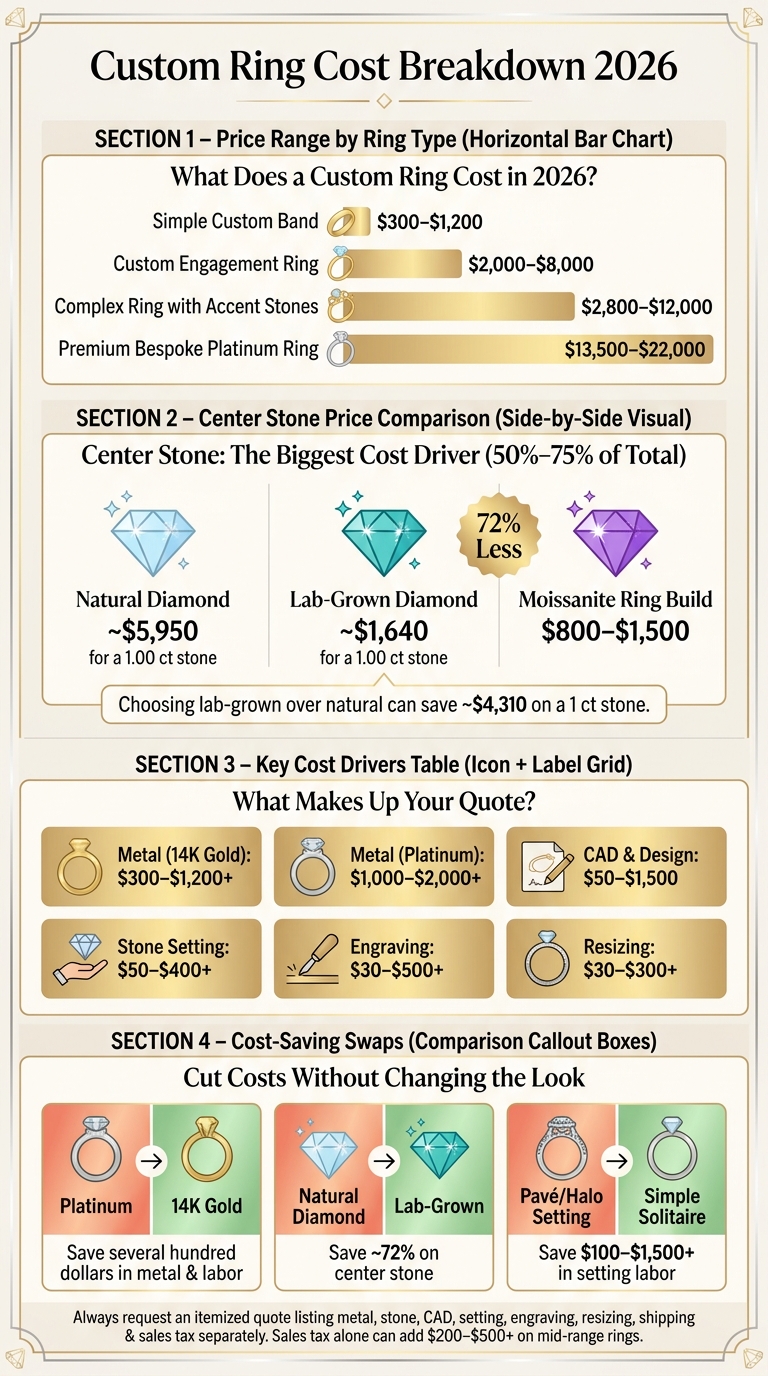
Custom Ring Cost Breakdown 2026: Lab-Grown vs. Natural Diamond & Metal Choices
Where Does Your Money Go in a Custom Engagement Ring?
sbb-itb-9da40c1
The Main Cost Drivers in a Custom Ring Quote
A custom ring quote usually comes down to three buckets: materials, fabrication, and finishing. That’s where the money goes, from the metal itself to the hands-on bench work.
| Cost Driver | Typical 2026 USD Range | What Moves the Price |
|---|---|---|
| 14K gold metal | $300–$1,200+ | Band width, ring size, total weight |
| 18K gold metal | $600–$1,200+ | More pure gold per gram |
| Platinum metal | $1,000–$2,000+ | Density, weight, fabrication difficulty |
| Center stone (lab-grown diamond) | $600–$1,200; higher-end stones can reach $2,500 | Carat, color, clarity |
| Center stone (natural diamond) | $3,500–$5,500+; larger stones rise sharply | Carat, origin, certification |
| Moissanite center stone or moissanite ring build | $800–$1,500 | Carat size, cut quality, metal choice |
| Accent stones / halo / pavé setting | $100–$1,500+ | Stone count, type, coverage |
| CAD / design / mockup | $50–$500+; complex pieces $300–$1,500 | Complexity, number of revisions |
| Casting & fabrication labor | Gold is usually priced by weight plus fabrication labor | Metal type, ring weight |
| Stone setting | $50–$400+ | Number of stones, setting style |
| Finishing & polishing | $50–$150 | Finish type, surface detail |
| Engraving | $30–$500+ | Text vs. decorative hand engraving |
| Resizing / adjustable sizing | $30–$100 to size down, $60–$150+ to size up; adjustable sizing: $100–$300+ | Mechanism complexity, metal type |
Note: Sterling silver and vermeil are available as lower-cost starting points, typically $80–$150 for simple rings, but most custom engagement ring builds in the U.S. start with 14K gold or above.
Metal Choice, Band Width, and Total Weight
Start with the metal because it sets the floor for the quote. Price moves with purity and weight. A heavier ring uses more metal. A wider band usually weighs more. A larger ring size can push that number up too.
In the U.S., 14K gold is the most common engagement-ring metal. Move up to 18K gold or platinum, and the quote usually climbs with it because you’re dealing with more pure gold, more density, and tougher bench work.
Center Stone and Accent Stone Pricing
The center stone is often the biggest line item on the quote. In many cases, it makes up 50% to 75% of the total price.
This is where stone type changes the math in a big way. A 1.00 ct natural diamond (G color, VS1) typically retails around $5,950, while a similar lab-grown stone runs about $1,640 - about 72% less. That’s not a small gap. It can swing the whole budget.
Moissanite sits even lower on the price ladder. Depending on carat size and metal, a full moissanite ring build can stay in the $800–$1,500 range.
Accent stones add cost from two directions at once: more materials and more labor. A simple pair of side stones or a modest pavé band may add about $100–$500. A full halo with pavé can land around $500–$1,500+, especially with natural diamonds.
If you want the same general look without the same hit to the quote, there are a few common ways people do it:
- Use lab-grown accent stones instead of natural diamonds
- Swap in moissanite accents
- Reduce how much pavé coverage is used
That kind of change can trim cost without changing the ring’s overall style too much.
Design, CAD, setting, engraving, and fit changes
Design work matters more than people think. CAD and design fees usually run $50–$500+ for standard projects, and $300–$1,500 for pieces with more detail or more back-and-forth revisions.
Setting costs depend on how many stones need to be set and how tricky the setting style is. A single center stone is usually around $50–$150, while pavé or halo work is more often $100–$400+.
Engraving has a similar spread. Simple inside-band text may cost $30–$100, while decorative hand engraving can run $150–$500+.
Fit changes affect the quote too. A ring with adjustable sizing costs more up front, but it may help avoid later resizing. Standard resizing usually costs $30–$100 to size down and $60–$150+ to size up. Adjustable sizing usually adds $100–$300+ at the start.
That’s why two rings that look somewhat alike in a photo can end up with very different quotes. Small shifts in metal weight, stone choice, or setting work can change the total by a lot. The next section turns those inputs into actual ring examples.
2026 Custom Ring Price Examples by Ring Type
These examples show how metal, stones, and labor can change a custom ring quote. To make it easier to see, here are three common custom-ring builds, starting with the simplest and moving up in price.
Simple Custom Gold Band
A plain custom 14K gold band with a 2–3 mm width usually costs $300–$700 in 2026. A wider 18K version often lands at $450–$1,200.
Small upgrades can change the total pretty fast:
- Machine engraving adds $30–$100
- Hand-script or decorative outside engraving adds $100–$250
- A specialty finish adds $40–$150
- Lab-grown diamond accents push the total to $500–$1,200
- Natural diamond melee accents can bring it to $700–$1,500+
Once stones enter the design, the price tends to climb fast.
Custom Diamond Engagement Ring
With custom diamond engagement rings, the center stone usually drives most of the price. That’s why the lab-grown vs. natural choice is often the biggest factor in the final quote.
| Tier | Stone | Setting | Estimated Total |
|---|---|---|---|
| Entry (lab-grown) | 0.5–0.75 ct, G–H color, VS2–SI1 | 14K gold solitaire | $1,000–$2,000 |
| Mid-range (lab-grown) | 1 ct, near-colorless, VS clarity | 14K/18K gold with pavé or halo | $2,500–$4,500 |
| Premium (lab-grown) | 2 ct, G color, VS1, excellent cut | Platinum or 18K with double halo + full pavé | $4,000–$8,000+ |
| Entry (natural) | 0.5–0.75 ct, H–I color, SI1 | 14K gold custom solitaire | $2,000–$3,200 |
| Mid-range (natural) | 1–1.5 ct, G–H color, VS clarity | 14K/18K gold with standard setting | $5,000–$10,000 |
| Premium (natural) | 2 ct, G color, VS1 | Platinum with halo, hand engraving, pavé | $17,500–$34,000+ |
At the high end, platinum and hand-finished details can push pricing even further.
Premium Bespoke Platinum Ring and Adjustable Ring Options
A premium platinum ring usually starts around $2,500–$3,500 and can go past $10,000–$15,000+ based on the stones and design detail.
Here’s a realistic example. A platinum band with hand-applied milgrain, custom-bezel sapphires or emeralds, and detailed CAD work could have metal and labor alone at $1,500–$3,000. Stones may add $1,000–$5,000+, and design fees can add another $300–$800. That puts the finished total around $3,000–$8,000+.
If you add high-spec natural diamonds or micro-pavé work, the total can move well past $10,000, even without a single large center stone.
Adjustable rings cost more at the start, but they may help cut future resizing bills. Adjustable mechanisms add about $100–$300 upfront, while future resizing often costs $30–$150 per change.
How to Lower or Raise Your Final Quote Without Losing What Matters
Once you know the base quote, the next step is figuring out which upgrades are worth the money.
Upgrades That Add the Most Cost
After the base quote is set, upgrades are what make the price move.
A few choices affect a custom ring quote more than almost anything else. The center stone is usually the biggest factor. A 1 ct natural diamond typically lands around $5,950, while a lab-grown stone of similar quality is about $1,640 - or roughly 72% less. That one decision can shift the ring into a completely different budget range.
Metal choice also matters a lot. Platinum usually costs more than 14K gold because it uses more metal and takes more labor to work with. Then there’s the setting. A full pavé band, a halo, or hand-engraved vintage details can push the setting price up by several hundred dollars. Hand engraving alone can add $300–$1,200.
Changes That Cut Cost While Keeping the Design Strong
If you want to bring the quote down without losing the overall look, a few swaps tend to work well. Choose 14K gold instead of platinum, go with lab-grown stones, and keep the setting simpler.
A solitaire or simple halo usually needs fewer stones and less bench labor than a full pavé band. Full pavé means more stones, more setting work, and a higher price. The same idea applies to engraving. Partial engraving on the shoulders, instead of all the way around the band, can keep that vintage look while lowering bench cost.
| Choice | Typical Cost Impact | Best For |
|---|---|---|
| Platinum vs. 14K gold | Platinum adds several hundred dollars or more in metal and labor. | Platinum: heirloom feel, hypoallergenic needs. 14K: everyday wear on a tighter budget |
| Natural vs. lab-grown diamond (1 ct) | Natural: about $5,950. Lab-grown: about $1,640 (about 72% less). | Natural: rarity and tradition. Lab-grown: maximizing size or setting quality |
| Complex vs. simple setting | Pavé, halo, and vintage details can add hundreds in labor and setting time. | Complex: high visual impact. Simple: more budget goes to the center stone |
| Fixed-size vs. adjustable band | Adjustable adds an upfront premium but can save on future resizing costs. | Adjustable: fluctuating sizes, arthritis, gifting. Fixed: stable finger size |
Why Adjustable and Resizable Features Can Save Money Over Time
Fit changes are one of the few upgrades that may cut future costs. If you're trying to avoid repeated alteration fees, sizing flexibility can matter more than people expect.
An adjustable band uses a hidden back mechanism that opens over the knuckle and closes snugly at the base. It costs more up front, but that extra spend can be lower than paying for resizing again and again. It can also help the band hold up better over time.
If regular adjustments are likely, solid gold is the better pick because plating wears faster at the sliding point.
Use these tradeoffs to shape your budget before asking for a written quote. That makes the budget split in the next section much easier to map out.
How to Build a Realistic Custom Ring Budget
Once you know what drives the price, the next step is simple: turn that into a budget target before you ask for quotes.
That gives you a cleaner way to compare options. It also helps you avoid falling for a nice-looking quote that leaves out half the cost.
A Simple Budget Split for Low, Mid, and Premium Ranges
A budget split helps keep the center stone, metal, labor, and personal touches in check.
| Budget Tier | Total Budget | Center Stone | Metal & Setting | CAD & Design | Labor & Setting | Personalization |
|---|---|---|---|---|---|---|
| Low (simple band) | $1,000 | $450 | $325 | $75 | $100 | $50 |
| Mid (engagement ring) | $5,000 | $2,750 | $1,125 | $325 | $575 | $225 |
| Premium (bespoke) | $15,000 | $10,000 | $2,700 | $1,000 | $1,700 | $600 |
If your budget lands between tiers - say, $3,500 - scale each column by the same ratio. That keeps the spending balanced instead of pouring too much into one part of the ring and starving the rest.
This split also gives you a common baseline when you compare itemized quotes. You're looking at apples to apples, not apples to mystery fruit.
What to Ask for in a Written Quote
A vague flat quote makes it hard to compare offers or even see where your money is going. Ask for a written quote with each part listed on its own line:
- Metal type, purity, and estimated weight (for example, 14K yellow gold, ~4 grams)
- Center stone details: gem type, shape, carat weight, color, clarity, and certification lab
- Accent stones: total carat weight and quality range
- CAD/design fees: flat or hourly, plus how many revisions are included
- Labor and stone setting: prong work, polishing, and finishing listed as separate charges
- Engraving and special finishes: price per engraving or per character
- Resize policy: how many free resizes are included, the time window, and the cost after that
- Adjustable-feature pricing: extra cost for hinged shanks or sliding mechanisms
- Delivery timeline, shipping, and insurance
- U.S. sales tax: whether tax is included, since most states charge about 4%–10% on jewelry.
Sales tax by itself can add a few hundred dollars to a mid-range ring. On a $5,000 ring in a state with 8% sales tax, your out-of-pocket cost is $5,400. That’s not a tiny detail. Build it into your plan from day one.
Key Points Before You Order
Metal choice is second only to the stone in shaping the price. After that, costs stack up through design complexity, engraving, and fit-related features. When you’re clear on the stone and the metal first, the rest of the tradeoffs get a lot easier.
Fit-based options like adjustable bands or resize-friendly designs cost more at the start, but they can save about $30–$150+ per resize over the life of the ring. For a ring you’ll wear every day - or if your ring size tends to change - that can be money well spent, not just an extra.
If you go with an adjustable style, choose solid gold. It holds up better than plated metal anywhere the ring slides or rubs.
Before you approve a quote, ask for one version at your target budget and one slightly above or below it. Then compare the line-by-line differences. That makes it much easier to see which upgrades are worth paying for.
FAQs
What affects custom ring pricing the most?
The biggest cost drivers are materials and labor.
In most cases, the price is pushed up by the metal you choose and the type and quality of the center stone. On top of that, design work, like consultations, CAD models, mockups, and revisions, can account for 30% to 40% of the total cost.
Labor can climb fast too. More involved designs, stone setting, and engraving take extra time and skill, which can noticeably increase the final price.
How can I lower the cost without changing the look too much?
Focus on smart material swaps. Moissanite gives you a look close to a diamond for a lot less, and lower-cost metals like sterling silver, tungsten, or titanium are far less expensive than platinum or 18K gold.
If you want the look of gold without the higher price tag, gold vermeil can cut the upfront cost for pieces you wear once in a while. An adjustable design can also help you skip resizing fees later, and sharing your budget early makes it easier to avoid labor-heavy, overly complex options.
What should be included in a custom ring quote?
A custom ring quote should spell out more than just the materials.
Ask for pricing for:
- metal and gemstones
- labor
- consultations, design mockups, and CAD work
Also, confirm how many revision rounds are included. Design and labor can account for 30% to 40% of the total, so that detail matters more than most people expect.
And check whether engraving, stone setting, and future resizing are included in the quote or billed separately.


