

Turning an Heirloom Ring Into Something You'll Actually Wear
If you never wear the ring, the update failed. I’d focus on three things first: is it safe, does it fit, and does it snag or annoy you during the day.
Here’s the short version:
- I’d document the ring before any work with photos, hallmarks, and an appraisal.
- I’d keep only 1 to 3 details fixed, like the center stone, engraving, or edge pattern.
- If the issue is only fit, I’d start with resizing. Small size changes often cost about $30 to $150+.
- If finger size changes a lot, I’d look at hinged or adjustable shanks, which often run $200 to $600+.
- If the ring catches on clothes or feels too tall, I’d think about a lower setting, retipped prongs, or a bezel/semi-bezel reset.
- If the band is worn thin, I’d ask about a half-shank or full-shank replacement, often starting near $149 or $249.
- Before I approve anything, I’d ask one plain question: Would I wear this most days?
A few facts stand out. The article notes that bezel settings may handle about 300% more force before stone movement than four-prong settings. It also points out that most simple resizing works best within about 1 to 2 U.S. sizes.
My takeaway: keep the story, fix the problem, and change as little as needed.
| Issue | First fix I’d check | Typical cost |
|---|---|---|
| Ring too tight or loose | Standard resizing | $30–$150+ |
| Knuckle much larger than finger base | Hinged or adjustable shank | $200–$600+ |
| Stone feels loose | Prong repair or head work | Varies |
| Ring snags on clothing | Lower setting or bezel/semi-bezel | Varies |
| Band is thin or worn | Half-shank or full-shank replacement | $149+ / $249+ |
If I were doing this, I would not start with a full remake. I’d start with the smallest fix that makes the ring safe, comfortable, and easy to wear.
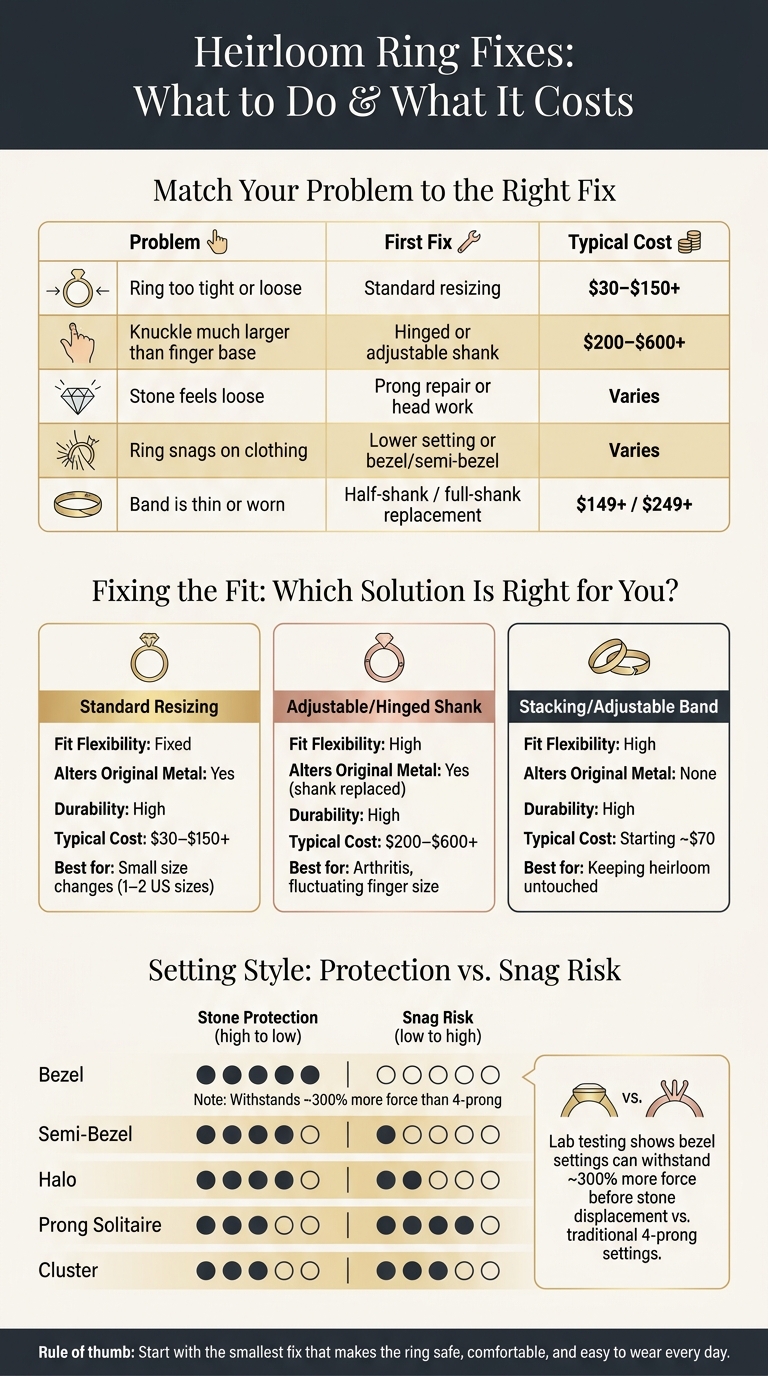
Heirloom Ring Fix Options: Cost, Fit & Protection at a Glance
Step 1: Evaluate the ring and decide what to keep
Check condition, safety, and wearability
Start with a simple visual check. Your eyes and a fingernail can spot a lot right away.
Set the ring on a flat surface and press lightly on the stone. If you notice movement or hear a click, the stone is loose and could fall out during normal wear. Slide your fingernail over the prongs. If it catches, the prongs may be worn, lifted, or rough. Then look inside the band for flat spots, dents, hairline cracks, or places where the metal looks thinner than the rest. If the ring snags on fabric, that often points to worn prongs or a rough edge that needs work.
A jeweler can check much more closely under magnification. They can spot loose stones, worn prongs, thin bands, chips, and metal fatigue. Once the ring is safe to handle, the next step is figuring out which parts make it this ring.
Identify the details worth preserving
Keep the few details that give the ring its identity. In most cases, only one or two features matter most.
Maybe it’s the center stone - an old European-cut diamond or a marquise sapphire your grandmother wore for decades. Maybe it’s an engraved date or initials inside the band. Or maybe it’s the milgrain border, the filigree on the shoulders, or the overall silhouette that makes it feel like her ring.
Pick one to three non-negotiable details, like the center stone, an engraving, or a signature motif. Let the rest stay flexible.
Choose the right redesign path
Once you know the ring’s condition and what matters most, choose the least invasive fix that solves the problem.
| Path | Best When | What to do |
|---|---|---|
| Repair as-is | You love the original style and the wear is minor. | Fix worn prongs or a thinning band without changing the look. |
| Small update | The ring fits poorly but is otherwise sound. | Resize the band or add comfort features. |
| Rebuild for daily wear | The ring is unsafe, too tall, or too delicate for daily wear. | Reset the stone or rebuild in a sturdier, more wearable style. |
If the ring has several issues at once - like a thin band, loose stones, and a setting that catches on everything - simple resizing won’t fix the root problem. In that case, a broader redesign is often safer and may cost less than repairing each issue one by one.
If you use your hands a lot, a tall or delicate vintage setting is more likely to snag and wear down. A lower-profile or bezel setting gives the stone more protection. And if fit is still the main issue, the next step is resizing or looking at an adjustable design.
sbb-itb-9da40c1
Transforming Heirloom Rings into Unique, Personalized Jewelry ✨
Step 2: Fix the fit with resizing, adjustable designs, or a new band
If the ring is structurally sound, fit is the fastest way to make it wearable without changing what matters. A ring that's too tight can be tough to remove, especially in hot weather or during pregnancy, when fingers swell. A ring that's too loose can spin, slip, or fall off. So if the ring itself is in good shape, the next move is simple: pick the easiest fix for the fit.
When standard resizing is enough
This option usually works best for a small change, about 1 to 2 US sizes. A jeweler can either remove metal or add metal to adjust the size. If the only issue is fit, this is often the cleanest fix because it keeps the original look of the ring.
Resizing down usually costs about $30–$100, while making the ring larger tends to cost $60–$150+ since extra metal is needed. That said, not every ring is easy to resize. Bands with stones, deep engraving, or very thin metal can be harder to change neatly. And if your ring size goes up and down a lot, a fixed resize may not hold up as the best answer over time.
When an adjustable design makes more sense
Sometimes a fixed size just doesn't cut it. Heat, pregnancy, medication, weight shifts, and arthritis can all affect ring size. Arthritis brings its own problem: the knuckle may be much larger than the base of the finger. That means a ring big enough to get over the joint may sit loose and spin once it's in place. One set size can't always handle both.
That's where adjustable shanks and hinged designs come in. A hinged shank opens at the bottom of the band, lets the ring pass over a larger knuckle, and then locks into place at the base of the finger. From the top, the hinge is nearly invisible. Other fixes include sizing beads, which are two small metal bumps soldered inside the shank to help stop spinning, and expandable bands, which flex within a limited size range.
If fit is still the main issue, it helps to compare the permanent options side by side instead of guessing.
Comparison: traditional resizing vs. adjustable options
Use this table to match the ring to how you actually wear it.
| Solution | Fit Flexibility | Original metal changed? | Durability | Maintenance | Typical Price (USD) |
|---|---|---|---|---|---|
| Jeweler resizing | Fixed | Yes - cutting/soldering | High if done once | Low | $30–$150+ |
| Permanent adjustable shank | High | Yes - original shank replaced | High when well-made | Occasional hinge checks | $200–$600+ |
| Adjustable stacking rings | High | None if worn separately | High in sterling silver or 18K gold | Standard cleaning; replating if vermeil | Starting around $70 |
If you don't want to alter the heirloom metal at all, a fully adjustable stacking band is worth a look. Worn next to the heirloom ring, a well-fitted stacking band can add comfort and still work with the original piece without changing it.
For daily wear, especially if you expect to adjust the ring often, solid gold is usually the better long-term pick than gold vermeil. Here's why: friction at the sliding contact point can wear through plating over time and expose the base metal underneath.
Step 3: Reset the stone or update the setting for daily wear
If resizing fixed the fit but the ring still snags, the setting is usually the next thing to fix. Once the size feels right, look at how the ring is built. A tall stone can catch on sweaters. Worn prongs can let the stone shift. An uneven band can rub against nearby fingers. The aim is simple: keep the ring secure and make it easy to wear every day.
Move the original stone into a lower, sturdier setting
One of the biggest causes of snagging is a tall prong setting, where the stone sits high above the finger. A jeweler can rebuild the setting head with a shorter version so the stone sits closer to the band. The original stone stays in place. Small design touches like milgrain edges, filigree, engraved motifs, or tapered prong tips can usually be copied onto the new head, so the ring still feels like the same piece.
If the main issue is worn prongs, retipping can make the ring secure again without changing the look. But if the setting head itself is no longer safe, replacing the whole head is often the better move before you start wearing the ring every day.
If you work with your hands a lot, a bezel or semi-bezel setting can make a big difference. A full bezel wraps metal around the entire edge of the stone. That gets rid of exposed prong tips and protects the girdle, which is the stone’s most vulnerable edge. One source cites lab impact testing showing that bezel settings can withstand roughly 300% more force before stone displacement compared with traditional four-prong settings. The trade-off is pretty clear: the look is more modern, and you may get less light return. A semi-bezel leaves two sides open, which gives you a middle ground. You get smoother edges and more protection than prongs, while still showing more of the stone’s outline.
Update the band for stacking, comfort, and balance
If the stone is secure, the band is often the next place to look. Older heirloom shanks are often too thin after decades of wear, too wide and flat to feel good on the hand, or off-balance in a way that makes the ring lean or spin. A half-shank or full-shank replacement can fix that while keeping the top of the ring in place. Pricing usually starts around $149 for a half shank and $249 for a full shank.
A comfort-fit interior can also help more than people expect. Instead of a flat inside surface, the interior is gently curved. That tends to feel better during all-day wear, especially with wider bands or rings that have to slide over a larger knuckle.
For stacking, a slimmer, straight-edged profile usually works best. It lets the heirloom sit flush against other bands instead of leaving odd gaps. In some cases, a slim band worn next to the heirloom can also help with balance without changing the ring itself.
Comparison: modern setting and band choices
| Option | Stone Protection | Snag Risk | Daily Comfort | Stacking Compatibility | Impact on Original Design |
|---|---|---|---|---|---|
| Prong solitaire | Moderate | High | Standard | Moderate | Minimal - classic look preserved |
| Bezel | Highest | Very low | High | Moderate | Noticeable - more modern appearance |
| Semi-bezel | High | Low | High | Moderate | Subtle - retains some original feel |
| Halo | High (center stone) | Moderate | Standard | Moderate | Moderate - adds sparkle, changes silhouette |
| Three-stone | Moderate | Moderate | Standard | Moderate | Moderate - traditional but more presence |
| Cluster | Moderate | Moderate | Standard | Low | Low if prongs are rebuilt in original style |
| New shank | N/A | N/A | High | High | Low if metal is matched carefully |
| Comfort-fit band | N/A | N/A | Very high | High | Very low - only interior changes |
| Stacking band | N/A | N/A | High | Very high | None - worn separately alongside heirloom |
| Adjustable band | N/A | N/A | Very high | High | None - original ring untouched |
The best setup depends on two things: how rough you are on your hands and how closely you want to keep the original look. Before saying yes to any redesign, ask to see sketches or sample settings.
Conclusion: Keep the story, change what stops you from wearing it
An heirloom ring sitting in a drawer isn't doing its job. The point of every change in this guide is simple: fix the exact thing that keeps you from wearing it, while holding on to what gives it meaning.
Keep the story. Change the part that gets in the way.
That usually means starting small. If a minor fix solves the issue, great. If not, then it makes sense to look at a full redesign, especially if the ring is still unsafe, uncomfortable, or too delicate for everyday wear.
Once you've worked out the fit, setting, and band, use this checklist before you approve any work.
A simple final decision checklist
Go through these questions one by one:
- Condition checked? Has a jeweler confirmed that the ring is structurally safe?
- Meaningful details identified? Have you picked the one or two details that must stay?
- Fit solution chosen? Have you decided between standard resizing, an adjustable design, or a new band based on how your finger size changes from day to day?
- Setting and band reviewed? Does the proposed design work for daily wear - low enough profile, smooth edges, and a metal that fits your lifestyle?
- Would you wear it most days? Think about a normal week. Does the updated ring fit into that routine without annoyance?
- Does it still feel like your heirloom, just updated for you? Does the finished design still feel like the original piece, only modernized - not like a generic new ring?
If you can say yes to all six, you're in good shape. If one answer gives you pause, that's the part to fix before the work starts, not after.
FAQs
How do I know if my heirloom ring is worth updating?
Your heirloom ring may be worth updating if it feels uncomfortable or doesn’t seem secure enough for daily wear. That matters more than people think, because finger size can shift with temperature, exercise, weight changes, pregnancy, or arthritis.
It may also make sense to update the ring if it can be resized or adjusted without making it weaker. In some cases, a reset or small upgrade can make the ring much easier to wear while still keeping the sentimental details that mean the most.
Will resizing or resetting lower the ring's sentimental or resale value?
It can. Resizing a ring the usual way may affect an heirloom ring’s sentimental or resale value, especially if the piece is antique, has detailed engravings, or uses an unusual setting.
Why? Because the process often involves cutting, heating, and soldering the band. That can permanently alter the original design, and in some cases, it may weaken the ring over time.
If preserving the ring matters most, leaving it in its original condition is usually the safest choice for protecting its sentimental and historical value.
What should I ask a jeweler before approving ring changes?
Before you approve any changes to an heirloom ring, ask your jeweler for a thorough evaluation. The goal is simple: make sure the ring can be modified safely without weakening its structure.
It also helps to ask how each change might affect the design. For example, resizing can impact stone settings, engravings, or decorative motifs. Cleaning, polishing, or replating may also interfere with sliding or moving parts.
The safest move is to confirm which method makes sense for your specific ring design.


