

Should You Wear Your Engagement Ring on the Wedding Day?
Yes - you can wear it, move it, or leave it off. In the U.S., there’s no fixed rule. Most brides pick 1 of 3 options: wear the engagement ring on the right hand during the ceremony, keep it on the left hand, or leave it off until after the vows.
I’d make the choice based on 4 things:
- Comfort: fingers often swell from heat, stress, food, and activity
- Fit: a ring can feel fine at 10:00 a.m. and tight by later in the day
- Photos: some people want the band to go onto a bare left ring finger
- Safety: high settings, loose rings, and recent resizing can make handling harder
In most U.S. weddings, the wedding band goes on first, closest to the hand, and the engagement ring sits above it after the ceremony. That’s why many brides move the engagement ring to the right hand before walking down the aisle.
My short take: if you want the easiest ceremony flow, use the right hand. If your ring fits well and you want to wear it as usual, keep it on the left hand. If the ring is loose, delicate, or costly, leave it off and put it on later.
Quick Comparison
| Option | Best for | Main upside | Main downside |
|---|---|---|---|
| Right hand during ceremony | Clean ring exchange | Left hand stays clear for the band | May feel odd if you never wear it there |
| Left hand during ceremony | Wearing it as usual | No need to remove it before the ceremony | You’ll need to switch ring order after |
| Leave it off | Loose, fragile, or newly resized rings | Lower chance of loss or snagging | It won’t be on your hand during the ceremony |
One more thing: I’d test both rings together for a few hours before the wedding day. Even a ¼ or ½ size issue can change how the stack feels.
How to Wear Your Engagement Ring & Wedding Ring 💍 Which Ring Goes First
sbb-itb-9da40c1
U.S. Ring Etiquette and How It Shapes the Decision
In the U.S., the usual order is simple: wedding band first, engagement ring above it on the left ring finger. That custom is why many brides think about ring placement before the ceremony starts.
Why Many Brides Move the Engagement Ring to the Right Hand First
Many brides move the engagement ring to the right-hand ring finger before the ceremony, then place it back on the left hand after the vows. It keeps the left ring finger clear, so the wedding band can slide on first without any fumbling at the altar.
If taking off the ring feels awkward, though, there’s another accepted option.
When Keeping It on the Left Hand Is Still Perfectly Fine
Keeping the engagement ring on the left hand through the ceremony is also perfectly fine. In that case, the wedding band can be placed above it during the ceremony and switched into the usual order afterward.
Etiquette is a guide, not a rule.
The Three Wedding-Day Options Compared
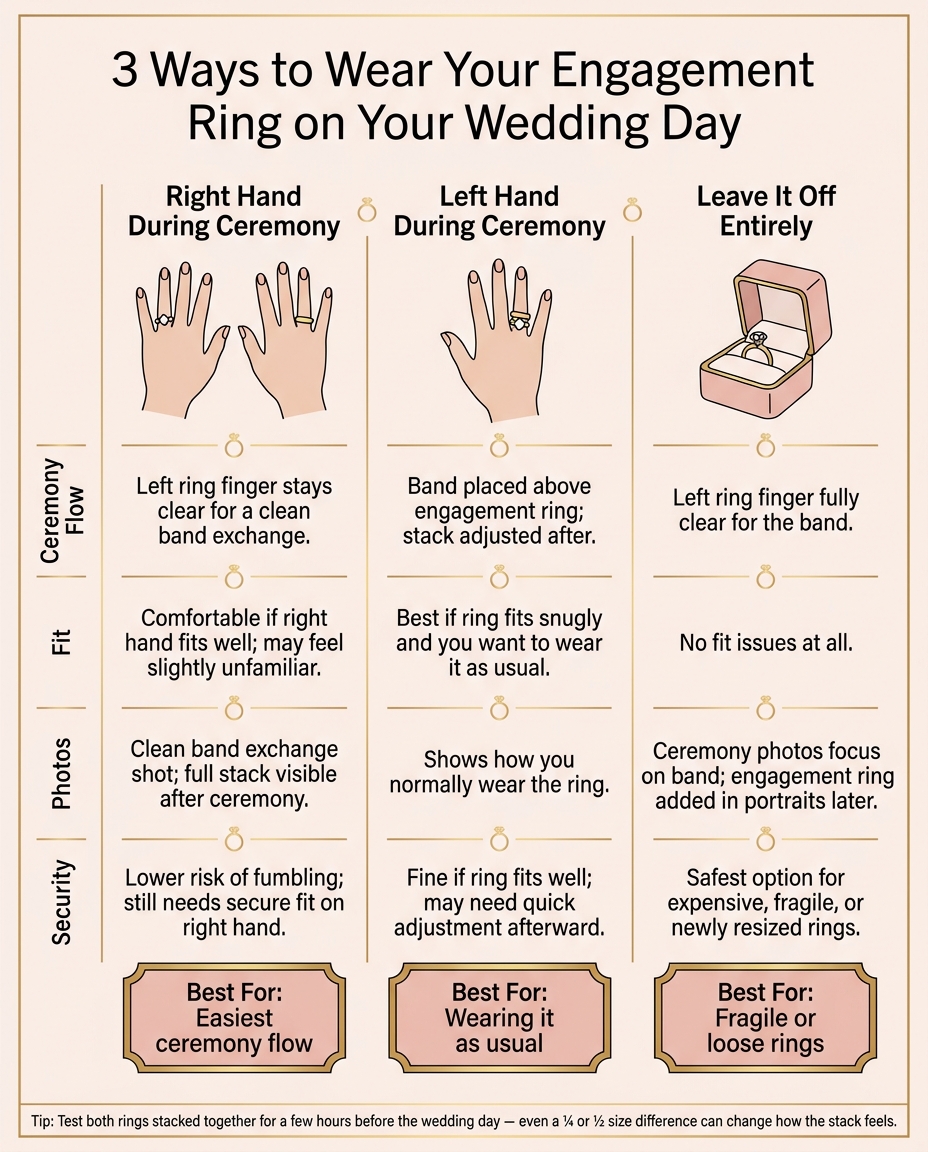
3 Ways to Wear Your Engagement Ring on Your Wedding Day
Once etiquette is out of the way, this choice usually comes down to three things: how the ceremony will flow, how the ring feels, and how safe it is. In day-to-day life, these three options play out a little differently.
Option 1: Wear the Engagement Ring on Your Right Hand During the Ceremony
This is often the simplest pick in the U.S. If you wear the engagement ring on your right hand, your left ring finger stays open when the wedding band is placed during the ceremony. After the vows, you can move the engagement ring back to your left hand, above the band, for the usual stack.
It tends to look clean in photos too. The ring exchange photo shows the band sliding onto a bare left ring finger. Then, in your post-ceremony portraits, you get the finished stack in the usual order.
Option 2: Keep the Engagement Ring on Your Left Hand or Leave It Off Entirely
Keeping it on the left hand can work well if the ring fits snugly and you want to wear it the way you normally do. The catch is simple: the wedding band has to go on above it during the ceremony, so you'll need to switch the engagement ring back above the band afterward.
Leaving it off entirely is often the safest move for rings that are expensive, fragile, or recently resized. If a ring feels loose or has a tall prong setting, it's easier to lose or snag. That's why many brides leave it with someone they trust until after the ceremony.
Here’s a quick side-by-side view:
| Option | Ceremony Band Placement | Fit | Photos | Security |
|---|---|---|---|---|
| Right hand | Left ring finger stays clear for the band | Comfortable if the right hand fits well; may feel a little unfamiliar at first | Clean band exchange shot; the usual stack shows up after the ceremony | Lower chance of awkward handling during the ceremony; still needs a secure fit on the right hand |
| Left hand | Band is placed above the engagement ring; stack adjusted after the ceremony | Best if you want to wear the ring as usual and it fits securely | Shows how you normally wear the ring | Fine if the ring fits well; may need a fast adjustment afterward |
| Off entirely | Left ring finger stays fully clear for the band | No fit issues | Ceremony photos focus on the band; the ring can show up in portraits later | Best for expensive, fragile, or newly resized rings when stored safely |
At that point, the best pick usually depends on fit, swelling, photos, and safety.
How to Choose Based on Comfort, Fit, Photos, and Ring Safety
Once etiquette helps narrow things down, comfort, fit, photos, and safety usually make the final call.
How Fit and Finger Swelling Can Affect Your Choice on the Day
Most people don't expect how much fingers can swell on a wedding day. Heat, stress, dancing, and salty food can all affect circulation. A ring that feels fine in the morning might feel tight a few hours later.
A smart move is to test the fit ahead of time for a few hours on a warm day or after a workout. If the ring feels tight or leaves a mark, it's better to change the plan before the ceremony than deal with it in the middle of the day.
If you have arthritis, large knuckles, or a ring that was recently resized, adjustable or resizable rings can help. That's often the easiest way to get a ring over a larger knuckle while still keeping it snug at the base.
Photography, Ceremony Order, and Keeping Your Ring Safe
If your engagement ring will move between your right hand, left hand, or a ring box, tell your photographer in advance. That way, the ring exchange shot and the final stack are framed the way you want. If you're planning to put the ring on later for portraits, set aside time for it on purpose so it doesn't get missed.
It also helps to tell your officiant which hand will hold the engagement ring and which ring goes on first. That small detail can save awkward pauses during the ceremony.
For high-set or delicate rings, it's often safer to store the engagement ring with a trusted person or in a lockable box during the ceremony and more active parts of the reception. High settings can catch on lace, veils, or hair. Delicate prongs can also bend during hugs, dancing, or a bouquet toss.
After the Ceremony: How to Wear the Wedding Band and Engagement Ring Together
After the ceremony, most brides wear the rings in this order: the wedding band first, then the engagement ring on top. That puts the wedding band closest to the hand, which usually gives the neatest fit.
If the two rings don’t sit well together, a jeweler may suggest a narrower band or a slim spacer.
If the combined width feels tight once both rings are stacked, it’s smart to sort that out before the wedding. A jeweler may recommend resizing by a quarter or half size, switching to a narrower band, or adding a slim spacer band to take some pressure off the finger.
Key Points to Go Over Before Your Wedding Day
Once the stack feels right, practice the switch at home. Put both rings on together and wear them for a few hours during normal daily use to see how they feel. Small issues can show up fast when you’re washing your hands, typing, or just going about the day.
If anything feels off, a jeweler can adjust the fit or suggest a band shape that works better for daily wear. It also helps to rehearse the re-stacking process a couple of times before the ceremony, so the switch feels easy afterward.
FAQs
What if my engagement ring and band don’t fit well together?
If your engagement ring and wedding band don’t sit right together, adjustable ring designs can help. They remove some of the hassle that comes with fixed sizing.
Satinski adjustable rings use a hidden, ergonomic mechanism that expands or contracts for a secure, comfortable fit. That means the ring can move with natural changes in finger size and may help you avoid professional resizing, which can weaken a ring’s structure.
Who should hold my engagement ring during the ceremony?
Who holds your engagement ring during the ceremony comes down to personal preference, your comfort level, and how you want the day to flow.
Most couples go with one of a few simple options: your maid of honor, your partner, or the best man. You can also wear the ring on your right hand during the ceremony, then move it later. If you'd rather not deal with it at all, leave it somewhere safe until the reception.
The main thing is simple: pick someone reliable who understands that this is not just another small item to keep track of.
When should I put my engagement ring back on after the vows?
You can put your engagement ring back on whenever it feels right after your vows. If you moved it to your right hand or tucked it away for the ceremony, the simplest move is usually to wait until after the ring exchange and once the ceremony is over. That helps avoid any mix-up in the moment.
If you’re wearing an adjustable ring, you can secure it for a more comfortable fit during the reception and the rest of the celebration.


