

Men's Rings and the Gym: What Lifting Does to Your Fingers
If I lift with a metal ring on, I risk swelling, skin damage, a stuck ring, and in worst cases, a severe snag injury.
Here’s the short version:
- Heavy grip work can make fingers swell, so a ring that felt fine before the gym can feel tight during or after training.
- Bars and handles rub the skin, which can lead to calluses, irritation, and rash under a ring.
- Snagging is the biggest danger. If a ring catches on a bar, cable, or pull-up setup, it can tear skin and deeper tissue.
- Metal rings also get scratched or bent from knurling, weights, and repeated impact.
- The safest move is simple: I take my ring off before heavy lifts, pull-ups, climbing, or any workout with hard grip and moving equipment.
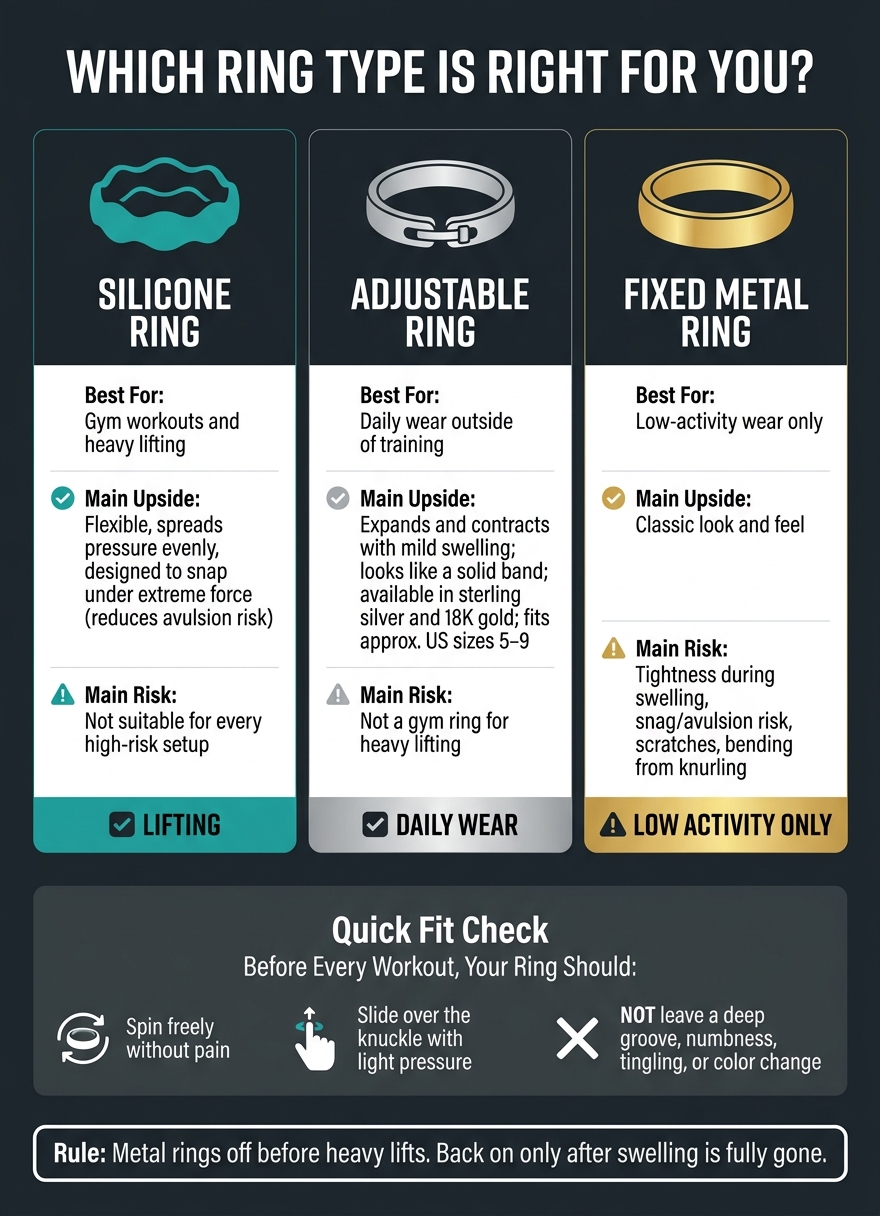
- If I want to wear something, a silicone ring is the better gym option because it bends and is made to break under force.
A fast ring check helps:
- It should spin without pain
- It should slide over the knuckle with light pressure
- If it leaves a deep groove, numbness, tingling, or color change, I take it off at once
The hidden danger of wearingf rings during sports and work
sbb-itb-9da40c1
Quick Comparison
| Option | Best use | Main upside | Main risk/problem |
|---|---|---|---|
| Silicone ring | Gym workouts | Flexes and can break under force | Still not for every high-risk setup |
| Adjustable ring | Daily wear outside training | Handles small size changes | Not a gym ring for heavy lifting |
| Fixed metal ring | Low-activity wear | Classic look and feel | Tightness, snag risk, scratches, bending |
So if I train hard, the rule is simple: metal rings stay off during lifts, and they go back on only after swelling is gone.
How Lifting Changes Your Fingers
Heavy grip work, heat, and shifts in hydration can change your finger size enough to change how a ring fits during training. It usually starts as mild tightness. Then, if you keep lifting with it on, it can turn into a safety problem.
Swelling During Heavy Grip Work
Grip-heavy lifts like deadlifts, rows, pull-ups, and kettlebell swings make your forearm and hand muscles squeeze hard and keep squeezing. That kind of sustained effort boosts blood flow and pressure in the hands and fingers. During lifts like deadlifts and farmer's carries, your hands also hang below heart level, so blood can collect in the fingers and make the tissue a bit swollen.
Add a warm gym to the mix, and the effect can get worse. A ring that felt normal when you walked in can feel snug by your last set.
Calluses, Friction, and Skin Irritation Under a Band
Repeated contact with barbells and dumbbell handles thickens the outer layer of skin across the upper palm and at the base of the fingers. Over months of steady training, those calluses can slightly change finger circumference and alter how a ring sits on the hand. A band that used to spin easily may start catching on rough skin near the knuckle or feel tighter as it slides over it.
Sweat trapped under a snug metal band makes this worse. That warm, damp space sets up the kind of conditions that lead to ring rash from sweat, soap, and trapped dirt. If the ring contains nickel or has plating, sweat can speed up metal ion release and push the risk higher.
Why Ring Fit Changes Between Morning and Workout Time
Fingers are usually at their smallest in the morning. In cooler conditions - around 68°F - blood vessels near the skin stay more constricted, so a ring may spin easily or even feel a little loose. Later, in the middle of a workout at a warm gym, higher core temperature and post-exercise hyperemia can make that same ring feel close to a half-size tighter, especially if the band is wide.
Hydration matters too. On days when you're well hydrated, your tissues hold a bit more fluid, and your fingers tend to feel fuller. If you sweat heavily and don't replace fluids, tissue volume can drop for a while, which may make the ring feel looser. Then during recovery, your body may hold onto water again, and the swelling can return. Even small shifts like that can change the feel of a close-fitting ring.
When fit changes this much, a ring can go from irritating to risky once you're using equipment.
Ring Problems Lifters Run Into
Once your fit changes, three issues tend to show up fast: tightness, snag risk, and wear.
Tightness, Stuck Rings, and Circulation Concerns
If your ring leaves a deep groove after training, don't brush it off as a small annoyance. That's a warning sign. A snug band can stop rotating, pinch the tissue around your finger, and limit blood flow.
Pay attention to signs like:
- A ring that won't spin
- A deep indentation that doesn't fade after a few minutes
- Numbness
- Tingling
- Throbbing
- Skin discoloration
If swelling starts or circulation changes show up, stop training and get the ring off right away.
Snag, Crush, and Avulsion Risk on Gym Equipment
This is where things can go from annoying to serious. A ring that catches can rip skin and soft tissue. Ring avulsion happens when a ring snags on a surface and the force tears skin, soft tissue, or deeper parts of the finger. It can range from lacerations to fractures and, in severe cases, partial or full amputation.
The biggest risk comes with movements where your hand can catch or twist without warning. Think pull-up bars, ropes, cables, and moving weights. Even a ring that feels only a little tight can turn dangerous once it snags.
Scratches, Bending, and Wear on Metal Bands
Even if your ring never gets stuck or causes pain, the gym can still beat it up. Barbell knurling can leave scratches and grooves over time. Repeated contact with gym equipment can dull polished surfaces, scratch bands, and bend thin rings.
Softer metals like gold and silver tend to show damage first. But harder metals aren't off the hook. With regular lifting, they can still pick up scratches and wear.
If a ring feels tight, catches on equipment, or starts showing wear, take it off before your next set. That's why fit and material matter so much before you train. Next comes the practical fix: when to remove a ring and what to wear instead.
When to Remove a Ring and What to Wear Instead
Metal vs. Silicone vs. Adjustable Rings for Men Who Lift
Remove Rings Before Heavy Lifts and High-Snag Movements
If a ring starts to feel tight or even a little risky, take it off before your set starts. The rule is pretty simple: remove your ring before any heavy lift or any movement where your hand grips hard or could catch on equipment.
That includes barbell work, pull-ups, rig movements, and any high-snag, high-grip training where things move fast and you won't have much time to react if a ring gets caught. For climbing and bouldering, the standard is even stricter: never wear a metal ring. One bad catch on a hold or edge can lead to a severe finger injury.
How to Check Ring Fit Before and After Training
Before you head to the gym, do a quick fit check. Your ring should rotate freely and slide over your knuckle with light pressure. If you have to force it, it's already too tight for a workout that will make your hands swell.
After training, don't rush to put it back on. Hands stay swollen longer than a lot of people think. Wait until the swelling goes down fully, then check again: it should rotate freely, slide over the knuckle, and cause no pain.
If you still want to wear something on your finger outside the gym, go with a ring made to handle size changes.
Silicone, Adjustable, and Resizable Rings for Active Wear
For actual lifting, silicone rings are the safer pick if you want something on your finger. They're flexible, spread pressure more evenly, and are made to snap under extreme force. That lowers the risk of avulsion if the ring catches. They also handle scratches and bending better than a rigid metal band, and they won't dig into your skin the way a tight metal ring can.
Outside the gym - during commuting, work, errands, or light activity - adjustable rings are a solid middle ground. Satinski's adjustable rings use a hidden adjustment mechanism inside the band, so the ring still looks like a solid band while expanding or contracting with mild swelling. They're available in sterling silver and 18K gold, and they cover about U.S. sizes 5 to 9.
That gives you room for the kind of day-to-day size shifts - about half a size to a full size - that active men deal with on a regular basis.
Wear each type where it makes sense:
- Silicone: best for lifting
- Adjustable ring: best for daily wear when size changes happen
- Fixed metal ring: best for low-activity wear
Care Routine and Conclusion: Protect Your Hands and Your Ring
A Simple Pre- and Post-Workout Ring Routine
Use a simple pre- and post-workout routine for your ring. About 15–30 minutes before training, check that the ring rotates freely and slides over your knuckle with light resistance. If it feels snug while you're at rest, take it off before your warm-up. If it doesn't pass that check, don't train with it on.
Store the ring in a zippered pouch or a locker. On heavy training days, it's often smarter to leave it at home.
After your session, put the ring back on only after the swelling goes down. Once your fingers are back to normal, wash and dry both your hands and the ring all the way.
If redness, itching, or a rash keeps coming back, switch to a skin-friendly material. If it doesn't clear within 1–2 weeks, see a dermatologist.
Those small habits go a long way. Take rings off before lifting, check the fit before and after training, and use silicone for workouts and metal for low-activity wear.
FAQs
Can lifting make my ring size change temporarily?
Yes. Weightlifting can make your fingers swell for a while. During a workout, increased blood flow often makes your hands puff up a bit, so a ring that feels fine at rest can suddenly feel tight.
That kind of fit change is common. Exercise, heat, and normal day-to-day activity can all affect finger size for a short time. Because of that, many active men go with adjustable rings so the fit can shift with them, without needing permanent resizing.
How long should I wait to put my ring back on after a workout?
There’s no fixed wait time. Put your ring back on only after the swelling is gone and your finger is back to its usual size.
If your fingers tend to swell during exercise, an adjustable ring or a silicone band can be a better pick for hard workouts.
Are silicone rings safe for every gym workout?
Not always.
Silicone rings are light, flexible, and often worn as a safer pick for higher-risk gym activities. But they’re not the best choice for every workout.
If your training includes heavy grip work, free weights, or gym machines, it’s usually best to take off any ring. That helps lower the chance of hurting your hands or wearing down the ring. Comfort and safety come first.


