

What Nobody Tells You About Moissanite Resale Value
Here’s the short answer: most moissanite jewelry sells for far less than the original price. In many U.S. resale cases, sellers get about 10% to 40% of retail, and pawn shops may pay based mostly on the gold weight, not the stone.
If I were trying to sell moissanite today, I’d keep four things in mind right away:
- Retail price does not set resale price
- Gold settings usually sell better than silver
- Brand papers, receipts, and box can help
- Private sale often pays more than a pawn shop
- Fees, shipping, and repairs cut into what you keep
A simple example: a ring bought for $1,200 might resell for only $150 to $400. And if I sell it online, fees and shipping can shave off another $50+.
Price and Resale Value Break Down of Moissanite v. Lab Diamond v. Natural Diamond
sbb-itb-9da40c1
Quick comparison
| Selling route | What buyers focus on | Time to sell | Usual payout |
|---|---|---|---|
| Pawn shop | Metal weight | Same day | Lowest |
| Gold buyer | Scrap gold value | Same day | Low |
| Local jeweler | Metal, and sometimes resale potential | Same day to a few days | Low to mid |
| Online marketplace | Brand, setting, stone, condition | Weeks to months | Mid |
Bottom line: if you buy moissanite, it makes more sense to think of it as a lower upfront-cost jewelry choice, not something you’ll later sell for close to what you paid.
Why most moissanite jewelry resells for much less than retail
Moissanite has a shallow secondary market in the U.S. And because it's a mass-produced lab-created stone, most buyers can find a brand-new piece for about the same price as a used one.
That simple fact changes the whole resale picture. If someone can buy new without much of a price jump, a used listing has to come in much lower to get attention.
Retail pricing includes markups that secondhand buyers will not pay
When you buy a moissanite ring at retail, you're not just paying for the ring itself. You're also paying for store overhead, labor, marketing, and packaging. A secondhand buyer doesn't care about those costs, so they won't pay for them.
A used ring also has to go head-to-head with new moissanite sold at similar prices. So a ring that first sold for $900 may only get offers in the $150–$350 range in mainstream U.S. resale channels. That's about 17–39% of retail.
At that point, the issue isn't whether moissanite resells well. It usually doesn't. The issue is which details still help the price hold up a bit better.
Pawn shops and gold buyers pay for metal weight, not the moissanite itself
Pawn shops and gold buyers usually look at the metal, not the moissanite. In plain terms, they're buying the setting for scrap value and giving $0 for the stone.
For a 14K or 18K gold setting, a small ring may bring about $80–$150 based on gold weight at current spot prices. If the setting is sterling silver, the payout may be only $5–$20, no matter how large or clean the stone looks.
That's why sellers are often shocked. The ring may look nice, but to a gold buyer, the moissanite often doesn't move the number at all. Many online buyback services decline moissanite outright because there is no standard resale market for it.
Selling costs reduce what the owner actually keeps
Even when you sell privately, the final take-home amount can drop fast. Platform fees of 5–15%, payment processing of about 2.9% plus a small per-transaction amount, and insured shipping of $15–$40+ can eat up $50–$70 or more on a mid-range sale.
So if you list a ring at $300, accept $250, and then pay those costs, you may net only about $180–$200. The payout gets hit twice: first by a weak resale market, then by the costs tied to selling.
Once the price drops into resale territory, a few things still shape what you can get back:
- Brand
- Paperwork
- Setting
- Condition
Those details don't erase the weak market, but they do affect how much of that market value you can still recover.
What actually affects secondhand moissanite pricing
In a weak resale market, four things still move price: brand proof, stone quality, metal, and fit. Why these? Because secondhand buyers pay for three simple things: proof, looks, and how easy the piece will be to resell later.
Brand, certification, receipts, and packaging
A known brand, original receipt, grading report, and box help buyers feel sure about what they’re getting. That paperwork doesn’t just sit there looking nice. It gives the listing more weight. Even the original packaging can help because it makes the piece feel more legitimate.
Branded, documented pieces in good condition can resell for around 10–25% of original retail in typical U.S. resale channels. By contrast, undocumented stones from unknown sources often land below 10% or sit for a long time without much interest.
Stone quality, ring style, and loose versus mounted
Cut quality matters most on the stone side. A well-cut moissanite looks bright and balanced both in photos and in person, and that’s what keeps buyers looking. A bigger stone with a weak cut may still get lower offers because it just doesn’t have the same visual punch.
Color is the next big filter. In the U.S., buyers usually lean toward near-colorless or colorless stones. Stones with visible tint tend to move more slowly. Shape matters too. Round and oval usually appeal to the largest group of buyers, while less common shapes like marquise, heart, or long pear cuts often need deeper discounts to sell.
Set versus loose can also change how a listing performs. A simple solitaire or clean halo in 14K gold can move faster because the buyer gets a ring they can wear right away. But if the setting feels dated or heavily personalized, a loose stone may do better with buyers who’d rather reset it on their own terms.
Metal type, condition, and size flexibility
Metal choice is one of the clearest price levers in the secondhand market. A moissanite ring set in 14K or 18K gold has commodity value that pawn shops and gold buyers can estimate from weight. Sterling silver is often treated more like fashion jewelry, and some buyers may pass on it altogether.
For peer-to-peer sales, gold-set rings in good condition can reach 20–40% of original retail, especially when the design is in demand and the paperwork is still there.
Condition shows up fast in photos. Rings with a clean stone, a thick band, and secure prongs tend to get the best percentages in peer-to-peer sales. On the flip side, scratches, worn prongs, or a cloudy stone usually pull offers down because buyers start mentally adding repair costs.
Then there’s ring size. A fixed-size ring in an unusual size can shrink the buyer pool and push the price down to make resizing worth the hassle. Adjustable or resizable designs usually appeal to more buyers because they remove some of that friction. A ring that fits more people is, plain and simple, easier to sell.
Where moissanite actually sells and what each channel pays
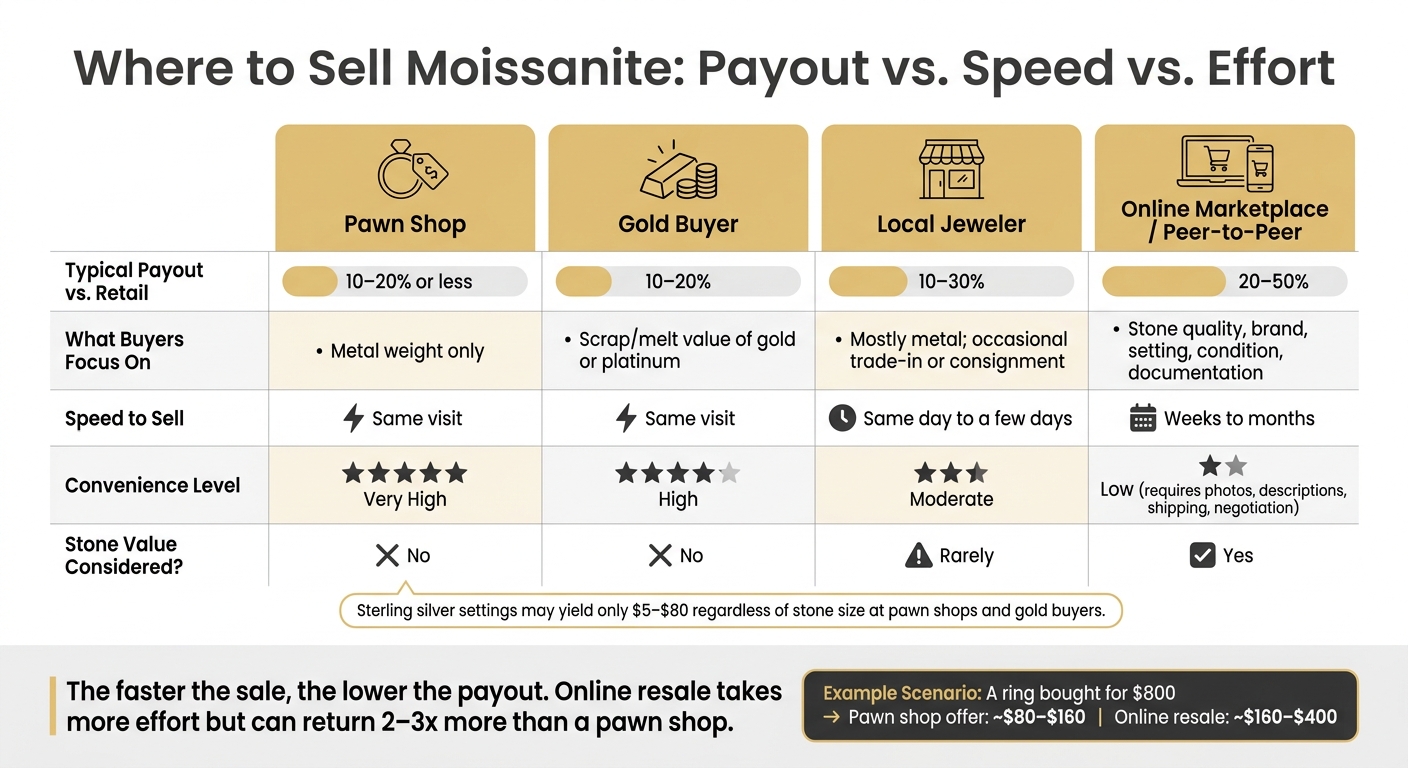
Moissanite Resale Value by Selling Channel: Payout, Speed & Effort
Pick the channel based on speed, payout, and how much work you want to do.
Jewelers, gold buyers, and pawn shops
If you want money fast, these are usually the fastest routes. The trade-off is simple: they also tend to pay the least.
Most local jewelers, gold buyers, and pawn shops make offers based mostly on the weight and karat of the metal, not the moissanite itself. So even if the stone looks great, the offer may still come down to scrap value. One reported case makes that pretty clear: an 18K gold ring with a 1-carat moissanite sold to a pawn shop for about $400, and the offer was driven by the gold weight, not the stone. Silver-set pieces can land even lower, sometimes selling for just $25–$80 no matter the stone size.
| Channel | Speed | Offer Basis | Convenience | Likely Payout vs. Retail |
|---|---|---|---|---|
| Local jeweler | Same day to a few days | Mostly metal value; occasional trade-in or consignment | Moderate | 10–30% |
| Gold buyer | Same visit | Scrap or melt value of gold or platinum | High | 10–20% |
| Pawn shop | Same visit | Metal value only | Very high | 10–20% or less |
Actual offers change based on metal weight, local demand, and how easy the piece looks to resell.
If your goal is a better payout, selling straight to another buyer usually beats scrap-style offers.
Online marketplaces and peer-to-peer resale
Direct resale takes more effort, but it usually pays more than a local buyout. Selling to other buyers through general marketplaces or jewelry resale groups can bring back about 20–50% of original retail for pieces that are in good condition and backed by solid documentation.
That’s because buyers in these spaces look at the stone, brand, and setting, not only the metal weight.
To get there, you’ll need:
- Clear, well-lit photos
- An accurate description with metal karat, stone size, shape, color, and any certifications
- Patience for questions, offers, and back-and-forth
- Insured shipping for higher-priced sales
Peer-to-peer sales can take weeks or months to close. But if you put in the effort, you can often get a better offer than you would from a pawn shop.
Adjustable rings can help here too. They appeal to more buyers because sizing is less of a headache. Someone buying a gift or unsure of their ring size may be more willing to choose a ring that fits sizes 5–9 than one locked into a single size. That can mean less time sitting unsold and less need to cut the price.
How to price a listing using sold comps
Your receipt price is not your resale price.
The better way to price a ring is to look at sold listings, not active ones, on the platform where you plan to sell. Active prices are often just wishful asking prices. Sold prices show what people have actually paid.
When checking comps, match as closely as you can on:
- Metal type and karat
- Stone size and shape
- Brand
- Certification
- Condition
Once you find a group of sold prices, set a range instead of one fixed number. For example, a ring that originally sold for $800 might list in the $300–$400 range. The lower end usually helps it move faster. The upper end works better if you’re fine waiting. Be sure to set your floor after fees and shipping, so you know what you’ll net.
Once you know the market price, the next step is keeping that value in mind when you buy, wear, or upgrade.
How to reduce losses when buying, upgrading, or reselling
Once you understand resale value, the next step is simple: hold on to as much value as you can.
Buy for long-term wear, not future profit
Buy moissanite because you want to wear it, not because you expect a payday later. Most pieces resell for about 10%–25% of retail.
That’s why the main win usually happens at the time of purchase. You pay less up front than you would for many other stones, and that savings is the part you get to keep. So it makes sense to focus on pieces that will age well: a good stone, a classic setting, and 14K or 18K gold, or platinum for better long-term wear.
Once price expectations are set, two things start to matter more: paperwork and condition.
Keep the documents and protect the condition
Hold on to the receipt, grading report, box, and warranty papers. A full set makes buyers more comfortable and can support a better offer.
Condition matters just as much. Check prongs every 6–12 months, store pieces separately, and clean them with mild soap and warm water. If a ring has damage or needs repairs, buyers may cut their offer by the repair cost or even more.
Fit also plays a big part, because a ring that’s tough to wear tends to sit in a drawer. And once that happens, resale usually slips.
Choose designs that stay wearable through life changes
Ring size can change with pregnancy, arthritis, weight shifts, and even temperature. If a ring no longer fits, it often gets worn less and sells for less.
Designs with clean shanks and minimal underside detail give jewelers more room to resize the ring safely. Adjustable designs can fit a range of sizes - often around US sizes 5–9 - without bench work, which may cut resizing costs over the life of the ring and help keep it in regular wear. They can also make resale easier by giving more buyers a ring they can wear without extra hassle.
FAQs
Does moissanite ever hold its value well?
Usually, no. Moissanite generally does not keep its resale value as well as diamonds.
Because it’s a lab-created gemstone and usually sells for less at retail, most moissanite pieces resell for far less than their original purchase price. It’s best to think of moissanite as a budget-friendly option for everyday wear, not as a financial investment.
Is it better to sell the ring or remove the stone first?
It depends on your goal.
Selling the ring intact is often the easier route on resale marketplaces or at jewelry shops, because the buyer gets a piece they can wear right away.
But if a jeweler is pricing the moissanite itself, they may prefer the stone loose. That makes it easier to check the quality, cut, and weight with more precision.
There’s also the metal to think about. If the ring is 18K gold or platinum, selling it intact may better reflect the combined value of both the stone and the setting.
How can I tell if a resale offer is fair?
Compare the quoted price to what similar moissanite pieces are actually selling for on the resale market, not the original retail price.
A few details can swing the resale price quite a bit:
- Metal type and purity
- Any certification or grading documents
- The stone’s condition
- Whether the setting is intact
If a listing doesn’t clearly say what metal was used or whether the stone has certification, slow down and look closer. Missing details like that can change the offer.
Satinski’s value calculator can help you set expectations before you accept a quote.


