

Your Wedding Ring Doesn't Fit After Weight Loss - 5 Options Compared
If your ring spins on its own, slides off without a wiggle, or is more than 1 full size too big, I’d stop wearing it on that finger now. Weight loss often makes fingers smaller, and a loose ring can disappear during handwashing, exercise, or a normal trip outside.
Here’s the short answer: the right fix depends on 3 things - how loose the ring is, whether your weight has leveled off, and whether the ring’s metal and setting can be changed. In most cases, I’d use a temporary fix first if finger size may still change, then move to a permanent fix later.
What this article covers:
- Professional resizing for rings that can be made smaller
- Ring guards or sizers for low-cost, short-term hold
- Sizing beads or inner liners to reduce spinning
- A new band or reset for rings that can’t be resized
- A necklace or another finger when wearing it safely matters more than looks
A few fast facts from the article:
- If a ring rotates more than 180° on its own, it’s too loose to trust
- Simple ring guards often cost about $5–$20
- Professional resizing often runs $40–$210+
- White gold may need $30–$80 more for rhodium plating
- Silicone or plastic adjusters may need replacement in about 3–6 months or 4–6 months
- Many jewelers suggest waiting about 4–8 weeks after your weight levels off before resizing
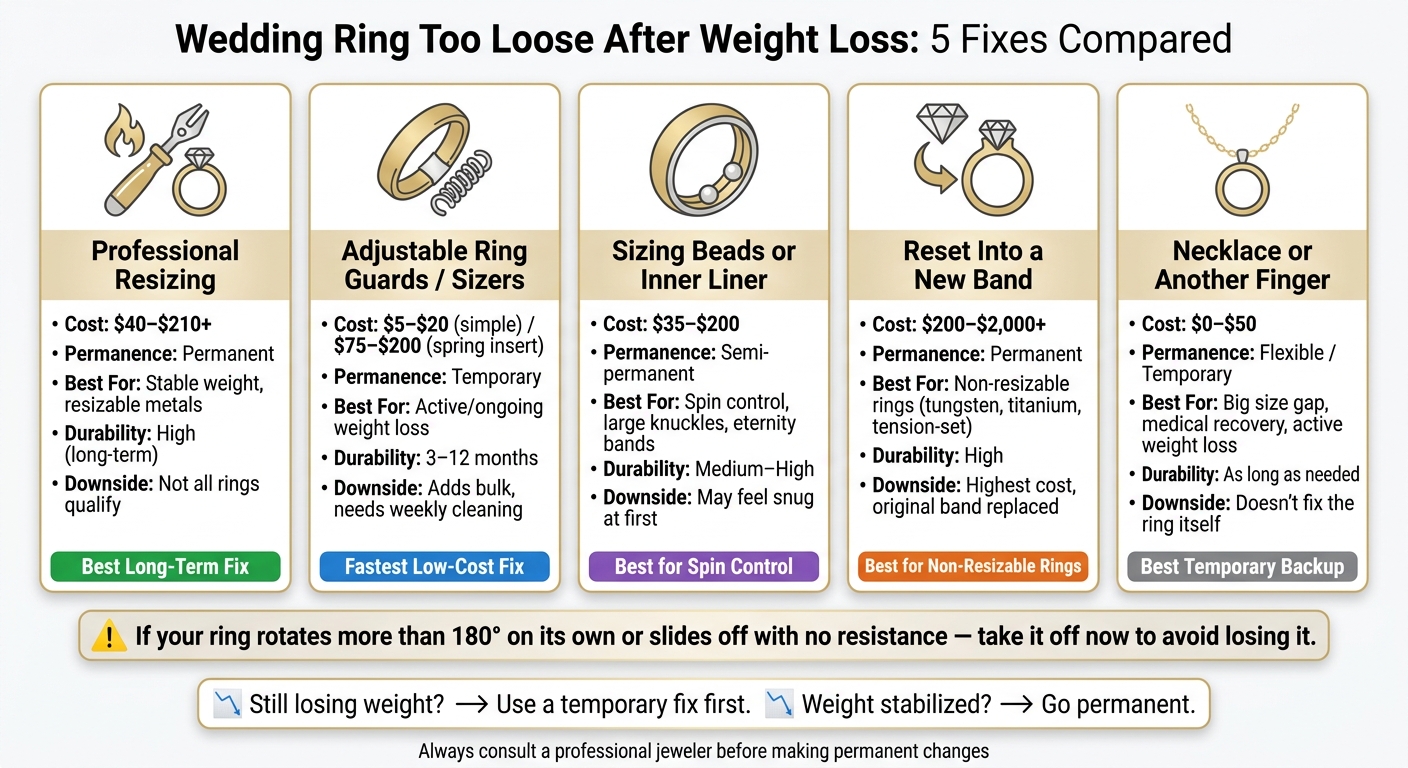
Wedding Ring Too Loose After Weight Loss: 5 Fixes Compared
How to Make Your Ring Fit Smaller: At Home DIYs & Professional Options
sbb-itb-9da40c1
Quick Comparison
| Option | Cost | Best for | How long it lasts | Main downside |
|---|---|---|---|---|
| Professional resizing | $40–$210+ | Rings in gold, platinum, or silver after weight levels off | Long-term | Not all rings can be resized |
| Ring guards / sizers | $5–$20 or $75–$200 | Short-term wear while size is still changing | A few months to about 1 year | Can add bulk and need cleaning |
| Sizing beads / inner liner | $35–$200 | Spin control, big knuckles, eternity or top-heavy rings | Medium to long-term | May feel snug at first |
| Reset into a new band | $200–$2,000+ | Rings that can’t be resized safely | Long-term | Highest cost |
| Necklace / another finger | $0–$50 | Big size gap or short-term backup | As long as needed | Doesn’t fix the ring itself |
My rule of thumb is simple: use the least permanent fix that still keeps the ring safe. Then, once your size is steady, pick the longer-term option that fits your ring style and budget.
Option 1 vs Option 2: Professional Resizing vs Adjustable Ring Guards
If your ring can still be altered, start with the permanent fix. If your size is still changing, go with a temporary guard first.
Professional Resizing: The Best Long-Term Fit Fix
Professional resizing is the best long-term fix once your weight has stabilized. In most cases, a jeweler removes a small section of metal and solders the band back together so the ring fits like it should. Most plain bands can handle one or two size changes.
A good resize should leave the band strong, smooth, and even. It shouldn’t feel awkward on the finger or look off-balance. It’s smart to wait 4–8 weeks after your weight stabilizes before resizing. That matters because resizing the same ring more than once puts extra wear on the joints. For the most accurate fit, have your finger measured in the late afternoon or evening, when fingers are usually at their largest.
Cost matters too. If you have a white gold ring, plan for an extra $30–$80 for rhodium plating so the color stays even after soldering.
Adjustable Ring Guards and Sizers: Fast, Low-Cost Protection
Ring guards make sense as a short-term fix while your size is still moving around. They make the inner circumference smaller without changing the ring itself. Simple silicone or plastic guards usually cost $5–$20, while jeweler-installed spring inserts often run $75–$200.
These options don’t last forever, and that’s the tradeoff. Silicone guards usually last about 4–6 months before they lose elasticity. Plastic coil adjusters often need replacement every 3–6 months. Metal spring guards can last up to a year. If a guard traps moisture against your skin, remove and clean it at least once a week to help prevent irritation. One big caution: don’t use hard plastic or metal guards on thin pavé bands under 2 mm. That pressure can bend prongs or loosen stones.
If a temporary fix doesn’t cut it, the next move is usually a more structural change or a new setting.
| Feature | Professional Resizing | Adjustable Ring Guards |
|---|---|---|
| Typical U.S. Cost | $40–$210+ depending on metal | $5–$20 for simple guards; $75–$200 for spring inserts |
| Permanence | Permanent | Temporary / removable |
| Comfort | Seamless, no added bulk | Slight bulk, varies by style |
| Visibility | None | Minimal to noticeable |
| Maintenance | Low | Weekly cleaning and periodic replacement |
| Durability | Long-term | 3–12 months depending on material |
| Best Ring Types | Plain bands, solitaires, three-stone rings | Rings worn during active weight loss or seasonal fluctuations |
| Metals Suited | Gold, platinum, silver | All metals, including tungsten and titanium |
| When to Avoid | Eternity bands, tungsten, titanium, some pavé or tension settings | Thin pavé bands under 2 mm |
If resizing isn’t an option, the next comparison is sizing beads, inner liners, and resetting the ring.
Option 3 vs Option 4: Sizing Beads or Inner Liners vs Resetting Into a New Band
If a standard resize or a ring guard isn't a fit, you’re down to two more structural fixes. One changes the inside of the band. The other starts over with a new ring build.
Sizing Beads or an Inner Liner: Best for Spin Control and Knuckle-Size Differences
Sizing beads are small bumps soldered inside the band. An inner liner, sometimes called a sleeve, is a thin insert that makes the inside narrower without changing the outside.
Sizing beads make sense when a ring spins but still has to get over a larger knuckle. They’re also a solid pick for:
- Top-heavy rings
- Wide knuckles
- Eternity bands that can't be cut
- Vintage or engraved rings where the outside detail needs to stay untouched
For eternity bands, beads help keep the stone pattern in place because the shank doesn’t need to be cut. That same idea applies to vintage or engraved pieces too. The outside stays the same, while the inside does the work.
Cost is usually modest next to a full reset. The fit can feel a bit snug at first, which is normal. One detail matters here: the bead metal should match the band metal to help limit wear over time.
If the ring still needs a permanent size change, a full reset is the next step.
Resetting Into a New Band: Best for Rings That Cannot Be Resized
A reset, sometimes called a remount, means taking the stones out of the original band and setting them into a brand-new mounting in the right size.
This is the move when the ring needs more than a small fix. You're not tweaking the old band. You're rebuilding the ring around the stones.
Use a reset for tension settings, damaged shanks, and rings that need more size change than the original band can safely handle.
The upside is simple: the ring is built to the correct size with full structural support. If all you need is less spinning, though, sizing beads are the lighter fix.
| Feature | Sizing Beads / Inner Liners | Resetting Into a New Band |
|---|---|---|
| Typical U.S. Cost | $35–$200 | $200–$2,000+ |
| Comfort | May feel slightly snug at first | High; feels like a standard ring |
| Appearance | Invisible from the outside | New band look or identical rebuild |
| Reversibility | High; beads can be unsoldered or filed off | Low; original band is replaced |
| Durability | Medium; joints should be checked periodically | High; structurally sound new piece |
| Ideal Ring Styles | Eternity, top-heavy solitaires, vintage/engraved | Tension-set, damaged shanks, alternative metals |
| Metal Considerations | Gold, platinum, silver; must match original alloy | Any; usually precious metals |
| Alteration Level | Minimally invasive; internal only | Full structural rebuild |
After any internal change or full reset, ask your jeweler to do a stone and prong security check. Even small adjustments can cause micro-shifts that loosen gems over time.
Option 5: Wear It on a Necklace or Another Finger
If resizing, beads, or guards aren't the right move yet, you still have a couple of short-term options. And if the ring is loose enough that it could slip off, it's smarter to take it off your finger for now than risk losing it.
When a Necklace Is the Safest Short-Term Choice
A necklace makes the most sense when the ring is much too large - more than one to two sizes - or when your finger size still hasn't settled. That's common during weight changes or medical recovery. In those cases, a loose ring can come off during normal day-to-day tasks without much warning.
Pick a chain that's strong enough to carry the ring safely. A wheat or cable chain in 14k or 18k gold, or platinum, is a solid option. Check the clasp and jump rings every week, since those connection points can wear over time. Wearing the ring on a necklace keeps it with you, but it doesn't solve the sizing problem.
When Moving It to Another Finger Works
If the ring is only a little loose, moving it to another finger may do the job for now. When the difference is around half a size, a larger finger can be a decent short-term fit. Your dominant hand is often about half a size larger, so trying the same finger on the opposite hand is a simple place to start.
Before you commit, do a quick shake test. Put the ring on that finger and shake your hand firmly. If it feels like it could slide off, don't trust it. The ring should feel snug, not tight. It also shouldn't spin freely or pinch your skin.
| Feature | Wearing on a Necklace | Wearing on Another Finger |
|---|---|---|
| Safety | High - removes sliding-off risk entirely | Moderate - depends on how well it fits the new finger |
| Comfort | High - no finger irritation or spinning | Moderate - may feel bulky or slightly off |
| Convenience | Moderate - requires a durable chain | High - instant, no extra equipment needed |
| Style | Shifts to a pendant look | Keeps the traditional ring aesthetic |
| Risk of Loss | Low if chain and clasp are secure | Moderate if the finger is still too small |
| Best For | Active weight loss, medical recovery, significant size gap | Minor discrepancies of about half a size |
Both options are temporary. Next, compare them with the permanent fixes.
All Five Options Side by Side: Cost, Fit, and What Works for Your Ring
Use this summary to match your ring type, budget, and how long your size is likely to keep changing.
| Option | Cost (USD) | Permanence | Comfort | Durability | Appearance | Ideal Use Case | Best Ring Types |
|---|---|---|---|---|---|---|---|
| Professional Resizing | $40–$210+ | Permanent | Excellent | High | Invisible | Permanent weight loss | Plain bands in resizable metals |
| Adjustable Guards/Sizers | $5–$20; $75–$200 for spring inserts | Temporary | Fair | Low | Visible | Active/ongoing weight loss | Most rings; plain bands |
| Sizing Beads or an Inner Liner | $35–$200 | Semi-permanent | Good to Excellent | High | Hidden | Top-heavy rings, large knuckles, spin control | Pavé, top-heavy, eternity, wide bands |
| Resetting Into a New Band | $200–$2,000+ | Permanent | Excellent | High | New band | Non-resizable rings | Tungsten, titanium, eternity bands |
| Necklace or Another Finger | $0–$50 | Flexible | High | High | Pendant/alternative look | Big size gap, temporary wear | Any ring too loose to wear safely |
Best Option by Situation
After the side-by-side view, these shortcuts make the choice easier.
- Fastest low-cost fix: Adjustable ring guards or silicone sizers
- Best long-term fix: Professional resizing after weight stabilizes
- Best for spin control: Sizing beads or an inner liner
- Best for non-resizable rings: Resetting into a new band
- Best temporary backup: Necklace or another finger
What to Keep in Mind Before You Decide
Don't wear a ring that fails the spin test. If it rotates more than 180° on its own or slides off with no resistance, take it off now. A loose ring can vanish during everyday tasks.
Price shouldn't be the only thing steering your choice. Temporary adjusters make sense when your size is still shifting. Permanent resizing makes more sense once your weight has leveled off. A good rule of thumb: pick the least permanent fix that still keeps the ring secure until your size settles.
FAQs
How do I know if my ring is too loose to wear safely?
A ring is too loose if it slips off with little effort, especially during exercise, swimming, or in cold weather when your fingers get smaller. It can also be too loose if it spins more than 180 degrees or if it’s over one full size too big.
If this keeps happening, and not just at certain times of day, it’s a good idea to see a professional jeweler. They can help with a permanent resize or suggest a secure fix like sizing beads.
Can every wedding ring be resized smaller?
No. Many gold or platinum wedding rings can be resized by a professional jeweler, but not every ring can.
For example, eternity bands often can't be resized because changing the size can damage the stone setting and throw off the design. The same goes for rings made from tungsten, ceramic, or titanium. Those materials are tough, but they're also hard to alter safely.
When resizing isn't an option, a jeweler may suggest other fixes, such as sizing beads or internal inserts.
Which fix makes the most sense if my weight is still changing?
If your weight is still changing, hold off on a permanent resize for now. Repeated adjustments can weaken the ring over time.
A better move is to use a temporary or semi-permanent fix that doesn't involve cutting the band. Good options include:
- Plastic or silicone ring guards
- Sizing beads
- Spring inserts
These can help keep the ring secure until your weight levels out and you're ready for a permanent resize.


