

Moissanite Cut Quality: What Actually Affects the Sparkle
If you want more sparkle, focus on cut first. Size alone does not tell you how bright a moissanite will look. In most cases, the stones that look best have clean facet work, strong symmetry, smooth polish, and balanced proportions such as a round table near 55%–58% and depth near 59%–62%.
Here’s the short answer:
- Brilliance = white light return
- Fire = rainbow flashes
- Scintillation = the blink-on, blink-off sparkle when the stone moves
- Round cuts usually give the most even sparkle
- Ovals can show a bow-tie dark band if cut poorly
- Emerald cuts show broad flashes, not glittery sparkle
- Poor polish or off proportions can make a stone look hazy, flat, dark, or see-through
- Videos in more than one light help more than sales words
If I were shopping, I’d check these first:
- Cut grade
- Polish
- Symmetry
- Table % and depth %
- How the stone looks in indoor light and daylight
- Whether the ring keeps the stone upright and centered
| Shape | Sparkle Style | Main Risk | What I’d Check |
|---|---|---|---|
| Round | Even, bright sparkle | Light leakage | Balanced table and depth |
| Oval | Bright, stretched look | Bow-tie shadow | Center brightness in motion |
| Emerald | Broad flashes | Flat or glassy look | Polish and straight facet lines |
The core idea is simple: a well-cut moissanite sends more light back to your eye, while a poor cut wastes that light. That’s what separates a stone that looks crisp and lively from one that looks dull, patchy, or too watery.
The cut factors that actually affect sparkle
These are the cut details that control brilliance, fire, and scintillation.
Facet precision and symmetry create even light return
Facet precision is about the tiny flat surfaces on the stone. Each one needs to be shaped, sized, and lined up the right way, with crisp facet junctions that meet at the right angles. Symmetry is the big-picture layout. It means those facets sit in a balanced, centered pattern across the whole stone. When both are on point, light comes back evenly across the stone.
If either one is off, you can usually see it fast. Some areas will flash hard while others look dead. In a round stone, a tilted pattern or dark zones near the edge often point to uneven light return. A well-cut moissanite should sparkle from edge to edge, not just light up in the middle.
Polish and proportions decide whether a stone looks sharp or flat
Polish is the smoothness of each facet after cutting. If the polish is poor, light gets scattered and the stone can look foggy or milky instead of crisp. Look for Excellent or Very Good polish. In most cases, either grade gives you a clearer, sharper look.
Proportions decide whether light stays inside the stone long enough to bounce back to your eye. For round moissanite, a table around 55% to 58% and total depth around 59% to 62% usually give a good mix of brightness and fire. Go too shallow, and you can get windowing. Go too deep, and the center may look dark.
Cut details that most affect sparkle
Here’s what matters most at a glance.
| Cut Factor | Impact on Sparkle | Common Visual Problem | What to Look For |
|---|---|---|---|
| Facet precision | Even brightness and crisp sparkle | Patchy light return, fuzzy facet edges | "Precision-cut" or "ideal" |
| Symmetry | Balanced, centered light pattern | Off-center pattern, uneven sparkle | "Excellent" or "Very Good" symmetry |
| Polish | Sharp, clear reflections | Haze, milky look, blurred sparkle | "Excellent" or "Very Good" polish |
| Table size | Balance of brilliance and fire | Flat look if too large; less fire if too small | Table % listed; prefer a midrange proportion |
| Pavilion depth | Strong light return vs. leakage | Windowing if too shallow; dark center if too deep | Depth % listed and balanced proportions |
These same cut choices show up differently in round, oval, and emerald moissanite.
sbb-itb-9da40c1
How round, oval, and emerald cuts handle light differently
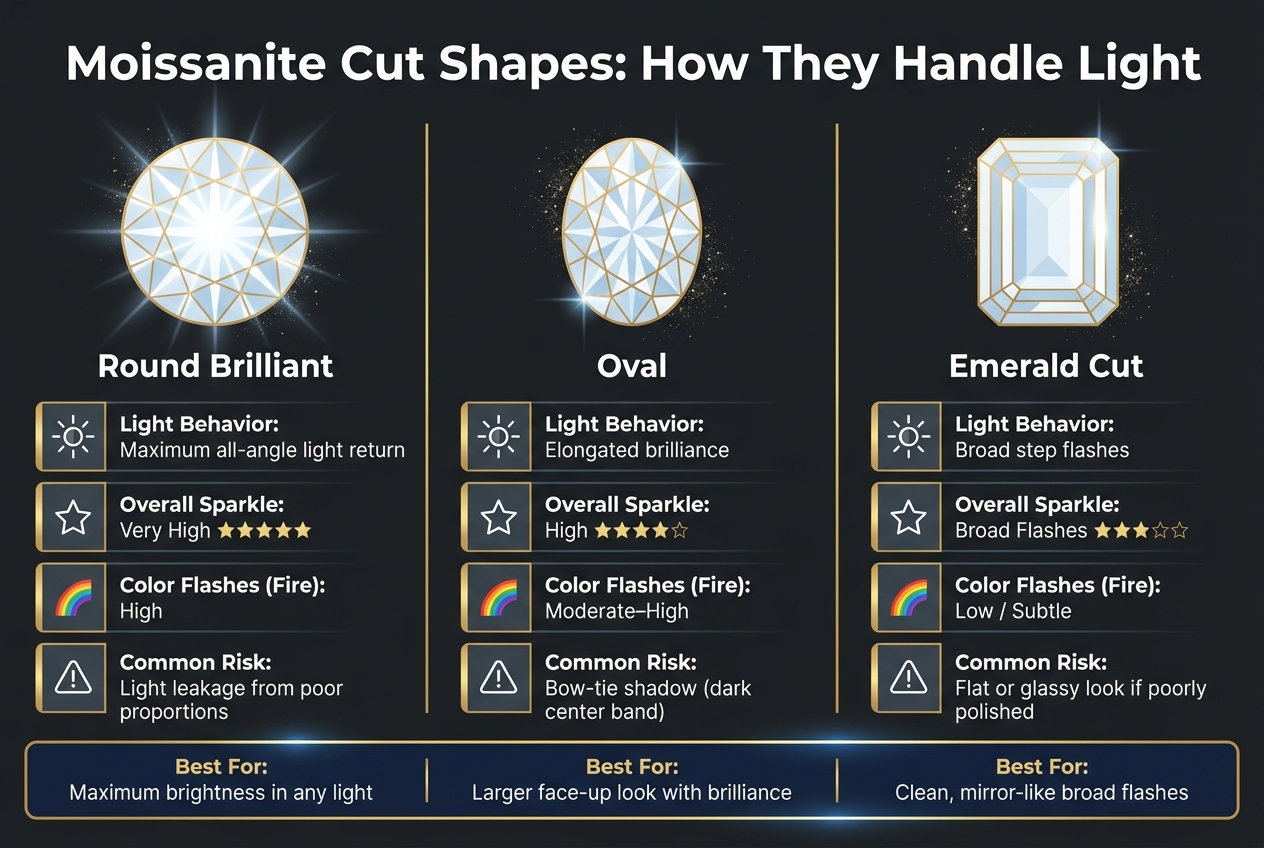
Moissanite Cut Shapes Compared: Round vs Oval vs Emerald Sparkle
The same cut basics can look very different once you change the shape. That’s the key idea here: shape affects the style of sparkle, not just the amount of light you see.
Round brilliant gives the most consistent sparkle
Round brilliant gives the most even, all-over sparkle. Its facet pattern sends light back from lots of angles, so it tends to look bright in most settings.
When the proportions and symmetry are well done, the stone stays bright from edge to edge under office light, daylight, and warm indoor light. You also don’t need to hold it at the perfect angle to see that brightness. If your top goal is maximum brightness across different lighting conditions, round brilliant is the safest choice.
Oval cuts need careful cutting to avoid dark zones
Oval moissanite uses a brilliant-style facet pattern, but its stretched shape changes the way light moves through the stone. One big plus is that it often looks larger face-up than other shapes with the same carat weight.
The catch is the bow-tie effect. A poorly cut oval can show a dark band across the center. A well-cut oval stays bright from end to end instead. That’s why facet alignment and bow-tie control matter so much.
When you shop, ask directly whether the stone shows bow-tie darkness. It also helps to look at videos that show the full face of the stone moving under light. A still photo can hide a lot.
Emerald cut gives broad flashes instead of scattered sparkle
Emerald cuts work differently. They use broad, parallel step facets instead of a brilliant-style facet pattern.
That gives you broad flashes of light instead of glittery sparkle. Some people love that clean, mirror-like look. But there’s less room for error. Since emerald cuts trade scattered sparkle for broad flashes, flaws show up faster.
Polish and symmetry matter most here. If the facets are off or the surface has haze, you’ll notice uneven bands or a watery look right away. That’s why cut quality in this shape is often easier to judge in person.
Use these shape differences to match the stone to the kind of sparkle you want.
| Cut Shape | Light Behavior | Overall Sparkle | Color Flashes | Common Risk |
|---|---|---|---|---|
| Round Brilliant | Maximum all-angle light return | Very high | High | Light leakage from poor proportions |
| Oval | Elongated brilliance | High | Moderate–High | Bow-tie shadow (dark center band) |
| Emerald Cut | Broad step flashes | Broad flashes | Lower / subtle | Looking flat or glassy if poorly polished |
How to judge moissanite cut quality when shopping
Now it’s time to use those cut rules on actual stones, videos, and product listings. That matters because some stones look flashy under jewelry-store spotlights, then fall flat in normal day-to-day light.
Check the stone under more than one light source
A well-cut moissanite should look bright in everyday settings, not only under the harsh lights above a display case. Start by looking at the stone face-up under indoor lighting. Check whether the brightness looks even across the whole surface. Then move near a window or step outside into open shade to see how it handles natural daylight. A strong cut stays bright in both.
After that, tilt and rotate the stone slowly. You want to see flashes of sparkle moving across the facets as the angle shifts. If dark areas stay put, that’s a warning sign for weak light return. With ovals, pay close attention to the center for a bow-tie shadow. Also check for windowing. If you can see straight through the stone to your finger or the setting below, light is leaking out instead of bouncing back to your eye. That usually means less sparkle.
Read the grading details that support sparkle claims
Listings should show the grades before you buy. Focus on the details below instead of leaning on sales copy alone.
| Detail | What to Look For | Why It Matters |
|---|---|---|
| Cut grade | Ideal or Excellent | Tied to how much light the stone returns |
| Polish | Excellent or Very Good | Affects sharpness of facet edges and reflections |
| Symmetry | Excellent or Very Good | Helps prevent uneven dark zones and dull patches |
| Table % | Around 55–58% for rounds | Keeps brightness and fire in balance |
| Depth % | Around 59–62% for rounds | Helps avoid windowing or dark centers |
| mm dimensions | Matches the stated carat equivalent | Flags unusual proportions chosen for size over sparkle |
Labels like premium cut or signature cut can sound impressive, but they aren’t grading standards. Treat them as a cue to check the actual numbers. If the listing includes a third-party certificate from a lab like GRA or AGL, verify the report number with the lab itself so you can confirm the grades match the listing.
Ask the jeweler direct questions before buying
Keep your questions tied to the main cut factors: symmetry, polish, proportions, and bow-tie control. A few direct questions can save you from guessing.
- Are the symmetry and polish grades Excellent?
- Can you send a slow-rotation video in daylight and indoor light?
- For ovals, has the cut been adjusted to reduce bow-tie?
- Were the proportions chosen for brightness or for face-up size?
Use those points to narrow your options before you move on to ring design.
Choosing a high-sparkle moissanite ring at Satinski
Why cut quality still matters in adjustable rings
Once you know what strong cut quality looks like, the next step is making sure the setting lets that sparkle show. An adjustable band changes the fit, but it doesn't change how the stone handles light. What it does change is how the ring sits on your finger.
That matters more than people think. The sliding back helps keep the ring centered, so the moissanite stays upright instead of twisting off to one side. In day-to-day wear, that kind of stability can make a big difference.
For anyone dealing with arthritis, swelling, or fingers that change size between summer and winter, this setup helps the moissanite stay upright and properly presented throughout the day without resizing.
What to look for in Satinski moissanite ring designs
If you want steady sparkle in daily wear, a round brilliant center stone is usually the safest bet. It tends to give the most predictable sparkle, which is helpful if you don't want surprises once the ring is on your hand.
Then look at the setting. A stone can be cut well, but if the ring lets it lean, spin, or sit unevenly, some of that visual punch gets lost. Pair a round brilliant with a setting that keeps the stone upright, and you're covering both sides of the equation: how the stone reflects light and how the ring supports it.
Conclusion: the shortest path to better sparkle
The formula is pretty simple: choose a well-cut stone, pick a setting that keeps it upright, and make sure the fit keeps it centered. Then check it with your own eyes under more than one light source, and read the listing details before you buy.
That's the shortest path to better sparkle: a well-cut stone in a stable, snug ring.
FAQs
How much does cut matter more than size?
Cut quality often matters more than size because it shapes how well the stone reflects light. And that has a direct effect on brilliance and fire.
A bigger stone can still look dull if the cut is poor. On the flip side, a well-cut stone gives you the sparkle and polished look most people want. That’s why it often feels like the smarter buy than a larger stone with less shine.
Can a well-cut moissanite still look dull?
Yes. Even a well-cut moissanite can look dull when dirt, oil, or other residue builds up on the surface and blocks light.
Lighting plays a part too. In low light or certain indoor settings, moissanite may show less of its usual sparkle. Regular cleaning helps keep its brilliance and clarity.
Which shape gives the most sparkle?
No single shape always gives the most sparkle. Moissanite is known for strong brilliance and fire, but the biggest factor is cut quality.
If a stone is cut well, with precise facets and good symmetry, it reflects light much better. That means many shapes, especially classic brilliant styles, can show bold, rainbow-like flashes.


