

7 Times Finger Size Changes Fast
Your ring fit can change in a single day - often by about 1/4 size, and sometimes by 1/2 size or more. That usually comes from short-term swelling, not from your ring changing shape.
If I had to sum up the article in one line, it’s this: don’t rush to resize a ring until I know whether the fit change is temporary, seasonal, or long-term.
Here’s the short version of what changes finger size fast:
- Heat and humidity can make fingers swell, sometimes close to 1 full size
- Flights and travel days can add about 1/2 size
- Pregnancy and postpartum can shift fit day by day
- Illness, inflammation, and some medications can cause sudden swelling
- Exercise and sports can make fingers swell by 1 to 1.5 sizes
- Aging and arthritis can change how a ring moves over the knuckle
- Weight change of about 5–10 lb can affect fit over time
What I’d do depends on the pattern:
- Take the ring off early if it starts to feel tight
- Wait before resizing if the change seems tied to weather, travel, workouts, or swelling
- Get checked by a doctor if there’s numbness, color change, or strong pain
- Think about an adjustable ring if the size keeps changing from day to day or season to season
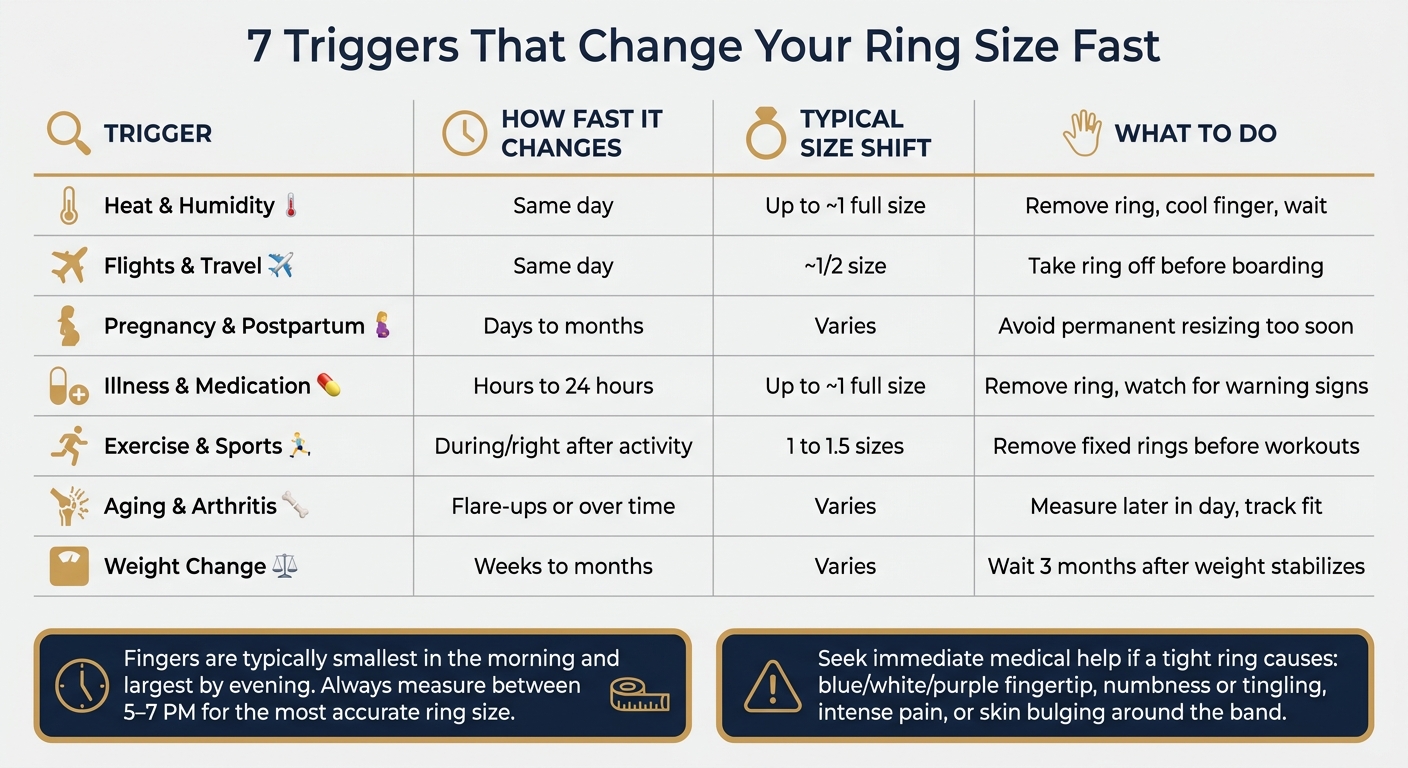
7 Triggers That Change Ring Size Fast: Speed, Shift & What To Do
Why does my ring fit differently all the time?
sbb-itb-9da40c1
Quick Comparison
| Trigger | How fast it can change | Typical shift | What I’d do |
|---|---|---|---|
| Heat and humidity | Same day | Up to about 1 size | Remove ring, cool finger, wait |
| Flights and travel | Same day | About 1/2 size | Take ring off before or during travel |
| Pregnancy/postpartum | Days to months | Varies | Avoid permanent resizing too soon |
| Illness/medication | Hours to 24 hours | Up to about 1 size | Remove ring and watch for warning signs |
| Exercise/sports | During or right after activity | 1 to 1.5 sizes | Remove fixed rings before workouts |
| Aging/arthritis | Flare-ups or over time | Varies | Measure later in the day and track fit |
| Weight change | Weeks to months | Varies | Wait about 3 months after weight levels off |
Bottom line: if your ring fit changes often, the main issue is not just size. It’s whether the change is short-term, repeat, or lasting.
Why Ring Fit Changes Faster Than You'd Think
A ring has to work with two parts of your finger at the same time: the knuckle and the base. The knuckle decides whether the ring can go on and come off. The base is where the ring actually rests. That's why one size doesn't feel perfect in every situation. Even small fluid shifts can change the fit.
Fingers are usually smallest in the morning and fuller by evening, after a day of warmth, movement, and gravity pulling fluid downward. So a ring that feels fine at breakfast can start to feel snug by dinner.
Temperature plays a big role. Warm weather makes blood vessels widen, which increases blood flow and tissue volume. Cold weather does the opposite, making vessels tighten and fingers shrink. In day-to-day terms, rings often feel tightest above 80°F and loosest below 50°F.
Food, drinks, and activity can also change fit fast. Salt, alcohol, dehydration, exercise, and manual labor can all lead to short-term swelling. That matters when you're trying to figure out if you should keep the ring on, take it off, or give it some time.
Morning measurements usually come in smaller than evening readings.
And these things can stack up in a single day. A hot afternoon, salty meal, and a bit of activity can all push the fit in the same direction. So if your ring feels fine earlier and tight later, that doesn't automatically mean something is wrong. Next: summer heat and humidity, the most common fast-change trigger.
1. Summer Heat and Humidity
Hot weather is one of the most common reasons a ring suddenly feels too tight. As temperatures go up, your blood vessels widen to help your body cool down. That can make the tissues in your fingers swell. Humidity can make it worse.
In extreme heat, fingers can swell by nearly a full ring size. Humid air adds to the problem by slowing sweat evaporation and making fluid retention more likely.
A few signs can tell you it’s more than a small fit issue:
- The band looks like it’s bulging into the skin
- You feel numbness or tingling
- The skin turns blue-purple
If a ring gets stuck, lift your hand, cool the finger, and use soap or lotion to help the ring slide off.
The key thing here is simple: the ring didn’t shrink. Your finger swelled.
If this happens to you over and over in the summer, an adjustable ring makes more sense. It’s built to deal with size shifts during the day instead of staying fixed at one size that may not work all season.
Flights can cause a different kind of swelling, even when the weather is mild.
2. Airplane Flights and Travel Days
Flying can make your fingers swell. When you stay seated for a long stretch, blood tends to collect in your hands and feet. On top of that, cabin altitude and changes in hydration during a flight can lead to extra fluid in your fingers. Dehydration can make it worse, and salty snacks or alcohol can pile on more swelling.
On travel days, fingers can get close to 1/2 a size larger. So if a ring already feels snug, take it off before boarding or as soon as you notice swelling.
If the ring is already tight while you're in transit, try this:
- Lift your hand above heart level for 30 to 60 seconds to help move fluid out of your fingers.
- Hold off on any permanent resizing choice right away, since travel swelling often goes down within hours or a few days after landing.
If you fly a lot, Satinski's adjustable rings can help with these short-term fit changes. Some ring-size shifts stick around longer than a single trip, which is why pregnancy calls for a different approach.
3. Pregnancy and Postpartum Changes
Pregnancy can change ring fit FAST, and not just for a few hours. These shifts can last for months. Swelling is especially common in the second and third trimesters, and it may build little by little or show up all at once in a single day.
Hormonal changes also lead to more water retention and looser soft tissue. That’s why a ring might feel fine in the morning, then feel much tighter by evening.
The main problem is a ring that gets stuck. If you notice visible indentation, numbness, tingling, or trouble sliding the ring over the knuckle, take it off early. Waiting too long can make things worse. In severe cases, a ring may need to be cut off.
After delivery, swelling often starts to ease as the body gets rid of retained fluid. But that doesn’t always happen right away. It can take days or weeks, depending on hydration, movement, and IV fluids during labor. This is where an adjustable ring makes a big difference.
Pregnancy swelling can shift from day to day, so a fixed ring can feel hard to trust. Satinski's adjustable wedding bands and engagement rings are made for changing finger sizes. If the ring has sentimental value, an adjustable design helps keep it wearable through pregnancy and postpartum.
4. Illness, Inflammation, and Medication-Related Swelling
Illness and medication can make fingers swell fast. Arthritis, thyroid or kidney problems, lymphedema, diabetes, autoimmune flares, and some blood pressure drugs, hormones, steroids, and antidepressants can all lead to fluid retention.
This isn't always a slow shift in fit, either. These changes can show up in hours or even minutes. In some cases, people fluctuate by as much as a full ring size within a single 24-hour period.
A metal ring doesn't stretch. When swelling hits, that ring can trap the finger and cut off circulation. If the finger turns blue, white, or numb, remove the ring and get medical help right away.
If a new medication suddenly makes your ring feel tight, tell your doctor. It may point to heavy fluid retention.
For people dealing with chronic or hard-to-predict swelling, a fixed-size ring can be a gamble from one day to the next. Satinski's adjustable rings are designed to shift with those fit changes, which makes them a safer pick for daily wear when swelling comes and goes.
Even a healthy workout can cause short-term swelling, which is why exercise is the next common trigger.
5. Exercise, Outdoor Sports, and Cardio Sessions
Exercise can change ring fit FAST, and it doesn’t always go the same way.
Hard cardio or outdoor sports in hot weather can make fingers swell by 1 to 1.5 ring sizes above their resting size. That’s a big jump for something as small as a ring. So the first move is simple: take off fixed-size rings before intense exercise, especially when it’s hot out.
The danger goes both ways. Heat can make a fixed-size ring clamp down on your finger. Cold-water sports can do the opposite and make it slide right off. During exercise, a tight ring can limit blood flow, cause numbness, or even lead to a bad finger injury if it gets caught on something.
The ring is not expanding; your finger is.
If your ring gets stuck after a workout, don’t force it. Lift your hand above heart level for 30–60 seconds, cool the finger with cold water, and then try again. If you’re trying to measure your finger size, give it at least 30 minutes after exercise so the swelling has time to go down.
For active wear, an adjustable ring can give you a little breathing room during exercise and then tighten back up after.
Some fit changes don’t end when the workout does. Aging and arthritis can make ring sizing harder to predict over time.
6. Aging, Arthritis, and Enlarged Knuckles
Aging can make knuckles larger. Arthritis can make ring fit tighter and much less predictable. Unlike swelling from heat or exercise, these changes can stick around.
During an arthritis flare, ring fit can change fast. One day it feels fine. The next day it doesn’t. That makes sizing harder to judge from a single measurement.
The main problem is simple: a ring may slide over the knuckle, then get stuck when you try to take it off. To cut that risk, measure your finger at the end of the day, when fingers are usually at their largest. Also skip cold-weather measurements, since fingers contract in the cold.
If you're in the middle of an arthritis flare-up, hold off on permanent resizing until things settle down. Track the fit for several weeks so you can tell the difference between a lasting change and flare-up swelling.
For aging fingers or arthritis, an adjustable ring is often the most practical fix. It can move over larger knuckles more easily and still stay secure at the base.
Weight changes can create a different kind of fit shift.
7. Weight Gain, Weight Loss, and Body Composition Shifts
A 5–10 lb change in weight or body composition can affect how your ring fits. These changes usually build over time and tend to stick around longer.
The biggest slip-up is resizing too soon. If your weight is still moving up or down, your finger size may still be changing too. That can leave you paying for another adjustment later. It’s smarter to wait at least three months after your weight levels off before resizing.
Once your weight has settled, you can choose between resizing and moving to an adjustable ring. If your weight tends to fluctuate, an adjustable ring usually makes more sense for the long haul. Satinski's adjustable rings are made for changing finger sizes and can handle day-to-day shifts without repeat resizing.
If your ring fit still changes from one day to the next, the next section looks at fast fixes that can help.
Quick Ring-Fit Fixes for Fingers That Change Size
Once you know what's behind the size change, the next step is pretty simple: figure out whether to remove the ring, wait it out, or get a better fit reading.
When to Take a Ring Off Right Away
Take the ring off as soon as it starts to feel tight, before swelling gets worse.
When a Ring Gets Stuck
If a ring gets stuck, don't force it. Lift your hand above your heart for about 60 seconds to help fluid move out, then try soap or oil. If it still doesn't move, stop.
When to Wait Before Getting a Ring Resized
Don't rush into resizing if the swelling is seasonal or temporary. Resize only when your fit stays the same over time.
How to Get a More Reliable Ring Size
If you need a new measurement, a few simple rules can help.
Measure your finger 2–3 times on different days, ideally between 5 PM and 7 PM, when fingers tend to be at their largest. Don't measure right after exercise, a salty meal, or alcohol. And if your knuckle is wider than the base of your finger, size for the knuckle.
If your ring size shifts from day to day, Satinski's adjustable rings can handle those changes without repeated resizing. The next section compares fixed-size and adjustable rings side by side.
Fixed-Size vs. Adjustable Rings: A Side-by-Side Look
If your ring size changes often, the better question isn’t how to resize a ring one time. It’s which ring style can keep up.
The best pick comes down to how often your finger size shifts. A fixed-size ring works best when your size stays steady. An adjustable ring makes more sense when it doesn’t.
Here’s a simple side-by-side view of where each one fits best.
Comparison Table: Fixed-Size vs. Adjustable Rings
| Factor | Fixed-Size Ring | Adjustable/Resizable Ring | Best Use Case |
|---|---|---|---|
| Swelling comfort | Can feel uncomfortably tight | Adjusts to accommodate swelling | Heat, pregnancy, illness, exercise |
| Security when fingers shrink | May spin or slip off | Tightens to stay in place | Winter, weight loss, postpartum |
| Repeated resizing | Often needs resizing when finger size changes | Low - adjusts as needed | Long-term changes like aging or weight shifts |
| Temporary fluctuations (daily/seasonal) | Poor fit during peaks and dips | Handles daily/seasonal swings of 1/4 to 1/2 a ring size | Travel, hot weather, salty meals |
| Major life changes (pregnancy, weight) | May need resizing after a shift of one full ring size or more | Adapts through the change | Pregnancy, weight gain or weight loss |
| Arthritis and enlarged knuckles | Can be difficult to put on and take off | Easier to manage with stiff joints | Aging, arthritis |
When an Adjustable Ring Is the Better Choice
If your fingers change size on a regular basis, an adjustable ring can save you from the same fit issue over and over. It’s a simpler fix for the ups and downs that happen with weather, daily swelling, pregnancy, weight shifts, or arthritis.
Satinski's adjustable rings are made for fingers that change size during the day or across seasons. They also work well during pregnancy, weight changes, or for people dealing with arthritis.
When Finger Swelling May Need Medical Attention
Most day-to-day ring-size changes are harmless. Your fingers can shift by about 1/4 to 1/2 a ring size over the course of a day because of heat, exercise, salt, or even the way you slept.
That said, swelling with a color change or numbness is not something to brush off.
Seek immediate medical attention if a swollen finger or tight ring comes with any of these signs:
- Fingertip turns blue, white, or purple
- Numbness, tingling, or loss of sensation
- Intense pain or skin bulging around the band
- Blood flow is restricted
If the ring is stuck, elevate your hand for 5–10 minutes and run cool water over the finger before trying again. Don’t force it. Yanking can cause bruising, skin tears, and more swelling.
For normal fit changes, sizing fixes usually do the job. But if you notice any of the warning signs above, treat it like a medical issue.
You should also schedule a doctor visit if your rings keep getting tighter without weight gain. That kind of pattern can point to thyroid, kidney, or cardiovascular issues.
Conclusion
Finger size can change fast, and the reason behind it usually points to the fix. The key is to match the ring to the pattern: temporary swelling, recurring fluctuation, or a lasting change.
So the best answer usually isn't one fixed ring size. It's the fit plan that matches how your finger changes over time. If those changes happen often or without much warning, an adjustable ring is the simplest long-term fix. Satinski's adjustable rings are made to move with those shifts in finger size.
Meaningful jewelry should fit real life, not one fixed measurement.
FAQs
How do I know if my ring is too tight?
A ring is likely too tight if it feels uncomfortable, leaves the skin puffing around the band, or makes your finger feel sore or numb. Trouble getting it over your knuckle is another clear sign. If your fingertip starts turning blue or white, that’s a bigger red flag.
Finger size can shift during the day because of heat, exercise, and water retention, so a little tightness now and then is common. But if the ring stays tight or starts to hurt, talk to a doctor.
When should I resize my ring?
Think about resizing your ring if it feels consistently too tight or too loose all year, not just during short-term changes from hot or cold weather.
Permanent resizing usually makes the most sense when finger-size changes are sticking around, like after major weight changes, aging, or long-term medical conditions. If your ring size tends to shift often, an adjustable ring from Satinski can be a smart long-term option.
Are adjustable rings better for changing finger size?
Yes. Adjustable rings are a practical choice because they can fit finger-size changes during the day, across seasons, or because of health issues.
Unlike fixed-size rings, they can open or tighten without professional resizing. That means fewer trips for resizing and a fit that feels more secure and comfortable.


