

Thyroid Conditions and Sudden Ring Size Changes
A ring that suddenly feels tight or loose can be a clue - but it does not prove you have a thyroid problem. In most cases, thyroid-related ring fit changes happen over weeks or months, not in a few hours. Tighter rings can line up with hypothyroidism and fluid retention. Looser rings can line up with hyperthyroidism and unplanned weight loss. But heat, exercise, salt, injury, and medicine can also change finger size.
Here’s the short version:
- Tighter ring over time: may happen with hand puffiness, fatigue, dry skin, constipation, or feeling cold
- Looser ring over time: may happen with weight loss, sweating, tremor, fast heartbeat, or feeling warm
- Sudden painful tightness: think urgent problem first, not thyroid
- One U.S. ring size = about 0.8 mm in inner diameter: even mild swelling can change fit
- Heat and humidity can change finger size by about one ring size: short-term shifts are common
- First step: remove the ring early if swelling starts and do not force it off
If I noticed my ring size changing, I’d look at the pattern, not just the ring. Does it happen only after a workout or on hot days? Or is it showing up again and again with other body changes? That’s the main point of this article: protect your finger first, then sort out whether the cause looks temporary, thyroid-related, or something that needs urgent care.
A small fit change can be harmless. A painful, stuck, numb, or discolored finger is not.
How Thyroid Conditions Affect Ring Fit
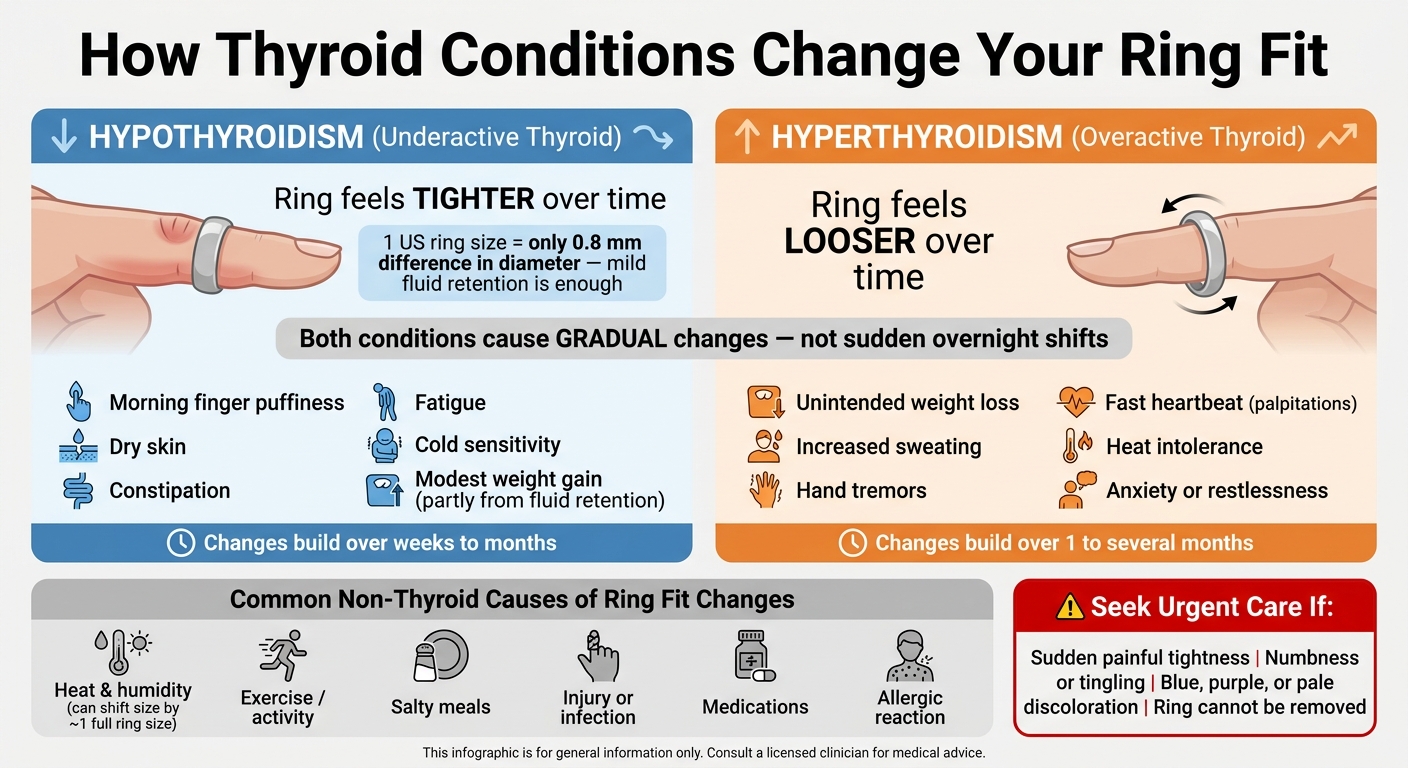
Hypothyroidism vs Hyperthyroidism: Ring Fit Changes & Symptoms
Thyroid-related ring changes usually show up gradually. In most cases, they build over weeks or months, not overnight. The main thing is to look at the direction of the change and what else is happening in your body at the same time.
Hypothyroidism and finger puffiness
Hypothyroidism can lead to fluid retention that makes the hands and fingers look and feel puffy. The American Thyroid Association says weight gain linked to hypothyroidism may be modest and can happen partly because of fluid retention, not just body fat.
That extra fluid can change ring fit in small but noticeable ways. A ring may feel tight when you wake up, leave a shallow mark on your finger, or become harder to remove than it used to be.
Morning tightness is a pattern many people notice. If your fingers are regularly puffy first thing in the morning, it deserves attention, especially if it shows up along with fatigue, dry skin, cold sensitivity, or constipation. Even a small shift matters here. One full US ring size changes the inner diameter by only about 0.8 mm, so mild fluid retention can be enough to make a ring feel different.
Hyperthyroidism, weight loss, and looser rings
An overactive thyroid speeds up metabolism, which can cause unintended weight loss even if your appetite goes up. As body weight drops, a ring may start to spin, slide around, or slip off more easily.
This pattern often comes with other symptoms too, such as heat intolerance, more sweating, hand tremors, a fast heartbeat, and feeling anxious or restless. If your ring has been getting looser over one to several months, and you're also losing weight without trying and feeling unusually warm, that's the kind of pattern to bring up with a clinician.
Temporary size shifts versus patterns that need follow-up
Not every change in ring fit points to a thyroid issue. If your ring gets tighter after hot weather, exercise, or a salty meal, then goes back to normal later, that's more likely a short-term fluid shift.
What matters most is consistency and context. A one-time change is one thing. A steady pattern, with other symptoms alongside it, is another.
| Pattern | What it may look like | What to do |
|---|---|---|
| Gradual tightening over weeks or months | Ring leaves indentation, harder to remove; also noticing fatigue, dry skin, constipation, cold sensitivity, puffiness, or weight gain | Schedule a routine medical evaluation |
| Gradual loosening over weeks or months | Ring spins or slides; also noticing unintended weight loss, sweating, tremors, fast heartbeat, anxiety, or increased appetite | Discuss with a doctor, especially if weight loss is unexplained |
| Sudden tightness within hours | Ring suddenly feels trapped or painful; may be limited to one finger or one hand | Seek prompt help if severe, numb, discolored, or rapidly worsening |
| Occasional mild variation | Slight snugness or looseness tied to heat, activity, or diet | Monitor; seek care if the pattern becomes frequent or persistent |
Sudden swelling is more often tied to injury, allergy, infection, heat, salt, medicine, circulation problems, or another acute issue. If a ring becomes embedded, causes numbness, color change, or severe pain, treat that as urgent and do not force it off. If the change sticks around or feels severe, use the warning signs below to decide what to do next.
sbb-itb-9da40c1
Warning Signs and First Steps to Take
Signs that need urgent attention
Some ring-fit changes are more than a comfort problem. They can turn into a safety issue fast.
If a ring starts feeling tighter and you also have severe or increasing pain, numbness, tingling, pale, blue, purple, or mottled finger color, unusual coldness, reduced sensation, weakness, or difficulty moving the finger, treat that as urgent. Thyroid-related swelling tends to build over time. Sudden pain or a color change usually points somewhere else.
Skin changes matter too. Spreading redness, warmth, increasing tenderness, drainage, blistering, or fever above 100°F are not signs of thyroid-related swelling. They may point to infection or skin injury. If you do not have those warning signs, take the ring off before the swelling gets worse.
What to do right away when ring fit changes
Take the ring off early. Relax your hand, use a small amount of soap or lubricant, and pull it straight off without forcing it. If pain gets worse or the finger changes color, stop right away.
After the ring is off, jot down a few details:
- Time of day
- Recent activity
- Heat exposure
- Meals
- Medications
- Weight change
- Thyroid-related symptoms like fatigue, cold intolerance, heat intolerance, palpitations, tremor, or unexplained weight change
That simple record can help sort out thyroid-related swelling from heat, injury, infection, or medication effects. MedlinePlus advises contacting a healthcare provider when major finger swelling does not go away in about 1 day, or when swelling comes with redness or fever.
Don’t put the ring back on if that finger swells in an uneven or hard-to-predict way. Keep it in a soft pouch until your finger size settles.
Short-term options: remove, adjust, or get professional help
Start with the shortest safe option.
| Option | When appropriate | Main benefit | Limitation | Key safety warning |
|---|---|---|---|---|
| Sizing aid (silicone coil or sizing guard) | Ring is only slightly loose, finger is not swollen, no pain or circulation change | Reduces slipping without altering the ring | Can trap moisture or conceal a worsening fit | Remove immediately if swelling, numbness, or color change develops |
| Take the ring off | Swelling is beginning, tightness is increasing, or fit varies unpredictably | Protects circulation, skin, and the ring | Ring cannot be worn until fit is reassessed | Remove early; do not wait for severe swelling |
| Professional removal by medical staff or a jeweler | Home removal fails; ring is embedded; finger has pain, numbness, or discoloration | Removes the constriction with appropriate tools | May require cutting the ring, which needs later repair | Use emergency medical care - not a jeweler - when circulation is compromised |
| Continue wearing the ring | Ring remains comfortable; finger has normal color, warmth, sensation, and movement | No interruption to wear | Swelling can escalate quickly | Stop at the first sign of pressure, tingling, or discoloration |
If your finger size keeps shifting, adjustable or resizable rings are usually the next practical move.
Ring Options That Work When Finger Size Fluctuates
When thyroid-related swelling or weight change keeps your ring size from settling, it usually makes more sense to use a ring that can flex with those changes - or hold off on resizing until your size stays steady.
When adjustable rings are a good fit
If thyroid symptoms make your finger size shift from day to day or week to week, an adjustable ring can save you from resizing over and over. It can also handle moderate swelling better than a fixed-size ring.
An adjustable ring usually has an open or split band that bends slightly to allow for moderate size changes. The key is to pick one with a range that lines up with your usual fluctuation.
When you fit it, adjust the band little by little until it feels snug, not tight. Make sure the opening isn't digging into your finger. It's also smart to check it now and then for sharp edges or skin irritation. That can help with comfort and lower the chance of the ring slipping off while the cause is still being sorted out.
When permanent resizing is the better choice
Permanent resizing is a better option once your finger size has stayed stable for several months after thyroid-related swelling has gone down. If you resize too soon, you may end up with a ring that fits badly once your size shifts again.
Before any resizing, a jeweler should check the ring's metal, setting, stones, and repair history. Some ring styles are hard - or flat-out impossible - to resize, including:
- full-eternity bands
- tension-set rings
- tungsten carbide rings
- ceramic rings
In those cases, replacement or a temporary sizing aid may be the safer route.
If the ring has sentimental value or costs a lot, ask the jeweler to walk you through the method they plan to use, any risk to the finish or stones, and whether the change can be reversed before you approve the work.
Fixed-size, adjustable, and resized rings compared
| Option | Adaptability | Best use case | Limitations | When to get professional help |
|---|---|---|---|---|
| Fixed-size ring | None after manufacture | Stable finger size | Becomes tight or loose when size changes | If it's hard to remove, causes symptoms, or risks slipping off |
| Adjustable ring | Moderate; covers a stated range | Short-term or recurring fluctuations | Limited range; the mechanism may pinch or wear over time | If it causes pressure, has sharp edges, or cannot be secured comfortably |
| Temporary sizing aid | Low to moderate | Useful for mild, temporary looseness while size is still shifting | May trap moisture, irritate skin, or shift during wear | For valuable rings, persistent discomfort, or uncertain compatibility |
| Permanent resizing | Low after alteration; creates a new fixed size | Stable, long-term size change | Not possible for all metals or designs; may affect settings | Always - especially for gemstones, engravings, thin bands, or previous repairs |
A simple way to think about it:
- Fluctuating size: adjustable ring or temporary sizing aid
- Stable size: permanent resizing
If the size change keeps moving, get medical input or have a jeweler review the ring before you commit to permanent resizing.
If the fit change is new, uneven, painful, or linked to swelling, get medical advice before resizing.
When to Call a Doctor or a Jeweler, and Key Takeaways
If your ring size keeps shifting, the pattern matters. So do the symptoms. In some cases, the next move is medical care. In others, it’s a jewelry repair issue.
When to contact a doctor
Call a doctor if finger or hand swelling sticks around, keeps returning without a clear reason, or shows up in both hands or in more than one area of the body. The same goes for unexplained weight change paired with symptoms like unusual fatigue, feeling cold all the time, dry skin, constipation, a rapid heartbeat, tremor, heat intolerance, or anxiety. A clinician can check what’s going on with an exam and thyroid blood tests.
A changing ring fit can be a clue, but it is not a diagnosis. Common first-line thyroid tests include TSH and, when needed, free T4. A clinician reviews those results in context, not on their own.
Get urgent care if the ring causes pain, numbness, blue, gray, purple, or black discoloration, or if it cannot be removed. Seek immediate care for breathing trouble, chest pain, fainting, severe palpitations, or reduced blood flow.
When to contact a jeweler
Once medical causes have been ruled out, a jeweler should inspect repeated fit changes, permanent size changes, or any ring damage. At that point, the issue may be fit, wear, or structure. A jeweler can examine the band, settings, joints, and weak spots to see if resizing is safe.
Don’t keep wearing a cut, bent, or visibly distorted ring until a jeweler has looked at it. More wear can weaken the band or loosen a stone.
If your size is still changing, start with a temporary fix. A temporary sizing tool or an adjustable ring can work as a safer short-term option until your finger size settles.
Conclusion: address comfort, protect the ring, and find the cause
Use the simplest next step below.
| Situation | Best next step |
|---|---|
| Persistent swelling, unexplained weight change, or possible thyroid symptoms | Contact a doctor |
| Sudden painful tightness, numbness, or ring won't come off | Seek urgent medical help |
| Repeatedly loose or tight fit after medical causes are assessed | Contact a jeweler |
| Ring is bent, cracked, cut, or has a loose stone | Stop wearing it; have a jeweler inspect it first |
Protect circulation first. Then use the least permanent fix until finger size stabilizes.
Medical disclaimer: This article is for general information only. It does not replace evaluation, diagnosis, or treatment by a qualified healthcare professional. If you have concerns about your health or thyroid function, consult a licensed clinician.
FAQs
Can thyroid problems change ring size before other symptoms appear?
Yes. Thyroid problems can change ring size by making your fingers swell or shrink. And sometimes, that happens before other signs show up.
Thyroid conditions can affect fluid balance and metabolism. So a ring may start to feel tight or loose for no clear reason. If that change sticks around, or shows up with other symptoms, talk to a medical professional.
How long should I watch a ring fit change before calling a doctor?
If your ring fit changes all of a sudden, or you can’t figure out why, call a doctor right away. Get immediate care if you also have sharp pain, redness, throbbing, numbness, tingling, or discoloration.
If the swelling sticks around, gets worse, or shows up with joint pain, stiffness, or fatigue, see a doctor. And if the change seems tied to weight, hold off on a permanent resize until your size has stayed steady for 3 to 6 months.
Should I resize my ring or wait for my finger size to stabilize?
If your finger size is changing because of a thyroid condition or another health issue, it's usually smart to hold off on a permanent resize until things level out. A permanent resize means cutting the band. That can weaken the ring over time, and in many cases, you can't fully undo it.
For now, temporary fixes make more sense. You can try:
- Silicone adjusters
- Ring guards
- Spacer bands
If you want something that gives you more flexibility for the longer run, an adjustable ring is often a good fit.


