

Ring Tourniquet Syndrome: When a Tight Ring Becomes an Emergency
A stuck ring can become a medical emergency within hours. If your finger turns blue, white, or purple, feels cold, numb, or hard to move, I’d stop home removal attempts and get help at an ER or urgent care right away.
Here’s the short version:
- Try home steps only if the finger is still pink, warm, and has normal feeling
- Lower swelling first: hold the hand up for 5 to 15 minutes, then use a cold pack wrapped in cloth for 10 to 15 minutes
- Use lubricant and gently twist the ring off
- Try floss only once, and stop if the ring gets tighter
- Go to a jeweler only if circulation still looks normal
- Go to medical care at once if you notice color change, numbness, severe pain, deep grooves, or trouble moving the finger
This happens because swelling and ring pressure feed each other: swelling makes the ring tighter, and the tighter ring traps more swelling. That loop can cut blood flow and press on nerves. In bad cases, waiting too long can lead to permanent tissue damage.
What I’d watch for first:
- Swelling that keeps getting worse
- A deep mark where the ring sits
- Throbbing pain
- Tingling or numbness
- Skin that looks pale, blue, or purple
- A finger that feels cold or won’t bend
| Situation | What I’d do |
|---|---|
| Finger is pink, warm, and feels normal | Try swelling relief, lubricant, then gentle removal |
| Ring won’t come off, but finger still looks normal | Consider a jeweler |
| Finger is cold, numb, pale, blue, or hard to move | Go to ER or urgent care now |
A ring should come off with mild pressure, not pain. If it leaves a deep groove that does not fade soon after removal, the fit is too tight for daily wear. Heat, exercise, salty food, and air travel can all make fingers swell more than people expect.
So if I had to sum it up in one line, it would be this: remove pressure early, stop if warning signs start, and treat color or feeling changes like an emergency.
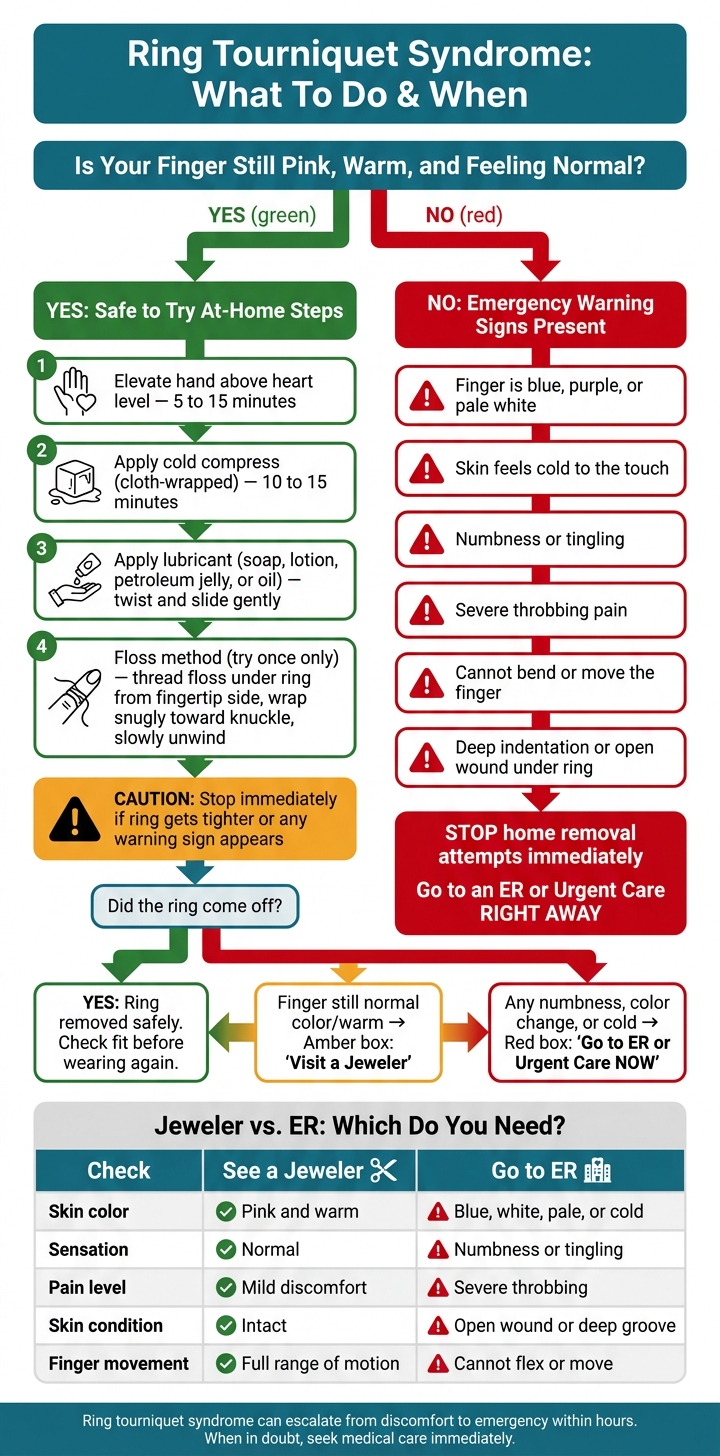
Ring Tourniquet Syndrome: Emergency Decision Guide
Ring Removal by Tourniquet || ViralHog

sbb-itb-9da40c1
Warning Signs You Should Not Ignore
Pay close attention to swelling, color changes, numbness, or severe pain. Those signs can mean the ring is starting to cut off circulation.
Early Signs That Need Immediate Attention
The first clues can be subtle, which is why people sometimes brush them off. Don’t. Look for swelling and a visible indentation around the ring, a sense that the band is getting tighter, throbbing pain, or trouble bending the finger. Those are red flags that pressure is already building.
Signs of Reduced Circulation or Nerve Pressure
These signs can mean blood flow or nerve function is already being affected:
| Check | Mild Sign | Emergency Sign |
|---|---|---|
| Skin color | Redness or slight puffiness | Blue, purple, or pale white |
| Sensation | Throbbing or mild discomfort | Numbness, tingling, or severe pain |
| Skin temperature | Warm or hot | Skin feels cold |
| Finger movement | Difficulty bending joints | Cannot move the finger |
| Skin appearance | Visible indentation from the band | Rapidly worsening swelling or deep indentations |
If the finger turns blue, purple, or pale white, feels cold, goes numb, or can’t move, stop trying to remove the ring at home right away. Those signs suggest blood flow is seriously reduced or the nerves are under pressure. At that point, get urgent help from a medical or jewelry professional.
If the finger still has normal color and temperature, move to safe removal steps next.
Safe At-Home Steps to Try First
If the finger is still pink, warm, and feels normal, you can try a few at-home steps before blood flow gets worse. The moment color, warmth, or feeling changes, stop. The first goal is simple: bring swelling down before you touch the ring with any tool.
How to Reduce Swelling Before Removing the Ring
Lift your hand above heart level for 5 to 15 minutes. After that, place a cloth-wrapped cold compress on the finger for 10 to 15 minutes.
Removal Methods That May Help
Once the swelling goes down a bit, put on a lubricant like soap, lotion, petroleum jelly, or oil. Work it around the ring, then gently twist and slide the ring off. Go slowly. Don't force it.
If lubricant doesn't work, you can try the floss method once. Use dental floss or a thin, strong string.
- Thread one end of the floss under the ring, from the fingertip side toward the hand.
- Wrap the floss snugly from just above the ring toward the knuckle to push swelling out of the way.
- Slowly unwind the short end from the hand side.
Stop right away if the ring gets tighter during the attempt. If it still won't move, don't keep fighting it. Get it removed by a professional.
If these steps fail, the next step is professional removal.
When to Go to an ER, Urgent Care, or a Jeweler
If the ring still won’t budge, the next move comes down to circulation. What matters most is whether the finger still has normal color, warmth, and feeling.
When to Go to Urgent Care or the ER
Go to an emergency room or urgent care immediately if the finger turns blue, white, or pale; feels cold or numb; you can’t bend or move it; the pain is severe throbbing; or there’s an open wound or deep indentation under the ring. Medical removal should happen right away.
When a Jeweler May Be an Option
If circulation is normal, a jeweler may be enough. If it isn’t, skip the jeweler and go straight for medical care.
If home methods failed but the finger still looks and feels normal, a jeweler may be the next step. A jeweler can remove a ring only when the finger is still pink, warm, and fully sensate. Tell them the ring metal, because some materials need specialized removal tools.
If there is any sign of reduced circulation, including mild numbness or color change, skip the jeweler and go straight to a medical facility.
| Symptom | See a Jeweler | Go to ER or Urgent Care |
|---|---|---|
| Color and temperature | Pink and warm | Blue, white, pale, or cold |
| Sensation | Normal | Numbness, tingling, or loss of sensation |
| Pain level | Mild discomfort | Severe throbbing pain |
| Skin condition | Intact | Open wound or deep indentation |
| Finger movement | Full range of motion | Inability to flex or move the finger |
How to Prevent Ring Tourniquet Problems in the Future
Prevention starts with fit. Your ring should never pinch, hold in swelling, or feel tough to remove.
How to Check Whether Your Ring Fits Safely
Once the ring is off, the next step is simple: check the fit at your largest normal finger size. A safe fit means the ring moves over your knuckle with mild, steady resistance, not pain. It should sit snugly at the base of your finger without leaving a deep groove. After removal, any mark on the skin should fade fast. If that mark sticks around, the ring is too tight for daily wear.
It also helps to test fit later in the day, when fingers are often at their largest. A ring that feels fine in the morning can get much tighter by afternoon, especially in summer heat, after a long walk, or after a salty meal. If you ever avoid taking a ring off because you’re not sure it will go back on - or come back off safely - that’s a red flag. The fit is no longer safe.
If your finger size shifts during the day, measure at your largest normal size and fit the ring to that size without pain. That matters most for rings you wear every day.
Why Adjustable Rings Can Reduce Sizing Risk
Fixed-size rings don’t change when your finger does. Swelling from heat, exercise, a long flight, or a health flare can turn a ring into a tight band fast. That’s where adjustable or resizable rings can help. They give you some room when your hands change size.
| Feature | Fixed-Size Rings | Adjustable/Resizable Rings |
|---|---|---|
| Fit flexibility | None; requires professional resizing | Adapts to daily and seasonal changes |
| Comfort during swelling | Can become painful or cut off circulation | Can be loosened immediately to relieve pressure |
| Ease of resizing | Requires professional resizing | Adjustable at home or designed for easy professional resizing |
| Knuckle clearance | Must be sized for the knuckle, often spins at the base | Slides over the knuckle and adjusts to the narrower base |
A smooth inner surface can also help by reducing pressure points. And resizable styles are made so a jeweler can alter them more than once over the years as your hands change, without weakening the metal. Better fit means less chance of ending up in the same situation again.
Conclusion: Act Fast, Remove Pressure Safely, and Choose a Better Fit
Ring tourniquet syndrome can go from mild discomfort to a circulation emergency within hours. Gentle at-home steps like elevation, cool compresses, and lubrication are only okay when the finger is still warm, pink, and sensate, and when the ring can still move at least a little. The second circulation looks or feels affected, skip home care and go to an ER or urgent care right away.
A few habits can lower the risk:
- Check ring fit on a regular basis
- Remove rings before activities that cause swelling
- If your finger size changes often, look into an adjustable or resizable ring design
That kind of small change can make a big difference.
FAQs
How fast can a stuck ring become dangerous?
A stuck ring can turn into an emergency fast if it starts cutting off blood flow. A little swelling from heat or activity might go down on its own, but warning signs aren't something to brush off.
Get urgent medical care right away if you have persistent swelling, severe pain, blue or white skin, or numbness. Loss of circulation can cause permanent damage if it isn't treated promptly.
Can I sleep on it and try again later?
No. Don’t wait. Ring tourniquet syndrome can turn into a medical emergency fast.
If you have swelling, discoloration, numbness, severe pain, or loss of circulation, don’t sleep on it. If soap, lubricant, or the dental floss technique doesn’t work, get urgent help at an urgent care center or emergency room right away.
What rings are hardest to remove?
Rings made from harder materials, especially tungsten carbide, plus platinum and stainless steel, are often the toughest to remove.
Softer metals like gold or silver can often be cut off by a jeweler. Tungsten carbide is different. It usually can’t be cut and may need to be shattered by a trained professional.
If a ring is stuck because of swelling, don’t force it. Start with simple at-home methods like lubrication or cold therapy. If those don’t work, get professional help.


