

Resized in January, Too Big by March: The GLP-1 Resizing Trap
If you’re losing weight on Ozempic, Wegovy, Mounjaro, or Zepbound, resizing your ring too soon can cost you twice. A ring that fits in January can feel loose by March because finger size may keep dropping during the first months of GLP-1 treatment.
Here’s the short version:
- Permanent resizing too early often backfires
- The fastest weight loss often happens in months 2–6
- Even 10–30 lb lost can change ring fit by about 0.5 to 1+ sizes
- Repeat resizing can add cost and put stress on the ring
- Short-term fixes usually make more sense until your size levels off
- A permanent resize is usually best after 3–6 months of stable weight and stable fit
If your ring is spinning, sliding, or feels loose after washing your hands or being in a cool room, don’t rush to cut the band. I’d look at silicone adjusters, ring guards, spacer bands, sizing beads, sizing bars, spring inserts, or an adjustable ring before paying for another resize.
Quick Comparison
| Option | Upfront cost | Can be removed? | Good during active GLP-1 weight loss? | Best use |
|---|---|---|---|---|
| Resize now | $35–$300+ | No | No | Weight and finger size have held steady |
| Wait and monitor | $0 now | Yes | Yes | You’re still losing weight |
| Temporary fix | $5–$100 | Yes | Yes | Ring is loose but size is still changing |
| Adjustable ring | Varies | Yes | Yes | You want a ring that can handle size shifts |
The main point is simple: protect the ring first, resize later. If your body is still changing, a short-term fit fix is often the safer move.
sbb-itb-9da40c1
Understanding the GLP-1 resizing trap
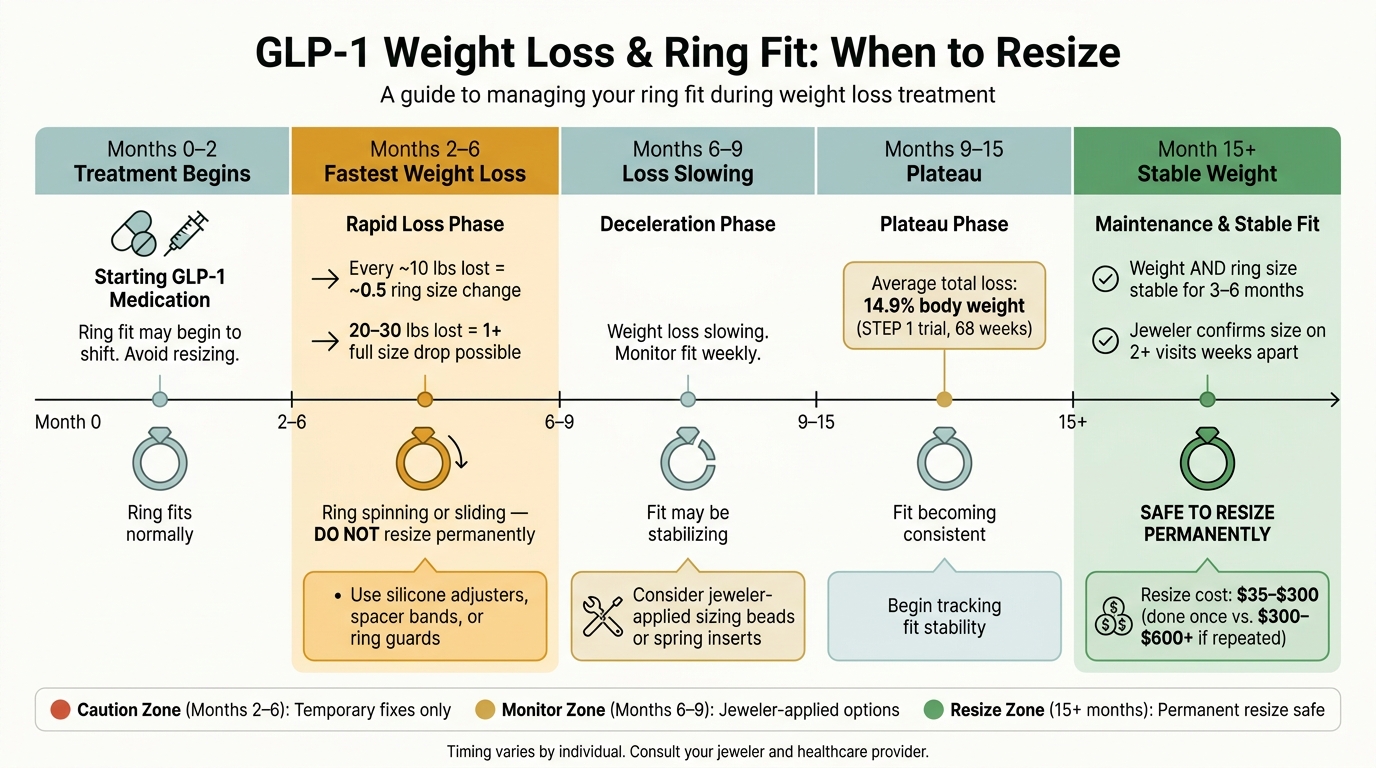
GLP-1 Weight Loss & Ring Fit Timeline: When to Resize
GLP-1-related ring loosening isn't the same as the fit shift you get on a cold morning or after a salty meal. Those changes come and go. This one can stick, because it points to actual tissue loss in the fingers. If you resize a ring while your hands are still getting smaller, that resize may not last long.
Medications like semaglutide and tirzepatide can reduce fat and soft tissue in the hands and fingers. So the change in fit may keep moving in one direction instead of bouncing around day to day.
How GLP-1 treatment timelines affect ring fit
GLP-1 treatment tends to follow a pattern, and ring fit often does too. Clinical trial data from the STEP 1 semaglutide study show an average loss of 14.9% of body weight over 68 weeks. The fastest drop usually happens in months 2–6, then slows into a plateau around months 9–15.
That timing matters. A ring resized in January might already feel too loose by March because finger size can keep falling after the resize. In plain terms, you can pay for a permanent change before your hands are done changing. That's why an early resize can stop working so fast.
How much weight loss can change ring size
Fingers are small, so even modest fat loss can change ring fit sooner than people expect. Jewelry pros often estimate that every 10 lb lost can shift ring size by about half a size for many adults, though the exact change depends on body composition and where fat is stored. If someone loses 20–30 lb in the early months of GLP-1 treatment, a full size drop or more isn't unusual.
Here's how that often plays out:
- At about 10 lb lost, a ring that used to feel tight may start feeling comfortable.
- At 20–30 lb lost, that same ring may spin at rest and feel less secure when hands are wet or cold.
- Beyond that, multiple size changes are common, especially for people who started with a higher BMI.
Check the fit after handwashing, in cool rooms, and during activity. If the ring acts loose across those situations again and again, the change is likely real and still in motion. At that point, a permanent resize becomes the risky move, and a temporary fix usually makes more sense.
Why permanent resizing during active weight loss often backfires
A loose ring can feel like a problem you need to fix right away. But during active GLP-1 weight loss, a permanent resize often fixes today's fit, not the fit you'll have a few months from now.
The cost and structural risk of resizing more than once
A resize can cost $35–$150 for a simple band and $150–$300+ for complex settings. If your fingers are still getting smaller, there's a good chance you'll need to pay for the same job again after the ring has already been cut and soldered once.
There's also a wear-and-tear issue. Repeated resizing can weaken a ring over time. It increases the risk of prong fatigue and shank failure. With thin bands, another resize may not even make sense later on. In some cases, the band has to be rebuilt instead.
Some styles are harder to work on from the start. Pavé and channel-set rings are tougher to resize safely because the process can loosen stones. And every new job adds both cost and the chance that a small diamond gets overlooked and later falls out.
That's why timing matters just as much as the resize itself.
When a ring should not be permanently resized yet
If the ring only started feeling loose not long ago and your weight is still dropping, it's usually smart to wait. A resize at that point may fit only one short phase of an active loss period.
A permanent resize is also too early if:
- You haven't yet reached a maintenance dose.
- You have not reached a stable plateau.
The ring's design matters too. Full eternity bands usually can't be resized and often need to be remade. Partial eternity and pavé shanks are often only safe to adjust by about half to one U.S. size before stone security becomes a serious issue. Heirloom rings with older alloys, detailed engraving, or fragile prongs are poor choices for repeat work. Each resize can warp details that can't be put back.
Use the comparison below to help sort out whether it makes more sense to resize now, wait, or use a temporary fix for the time being.
Resizing now vs. waiting vs. temporary fixes: a side-by-side look
| Resize now | Wait until weight stabilizes | Temporary fix | |
|---|---|---|---|
| Fit during active loss | May be loose again within weeks | Loose in the short term, better fit later | Can change as your size keeps shifting |
| Likely cost over time | $300–$600+ if repeated | $35–$300 for one job | $5–$100 total |
| Reversibility | Low - permanently changes the band | Low - but done once, at a better time | Fully reversible, no alteration |
| Risk to ring integrity | Moderate to high if repeated | Low if done once after plateau | None |
| Best use case | Weight stable for several months, simple band | Still losing, but want a plan | Active loss phase, sentimental or complex ring |
Temporary fixes can bridge the gap until your weight levels off.
Safe solutions while your ring size is still changing
Low-risk temporary tools for a loose ring
If your ring is loose and your finger size is still shifting, start with fixes you can undo. That gives you more control and helps you avoid changing the ring too soon. Good first options include silicone adjusters, clip-on guards, and spacer bands.
Silicone adjusters sit along the inside bottom of the shank and can reduce the inner diameter by about 0.5-1.5 U.S. ring sizes. They’re easy to use and easy to remove, which makes them a solid choice when your fit seems to change from one week to the next. The catch? They can hold moisture during exercise or in hot weather. If you’re active, take them off and dry them out on a regular basis.
Clip-on ring guards are usually U-shaped metal or hard plastic pieces that grip the underside of the band. They tend to work better when the ring is more than a full size too large or when a heavy center stone keeps making the ring spin. They’re not as discreet, and some people find them a bit bulky, but they can hold the ring in place when a soft silicone adjuster just doesn’t cut it.
Spacer bands give you a cleaner look, especially if you wear a wedding set. A slim 1-2 mm band next to the loose ring acts like a stopper, helping keep the ring from sliding off without changing the original setting. This usually works best when the ring is about 0.5-1 size too large, not when it’s far oversized.
Jeweler-applied options that stop short of a full resize
If your ring spins all the time and at-home fixes feel like a bandage, a jeweler can add sizing beads, a sizing bar, or a spring insert inside the band. These options don’t require cutting the ring, so they’re less invasive than a full resize. That matters if the ring is sentimental, custom, or both.
Sizing beads are two small metal half-spheres soldered to the inside of the shank. They’re hidden from the top, can reduce the fit by about half a size, and often help with spinning. A sizing bar does a similar job but creates a slightly larger contact area. That can help with wider bands or rings that need a bit more reduction.
Spring inserts work a little differently. They use a flexible metal strip that compresses over the knuckle and then grips the base of the finger. That makes them especially useful if your knuckles are still larger than the slimmer part of your finger.
These fixes do mean a trip to the jeweler, and repeated changes can add wear over time. It makes sense to save them for the point when your weight loss has slowed down and you’re close to stable, but not ready for a permanent resize.
Adjusters, sizing beads, spacer bands, and adjustable rings compared
Use the table below to match the option to how much your ring size is still moving.
| Option | Comfort | Appearance | Reversibility | Needs a jeweler | Best for GLP-1 users |
|---|---|---|---|---|---|
| Ring guards / adjusters | Soft adjusters are comfortable; rigid guards can press | Slightly visible under the finger | Fully removable, no alteration | No | Rapid, week-to-week size changes |
| Sizing beads / bars | Beads can press into skin; bars feel more uniform | Hidden inside the shank | Semi-reversible; requires soldering to remove | Yes | Size mostly stable, minor spin control needed |
| Spacer bands | Comfortable if slim; slight bulk between fingers | Looks like an intentional stack | Fully removable, no alteration | No | Moderate looseness in a wedding set |
| Adjustable rings | Ergonomic; built for changing fit | Mechanism hidden | Built-in adjustability | No | Long-term or ongoing size changes |
A simple way to think about it: start small. A silicone adjuster or spacer band is often enough at first. If your size has slowed but the ring still shifts when your hand is at rest, sizing beads may be the next step. And if your fit keeps changing for months, an adjustable ring with a built-in sizing mechanism can give you room to breathe without cutting or soldering the original piece.
When to resize for good and when an adjustable ring makes more sense
A practical timeline for permanent resizing
After fast GLP-1-related weight loss, the best time for a permanent resize is after the shrinking levels off. If small stopgaps no longer do the job, the next step is figuring out when a permanent change is worth doing.
Resize a ring only after both your weight and ring size have stayed steady for 3–6 months near your maintenance weight. The ring should feel the same through the day, with light resistance over the knuckle and no spinning at the base. Before you schedule a resize, have a jeweler check your size on at least two separate visits, spaced a few weeks apart. Go at about the same time of day each time, keep your hands at room temperature, and take off any temporary adjusters so the jeweler measures your actual finger size. If your GLP-1 dose is still going up, or the fit changes from week to week, hold off.
How Satinski adjustable and resizable rings fit changing needs
If your size is still moving, an adjustable ring can save you from another cut-and-solder cycle. That’s the sweet spot where adjustable rings help protect both the fit and the original setting.
Satinski's adjustable rings use a hidden mechanism, so the ring still looks like a standard ring. They fit US sizes 5–9 and come in sterling silver and 18K solid gold. Styles include engagement rings, wedding bands, and stacking rings. You can wear one as your daily ring during active weight loss, or use it to hold things steady while you wait for a sentimental ring’s fit to settle.
Conclusion: Protect the ring first, resize later
GLP-1 weight loss can change finger size faster than many people think. A ring resized in January can feel too loose by March if the weight is still coming off. Every permanent resize adds cost and can slightly weaken the band, especially with thin shanks or delicate settings. Temporary tools like silicone adjusters and spacer bands are often the safest short-term fix. Go with a permanent resize only after things have stayed steady. If that stability still isn’t there, an adjustable ring usually makes more sense.
FAQs
How do I know if my ring is truly too loose or just fluctuating day to day?
Track your finger size for a few weeks under different conditions, like shifts in temperature, humidity, and activity. Fingers often swell in hot weather, after exercise, or following salty meals. Then they usually go back to normal once your body cools down or settles.
If your ring feels consistently loose in those situations, or the change sticks around no matter the weather or what you eat, the size shift may be more lasting due to weight loss or hormonal changes.
What if my engagement ring cannot be safely resized again?
If your ring can’t be resized safely, it’s best to hold off on any more permanent resizing while you’re still losing weight. Changing the size again and again can weaken the metal and put stress on the setting, which is a bigger issue with delicate designs.
For now, use short-term fixes like ring adjusters or sizing beads to help keep the ring in place until your weight levels out. If you want more room to work with down the line, an adjustable ring design can make things a lot easier.
Can I wear a temporary ring adjuster every day while losing weight on GLP-1s?
Yes, but only as a short-term fix.
Temporary ring adjusters, like plastic coils or shims, are made for small, temporary size changes. They can help when a ring feels a little loose, but they’re not a good everyday answer if your ring size is still changing.
Use one too often, and the ring may start to feel uncomfortable. There’s also a higher chance of the ring slipping off, which puts your jewelry at risk. If your weight change looks like it’ll last for a while, professional resizing or an adjustable ring is the safer option.


