

Non-Traditional Engagement Rings for People Who Hate Solitaires
If a solitaire feels plain, snags on things, or never fits quite right, you have other options. I’d focus on rings that add more detail, sit lower on the finger, and deal with swelling or big knuckles from the start.
Here’s the short version:
- For more meaning: toi et moi, cluster, and three-stone rings
- For lower profile and daily wear: bezel-set rings
- For more color and personality: sapphire, ruby, emerald, morganite, or salt-and-pepper diamond
- For more character: vintage-style rings and stacking sets
- For fit issues: adjustable or custom rings instead of relying on repeat resizing
A few numbers stand out:
- 20%+ of people say they’d swap a diamond center stone for a colored gem
- Prongs sitting more than 1.2 mm above the girdle can lead to 3.5x more snagging
- Most rings can only be resized about 1–2 U.S. sizes
- Bands around 3 mm+ often feel more solid for daily wear
- Some adjustable rings cover about U.S. sizes 5–9
What I like about this approach is that it fixes the main solitaire problems in plain terms: style, comfort, and fit. So instead of asking, “What ring am I supposed to get?” I’d ask, “What ring will I want to wear every day?”
Quick Comparison
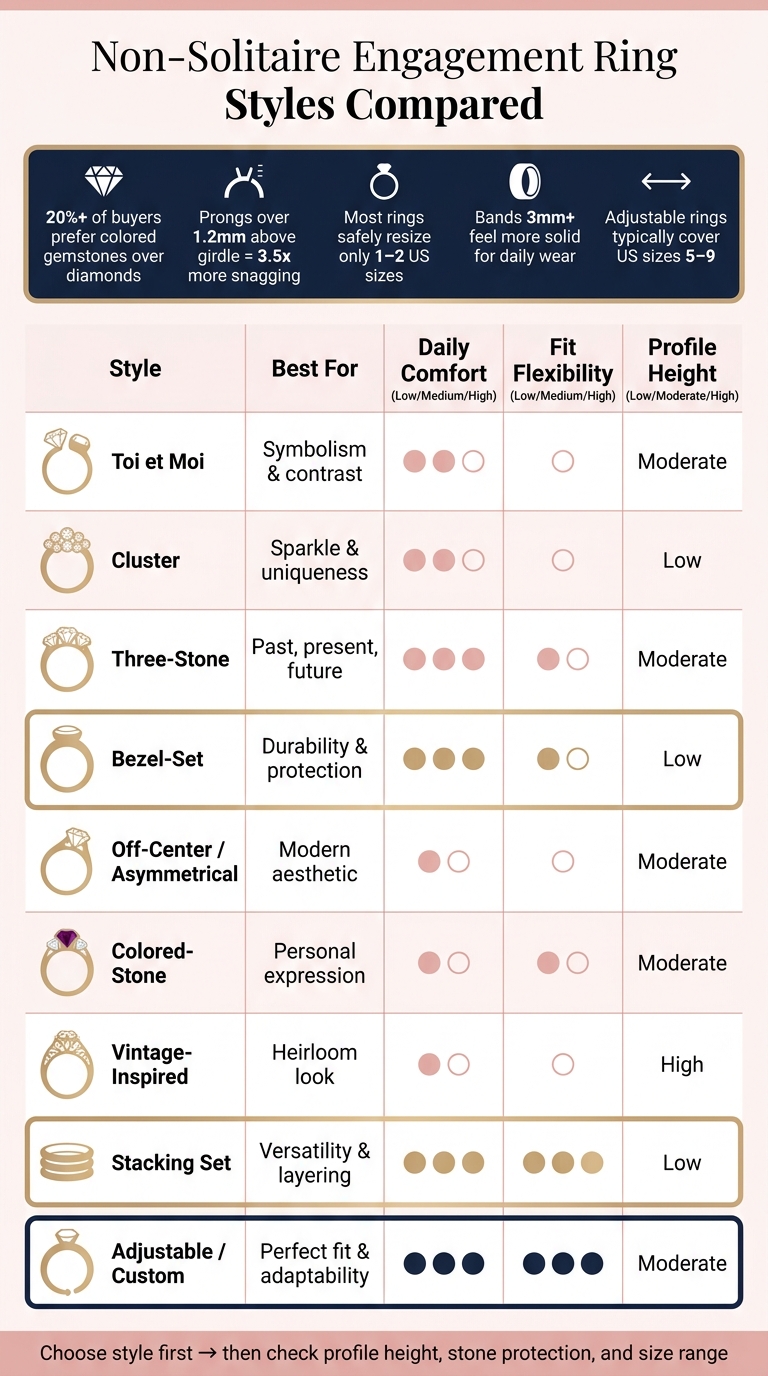
Non-Solitaire Engagement Ring Styles: Style, Comfort & Fit at a Glance
| Ring style | Best for | Daily comfort | Fit options |
|---|---|---|---|
| Toi et moi | Symbolism and contrast | Medium | Better with adjustable/custom band |
| Cluster | More sparkle and detail | Medium | Standard fit, some limits |
| Three-stone | Meaning and structure | Medium | Standard fit, some limits |
| Bezel-set | Low profile and stone protection | High | Better for daily wear |
| Off-center designs | Less expected look | Medium | Depends on setting |
| Colored-stone rings | More personal style | Medium | Depends on stone and band |
| Vintage-style rings | Old-world detail | Medium | Resizing may be harder |
| Stacking sets | Flexibility in how you wear it | High | Can help with day-to-day wear |
| Adjustable/custom rings | Swelling, knuckles, arthritis | High | Best for changing size |
If I were buying, I’d pick the style first, then check the side profile, stone protection, and size range before anything else.
sbb-itb-9da40c1
How to Choose a Non-Solitaire Ring That Works for Your Life
Once you know why solitaires don’t work for you, the next step gets a lot easier: pick a ring you’ll want to wear every day. The simplest way to do that is to run each option through three filters: style, comfort, and fit.
Match the ring to your personal style
Start with the way you already dress and accessorize. Your ring should feel like you, not like a piece you have to talk yourself into wearing.
If your style leans romantic, vintage-inspired rings, toi et moi designs, cluster rings, and three-stone rings often fit well. If you like a bolder look, colored stones, asymmetry, and off-center settings can feel more in sync. If your style is cleaner and more pared back, bezels, east-west settings, and geometric shapes usually make more sense.
That gives you a visual starting point. After that, check whether the setting also fits the way you live day to day.
Match the ring to your daily routine
A ring can look amazing in photos and still annoy you by lunchtime. That’s why wearability matters just as much as looks.
One of the biggest things to check is profile height. Low-profile settings, like bezels or compact cluster designs, sit closer to the finger. In plain English, that usually means less snagging on clothing, gloves, or hair. If you type a lot, work out, lift, travel, or use your hands all day, this is worth putting near the top of your list.
Band width matters too. A band around 3 mm or wider tends to feel more solid for daily wear.
Stone choice plays a part as well. Sapphires and moissanite can be good for everyday wear when they’re set in a protective way, and both have become more common with non-traditional buyers who want personality without having to baby the ring.
If your ring size tends to change, that’s not a small detail. It should shape your choice from the start.
Decide early whether you need size flexibility
Most standard rings can only be safely resized by about 1–2 US sizes. That’s a pretty tight range, especially if your fingers swell often or your size shifts over time.
Some styles are also harder to resize than others. Channel settings, tension settings, filigree, and three-stone layouts can be more difficult to adjust. So if permanent resizing may not work well for you long term, look into adjustable or custom-fit options before you commit to a style, not after.
That way, you can narrow the options below with a clearer sense of what will look good, feel good, and keep working in daily life.
Non-Solitaire Engagement Ring Styles Worth Considering
These styles can help you shrink your shortlist based on look, comfort, and fit. Each one fixes the solitaire issue in its own way: more meaning, more personality, or easier daily wear. Start with the look you want, then narrow things down by profile and how the ring will feel day to day.
Toi et moi, cluster, and three-stone rings for more meaning and detail
These three styles move past the single-stone setup. They add more presence, texture, or symbolism than a plain solitaire.
A toi et moi ring places two center stones side by side, often in different shapes or colors. The idea is simple and sweet: two people coming together. A pear-shaped diamond next to a square emerald-cut sapphire, for example, creates a nice contrast between soft curves and crisp lines. It feels modern, but still personal.
Cluster rings group several smaller stones together, sometimes in floral or starburst patterns, so they read like one larger stone. You get plenty of sparkle without paying for one large diamond, which makes this style a smart pick if you want strong visual impact on a budget that feels doable. Three-stone rings go in a more structured direction: one larger center stone with two side stones, often said to stand for past, present, and future. You can keep the look from feeling too standard by mixing shapes, like an oval center with trillion-cut sides, or by using colored side stones.
Bezel-set, off-center, and colored-stone rings for a modern or bold look
If your taste leans current, or you want something that clearly doesn't read as a solitaire, these styles deserve a close look.
Bezel settings surround the stone with metal instead of using prongs. That creates a low-profile look and helps protect the edges, which is handy for softer gems like emerald or morganite. It also tends to feel more comfortable for active daily wear.
Off-center and asymmetrical designs move the stone or nearby details away from perfect symmetry. That's a good match for anyone who finds more classic rings too rigid or too formal. Picture a main stone set a little to one side, with a curved band of smaller diamonds sweeping around it. Or think of an asymmetric cluster with mixed shapes like round, marquise, and baguette stones.
Colored stones shift the whole mood fast. Sapphire feels rich. Ruby feels bold. Morganite feels soft. Salt-and-pepper diamond has a more individual look. That kind of choice can make a ring feel much more personal than a standard colorless diamond.
Vintage-inspired rings and stacking sets for character and flexibility
Vintage-inspired rings pull from Art Deco, Victorian, and Edwardian jewelry. You’ll often see filigree, milgrain, geometric step-cut stones, and engraved shoulders. Those details build a layered, old-world look that works well if you want your ring to feel full of character instead of plain or minimal.
Stacking sets bring multiple bands together into one look, which gives you more flexibility. You can wear a simpler version each day and add bands for anniversaries or other milestones. For example, you might begin with a band that has a modest center stone, then add a contour or chevron band later. Wear one band for everyday use, or the full stack when the moment calls for it. That kind of flexibility makes stacking sets a strong pick if your style may change over time.
If fit changes are part of the issue, the next step is choosing a ring that can adjust with your hand.
Rings for Sizing Problems: Adjustable and Custom Engagement Rings
Why permanent resizing is not always enough
When ring size becomes the sticking point, adjustable rings can fix the fit issue without pushing you toward a plain solitaire. A one-time resize only works if your finger size stays about the same. For a lot of people, that just isn't the case. Finger size can change by a full size or more over time due to heat, activity, and fluid retention.
Most jewelers see 1 to 2 US sizes up or down as the safest resizing range before the band or setting may start to weaken. That sounds fine on paper. But for swollen hands, arthritis, or a wide knuckle, it often falls short. A ring sized large enough to slide over the knuckle may spin all day at the base. A ring sized to sit snugly at the base may be tough to remove when swelling kicks in. Sizing beads and ring guards can help with fit, but they don't actually adjust.
How adjustable engagement rings solve style and fit at the same time
Adjustable rings deal with both problems at once. They use a hidden part inside the band that lets the ring open enough to pass over the knuckle, then sit more snugly at the base. From the outside, the ring still looks like a standard design. No bulky insert. No obvious gap.
This matters if you want more than a plain band. Bezel-set rings, toi et moi designs, clusters, asymmetrical styles, and vintage-inspired pieces can all work well when the band is made to hide the adjustment. Stacking-friendly rings also make sense here, since you can wear them solo or pair them with other bands as your finger size shifts. Most adjustable designs cover US sizes 5 to 9. So fit becomes part of the design from day one, not a fix you deal with later.
Where Satinski fits for readers who want good design and everyday comfort
Satinski was built around this exact issue. The brand offers adjustable rings from $70 and engagement rings from $90, with choices in 925 sterling silver, 18K gold vermeil, and solid 18K gold. Custom orders are also available if you want a specific non-solitaire style made around a sizing issue from the start, instead of trying to alter a finished ring afterward.
Charlene Rowe, a verified buyer, said:
"I had given up hope of being able to wear a wedding ring due to an autoimmune condition which makes my hands swell throughout the day. But thanks to the adjustability of the ring I can now wear a ring again." - Charlene Rowe, Verified Buyer
If your finger size changes a lot, or the gap between your knuckle and ring base keeps causing trouble, an adjustable or custom ring treats fit and style as the same issue. The next section compares fixed bands, resized rings, and adjustable rings side by side.
How to Pick the Right Ring Before You Buy
Once you know what you want to fix, compare styles based on how they look and how they feel on your hand.
Style comparison
Start with your main issue with solitaires. That makes it much easier to narrow your options.
If meaning matters most, some styles lean more symbolic. If you want more detail from the top view, others give you more going on visually. And if you plan to wear the ring every day, comfort and profile height matter more than most people expect.
| Ring Style | Symbolism | Visual Detail | Durability | Profile Height | Color Options | Fit Flexibility |
|---|---|---|---|---|---|---|
| Toi et Moi | Very High | High | Moderate | Moderate | High | High if adjustable/custom |
| Three-Stone | Very High | High | Moderate–High | Moderate | Moderate | Moderate |
| Cluster | Moderate | Very High | Moderate | Moderate–High | High | Moderate |
| Bezel-Set | Low–Moderate | Moderate | Very High | Low | Moderate | High if adjustable/custom |
| Asymmetrical | Moderate | Very High | Moderate | Moderate | High | Moderate |
| Colored-Stone | High | Moderate | Varies by stone | Moderate | Very High | High if adjustable/custom |
| Vintage-Inspired | High | Very High | Moderate | Varies | Moderate | Moderate |
| Stacking Set | Moderate | High (combined) | High | Low | High | High |
Use the table to match the ring to your top priority: symbolism, visual detail, or daily wear.
Fixed bands, resized rings, and adjustable rings compared
Style handles the look. Band type handles the fit.
After you choose a style, compare how each band works if your finger size changes over time. That part gets overlooked a lot, but it can make a huge difference in day-to-day comfort.
| Feature | Fixed Bands | One-time resizing | Adjustable Rings |
|---|---|---|---|
| Comfort Over Time | Decreases if finger size changes | Good until size shifts again | High - adapts to daily changes |
| Maintenance Needs | None until it stops fitting | Requires a jeweler when fit changes | Adjusts at home |
| Appearance Impact | Seamless | May thin the shank or show a seam | Hidden band looks standard |
| Suitability for Swelling | Poor | Poor | Excellent |
| Suitability for Arthritis | Poor | Poor | Excellent - slides over knuckles |
Key points to remember when choosing your ring
Before you buy, use three simple checks.
- Pick the style first.
- Then look at profile height, stone protection, and size flexibility.
- Check the side profile, not just the top view.
That last point is easy to miss online. A ring can look perfect from above and still sit too high on the finger. When that happens, it may snag more often and feel less comfortable during daily wear.
If your finger size changes often, treat fit as part of the design from day one, not something to deal with later.
The best ring feels personal, wearable, and easy to fit.
FAQs
Which non-solitaire ring style is best for everyday wear?
For everyday wear, an adjustable engagement ring is a smart pick because your finger size can shift during the day. Heat, swelling, workouts, and even small changes in activity can all affect how a ring fits.
Satinski’s adjustable designs use a hidden ergonomic mechanism that keeps the fit comfortable and secure without standard resizing. That matters, because repeated resizing can weaken a ring over time.
How do I choose a ring if my finger size changes often?
If your finger size shifts with temperature, daily activity, or health issues like arthritis, an adjustable engagement ring can make life a lot easier. It has a hidden mechanism built into the band, so you can loosen or tighten the fit without going to a jeweler for resizing.
A lot of styles are made to fit US ring sizes 5 to 9. Some also come with a resizing stick, which helps the band keep its round shape when you adjust it at home. That can help with both comfort and a more secure fit.
Are colored gemstones durable enough for an engagement ring?
Yes. Colored gemstones can be durable enough for daily wear, which makes them a strong pick for an engagement ring.
Popular choices like sapphires, rubies, and emeralds offer a more personal look than a diamond. And if you want extra peace of mind, pair your gemstone with a durable setting like platinum or 18K gold.


