

Men's Ring Sizing: Why He's Probably Wearing the Wrong Size
Most men are wearing the wrong ring size because finger size is not fixed. A finger can shift by about 1/2 to 1 full U.S. ring size during the day, and things like heat, workouts, salty food, band width, and knuckle shape can change how a ring feels.
Here’s the short version:
- One measurement is often not enough
- Morning and evening fit can be different
- Thick bands usually feel tighter than thin bands
- A big knuckle can make a ring fit loose at the base
- A good ring should pass the knuckle with mild resistance
- If it leaves deep marks, throbs, or needs soap to come off, it’s too tight
- If it spins or slides during handwashing, it’s too loose
I look at ring sizing like this: the right fit is not just about the number. It’s about how the ring feels all day, not just for 30 seconds during sizing.
Quick comparison:
| Fit issue | What it looks like | What I’d do |
|---|---|---|
| Too tight | Bulging skin, deep mark, numbness, hard to remove | Go up in size or get it adjusted |
| Too loose | Spins, slips over knuckle, moves when hand hangs down | Go down in size or use a better fit option |
| Good fit | Mild resistance over knuckle, snug at base, no pain | Stay with that size |
| Thick band problem | Same size feels tight in 5 mm to 6 mm bands | Try 1/4 to 1/2 size up |
| Large knuckle problem | Fits knuckle but spins at base | Check base and knuckle, then pick the best balance |
If you want to avoid the wrong size, the fix is simple: measure more than once, measure later in the day, check both the knuckle and finger base, and account for band width.
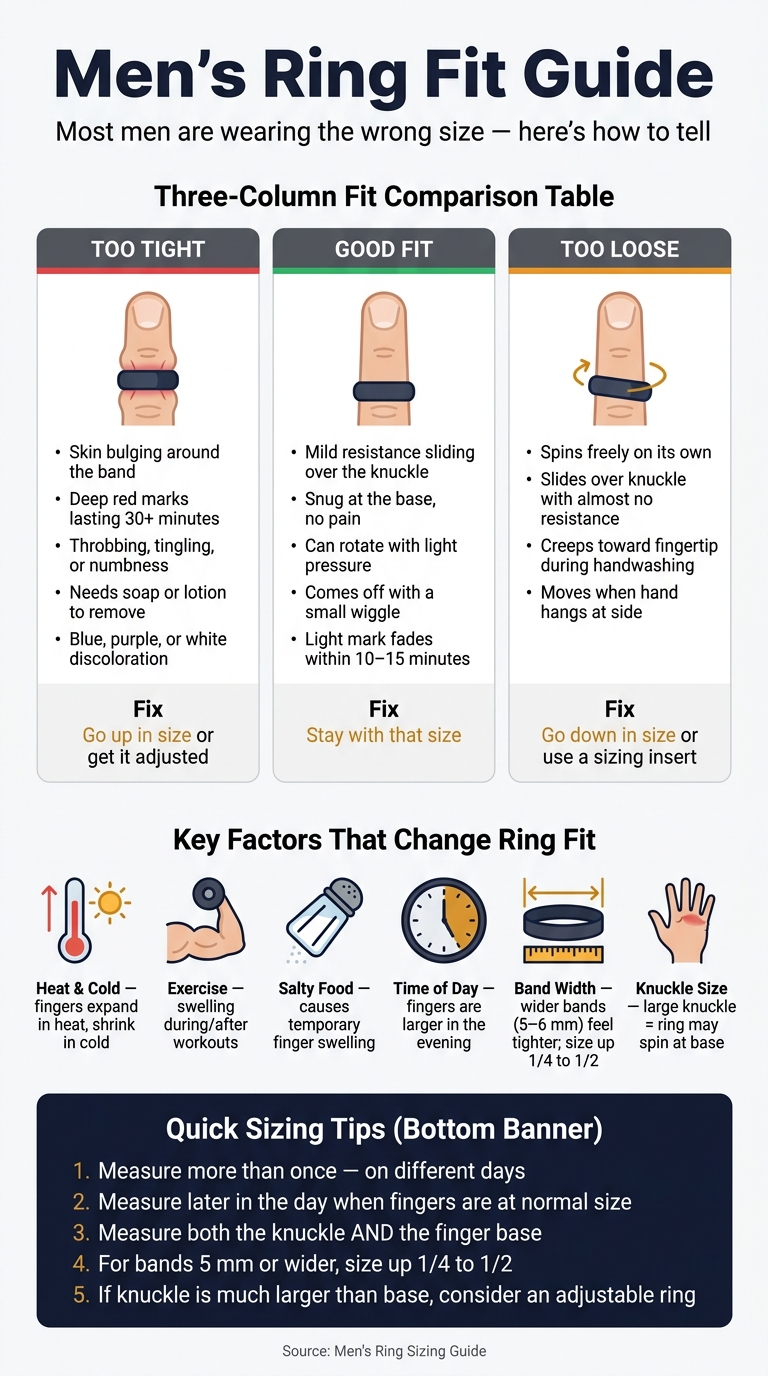
Men's Ring Fit Guide: Too Tight vs. Too Loose vs. Just Right
Ring Sizing for Men: Expert Tips and Tricks
sbb-itb-9da40c1
Why Men Get Ring Sizing Wrong
Most ring sizing mistakes start with the measurement. Then things get messier once the ring meets a finger that changes over the course of the day. So you end up with a size that looks fine on paper but feels off in daily wear.
Common Measuring Mistakes That Lead to the Wrong Size
A bad fit often comes from one bad reading. The most common mistake is measuring only once. One measurement doesn't show how your finger changes from day to day or even hour to hour.
It's smarter to measure more than once, on different days, and later in the day when finger size is closer to normal.
String or paper methods can also cause trouble. They’re easy to pull too tight, which can lead to a size that runs small. And a number by itself doesn't tell you how a ring will actually feel. Using an old ring size without factoring in weight changes or a different band style only makes that mismatch worse.
Daily Changes That Make a Correct Size Feel Wrong
A ring can feel completely different by evening than it did in the morning. Heat, activity, salty food, and hydration all play a part. Fingers can change enough between morning and evening to affect how the ring sits - fine early in the day, then snug or tight by nighttime.
Cold weather flips the script. Fingers shrink a bit, and a ring that fit well in summer may spin around in winter.
Long-term changes matter too. Weight gain and aging can slowly change finger size. That means a size picked years ago may not fit the same now - especially with wider rings, which tend to make even small size changes more noticeable.
How Knuckle Shape and Ring Width Change the Fit
Even when the measurement is right, the fit can still feel off because the ring has to pass over the knuckle. If the knuckle is larger, there's a built-in tradeoff: the ring needs enough room to get over it, but it also can't feel loose at the base. That difference between knuckle size and base size is a big reason rings spin.
Wide bands and flat interiors usually feel tighter than slim bands or comfort-fit styles.
How to Tell If a Men's Ring Fits Correctly
What a Good Fit Should Feel Like
Once you know why ring size can shift, the next step is simple: pay attention to how the ring feels on your finger.
A good fit should slide over the knuckle with mild resistance, then rest snugly at the base of the finger. It shouldn't pinch, squeeze, or feel stuck. At the same time, it also shouldn't feel so loose that it moves around by itself.
You should be able to turn the ring with light pressure from your other hand. It can move a bit, but it shouldn't spin freely on its own. And when you take it off, it should come over the knuckle with a small wiggle, not a struggle.
Signs the Ring Is Too Tight
A ring that's too tight usually gives itself away pretty fast. The first clues are often pressure, swelling, or changes in skin color.
If the skin is bulging around the band, that's a clear warning sign. Deep grooves or red marks that stick around for more than 30 minutes are another problem. A light mark that fades within 10 to 15 minutes is normal.
Pay attention to how your finger feels too. Throbbing, tingling, or a fingertip that feels "off" can mean the ring is pressing on blood vessels or nerves. If you notice numbness that won't go away, swelling, or blue, purple, or white discoloration, the ring is too tight for safe daily wear and should be removed as soon as possible.
Here's another plain-English test: if you keep needing soap, lotion, or cold water just to get the ring off, it's too tight for everyday use and should be resized.
Signs the Ring Is Too Loose
A loose ring tends to be just as easy to spot. It often spins on its own, so the stone or design shifts to the side or even underneath the finger without you touching it. It may also slide over the knuckle with almost no resistance going on or coming off. During handwashing, it can creep toward the fingertip or feel like it's about to slip away.
One simple check works well: let your hand hang at your side and give it a few gentle shakes. If the ring moves toward the fingertip or slips across the knuckle without much effort, it's too loose. If it mostly stays put and only shifts a little, that's a much safer fit for day-to-day stuff like pulling on gloves or washing dishes.
Common Sizing Problems and How to Fix Them
Once you understand that fit shifts with band width and finger size, the next step is picking the right size for the ring style itself. This is where a lot of people get tripped up.
Wedding Bands and Thick Rings That Are Often the Wrong Size
A man fitted for a thin band will often need a slightly larger size in a 5 mm or 6 mm wedding band. The reason is simple: wider bands touch more of the finger. That extra contact can make the same size feel tight, especially in warm weather. So yes, a size that feels fine in a thin band can fail in a wider one.
The same problem shows up with thick statement rings. A man who wears a size 10 in a slim 2 mm band may find that same size 10 in a bold, chunky ring pinches at the knuckle or gets stuck when his hand swells a little. In many cases, bands that are 5 mm to 6 mm wide fit better when sized up by a quarter to half size.
Professional Sizing and Reliable At-Home Tools
For a wedding band, or any ring you plan to wear every day, getting sized by a jeweler is worth it. Jewelers usually work with metal ring sizers or sample rings, so they can compare several sizes back to back and account for things like knuckle width and how snug you want the fit. It also helps to measure later in the day, when your finger is closer to its usual size.
If you're measuring at home, the most dependable tools are:
- A plastic ring sizer
- A flexible measuring strip
- A printable U.S. ring size chart
Measure more than once, and do it at different times of day. Also measure both the base of the finger and the knuckle. If there's a clear gap between those two measurements, go with a size that passes over the knuckle with mild resistance but still feels secure at the base.
When Adjustable or Resizable Rings Are the Better Choice
Sometimes a fixed size just doesn't solve the problem. Swelling, large knuckles, and seasonal changes can make ring sizing feel like trying to hit a moving target.
If your knuckle is much larger than the base of your finger, a ring sized for the knuckle may spin once it's on. But a ring sized for the base may not go on at all. The same issue can come up if you have arthritis, deal with seasonal swelling, or are ordering online without a solid measurement. In those cases, a fixed size can be a gamble.
Adjustable rings can make more sense for long-term wear. Satinski's adjustable rings use a hidden sliding band that keeps the front clean while letting the fit change.
Fixed-Size vs. Adjustable Rings: Which Option Works Better Over Time
When ring size keeps shifting, the choice comes down to this: a fixed fit or a ring that moves with you. What works best depends on how often your finger size changes.
If your finger size stays steady and the fit is right from day one, a fixed-size ring can work well. But that’s not how it goes for everyone. Fingers can swell or shrink with weather, workouts, weight changes, or health issues. When that happens, a fixed ring may need to be resized again and again.
A jeweler can fix a bad fit, of course. But repeat resizing costs money and puts more stress on the band over time. In plain terms, ring sizing isn’t just about one measurement. It’s about how the ring feels after months and years of wear.
The easiest way to compare these options is to look at how they deal with day-to-day changes.
| Feature | Fixed-Size Ring | Professionally Resized Ring | Adjustable Ring |
|---|---|---|---|
| Handles daily size changes | Can feel too tight or too loose; no quick fix | Fits better after resizing, but still cannot adapt day to day | Expands and contracts to handle daily fluctuations |
| Comfort for large knuckles or arthritis | Often has to be sized for the knuckle, which can make the ring spin at the base | Can improve the balance between knuckle and base fit | Opens to pass the knuckle and closes snugly at the base |
| Ease of future adjustment | Not adjustable without a jeweler | Requires another jeweler visit if your size changes again | Adjusts in seconds |
Conclusion: The Simplest Way to Avoid the Wrong Size
A lot of men end up in the wrong size for the same reasons: they measure once, forget about knuckle width, miss how ring width changes fit, and don’t account for how much fingers can shift during the day. A ring that feels fine in the morning can feel tight by evening.
The simplest fix is to compare the base of your finger with your knuckle and factor ring width into the decision. If your fingers change size often, adjustable rings take out much of the guesswork. When finger size is hard to predict, they’re the cleanest way to avoid repeat resizing.
FAQs
Should I size up for a wide men's ring?
Yes, wide rings often feel tighter than thin bands. They cover more of your finger, so there’s more skin contact. That added contact can make the ring feel snugger and a bit more restrictive, especially when your fingers swell during the day or when the temperature shifts.
Instead of guessing on size, an adjustable design can make things much easier. Satinski adjustable rings can be gently expanded or contracted for a fit that feels secure and comfortable.
What if my knuckle is bigger than my finger base?
If your knuckle is larger than the base of your finger, a fixed-size ring can be hard to wear. It has to be large enough to get over the knuckle, but that can leave it loose and spinning once it sits at the base of your finger.
The best move is to measure both spots and look for the right middle ground. An adjustable, resizable band can help too. It can open enough to slide over the knuckle, then tighten so it fits more snugly at the base.
When is the best time of day to measure ring size?
For the most accurate ring measurement, check your finger size at the end of the day. Fingers change throughout the day based on temperature, activity, and your body’s natural rhythm. By evening, they’re usually at their largest.
It also helps to measure more than once, at different times and under different conditions. That gives you a steadier read on normal swelling and shrinking, instead of leaning on one measurement that might be off.


