

Matching His and Hers Bands When Your Sizes Are Wildly Different
You do not need the same ring in two sizes to make your bands match. If one of you wears a size 4.5 and the other wears a size 12, the best match usually comes from shared details and good proportion, not a copy-and-paste design.
Here’s the short answer:
- Match metal color, finish, and edge style
- Use widths that look right on each hand, such as 3 mm and 6 mm or 4 mm and 7 mm
- Remember that bands around 5–6 mm may need about +0.25 size, and 7–8 mm may need about +0.5 size
- Finger size can shift by about 0.25 to 0.5 size during the day
- Plain bands are often easier to resize by 1–2 U.S. sizes
- If swelling, large knuckles, or arthritis are part of the picture, an adjustable band may make more sense
I’d keep it simple: make the rings look related, make each one fit the hand wearing it, and plan for future size changes before you buy.
| Focus area | What to do |
|---|---|
| Look | Match metal, finish, and edges |
| Width | Keep one band about half to two-thirds the other |
| Fit | Account for width, knuckles, and swelling |
| Future changes | Check resize limits or consider adjustable bands |
That’s the core idea of the article: matching bands should be scaled to each person, while comfort and long-term wear come first.
What Makes Ring Sizes 'Wildly Different' in Practice
A big ring-size gap changes more than fit. It changes how the set looks on each hand.
In day-to-day terms, “wildly different” usually means a gap of several numeric sizes plus a clear width split - for example, one partner wearing a slim 2–3 mm band and the other wearing a 6–8 mm band. That width difference matters just as much as the size itself. Why? Because band width changes both how the ring feels and how the pair looks together.
If one ring is thin and light while the other is much broader, the set can drift from “matched” to “mismatched” fast. So the goal isn’t making both rings look identical. It’s making them feel like they were chosen on purpose.
Why Band Width Changes How a Ring Fits
Wider bands usually fit tighter, even when the numeric size stays the same. More metal covers more of the finger, which means more pressure and more friction.
That’s why many jewelers suggest sizing up for wider bands:
- About a quarter size for 5–6 mm bands
- About a half size for 7–8 mm bands
For very wide 6 mm-and-up rings in a standard flat profile, some jewelers go even further and suggest sizing up a full size.
Profile matters too. A comfort-fit band has a rounded inner surface, so it touches less of the finger. That can make a wider ring feel easier to wear, even when the outside still has that broad look.
How Finger Shape, Knuckles, and Swelling Affect Fit
Finger shape can make sizing feel less like math and more like trial and error.
A tapered finger is slimmer at the base than at the knuckle. So a ring may need extra room to slide over the joint, then feel loose once it settles into place. A straight finger tends to size more evenly, but a large knuckle can still force a bigger size just to get the ring on. Then you end up with a ring that spins at the base.
This gets more noticeable with wider bands. There’s simply more metal pushing against the knuckle when the ring goes on or comes off.
Swelling adds another layer. Fingers can change by roughly a quarter to half a size during the day or when the temperature shifts. Hot weather, activity, and even time of day can change the fit enough to matter. And for people with arthritis, enlarged or uneven knuckles can make the fit much harder to dial in.
All of that affects the best choice for width, profile, and sizing approach. And in pairs with a big size gap, those details often decide whether the rings feel balanced - or just awkward.
sbb-itb-9da40c1
How to Keep Bands Looking Matched When Sizes Differ
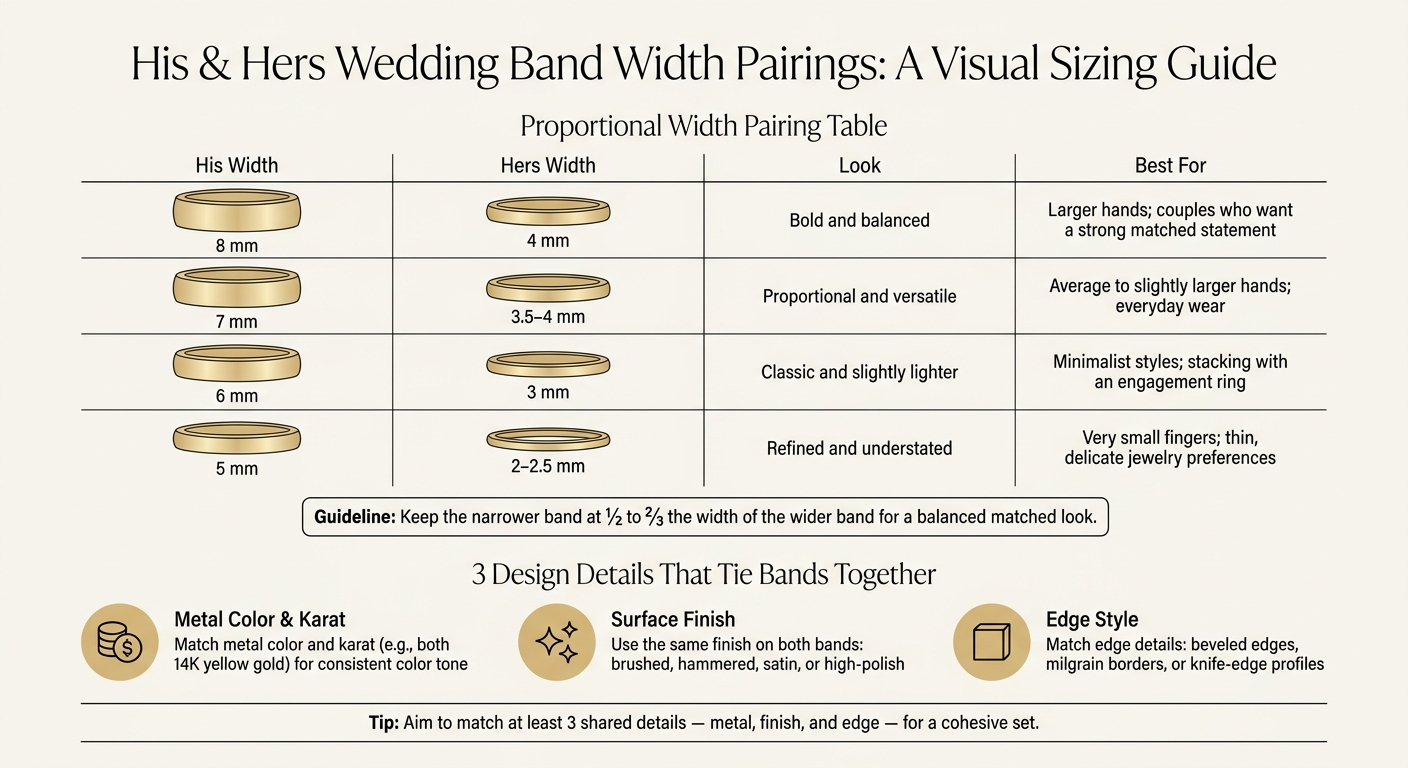
His & Hers Wedding Band Width Pairings: A Visual Sizing Guide
Once you've handled fit, the next job is making both rings look like they belong together. That usually comes down to proportion and a few shared design details.
Width Pairings That Look Balanced on Different Hands
A simple guideline: keep the narrower band at about half to two-thirds the width of the wider band. That range tends to look matched without making one ring seem too heavy next to the other.
| His Width | Hers Width | Look | Best For |
|---|---|---|---|
| 8 mm | 4 mm | Bold and balanced | Larger hands; couples who want a strong matched statement |
| 7 mm | 3.5–4 mm | Proportional and versatile | Average to slightly larger hands; everyday wear |
| 6 mm | 3 mm | Classic and slightly lighter | Minimalist styles; stacking with an engagement ring |
| 5 mm | 2–2.5 mm | Refined and understated | Very small fingers; thin, delicate jewelry preferences |
Treat these as starting points, not hard rules. Put the rings next to each other in the same light and see how they read as a pair.
If the widths feel right, tie the set together with matching metal, finish, and edge style.
Match Design Details Instead of Copying the Same Band
Metal color does the fastest work here. If both rings are in 14K yellow gold, or both are in platinum, they'll read as a set right away, even when the widths are very different.
After that, surface finish helps a lot. A brushed center, hammered texture, or satin finish used on both bands creates a shared look without forcing the rings to have the exact same shape. Edge style helps too. Matching beveled edges, milgrain borders, or rounded knife-edge profiles gives both rings the same visual frame. Try to keep at least three details the same: metal, finish, and edge.
If one partner wears an engagement ring, match the wedding band to that ring's metal, finish, and edge style first. Then repeat those same details in the larger band so the full set feels connected.
Fixing Fit Problems With Resizing and Adjustable Bands
Once the bands look like a pair, the next job is making sure they keep fitting well. Fingers change. Weight shifts, weather, pregnancy, arthritis, and day-to-day swelling can all affect fit. A ring that felt perfect on your wedding day can start to feel snug or slippery later.
When Traditional Resizing Works and When It Does Not
Standard resizing usually works well for plain gold, platinum, and many sterling silver bands without stones or detailed surface work. A jeweler can cut the shank, add or remove metal, and solder it back together - usually by 1 to 2 U.S. sizes with little visible change.
That said, the easy fix tends to stop there. More detailed designs can be much harder to resize safely. Full-eternity bands are often poor candidates because cutting the ring interrupts the pattern and can weaken the stone settings. Pavé shanks, continuous engraving, and detailed milgrain borders run into the same issue.
If you're leaning toward one of those styles and think your finger size may change, ask your jeweler about resizing before you buy. It’s a lot better to know upfront than to find out later that the ring has almost no room for adjustment.
How Adjustable Rings Help With Swelling, Arthritis, and Uneven Sizing
For fingers that change size often, an adjustable band can solve a problem that one-time resizing simply can't.
These rings use a hidden inner mechanism that lets the band expand or contract without changing its outer look. So from the outside, it still looks like a normal wedding band. On the hand, though, it gives you more day-to-day control.
For someone with large knuckles, that means the ring can open enough to get over the knuckle, then sit more snugly at the base of the finger. For arthritis or daily swelling, the wearer can loosen the band during a flare-up and tighten it again later, without repeated trips to the jeweler.
Satinski’s adjustable wedding and stacking bands place the adjustment system inside the band. Their sterling silver adjustable bands can be a smart starting point for couples who want to try this fit style before moving to 18K gold. Satinski also makes 18K gold adjustable bands in coordinated finishes like brushed, high-polish, and textured. That makes it easier to pair one adjustable ring with one fixed band while still keeping the set matched on the outside.
Fixed Bands vs. Standard Resizing vs. Adjustable Designs
| Criteria | Fixed-Size Bands | Traditional Resizing | Adjustable Mechanisms |
|---|---|---|---|
| Fit Flexibility | Single static size | Permanent one-time change | Dynamic range, adjustable at home |
| Best for Swelling or Arthritis | Poor | Limited | Strong; loosens and tightens as needed |
| Design Restrictions | None | Difficult for eternity or patterned bands | Requires hidden internal engineering |
| Typical Use Case | Stable sizes, simple designs | One-time correction for plain bands | Fluctuating sizes, large knuckles, arthritis |
If both partners have steady finger sizes and want plain bands in metals that can be resized, standard resizing will cover most future fit issues. But if either person deals with large knuckles, repeat swelling, or a health issue that affects finger size, it makes sense to plan for adjustability from the start. Trying to add a workaround later can be a headache.
After choosing the fit approach, the next step is measuring both hands for real wear.
A Step-by-Step Sizing Process for Couples With Very Different Hands
When your sizes are far apart, it helps to treat ring sizing as one joint decision instead of two separate tasks. Measure each hand on its own, pick the band width and profile first, and think through fit changes before you place the order. The main goal is simple: choose a ring that feels right in daily wear, not one that just matches a chart number.
When and How to Measure for the Right Fit
Measure later in the afternoon, when fingers tend to be a little larger. Summer heat can add up to half a size, so timing matters even more if you're shopping in warm weather.
If you can, use a sample band in the final width. That part gets missed all the time. A wider band often needs a slightly larger size than a narrow one, so the width you choose can change the fit.
Comfort-fit interiors usually slide over knuckles more easily and can feel a bit looser than flat bands. If either partner has large knuckles or deals with swelling, comfort-fit is often the better place to start. The ring should move over the knuckle with modest resistance, then sit snugly at the base without spinning freely.
It also helps to measure on 2–3 different days. Skip measuring right after exercise, a hot shower, or a salty meal, since all three can make fingers swell. If swelling is part of normal life, an adjustable design may be the better pick.
Once the fit is dialed in, you can use metal and finish to make both bands feel connected.
Pick Metals and Finishes That Tie Both Bands Together
After sizing is set, match the metal color, karat, and finish so the rings look like they belong together. For example, a 3 mm band and a 7 mm band in 18K yellow gold with a brushed finish can still read as a pair. Matching the karat helps keep the color tone the same. Mixing karats can make the bands feel less matched.
If you're after a premium white-metal look, platinum is naturally white and durable, though it does feel heavier than gold. Sterling silver costs less, but it scratches and tarnishes faster.
A shared engraving can also pull the set together. A date, initials, or a short phrase in the same font adds a quiet matching detail.
Conclusion: Prioritize Proportion, Comfort, and Fit Flexibility
Once you’ve settled the width, finish, and fit, the last step is making both bands feel like one coordinated choice. Matching bands should be scaled to each hand, not copied exactly. Stick with the same metal or finish, then choose widths and profiles that fit each person well.
The strongest sets usually follow the same simple pattern: they share one or two design details, and those details do the work. That might be a common finish, a matching profile, or the same edge style. No need to force every part to be identical.
When fit flexibility matters, adjustable bands can handle changes that fixed rings can’t.
Before placing the order, do one last check on the basics:
- proportional width
- one shared design element
- width-specific sizing
- future adjustability
The best matched set is the one both partners can wear comfortably for years.
FAQs
Can matching bands have different widths?
Yes. Matching wedding bands can absolutely have different widths, especially when there’s a big difference in ring sizes.
The key is keeping the overall look aligned without forcing both rings to be identical. A simple way to do that is to choose bands from the same collection and keep a few design details consistent, such as:
- the same metal
- the same finish
- similar edge work or architectural details
Then each person can pick a width that looks balanced on their finger and feels comfortable to wear every day.
Should I size up for a wider wedding band?
With rigid wedding bands, people often have to size up because wider bands tend to fit more snugly than thinner ones.
With a Satinski adjustable ring, that problem mostly disappears. The discreet open-back design lets you gently expand or tighten the band for a more personal fit. That means better day-to-day comfort and extra room for normal finger-size changes, without needing professional resizing.
When is an adjustable band better than resizing?
An adjustable band works better than standard resizing when your finger size doesn’t stay the same. That often happens with weight changes, pregnancy, medication, or even normal day-to-day swelling.
It’s also a smart pick if your knuckle is larger than the base of your finger. The band can open enough to slide over the joint, then close for a secure fit once it’s in place. That means you may be able to skip repeated trips for professional resizing over time.


