

Hinged Rings Need the Finger Dexterity Arthritis Takes Away
If arthritis makes pinching, lining up, and pressing small parts hard, a hinged ring may still be tough to use. I’d sum it up like this: hinged rings help a ring get past a swollen knuckle, but they still depend on the fine finger control arthritis often weakens first.
About 54.4 million U.S. adults live with arthritis, and hand arthritis can cut pinch strength, grip control, and steadiness. That matters because a hinged ring still asks you to:
- open a small latch
- hold the ring steady
- line up both ends
- press it shut until it locks
For me, the main takeaway is simple: the problem is often not ring size alone. It’s the small hand motion the ring requires. If your thumb hurts, your fingers feel stiff, or your hand size changes through the day, a latch-free adjustable ring may be easier to wear than a hinged one.
| Option | Best for | Hard part |
|---|---|---|
| Hinged ring | Big gap between knuckle and finger base | Small latch work |
| Adjustable ring | Swelling that changes during the day | Fit and style vary by design |
| Hidden resizable ring | Standard look with easier size changes | Depends on the band system |
Bottom line: I’d choose a ring based on what my hand can do on a bad day, not just what fits at rest.
Why hinged rings can still be hard to use with arthritis
Even when a hinge helps the ring get past the knuckle, the clasp still has to work for the hand. That’s the catch.
A hinged ring fixes one problem: getting over a swollen or stiff knuckle. But it doesn’t remove the need to open, place, and close a small clasp. And for someone with arthritis, that small step can be the hardest part.
Less force over the knuckle does not mean less effort overall
Arthritis can reduce grip, pinch strength, and coordination, which makes a tiny latch harder to handle. In plain terms, the clasp relies on the same hand control arthritis often takes away.
So yes, skipping the tug over the knuckle helps. But there’s a trade-off. You still need to:
- pinch a small clasp
- keep the band steady
- line up both ends
- press until it clicks
That’s not mainly a strength issue. It’s a precision issue.
And precision can be hard on stiff days. The clasp may need only a light press, but it has to be in the exact right spot. If your fingers feel shaky, sore, or slow to respond, that kind of fine movement can turn into a frustrating little battle.
Daily wear can turn a small motion into a repeated strain
This gets even tougher with daily use. If you take the ring on and off a lot, that same small clasp motion starts to add up. Morning stiffness, flare-ups, or cold weather can make something that worked yesterday feel much harder today.
So a ring design that works once in a calm moment may still fall short as an everyday fix. That’s why it helps to compare lower-effort ring options next.
sbb-itb-9da40c1
The specific hand movements that cause trouble
That precision issue tends to show up in three parts: opening the latch, holding the ring in place, and snapping it shut.
Pinching and lifting a small latch
Opening a hinged ring starts with a precision pinch on a tiny latch. That’s one of the hand motions arthritis often weakens the most.
The research is pretty clear here. Symptomatic hand osteoarthritis tripled the odds of low pinch grip strength in the dominant hand (odds ratio 3.3; 95% CI 1.8–6.2), even after adjusting for age and other factors. Thumb CMC arthritis causes pain and weakness at the base of the thumb, which is the joint doing much of the work when you lift a small latch. So the problem isn’t just that the tab is small. It’s that the thumb has to do fine, exact work at the very moment it hurts most. The tab can feel impossible to grip, the thumb pushes back, or the latch slips before it opens all the way.
Holding the ring steady while positioning it
Once the ring is open, the hard part isn’t over. You still have to keep it steady while the other hand places it. In plain terms, that means holding a small ring still while guiding it onto your finger.
Studies show that people with hand OA have clear problems with grip force-matching accuracy and steadiness, which makes it harder to keep a consistent hold on a small object. That’s where things can start to go sideways. The ring may shift, twist, or slip at exactly the wrong moment. Pain can also make you loosen your grip without meaning to, which throws off the whole positioning step.
Pressing the hinge closed securely
Closing the hinge sounds simple, but it takes firm, exact pressure. The latch has to meet the right spot and lock there.
For arthritic hands, that creates a two-part problem. Too little force leaves the ring unlocked. Too much force strains the thumb joint. People with OA often have trouble applying the right amount of pressure because force-control accuracy is measurably impaired. And if the click doesn’t feel clear, many people press again and again just to make sure it’s closed, adding more strain to joints that are already doing a lot of work.
When a ring asks for this much hand control, fully adjustable and resizable designs tend to be the easier choice.
Ring options that are easier to use with limited hand strength
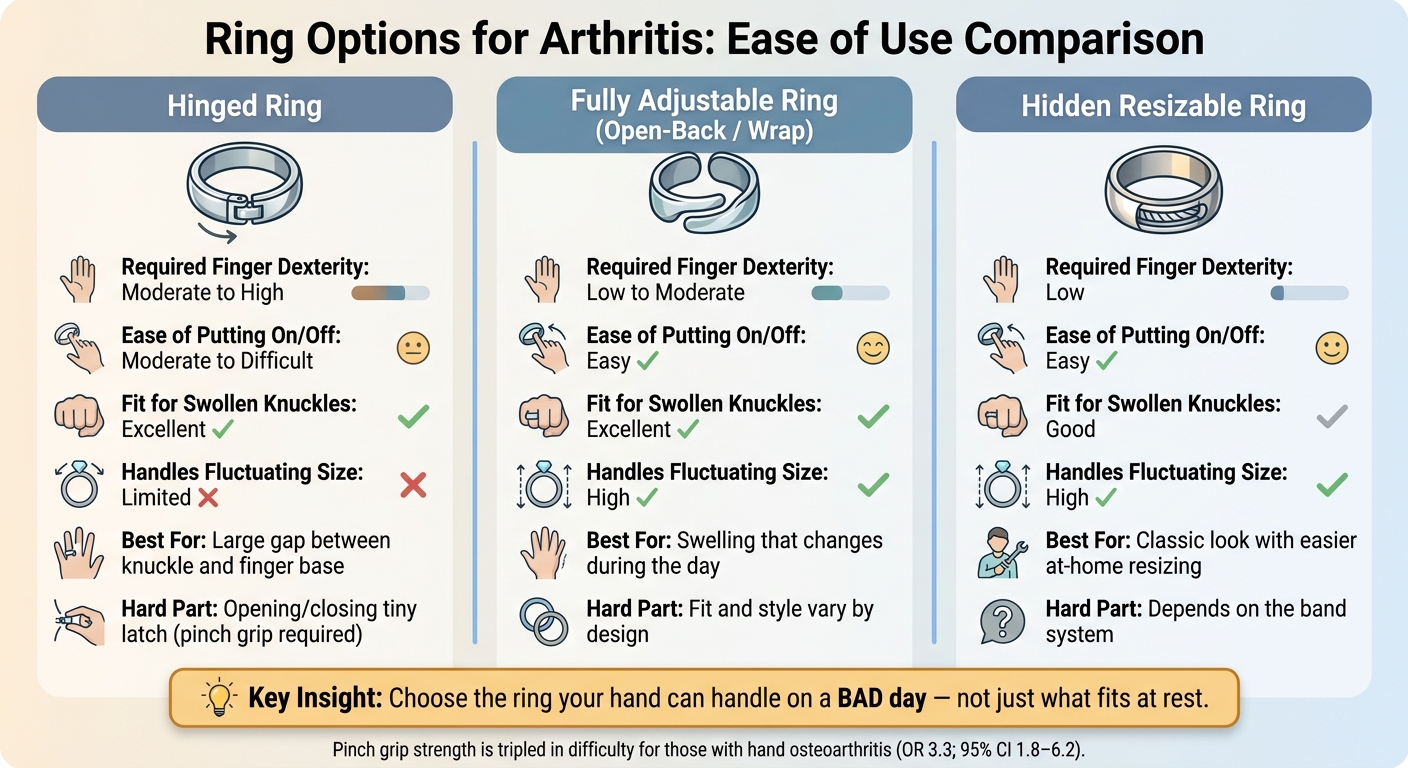
Hinged vs. Adjustable Rings for Arthritis: Which Is Easier to Use?
How fully adjustable and resizable rings reduce hand strain
Hinged rings can get past the knuckle, but they still ask for the kind of small, precise finger movement that arthritis often makes hard. Fully adjustable rings take a different route. Instead of tiny latches, they use broader squeezing or sliding motions. For arthritic hands, that change is a big deal.
Open-back, wrap, expandable, sliding, and adjustable-shank rings all change size through larger hand movements. That tends to make day-to-day use less frustrating.
They also help when finger size shifts during the day. If swelling comes and goes, an adjustable ring is easier to refit without a lot of fuss.
The main difference between these options comes down to how much hand control they need.
| Feature | Hinged Rings | Fully Adjustable Rings |
|---|---|---|
| Required finger dexterity | Moderate to high (tiny latches) | Low to moderate (squeeze or slide) |
| Ease of putting on and taking off | Moderate to difficult | Easy |
| Fit for swollen knuckles | Excellent | Excellent |
| Suitability for fluctuating size | Limited | High |
When a hidden adjustable design makes more sense
A hidden adjustable design is a better fit when you want the ring to look classic on the outside but still need something easier to wear every day. The adjustment piece sits inside the band, so the ring keeps a more standard appearance while giving you extra flexibility in sizing.
Satinski's Allring is one example of this setup. It uses a hidden adjustable band that fits US sizes 5–9. Some models also come with a resizing stick for at-home changes, which can help enlarge or reduce the band without a jeweler or the need to handle tiny parts.
That means you get a ring that looks more like a standard band, while still making resizing much simpler at home.
Next, focus on the features that make a ring easiest to put on, remove, and keep comfortable.
Ring features that improve ease of use and how to choose the right fit
Design details that make a ring easier to put on and take off
Some ring details make day-to-day wear much less frustrating.
Wide tabs or raised buttons let you press with the side of your thumb instead of pinching with your fingertips. That one shift can make a big difference on stiff mornings.
Smooth, rounded edges help the ring slide over a sore knuckle with less drag. Bands that stay centered on the finger - such as comfort-fit interiors with a slightly curved inner surface, or moderately wider bands - also help because they move around less, so you don’t have to keep fixing them. The best ring designs cut down on pinch force, not just friction at the knuckle.
When you look at adjustment mechanisms, go for one that works with broad pressure instead of a small, exact pinch.
When a hinged ring still works and when to choose something else
A hinged ring can still make sense if your arthritis is mild, your finger dexterity stays fairly steady, and your finger size doesn’t shift much from day to day. It’s often a good match when there’s a big size gap between the knuckle and the base of the finger. Some adjustable hinged shanks are made to open up to three full sizes larger than the resting fit, then lock in place securely.
If you can open and close the latch again and again without pain or slipping, and the latch gives a clear click when it shuts, a hinged ring may work well. If that latch feels fiddly or hard to control, a latchless adjustable band is usually the easier pick.
But if swelling changes a lot between morning and evening, or if pinching and lining up small parts hurts, a hinged ring may still ask too much from your hand. In that case, an open adjustable band or a hidden resizable design - something you can widen or narrow with a broad squeeze or gentle press - will usually be easier to live with on most days.
Conclusion: choose the ring that fits how your hand works, not just your finger size
Choose the ring your hand can handle on its own, not just the one that matches your finger size. Rings built around wider contact points, smooth edges, and low-fuss adjustment make more sense when arthritis changes dexterity over time. The best choice is the one you can use on most days, including the hard ones, and that still feels comfortable when swelling is at its worst.
FAQs
How do I know if a hinged ring is too hard for my hands?
A hinged ring may be too hard for your hands if opening, placing, or closing it causes resistance, stiffness, pain, or pinching. If you have to force the hinge or struggle because your grip strength is limited, it may not fit your current dexterity.
If wearing or adjusting the ring feels taxing or causes irritation, that's also a sign it may not support your hand comfort well enough.
What ring style is easiest to use with arthritis?
For people with arthritis, an adjustable ring with a hidden adjustment mechanism is often the easiest option to wear. Unlike closed bands or hinged rings, which can take a lot of finger control, open-back or flexible styles are much easier to loosen or tighten.
They can slide over swollen joints and adjust to day-to-day changes in finger size for a more comfortable fit, without tools or tricky movements.
What features should I look for in an arthritis-friendly ring?
Look for a ring that can handle day-to-day swelling or stiffness without making your hands work harder than they need to. A smooth, comfort-fit interior helps the ring slide on more easily, while hypoallergenic materials like sterling silver or 18k gold can cut down on irritation and make all-day wear more comfortable.
It also helps to choose a ring with hidden adjustment mechanisms so you can change the size fast and without fuss. Smooth, rounded edges and a lightweight design can also make a big difference, giving you a secure fit with less pressure on sore or sensitive joints.


