

Does Moissanite Pass a Diamond Tester? Thermal vs Dual Testers Explained
Yes - moissanite often passes a basic diamond tester. But that result usually comes from a thermal-only tester, which checks heat flow, not stone identity. If you want to tell moissanite from diamond, I’d use a dual tester because it checks both heat and electrical conductivity.
Here’s the short version:
- Thermal tester: diamond, lab diamond, and moissanite can all test as diamond
- Dual tester: diamond and lab diamond usually read as diamond, while moissanite is often flagged as moissanite or not diamond
- Cubic zirconia (CZ): usually fails both
- Type IIb blue diamonds: a rare case that can confuse some dual testers
- Bottom line: a handheld tester is a screening tool, not final proof
If you’re checking a ring at home, this is the part that matters most: a “diamond” result on a pen tester does not prove you have a diamond. It may only mean the stone handles heat in a similar way. That’s why mix-ups happen in resale, insurance, and secondhand buys.
Quick comparison
| Stone | Thermal tester | Dual tester | Main issue |
|---|---|---|---|
| Natural diamond | Pass | Pass | Can look the same as lab diamond |
| Lab-grown diamond | Pass | Pass | Can look the same as natural diamond |
| Moissanite | Often pass | Usually flagged | Can fool thermal-only testers |
| Cubic zirconia | Usually fail | Usually fail | Low mix-up risk |
One data point stands out: about 80% of near-colorless moissanite samples show electrical conductivity, which is why dual testers can often sort them from diamonds.
So if I only needed to rule out glass or CZ, a thermal tester would be enough. If I needed to know whether a stone might be moissanite instead of diamond, I’d skip the thermal pen alone and use a dual tester or get a lab report from GIA or IGI.
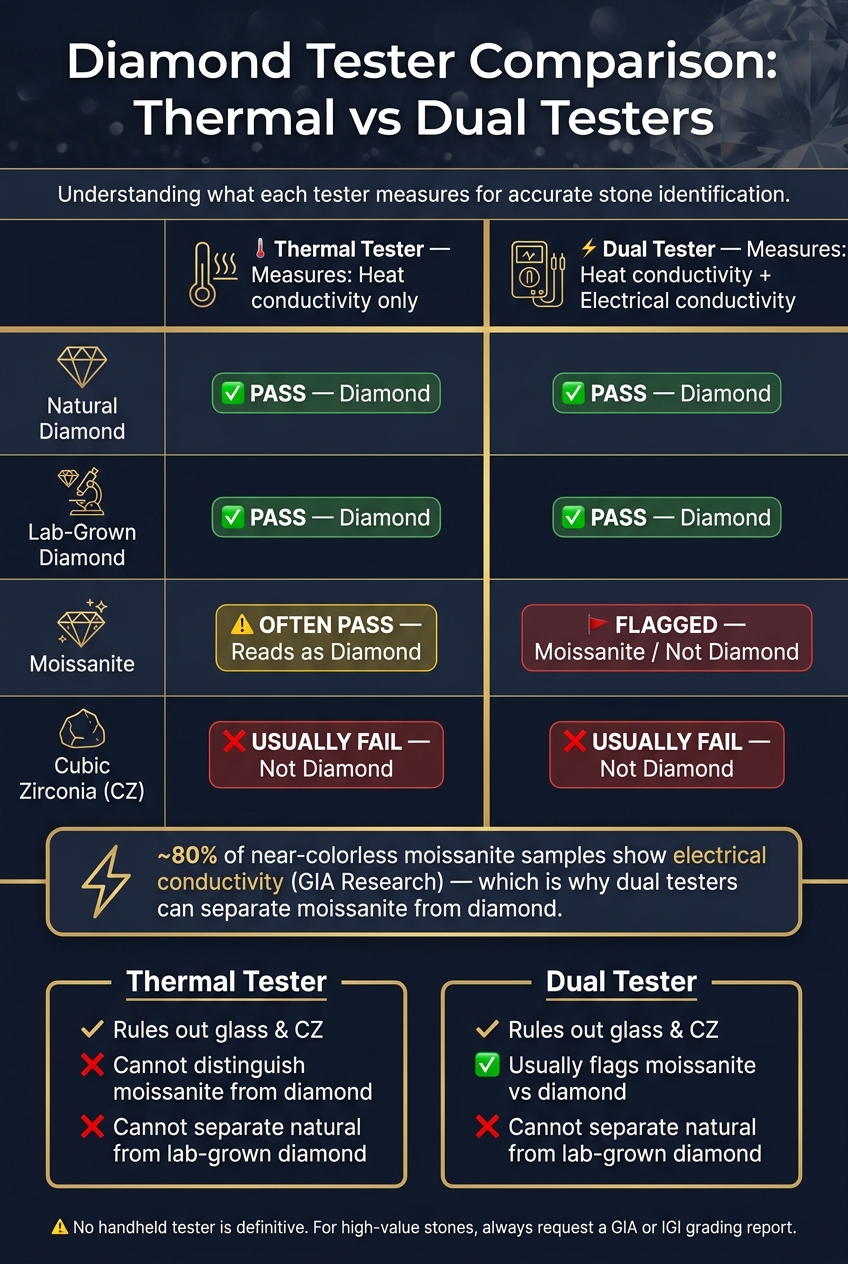
Diamond Tester Comparison: Thermal vs Dual Testers for Moissanite & Diamond
Moissanite v. Diamond Testers: Pass or Fail?
sbb-itb-9da40c1
How thermal diamond testers work and why moissanite often passes
A thermal tester uses a heated probe to check how fast a stone pulls heat away. If the result falls in the diamond range, the device signals diamond. If not, it shows non-diamond.
That means the test looks at thermal conductivity only. Nothing more.
These pen-style testers are popular for a simple reason: they’re cheap, easy to carry, and simple to use. You don’t need special training to get a basic reading.
Thermal tester results for diamond, lab diamond, and moissanite
Natural diamond, lab-grown diamond, and moissanite can all show a diamond reading on a basic thermal tester.
Natural diamond moves heat very fast, which is exactly why thermal testers were made to spot it in the first place. Lab-grown diamonds also pass because they have the same crystal structure and similar thermal behavior as natural diamond. Moissanite is where people get tripped up. Its thermal conductivity is close enough to diamond’s that many basic testers read it as diamond too.
Cubic zirconia is a different story. It moves heat much more slowly than diamond, so it usually fails a thermal test and shows up as non-diamond.
So, thermal testers are handy for ruling out obvious simulants like CZ. But they don’t do a good job separating diamond from moissanite.
| Stone Type | Typical Thermal Tester Result | Why |
|---|---|---|
| Natural diamond | Passes | Very high thermal conductivity |
| Lab-grown diamond | Passes | Same crystal structure and similar thermal behavior as diamond |
| Moissanite | Often passes | Thermal conductivity is close to diamond's |
| Cubic zirconia | Usually fails | Much lower thermal conductivity |
What a thermal reading cannot tell you
A diamond reading does not prove the stone is diamond. It only tells you the stone handles heat like diamond.
That leaves out a lot. A thermal tester can’t tell natural diamond from lab-grown diamond. It also can’t show color, clarity, or treatments. That’s why pros use thermal testers as a screening tool, not a final ID method.
Readings can also get thrown off by simple stuff:
- Dirt, oil, or lotion on the stone
- Weak probe contact
- Touching the setting instead of the stone
- Very small stones
If the result seems off, clean the stone, test a flat facet, and try a few facets if the reading changes.
That limit is why dual testers add an electrical check.
How dual testers tell moissanite apart from diamond
A dual tester checks two things: thermal conductivity and electrical conductivity. That second step is the key difference-maker.
Diamond conducts heat well but does not conduct electricity under normal jewelry testing conditions. Moissanite works differently. It’s a semiconductor, which means it conducts heat and a measurable amount of electricity. So when a tester finds diamond-like heat flow plus measurable electrical conductivity, it marks the stone as moissanite instead of diamond.
That’s why dual testers catch what thermal pens miss.
What natural diamonds, lab-grown diamonds, and moissanite show on dual testers
The reading pattern stays steady across these stone types. Natural diamonds and lab-grown diamonds both show up as diamond on a dual tester. They do this because they share the same crystal structure and don’t show meaningful electrical conductivity.
Moissanite takes a different route. It passes the thermal check, just like diamond. But then the electrical test steps in. The device detects conductivity and flags the stone as moissanite. According to GIA research, about 80% of near-colorless moissanite samples show electrical conductivity, while most near-colorless diamonds do not. That’s the main reason dual testers separate moissanite from diamond with better accuracy.
| Stone Type | Thermal Result | Electrical Result | Device Reading |
|---|---|---|---|
| Natural diamond | Diamond range | No conductivity | Diamond |
| Lab-grown diamond | Diamond range | No conductivity | Diamond |
| Moissanite | Diamond range | Measurable conductivity | Moissanite / Not diamond |
There is one rare exception. Type IIb blue diamonds can be naturally electrically conductive and may trigger a moissanite reading on the electrical test. These account for far less than 1% of natural diamonds. Stones with that kind of conductive result need gemological review.
When to use a dual tester instead of a thermal tester
Use a dual tester when the diamond-versus-moissanite distinction matters. That includes buying, verifying, appraising, or reselling jewelry.
It also matters for insurance. A stone’s identity affects both valuation and the way the item is described on the policy. In that setting, a dual tester works well as a fast screening step before paperwork and gemological testing.
Next, compare thermal and dual testers side by side before using either one to buy or verify jewelry.
Thermal vs dual testers: results compared and how to use them when buying
A thermal tester checks heat only. A dual tester also checks electrical conductivity, and that’s the key difference when you’re trying to tell moissanite from diamond.
Here’s the practical side-by-side view.
| Stone Type | Thermal Tester Result | Dual Tester Result | Main Misidentification Risk |
|---|---|---|---|
| Natural Diamond | Diamond (Pass) | Diamond (Pass) | Confusion with lab-grown diamond |
| Lab-Grown Diamond | Diamond (Pass) | Diamond (Pass) | Confusion with natural diamond |
| Moissanite | Diamond (Pass) | Moissanite / Not Diamond | Mistaken for diamond on thermal-only testers |
| Cubic Zirconia | Non-Diamond (Fail) | Non-Diamond (Fail) | Low risk; usually ruled out by thermal testing |
This gap matters most when you need to separate moissanite from diamond, not when you’re just trying to rule out obvious fake stones.
What each tester can and cannot tell you
Thermal testers are good at ruling out glass and most cubic zirconia. But they can’t tell moissanite apart from diamond. Why not? Because moissanite moves heat in a very similar way, so it passes a thermal test and often reads as diamond on basic testers. That means a thermal result shows high thermal conductivity, not the stone’s exact identity.
A dual tester adds the electrical check that thermal pens don’t have. That’s why it can flag moissanite instead of lumping it in with diamond. But there’s still a limit: dual testers can’t separate natural diamonds from lab-grown diamonds. Both have the same basic structure, so they usually produce the same reading on these tools. If you need that answer, you’re out of tester territory and into grading certificate or lab analysis territory.
Using tester results when shopping for rings and caring for jewelry
The main thing is to match the tool to the question you’re asking. If you want to check whether a diamond ring is actually moissanite, a dual tester makes more sense.
For bigger-ticket situations, like engagement rings, secondhand sales, or insurance appraisals, treat any tester result as a screening step, not the final word. That’s the safest way to look at it.
A few habits help:
- Clean the stone before testing.
- Make sure the probe touches the stone, not the metal setting.
- Test more than one facet.
If the reading jumps around, especially on a very small stone, treat it as inconclusive and get it checked by a professional. For high-value pieces, back up the result with a grading report from GIA or IGI.
Conclusion: Which tester fits your needs
The right tester comes down to one thing: what you need to find out.
For a quick screen, a thermal tester does the job. If you're trying to tell moissanite from diamond, go with a dual tester. Thermal pens are handy for fast checks, but they can't reliably tell moissanite apart from diamond.
Dual testers add an electrical check. That's why they usually flag moissanite instead of reading it as diamond. If the stone's identity affects price or ownership, use a dual tester or get a professional review. That difference matters most when money or identity is at stake.
A grading report from GIA or IGI is still the only way to confirm whether a diamond is natural or lab-grown, because handheld testers can't make that call. No handheld tester is final. If you get an odd or mixed reading, treat it as a screening result, not the last word.
FAQs
Can a dual tester be wrong?
Yes. A dual tester can still give a wrong reading, even if it checks both thermal and electrical conductivity.
A few things can throw off the result:
- Dirt on the stone
- Surface coatings
- Extreme heat or cold
- Poor contact between the sensor and the stone
To cut down on errors, clean the stone first and make sure the device is calibrated before you use it.
How small can a stone be for accurate testing?
The available information does not give a minimum stone size for accurate testing with thermal or dual diamond testers.
For the most reliable reading, check the manufacturer's manual for your specific device. Sensitivity and minimum size can vary from one model to another.
Do mounted stones test differently than loose stones?
Yes. Mounted stones can test a bit differently because the metal setting can affect a diamond tester’s accuracy.
Here’s the main issue: metal conducts heat and electricity very well. So if the probe touches the setting instead of only the stone, the tester may give a false reading or throw off the sensor.
For the best result, test a loose stone when you can. If the stone is mounted, make sure the probe touches only the gemstone.


