

Custom Rings for Hands That Change: Designing for Fit Over Time
A ring that fits once may not fit for long. Finger size can shift by about 0.5 U.S. ring size in a single day, and for some people it can swing by close to 1 full size with heat, exercise, or fluid changes.
If I want a ring to stay comfortable for years, I need to plan for change from the start. That usually means choosing the right mix of open-shank or hinged designs, comfort-fit interiors, sizing beads or spring inserts, and a metal like 18K gold or platinum that a jeweler can work on later if needed.
Here’s the short version:
- Fixed-size rings work best when my finger size stays fairly steady.
- Open-shank bands help with small day-to-day swelling.
- Hinged shanks help when the knuckle is much larger than the base of the finger.
- Comfort-fit interiors can ease pressure, mostly on bands around 6 mm to 8 mm.
- Sizing beads help stop spinning and can tighten fit by about 0.25 to 1 size.
- Spring inserts help when a ring must pass over a larger knuckle but still sit snug at the base.
- 18K gold and platinum are usually better picks than metals like tungsten, titanium, or ceramic if future sizing may matter.
- A shank around 1.6 mm or more at the bottom gives more room for later work than a very thin band.
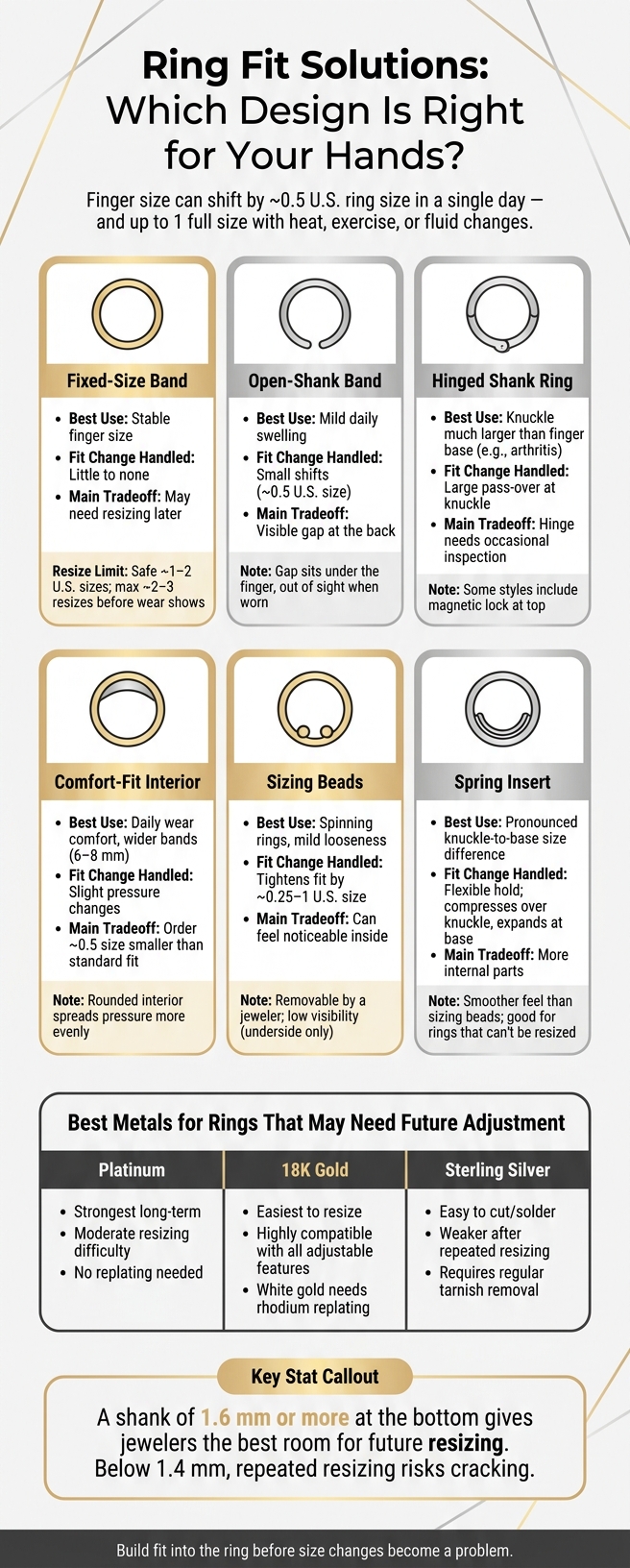
Ring Fit Solutions: Which Design Is Right for Your Hands?
Adjustable Rings Guide: Types, Pros & Cons + How Resizable Rings Work
sbb-itb-9da40c1
Quick Comparison
| Option | Best Use | Fit Change It Handles | Main Tradeoff |
|---|---|---|---|
| Fixed-size band | Stable finger size | Little to none | May need resizing later |
| Open-shank | Mild daily swelling | Small shifts | Gap at the back |
| Hinged shank | Large knuckle difference | Big pass-over at knuckle | Hinge needs checkups |
| Comfort-fit interior | Daily wear comfort | Slight pressure changes | May need different sizing |
| Sizing beads | Spinning or slight looseness | Small tightening | Can feel noticeable inside |
| Spring insert | Larger knuckle, slim base | Flex at lower band | More parts inside the ring |
The main idea is simple: instead of waiting for fit problems, I’d build room for them into the ring before ordering it.
Why fixed-size rings often stop fitting well
A fixed-size ring can't move with your finger. Once your size changes - even by just half a U.S. ring size - the band stays exactly where it was. There’s no built-in give. And that’s the core issue: the ring can’t change with the hand.
Over time, that becomes hard to ignore. Fingers swell in hot weather. Bodies change during pregnancy. Weight shifts. Health issues show up. Even day-to-day fluid changes can affect fit. If you wear a ring through different seasons or different stages of life, a fixed size can go from fine to frustrating.
When resizing works and when it causes problems
For most gold and platinum rings, resizing is usually safe by about 1 to 2 U.S. sizes in either direction. In that range, a jeweler can cut the band, adjust it, and reshape it without much trouble.
The problem isn’t usually one resize. It’s repeated resizing. Each time a ring is cut and repaired, the shank takes on more stress. After enough rounds, that stress can weaken the band and crack the repair point. Many jewelers suggest limiting resizing to about two or three times over the life of a ring before wear starts to show.
Some rings leave even less room for error. Full eternity bands, tension-set rings, and rings made from titanium, tungsten carbide, or ceramic may not resize safely at all. In those cases, replacement is often the only path.
Fixed-size bands vs. adjustable ring designs: a side-by-side look
Here’s how the main ring styles deal with size changes.
| Feature | Fixed-Size Band | Open-Shank Adjustable | Hinged Shank Ring |
|---|---|---|---|
| Adjustment range | No built-in flexibility; requires permanent resizing | Small built-in flex for minor day-to-day changes | Opens and closes to fit more easily over larger knuckles |
| Comfort for swollen joints | Poor; must be sized to clear the largest point of the finger | Good; can fit the base more comfortably | Excellent; helps bypass the knuckle and fit the base more securely |
| Appearance | Seamless, traditional look | Visible gap or overlap at the band's back | Discreet mechanism, usually on the underside |
| Durability | High if resized rarely; weaker after repeated resizing | Moderate; avoids repeated cut-and-solder work | High when well made; hinge needs occasional inspection |
| Service needs | Required for each meaningful size change | Less frequent | Mostly maintenance and occasional inspection |
If someone expects their hands to stay about the same size, a fixed band can still be a solid choice. But if pregnancy, arthritis, weight change, or seasonal temperature swings are part of the picture, frequent resizing is a slow way to wear down a ring that matters. That’s why fit-forward custom rings use adjustable construction and interior support instead of depending on repeat resizing. The goal is simple: build the adjustment into the ring itself.
Custom ring features that keep fit comfortable over time
A lot of ring fit issues can be handled at the design stage. The outer shape affects how the ring sits, while interior details do the work on comfort and stability.
Adjustable band styles: open-shank and hinged designs
An open-shank band has a small gap or slight overlap at the back of the ring. That bit of flex lets the band expand or contract by about half a U.S. ring size, which is often enough for normal daily swelling from heat, exercise, or mild inflammation. Because the opening sits under the finger, it stays out of sight when the ring is worn.
A hinged shank has a small mechanical hinge in the lower part of the band. The ring opens, goes over the knuckle, then closes and locks at the base of the finger. A well-made hinged shank can open far enough to get past a larger knuckle, which makes it a good option when the knuckle is much bigger than the finger base. That can happen with arthritis or an old joint injury. Some arthritis-focused styles pair a bottom hinge with a magnetic lock at the top, which makes the ring easier to put on without changing how it looks from above.
Use open-shank styles for small, steady swelling. Go with hinged shanks when the knuckle is much larger than the base of the finger.
Interior fit options: comfort-fit, sizing beads, and spring inserts
These features work from the inside of the ring. They don’t change the top view, but they can make a big difference in how the ring feels and how well it stays put.
A comfort-fit interior swaps the flat inner wall of a standard band for a gently rounded, domed shape. That curve spreads pressure more evenly across the finger, so slight tightness from heat or a long day feels less harsh. It’s especially helpful on wider bands - like 6 to 8 mm wedding bands - where a flat interior can start to feel restrictive by late afternoon. Because the rounded inside adds extra room, comfort-fit bands usually need to be ordered about half a size smaller than a standard fit.
Sizing beads are two small metal spheres soldered to the inside of the band, usually near the bottom. They reduce the inner circumference by about a quarter to a full U.S. size and add enough friction to help keep the ring from spinning. That makes them a good match for top-heavy engagement rings, where a solitaire setting can rotate out of place during the day.
Spring inserts, sometimes called spring bars or butterfly springs, are thin, curved metal strips fitted inside the lower band. They compress a bit as the ring moves over the knuckle, then expand to hold it snugly at the base. Compared with sizing beads, a spring insert gives a smoother, more even feel. That can help when the difference between the knuckle and finger base is more noticeable. They’re also useful for rings that can’t be resized easily, such as eternity bands or detailed vintage settings.
| Solution | Adjustment Effect | Removable? | Comfort Level | Visibility | Best For |
|---|---|---|---|---|---|
| Comfort-fit interior | Subtle; makes the ring feel roomier | No (built into band) | High | None | Daily wear, wider bands, mild temperature swelling |
| Sizing beads | Small size reduction and better stability | Yes (by a jeweler) | Moderate to high | Low (underside only) | Spinning rings, mild looseness, larger knuckles with slimmer bases |
| Spring inserts | Flexible hold at the base | Yes (by a jeweler) | High | Low | Pronounced knuckle-to-base difference, rings that can't be fully resized |
Fit features only help if the metal can handle later adjustment.
Choosing metals and construction for rings that last
Once the fit system is set, the metal and build still need to support changes down the line.
Best metals for rings that may need future adjustment
The metal you choose plays a big role in whether a ring can be resized later without losing strength.
18K gold is one of the easiest metals to resize, and most bench jewelers know how to work with it. Yellow and rose gold usually resize cleanly. White gold can also be resized, but it needs rhodium replating after sizing and again over time.
Platinum is the strongest long-term option. When it gets scratched, the metal shifts instead of wearing away, which helps prongs and shanks hold their form longer. It can be resized too, but the job takes more heat and special tools.
Sterling silver is easy to cut and solder, which makes resizing simple at first. But it’s softer than gold or platinum, so thin bands can weaken faster after repeated resizing. It also tarnishes more easily.
Construction details that protect future fit options
Metal matters, but construction matters just as much.
Shank thickness is one of the biggest choices for long-term wear. A band with about 1.6 mm or more of metal at the bottom gives a jeweler enough material to work with. Once the shank drops below about 1.4 mm, resizing more than once gets risky because the band can crack or lose shape under pressure. If you’re having a ring made, ask for the shank thickness at its narrowest point.
A plain sizing area at the bottom of the band also makes a big difference. If stones, engraving, or pattern work go all the way around, there may be no safe place to cut the ring for sizing. If you like the eternity look but think your size may shift, a three-quarter eternity design is a smarter route. It keeps stones across the top and sides while leaving the bottom plain for later adjustment.
That simple choice can save a lot of trouble later. Decorative details can stay on the top and sides, while the underside stays easy to work on.
These details should be locked in before the custom order goes through.
Comparing metal options for rings worn over many years
| Metal | Ease of Resizing | Works with adjustable features | Maintenance |
|---|---|---|---|
| Platinum | Moderate; requires more heat and specialized tools | Excellent for hinges and inserts when properly engineered | Low; occasional polishing, no plating needed |
| 18K Gold | Excellent; highly workable for most jewelers | Very compatible with sizing beads, spring inserts, and hinged shanks | Low to moderate; white gold needs periodic rhodium replating |
| Sterling Silver | Easy to cut and solder, but repeated resizing can weaken thin bands | Basic adjustable features work, though moving parts may wear faster | Higher; regular tarnish removal and cleaning |
How to order a custom ring that fits your real life
Matching ring design to your day-to-day needs
Once the ring's build is set, match the fit feature to the issue your hand actually deals with day to day.
- For mild daily swelling, go with an open-shank adjustable band.
- For spinning, use sizing beads.
- For sensitive skin or all-day size shifts, choose a comfort-fit interior.
- For a knuckle much larger than the finger base, pick a hinged or sliding shank.
If the design will move a lot, use solid gold. Plated metal tends to wear down faster where parts rub or touch.
After that, lock in the measurements that support the mechanism.
What to confirm before placing a custom order
Before you place a custom order, a few details can make a big difference in how the ring feels over time.
Start with your current U.S. ring size. Measure at different times of day and in different temperatures. That gives you a better read on how the ring will fit through seasonal swelling, pregnancy, or joint changes. It also helps to note whether one hand fits a little differently from the other. Most adjustable designs cover U.S. sizes 5–9, with custom options available outside that range.
Then confirm the practical choices: your metal, band width, stone layout, and whether you want the adjustable part to show or stay hidden at the back of the finger. If you're ordering a comfort-fit interior, ask if the ring should be sized slightly down to balance out the roomier feel.
Conclusion: The best custom rings are built for change
The goal is simple: build fit into the ring before size changes turn into a headache. The right mix of adjustable structure, interior fit detail, and a metal that can handle wear helps the ring stay comfortable through daily life, not just on the day it arrives.
FAQs
How do I know if I need a hinged shank or an open-shank ring?
It comes down to comfort, hand mobility, and how you wear the ring day to day.
A hinged shank opens and closes, so it’s easier to get on and off. That can help a lot if you deal with swollen knuckles or have limited hand movement.
An open-shank ring has a small gap that can be adjusted gently as your finger size changes during the day. That’s useful if swelling shifts with temperature, activity, or arthritis, and you need to tweak the fit often.
Can an adjustable ring still look like a traditional ring?
Yes. Modern rings with size-adjustment features can look just like classic rings because the mechanism is tucked into the design.
Details like hidden sliding bands or inner sizing systems are often placed underneath or inside the band. That way, the ring keeps a smooth, classic look without visible gaps or joints.
What should I ask a jeweler before ordering a ring for changing finger size?
Explain things like weight changes, pregnancy, or arthritis, and ask which design fits your needs best. It’s also smart to ask whether the ring can be resized later, plus any costs or limits that come with resizing.
If the ring has an adjustable or sliding mechanism, ask whether cleaning, polishing, or replating could affect how it works. Also check how well the band holds up over time and whether any stone settings are secure enough for everyday wear.


