

Do Copper and Magnetic Arthritis Rings Actually Work? Evidence Review
Short answer: no. Based on controlled studies, copper and static magnetic arthritis rings have not been shown to beat placebo for pain, stiffness, swelling, or hand function.
If I were summing up the whole article in a few lines, I’d put it like this:
- Copper rings and bracelets don’t have clinical proof for arthritis symptom relief.
- Static magnetic jewelry doesn’t show steady results for arthritis either.
- PEMF devices are different from magnetic rings, so research on one does not prove the other.
- If your fingers hurt or swell, ring splints may help support joints.
- If your ring fit changes during the day, adjustable rings may help with comfort, not treatment.
A big reason this matters is simple: arthritis symptoms can change on their own. That’s why placebo-controlled trials matter. In those studies, copper and magnetic jewelry did not show a clear edge.
What may help instead?
- Ring splints for finger joint support
- Adjustable rings for swollen knuckles and day-to-day size changes
- Medical care that has been tested for arthritis
| Option | What it’s meant to do | What studies show |
|---|---|---|
| Copper rings/bracelets | Cut inflammation and pain | No clear effect beyond placebo |
| Static magnetic rings/bracelets | Ease pain and stiffness | No steady symptom relief shown |
| PEMF therapy | Use pulsed electromagnetic treatment | Not the same as jewelry |
| Ring splints | Support finger joints | Can help pain and hand use in some people |
| Adjustable rings | Improve fit with swelling | Helps comfort and wearability |
So if you’re thinking about buying an arthritis ring, the main question is not “copper or magnet?” It’s “Do I want symptom treatment, joint support, or a ring that fits better?”
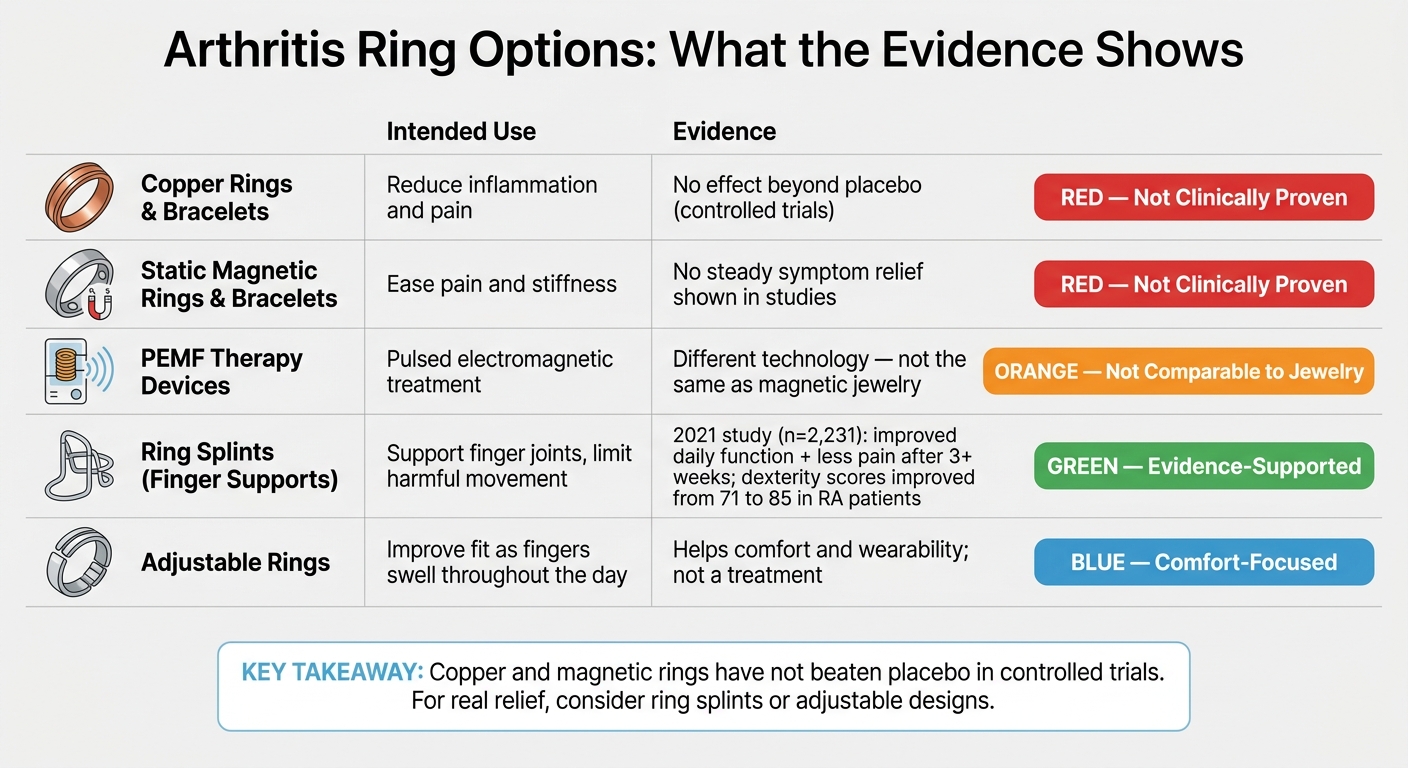
Arthritis Rings Compared: What the Evidence Actually Shows
Copper Arthritis Rings and Bracelets: Clinical Evidence Review
Controlled trials have not found copper jewelry to beat placebo for arthritis symptoms.
What Controlled Trials Found for Rheumatoid Arthritis and Osteoarthritis
Randomized, double-blind, placebo-controlled trials did not find that copper bracelets or other copper jewelry worked better than placebo for rheumatoid arthritis or osteoarthritis.
In the best-known trial, copper bracelets did not outperform placebo devices for pain, morning stiffness, disability, or swelling.
Why the Proposed Copper Mechanism Does Not Hold Up
The main claim behind copper jewelry sounds simple: copper passes through the skin and helps reduce inflammation. But that idea doesn’t hold up. The skin acts as a barrier, and the claim that copper is absorbed through it in a way that reduces inflammation is not supported.
That helps explain the trial results. If the proposed mechanism doesn’t work, it makes sense that study after study fails to find a treatment effect.
Skin Side Effects and Placebo Effects
These results do not support copper jewelry as a reliable arthritis treatment.
Copper jewelry does not show a reliable treatment effect, so the next question is whether magnetic rings and bracelets do any better.
sbb-itb-9da40c1
Magnetic Arthritis Rings and Bracelets: What Studies Actually Found
Magnetic jewelry is often sold as the next step after copper bracelets. But when you look at the research, the story doesn't change much. Controlled evidence does not show that magnetic jewelry improves arthritis pain, stiffness, swelling, or hand function.
Static Magnetic Jewelry Has Not Shown Reliable Benefit
Studies have not shown that static magnetic rings or bracelets relieve arthritis symptoms in a dependable way. That’s the point that matters most.
For people with arthritis, the main issue is simple: does a static magnet help with symptoms that affect daily life? Based on controlled evidence, the answer is no. The research does not support the idea that static magnetic jewelry changes pain, stiffness, swelling, or hand function in a meaningful way.
Static Magnets Are Not the Same as PEMF Therapy
This is where a lot of people get tripped up. The phrase "magnet therapy" is often used for two very different things.
Static magnetic jewelry uses a constant magnetic field. PEMF therapy uses medical devices that deliver pulsed electromagnetic fields. Those are not the same product, and they do not work in the same way.
So even if someone points to research on PEMF therapy, that does not mean the same findings apply to magnetic rings or bracelets. Evidence for PEMF therapy does not automatically carry over to static magnetic jewelry.
What the Evidence Means for Buyers
If you're thinking about buying magnetic jewelry for arthritis, the evidence gives a pretty clear answer: static magnetic jewelry has not been shown to reliably relieve arthritis symptoms.
That makes it a poor substitute for treatments with proven symptom relief.
Ring-Based Solutions That Can Help When Fingers Swell or Hurt
If the goal is comfort, not symptom relief, ring-based options can still make a big difference. They usually help in two ways: ring splints for support and adjustable rings for fit.
Ring Splints and Finger Supports for Hand Arthritis
Ring splints are small orthotic devices, usually made of metal or tough plastic, that wrap around a finger joint to limit harmful movement and keep the joint in line. They help through mechanical support, not copper or magnets.
Research points to clear benefits here. A 2021 study of 2,231 people with hand osteoarthritis found better day-to-day function and less pain after at least three weeks of ring splints. An observational study in rheumatoid arthritis found dexterity scores improved from 71 to 85 on joints without active inflammation.
These splints are often recommended by a hand therapist or rheumatologist. They tend to help most when someone has:
- swan-neck deformity
- joint hyperextension
- painful instability in certain finger joints
Adjustable Rings for Swollen Knuckles and Size Changes
For people who don't need joint support, the main problem is fit, not function. That's where adjustable rings come in. They let the wearer loosen or tighten the ring as swelling changes.
That small shift can matter a lot. It can ease pressure on larger knuckles and make stuck rings less likely.
How Satinski Fits for Comfort-Focused Ring Wear
Satinski offers hidden-adjustment rings in U.S. sizes 5–9, with sterling silver and 18K gold-plated options starting at about $70.
Conclusion: Bottom Line and Next Steps
Controlled studies show that copper and magnetic arthritis rings do not reliably cut pain, stiffness, or swelling, and they don’t improve hand function in a consistent way. If someone feels better while wearing one, the most likely reason is the placebo effect, not the copper or magnetic material.
That said, if your goal is comfort instead of symptom relief, wearing a ring can still work well. The key issue is fit and support. It’s not about copper or magnets. It’s about choosing a ring that feels good on your hand.
Key Points to Take Away
- No strong clinical proof supports copper or magnetic rings as arthritis treatments.
- Mechanical supports and adjustable designs focus on fit and comfort, not treatment claims.
- Adjustable designs can help with day-to-day finger size changes.
- Copper and magnetic rings should not replace evidence-based care.
If you want to wear rings more comfortably with arthritis, size the ring for your knuckle, measure at the end of the day, and pick a design that can flex with swelling.
FAQs
Are magnetic rings and PEMF the same thing?
No. Magnetic rings and pulsed electromagnetic field (PEMF) therapy are not the same thing.
Magnetic rings use static magnets, which means they produce a constant magnetic field. PEMF therapy, on the other hand, uses devices that send electromagnetic pulses through the body.
That difference matters. But based on the research provided, there’s no evidence that either one helps with arthritis pain or stiffness.
Can ring splints help more than arthritis rings?
Yes - possibly, but for a different reason.
Ring splints can give a finger joint mechanical support and help hold it in a better position. That may lower stress on the joint.
Copper and magnetic arthritis rings are a different story. In the sources provided here, there’s no evidence that they improve arthritis outcomes.
There’s also an important catch: the magnetic and clamp/splint-related sources available here are about surgery or surgical instruments. They are not about arthritis pain, swelling, stiffness, or hand function.
Should I wear an adjustable ring if my fingers swell?
Yes. An adjustable ring can be a practical pick if your fingers swell. The flexible fit gives you a bit of room when inflammation flares up, which can help you avoid the painful squeeze that often comes with a fixed-size ring.
It helps to look for styles made for arthritis-related finger changes, especially hinged or stretch designs. And if a ring resists, don’t force it. That can make a bad situation worse. It’s also smart to take it off before bed, since swelling during sleep can put extra tension on the mechanism.


