

Buying an Engagement Ring Online Without Knowing Her Size
You can buy an engagement ring online without knowing her size. If I want to keep the proposal a surprise, I’d usually start with U.S. size 6 or 6.5, choose a plain solitaire or plain band, and make sure the seller offers resizing and returns.
Here’s the short version:
- Most U.S. women’s ring sizes fall between 5 and 7
- Size 6 is the most common single starting point
- If I’m between sizes, I’d go up, not down
- A simple shank is easier to resize than pavé, channel-set, twisted, or eternity styles
- Resizing can cost about $50 to $150+, and more for platinum or stone-set bands
- Many online jewelers offer free resizing within the first year, but limits often apply
If I can borrow a ring she already wears on her left ring finger, that gives me the best clue. If not, I’d use a printed size chart, a millimeter measurement, or a sizing app to get close. And if I’m still unsure, I’d buy a ring style that leaves room to fix the fit later.
| What I’d do | Why it helps |
|---|---|
| Start with size 6 or 6.5 | That’s a common U.S. range |
| Pick a plain solitaire or plain band | Easier for a jeweler to resize |
| Avoid eternity, full pavé, and channel-set rings | Harder or sometimes not possible to resize |
| Check the resize window before buying | Some stores offer free resizing for a limited time |
| Wait on engraving | Resizing or returns may be blocked after changes |
That’s the core answer: guess carefully, choose a resize-friendly design, and check the policy before you pay.
How to Find Your Ring Size at Home
sbb-itb-9da40c1
Ring Size Basics You Need to Know Before You Order
Before you browse, it helps to know how sizing works and which ring styles are simpler to adjust later.
Common U.S. Women's Ring Sizes and What Affects Fit
U.S. ring sizes come in whole, half, and quarter sizes, and each size matches a ring’s inner diameter and circumference. A size 7 ring, for example, has an inner diameter of about 17.3 mm. That may sound like a tiny detail, but even a small size change can turn a good fit into one that feels too tight or slips around.
Band width plays a big part too. Wider bands usually feel tighter, even when the size number stays the same. It also helps to know two basic terms: the shank is the band itself, and the setting is the part that holds the stone. Both can affect day-to-day fit and whether the ring can be resized later.
A few physical factors can change the right size:
- Fingers on the dominant hand are often a bit larger than on the non-dominant hand.
- Warm weather and exercise can make fingers swell by as much as half a size, while cold weather can make them shrink.
- Age, arthritis, and weight changes can also shift fit over time.
Which Engagement Ring Settings Are Easier to Resize Later
The ring’s design matters just as much as the size estimate. Plain bands and solitaire settings with a smooth shank are usually the simplest to resize, often within about ±1 to 2 U.S. sizes. That’s because a jeweler can cut the shank and add or remove metal without affecting the rest of the ring.
Some styles are much harder to adjust. Full-eternity bands, where stones go all the way around the band, are the main example. Resizing them would interrupt that continuous pattern, so many jewelers won’t do it at all. If they will, the job often means removing and resetting every stone, which adds cost and risk.
Pavé bands, with small diamonds set closely into the shank, can run into similar issues.
If you still don’t know her size, discreet estimate methods can help before you place the order.
How to Estimate Her Ring Size Without Spoiling the Surprise
Use a Ring She Already Wears or Take a Simple Measurement
The safest low-key move is to borrow a ring she already wears on the finger you’re buying for, ideally her left ring finger. That part matters more than people think. Ring sizes can change from finger to finger, and even from one hand to the other, so a ring from a different finger is only a rough clue.
Once you have the ring, measure the inside diameter in millimeters with a ruler. Only measure the inner opening. The outer edge doesn’t change the fit. If that feels a little fiddly, set the ring flat on a printed size chart and match the inside edge to the printed circle that fits it best. Then use that number to check a chart or app.
No ring to borrow? You can still get a rough read. Wrap a thin strip of paper around the base of her finger so it sits snugly, not tight. Mark the spot where the paper overlaps, then measure that length in millimeters and convert it with a sizing chart.
Use Printable Charts, Apps, and Finger Comparisons to Convert Your Estimate
A printable U.S. ring size chart gives you a simple way to turn diameter or circumference into a size you can order. For a quick reference, size 6 = 16.5 mm inner diameter / 51.9 mm circumference, and size 6.5 = 16.9 mm inner diameter / 53.1 mm circumference.
Print the chart at 100% on standard 8.5 x 11-inch paper, and check the scale marker before you use it. If the print scale is off, the result will be off too.
Mobile sizing apps can help as well. They can convert measurements between U.S., UK, EU, and JP systems, which helps if you’re looking at ring listings that use different sizing formats.
Finger-to-finger comparisons can work as a backup check, but don’t treat them as your final call. They’re less exact than measuring a ring she already wears. Still, if that guess matches your other clues, it can help you settle on a likely range.
If your estimate falls between two sizes, go with the larger one. A ring that’s a bit loose is usually easier to resize or adjust for the short term than one that won’t go on at all.
When to Start With a Standard Size If You're Still Unsure
If you’ve tried everything and still don’t feel sure, size 6 or 6.5 is a common starting point for many women’s engagement rings in the U.S. If you still can’t confirm the size, start with 6 or 6.5.
Use that estimate to narrow your ring design choices next.
Ring Designs That Reduce the Risk of a Poor Fit
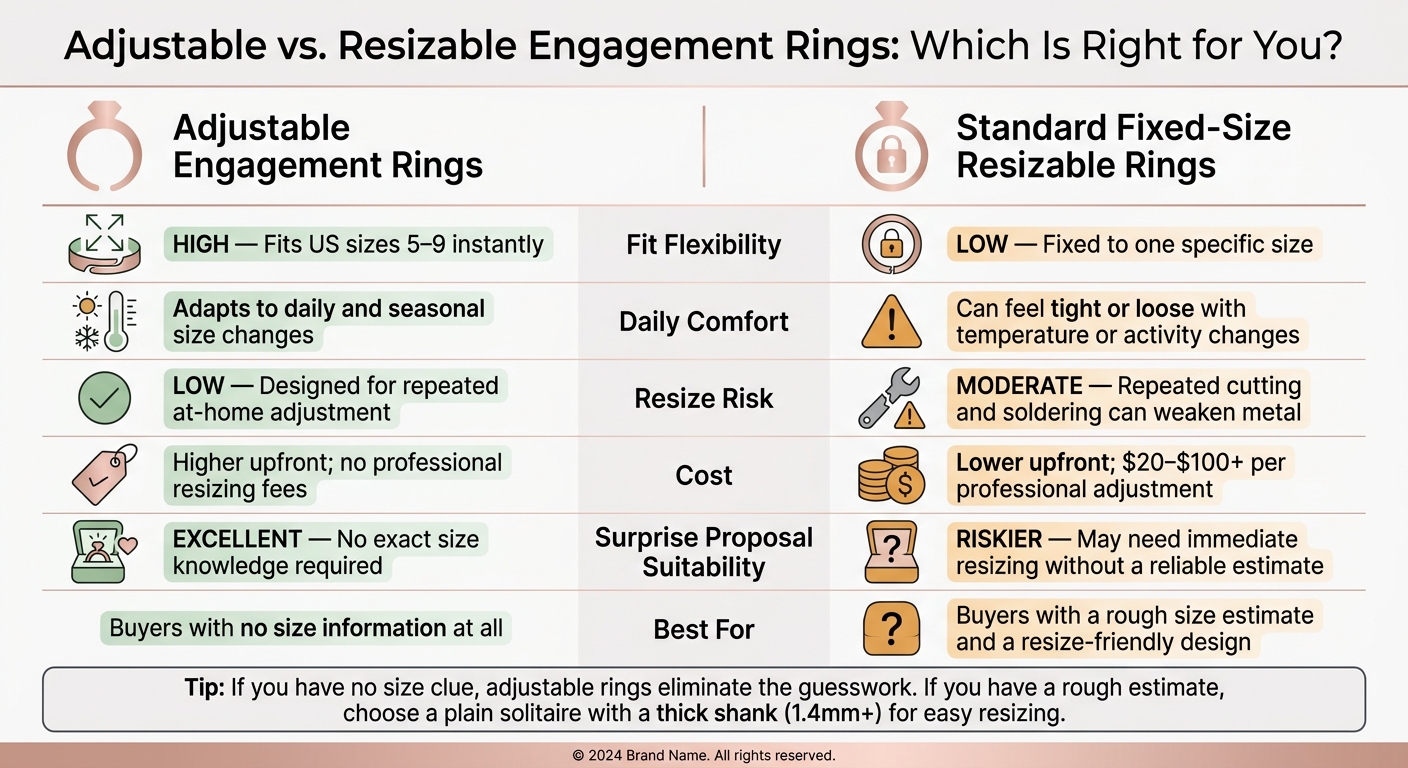
Adjustable vs. Resizable Engagement Rings: Which Is Right for You?
Once you have a rough size estimate - or no estimate at all - the ring design itself can lower the odds of getting the fit wrong. For online buyers, the safest picks are adjustable engagement rings and standard rings with simple, resizable shanks.
Adjustable Engagement Rings for Immediate Fit Flexibility
Adjustable engagement rings have a built-in band system that lets you tighten or loosen the fit without going to a jeweler. Satinski’s adjustable designs use a hidden adjustment mechanism, so from the outside, the ring still looks like a closed, standard design. Many fit a range like US sizes 5 to 9.
That kind of built-in range helps with day-to-day swelling, weather-related changes, and small shifts in fit. It can also help with larger knuckles or mild arthritis, since the band can open enough to pass over the joint and then be secured once it’s on.
If you’d rather stick with a more classic fixed-band style, go with a plain shank that can be resized later.
Standard Rings That Are Easier to Resize Later
If future resizing is part of the plan, a solitaire with a plain shank is usually the safest route. Look for a shank about 1.4 mm or thicker at the sizing area. Solitaire prong settings can often be resized by about 2 to 3 U.S. sizes, as long as the shank is thick enough and doesn’t have detailed metalwork.
18K gold is a smart pick if you expect the ring may need resizing later. White gold can be resized too, but it may need re-rhodium plating afterward. Sterling silver 925 is also resizable, but it’s softer, so repeated resizing can wear it down faster than gold.
When the size is still a guess, skip styles that are harder to alter later, including:
- Full eternity bands
- Full pavé settings
- Channel-set rings
- Heavily engraved shanks
- Twisted shanks
Adjustable vs. Resizable Rings: Side-by-Side Comparison
Use this comparison to match the ring style to how unsure you are about her size.
| Feature | Adjustable Engagement Rings | Standard Fixed-Size Resizable Rings |
|---|---|---|
| Fit Flexibility | High; fits US sizes 5–9 instantly | Low; fixed to one specific size |
| Comfort for Daily Size Changes | Adapts to daily and seasonal changes | Can feel tight or loose with temperature or activity changes |
| Resize Risk | Low; designed for repeated at-home adjustment | Moderate; repeated cutting and soldering can weaken metal |
| Cost | Higher upfront; no professional resizing fees | Lower upfront; $20 to $100+ per professional adjustment |
| Suitability for Surprise Proposals | Excellent; no exact size knowledge required | Riskier without a reliable estimate; may need immediate resizing |
Once you’ve narrowed down the design, check the seller’s resizing and return policy before you place the order.
What to Check on Resizing, Returns, and Costs Before You Buy
Once you’ve narrowed down the style, the seller’s policy is the next big safety check. The listed ring price isn’t the full cost if the sizing turns out to be wrong.
What to Look for in Resizing and Return Policies
Start by checking whether the seller even allows resizing or returns for the ring style you want. Eternity bands, tension settings, and alternative metals like tungsten or titanium are often excluded from resizing. In some cases, they’re also nonreturnable.
If the ring can be resized, look at two things right away: the free resizing window and the largest size change allowed. A good policy page spells out how long you have to request a resize, how much the size can go up or down, and whether the change has to stay within a set range. You’ll also want to see whether resizing or engraving after purchase makes the ring final sale. If you plan to engrave it, wait until you’ve confirmed the fit first.
Shipping matters too. Some sellers cover insured shipping both ways. Others expect you to pay for shipping or buy insurance yourself. It’s also smart to check whether returns are limited to unworn, unaltered items and whether restocking, polishing, or inspection fees apply. If any part of the policy feels fuzzy, ask customer service for written confirmation before you place the order.
How to Weigh Ring Price Against Future Sizing Costs
Then look at the total cost, not just the sticker price. Typical U.S. resizing costs can run about $50–$150 for a simple solitaire, $90–$250 for platinum, and $120–$350+ for rings with stones set into the band.
That can change the math fast. A ring that looks cheaper upfront may end up costing more once resizing fees are added. If the size is still a guess, a simpler design that’s easier to resize often ends up being the smarter buy than a lower-priced ring that’s tough to alter cleanly later.
Policy Details to Compare Before You Place Your Order
Use this table to compare the key policy details before checkout.
| Policy Element | What to Look For |
|---|---|
| Free resizing window | How long the free resize lasts after purchase, and whether the clock starts at shipment, receipt, or delivery |
| Included resizes | Whether you get one free resize, more than one, or none |
| Allowed size range | The largest increase or decrease allowed, and whether limits are listed in half-size or full-size steps |
| Design exclusions | Eternity bands, pavé, tension settings, and custom orders are often excluded |
| Alteration & return rules | Whether resizing or engraving makes the ring final sale, and whether the item must be unworn and unaltered |
| Shipping responsibility | Whether the jeweler gives you a prepaid insured label or expects you to pay and insure the package |
| Extra charges | Any duties, restocking, polishing, or inspection fees |
| Remake fees | The cost of a full remake if resizing isn’t possible |
Get written confirmation of the policy before checkout.
Conclusion: The Safest Way to Buy an Engagement Ring Without Knowing Her Size
At this point, the path is pretty simple. Start with a common U.S. size range, use a ring she already wears to narrow your estimate, and round up if you land between sizes.
When possible, pick a simple setting that's easier to resize later. Plain bands and solitaires are usually easier to adjust than detailed styles or full-band designs. Then make sure the purchase is backed by the seller's resizing and return terms.
Before checkout, double-check your estimate, confirm the resize or return policy, and add any likely resizing fees to your budget. That helps keep the proposal surprise-safe, lowers the risk of a bad fit, and keeps the total cost under control.
FAQs
How much can a ring usually be resized?
With standard professional resizing, most rings can be adjusted up or down by one to two sizes without harming the ring’s structure. Go past that range, and the metal can weaken or the design can get damaged.
Satinski adjustable rings work differently. They use hidden mechanisms that let the band expand or contract within a set range, usually covering US sizes 5 through 9. That means there’s no need for professional resizing.
What if she wears a ring on a different finger?
If she wears a ring on a different finger, it’s tough to estimate her engagement ring size with much accuracy. Finger sizes can vary more than most people think.
If you want to keep the proposal a surprise, an adjustable style can be a smart pick since it fits a range of sizes. And if you borrow one of her rings to estimate size, use one she wears on the same finger you’re buying for. That gives you the best shot at getting it right.
Should I buy adjustable or resizable?
Yes. An adjustable or resizable ring is a smart choice if you don’t know her exact size.
It cuts down on guesswork, can be worn right away, and helps keep the fit comfortable if finger size shifts due to temperature, activity, or weight. Satinski offers adjustable designs that fit US sizes 5 through 9.


