

Rheumatoid vs Osteoarthritis vs Psoriatic Arthritis: Different Hands, Different Rings
The best ring is not about the arthritis name. It’s about how your finger changes today.
If I boil this down, the article says 3 simple things:
- RA often means soft swelling, morning tightness, and fingers that may drift sideways over time.
- OA often means hard enlarged knuckles that a ring must pass over, even if the finger base is smaller.
- PsA often means whole-finger swelling and nail-area pain, so a ring may fit one day and hurt the next.
That leads to different ring picks:
- RA: hinged, light, and easy-to-adjust bands
- OA: rings that clear a large knuckle but stay put at the base
- PsA: soft or low-pressure rings, especially during flares
About 1 in 4 adults in the U.S. has doctor-diagnosed arthritis, and hand changes can make ring sizing much harder than choosing a standard U.S. size alone. In many cases, the problem is not the ring size by itself. It’s the gap between the knuckle size and the finger base size, plus swelling that can shift from morning to night.
My quick takeaway: if your ring pinches, spins, or gets stuck, match the ring to the hand problem - swelling, large knuckles, drift, or skin sensitivity.
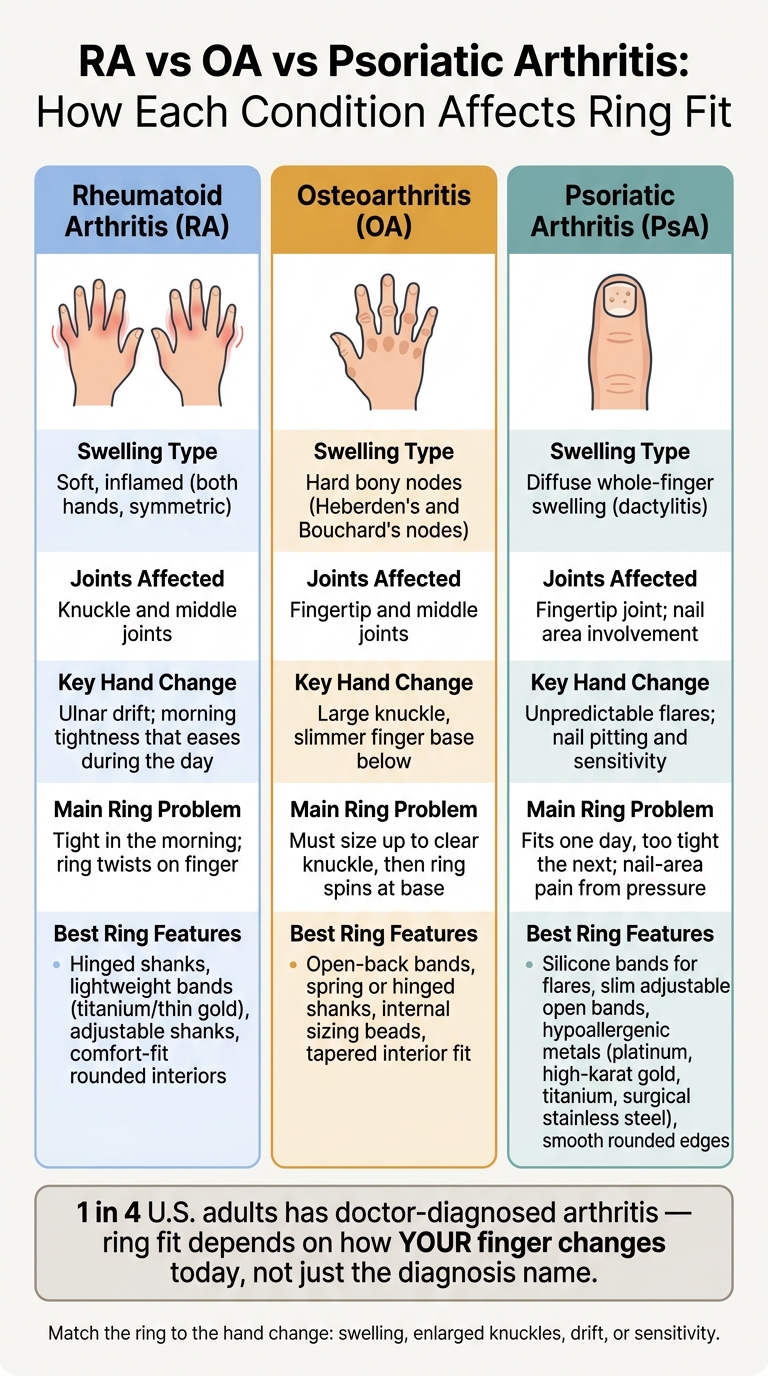
RA vs OA vs Psoriatic Arthritis: Ring Fit Guide by Hand Change
Arthritis Of The Fingers - Everything You Need To Know - Dr. Nabil Ebraheim
sbb-itb-9da40c1
Quick Comparison
| Condition | Common hand change | Main ring problem | Ring types that often help |
|---|---|---|---|
| Rheumatoid arthritis (RA) | Soft swelling in both hands, finger drift | Tight in the morning, may twist on the finger | Hinged bands, light bands, adjustable styles |
| Osteoarthritis (OA) | Hard bony knuckles, nodes | Must size up to get over knuckle, then ring spins | Open bands, spring or hinged styles, inside fit changes |
| Psoriatic arthritis (PsA) | Whole-finger swelling, sore nail area | Fits one day, too tight the next | Silicone rings, slim open bands, smooth hypoallergenic metals |
If I were choosing a ring with arthritis, I’d start with how the finger looks and feels right now, then pick the ring style from there.
How Rheumatoid, Osteoarthritis, and Psoriatic Arthritis Affect the Hands
Each condition changes ring fit in its own way. And that matters more than it might seem at first glance. In some cases, a ring needs more room to get over the joint. In others, the issue is day-to-day swelling. Sometimes the bigger problem is pressure against a sore spot.
Rheumatoid Arthritis: Symmetric Swelling and Finger Deformity
RA usually causes soft, inflamed swelling in the knuckle and middle joints of both hands, often in a symmetric pattern. That swelling is often worst in the morning and eases as the day goes on. So a band that feels fine after lunch can feel painfully tight the next morning.
Over time, long-term inflammation can change finger alignment. One common change is ulnar drift, where the fingers angle toward the pinky side. When that happens, a standard round band may press harder on one side than the other. And if the joint is inflamed, a rigid ring can hurt to push over the knuckle. Even after the ring gets past that point, the slimmer base of the finger may let it spin or slide.
Osteoarthritis: Enlarged Knuckles and Bony Nodes
OA creates a different kind of fit problem. Instead of soft inflammatory swelling, the joints form hard bony growths - Heberden's nodes at the fingertip joints and Bouchard's nodes at the middle joints. These don’t come and go the way inflammatory swelling does.
That creates a plain size mismatch: the knuckle stays wider than the rest of the finger. To get a closed band over that enlarged joint, many people need to size up - sometimes by a full size or more. But once the ring moves past the node and sits closer to the palm, the narrower finger shaft can make it spin, tilt, or slide. That movement can lead to friction, skin irritation, and trouble keeping a stone facing the right way.
Psoriatic Arthritis: Sausage Digits and Nail-Area Sensitivity
PsA makes ring fit harder to predict. Swelling along the whole finger, called dactylitis, can show up in just one or two fingers and shift during flares. A ring that fits on a calm day may become impossible to remove during a flare.
PsA also often comes with nail changes - pitting, onycholysis, crumbling, and discoloration - closely linked to inflammation at the fingertip joint. If a ring sits near that joint or presses against the nail fold, it can cause burning or throbbing pain during active flares. That makes band placement and material choice especially important.
Here’s the practical difference at a glance:
| Rheumatoid Arthritis | Osteoarthritis | Psoriatic Arthritis | |
|---|---|---|---|
| Hand pattern | Symmetric; both hands | Often asymmetric; localized | Asymmetric; any finger |
| Joints affected | Knuckle and middle joints; wrists | Fingertip and middle joints | Fingertip joint; whole digit |
| Swelling type | Soft, inflamed | Hard, bony nodes | Diffuse, whole-finger (dactylitis) |
| Knuckle changes | Inflamed, puffy knuckle and middle joints | Heberden's and Bouchard's nodes | Fingertip joint swelling; nail-area involvement |
| Finger shape changes | Ulnar drift; altered joint alignment | Large knuckle, slimmer base below | Uniform sausage swelling; nail changes |
| Ring-fit challenge | Swells and twists | Clears the knuckle, then spins | Fits one day, tight the next |
Ring Features That Work Best for Each Hand Change
Knowing the hand change is only half the puzzle. The other part is pairing that change with the right ring build. Different hand changes need different ring features.
For Rheumatoid Arthritis: Hinged, Adjustable, and Lightweight Bands
A hinged shank helps the ring get past a swollen joint. After that, an adjustable, lightweight band with a rounded interior can help cut down on pressure and twisting.
For day-to-day swelling shifts, adjustable shanks with sliding or expandable parts let you fine-tune the fit as your hands change.
If ulnar deviation is part of the picture, lightweight metals like titanium or thin gold put less rotational force on the finger. Slim, ergonomic bands with comfort-fit (rounded) interiors also create less friction over tender joints and tend to feel less tight against inflamed tissue.
For Osteoarthritis: Open Bands, Stable Fits, and Custom Adjustment
OA creates a more fixed sizing issue: the knuckle stays wider than the base of the finger. In that case, open-back bands or spring shanks help the ring pass over enlarged knuckles, while sizing beads or a tapered interior help keep it from spinning once it's in place.
Internal sizing beads or bars are soldered inside the band. They add friction at the finger base, which helps keep the ring from rotating without changing how it looks on the outside. A jeweler can also make a custom tapered inner circumference - slightly oval or tapered - so the ring holds the base of the finger more securely even with a larger knuckle.
For Psoriatic Arthritis: Flexible Fit and Low-Irritation Materials
When dactylitis is active, silicone bands are often the most practical pick. They stretch over a swollen finger without squeezing circulation, weigh almost nothing, and don't press hard on skin near the nails.
On lower-symptom days, a slim adjustable metal ring with an open band gives a cleaner look while still making room for size changes. Choose nickel-free, hypoallergenic metals: platinum, high-karat gold, titanium, or surgical stainless steel. Smooth, rounded edges and a polished or satin finish also help cut down on friction against plaques and skin around the nails.
Here’s the shortest way to match each hand change to the right ring feature:
| Hand Change | Most Suitable Ring Features |
|---|---|
| Swollen knuckles | Hinged shanks; adjustable bands; open-back designs |
| Bony enlargement (nodes) | Open-back bands; spring shanks; sizing beads or tapered fit |
| Whole-finger swelling | Silicone bands; slim adjustable metal bands |
| Finger deviation | Lightweight ergonomic bands; hinged shanks |
| Skin sensitivity | Hypoallergenic metals; smooth rounded edges; silicone for flare days |
Once the build matches the hand shape, the next step is picking the right ring for how the hands change over time.
How to Pick a Ring That Fits Your Hands Right Now
Now that the hand patterns are clear, use them to pick a ring build that deals with the fit issue you have right now.
Match the Ring to the Hand Problem, Not Just the Diagnosis
Two people can have the same diagnosis and still need totally different rings. The better way to choose is to focus on the hand change you notice most: swelling, enlarged knuckles, finger drift, or sensitivity near the nail area.
Measure both the knuckle and the base of the finger in the morning and again later in the day. That simple check tells you a lot. If there's a big gap between those two points, you need a ring that can get over the knuckle without turning and sliding around at the base.
When Adjustable Rings Are the Right Choice
Adjustable rings make sense for day-to-day swelling, especially if your size shifts from morning to evening.
They let the ring move with those size changes without a full resize. That's what makes them such a solid pick for everyday bands, stacking rings, and engagement-style pieces. If your hands change during the day, this kind of ring can take a lot of the hassle out of wearing jewelry.
When to Look at Custom-Fit or Occasion-Based Options
If an adjustable band still feels unstable, it's time to look at a shaped or custom interior.
Custom-fit or hinged rings work well when the gap between your knuckle and finger base is too large for an adjustable band, or when the shape of your finger has changed. Another practical option is to wear an adjustable band every day and keep a separate event ring for times when swelling is lower.
For a wedding band or heirloom piece, a jeweler can shape the inside of the ring to fit your finger better and cut down on spinning without changing how the outside looks. And if your swelling stays fairly steady but your main issue is a large knuckle with a smaller finger base, ask about internal sizing beads for a ring you already own. That can make the ring easier to wear day to day while still keeping a cleaner look for special occasions.
Conclusion: Match Your Ring to the Way Your Hands Change
After looking at swelling, nodes, and sensitivity, the main issue is fit. Each type of arthritis changes the hands in its own way, so the best ring is the one that fits the way your fingers fit today. PsA can also make the nail area extra sensitive, which means sharp edges or rough inner surfaces near the cuticle can start to hurt fast.
Different hand changes call for different ring builds. That’s why comfort starts with the shape of the hand, not the name of the condition on a chart. Put simply: comfort comes from matching the ring feature to the hand change, not the diagnosis.
That’s the problem Satinski adjustable rings are made to handle. Their hidden adjustment mechanism fits US sizes 5–9 and shifts with day-to-day swelling. And custom-order options can be shaped around permanent deformities or large gaps between knuckle and finger size. So whether you need an everyday band that can deal with a rough morning or a special-occasion ring built around how your hands look right now, the fit can be built around your needs.
Choose the ring that solves the fit problem you have now - swelling, enlarged knuckles, drift, or sensitivity.
FAQs
How do I measure my finger if swelling changes during the day?
If your finger size changes during the day, use your summer fit as your guide. That’s usually when fingers are at their largest because swelling is more common. It’s also normal for fingers to be smaller in the morning and a bit larger later in the day due to heat, movement, and hydration.
If the change feels constant or more than minor, talk with a medical professional. For day-to-day comfort, adjustable rings can be a smart pick since they can handle small size changes more easily.
Can an existing ring be modified for large knuckles or finger drift?
Yes. An existing ring can often be changed to work better for large knuckles or finger drift.
For enlarged knuckles, a jeweler may add a hinge or a resizing feature, such as a spring insert or sizing bar. That lets the ring open more as it goes over the knuckle, then sit more snugly at the base of the finger.
For finger drift, custom-fit or open-band styles can give you a more comfortable fit and a bit more flexibility over time.
When should I choose silicone instead of metal?
Choose silicone when comfort, flexibility, and practicality matter most. It’s a smart pick if you’re active, work out often, or deal with a lot of finger swelling.
Silicone is lightweight, hypoallergenic, and gentle on sensitive skin. It’s also a budget-friendly choice for daily wear, and it’s made to break under extreme pressure. The downside? It doesn’t look as formal as metal, and you may need to replace it more often.


