

How to Measure His Ring Size Without Him Knowing
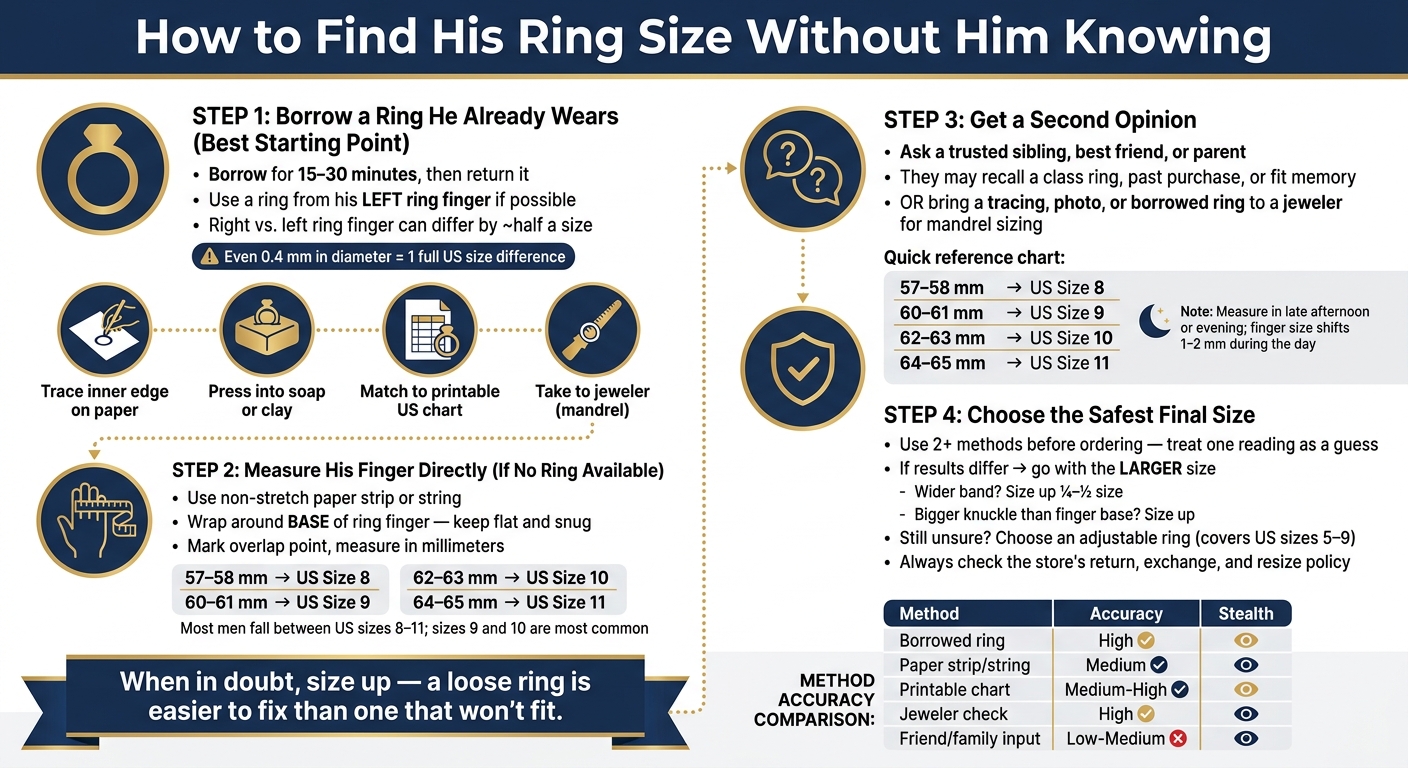
The safest way to find his ring size in secret is to check a ring he already wears, then back it up with one more method. If you can’t borrow a ring, I’d use a paper strip or string on his finger, then confirm the number with a U.S. size chart or a jeweler. Most men fall between U.S. sizes 8 to 11, with 9 and 10 showing up most often.
Here’s the short version:
- Best first step: borrow a ring from his left ring finger if possible
- Most exact home check: measure the ring’s inside diameter in millimeters
- Direct finger check: use paper or non-stretch string and measure circumference
- If numbers differ: go with the slightly larger size
- If his knuckle is bigger than the base of his finger: size up a bit
- Best time to measure: late afternoon or evening at room temperature
- Backup plan: ask a close friend, sibling, parent, or a jeweler
- Low-risk option: choose a ring with an exchange, resize policy, or an adjustable fit
Finger size can shift by about 1–2 mm during the day, and even 0.4 mm in diameter can change a full U.S. size. So if I were doing this, I’d treat one single reading as a guess and use 2 methods before ordering.
| Method | What I’d use it for | Accuracy | How hidden it is |
|---|---|---|---|
| Borrowed ring | Best starting point | High | High |
| Paper strip or string | If I can reach his finger | Medium | Medium |
| Printable U.S. chart | To confirm ring or finger numbers | Medium-High | High |
| Jeweler check | Final confirmation | High | Medium |
| Friend or family input | Backup clue | Low-Medium | Medium |
Bottom line: I’d start with a ring he wears, confirm with a chart or jeweler, and if I’m between sizes, I’d order the larger one.
How to Find His Ring Size in Secret: Step-by-Step Guide
Ask A Jewelry Designer: How To Sneakily Find Out Your Partner’s Ring Size | Nina Berenato
sbb-itb-9da40c1
Method 1: Borrow a ring he already wears and measure it
If you can borrow a ring he already wears, this is the best place to start. It gives you the closest day-to-day fit with the least guessing. Borrow it for 15–30 minutes, then put it back right away.
Try to use a ring from the same hand and the same finger. That matters more than most people think. The right and left ring fingers can differ by about half a size, and middle and index fingers are often larger. If you only have a ring from another finger, use it as a starting point and plan to adjust before you place the final order.
Trace the inside edge or press the ring into soap or clay
Place the ring flat on a hard surface and trace the inner circle with a sharp pencil or fine-tipped pen. Keep the ring completely level. Even a small tilt can turn the circle into an oval and throw off the measurement. Trace the inner edge 2–3 times, then measure the inner diameter in millimeters.
If tracing isn't practical, press the ring straight down into soap, modeling clay, or wax. Lift it out vertically so the imprint stays clean and round. Then let the material set before measuring. Clay may need about 15–20 minutes. Measure the inner opening only. If you measure the outside of the band, you can add 1–2 mm by mistake, which may push you at least one full US size too large.
Match the ring to a printable US ring size chart or mandrel
Print a US ring size chart at 100% scale. Then place the ring over the chart and find the circle that touches the inner edge all the way around. If the ring lands between two sizes, choose the larger one.
If you want the closest result, take the ring to a jeweler and ask them to size it on a mandrel. The point where the ring stops on the mandrel shows the size, including half sizes.
Use the table below to pick the fastest option for your situation.
Comparison table: ring-based measuring methods
| Method | Accuracy | Stealth Level | Tools Needed | Best Use Case |
|---|---|---|---|---|
| Tracing on paper | Moderate | High | Paper, sharp pencil, mm ruler | Quick home measurement |
| Soap or clay impression | Moderate | High | Soap, clay, or wax; mm ruler | Fast imprint when tracing isn't possible |
| Printable chart matching | Moderate–Good | High | Printer, 8.5×11 paper, ruler | Visual matching without math |
| Ring mandrel (jeweler) | High | Moderate | Short trip to a jeweler | Precise sizing for an engagement ring |
| Jeweler mandrel check | Highest | Moderate | Borrowed ring, local jeweler | Full accuracy with professional fit advice |
If borrowing a ring isn't an option, the next method shows how to measure his finger without making it obvious.
Method 2: Measure his finger without making it obvious
If borrowing a ring isn't an option, you can measure his finger directly. Just know this method usually misses by about half to one U.S. ring size.
The easiest place to start is with something simple and low-key: a paper strip or a piece of string.
Use string or a paper strip while he is distracted or asleep
Cut a strip of non-stretchy paper, or use non-elastic string. Wrap it around the base of his ring finger while he's distracted or asleep. Keep it flat and snug so it holds its shape, but don't pull so hard that it presses into the skin. Make sure it doesn't twist.
When it's in place, mark the exact spot where the end overlaps with a fine-tip pen. Then remove it and lay it flat against a metric ruler. Record the length in millimeters. That number is his finger circumference. Check the knuckle too, since the ring still needs to slide over it later.
Do the measurement at room temperature, then repeat it on another day. If the two numbers don't match, use the larger one.
Convert your measurement using a chart or ruler app
Match the circumference to a US ring size chart, or divide the number by 3.14 to estimate diameter.
For a fast ballpark check:
- 57-58 mm is about a US size 8
- 60-61 mm is about a US size 9
- 62-63 mm is about a US size 10
- 64-65 mm is about a US size 11
Check at least two charts from trusted jewelers because sizing charts can differ a bit. A phone ruler app can help in a pinch, but it's smart to confirm the result with a printed chart before you order.
If the measurement falls between sizes, round up.
Comparison table: finger-measuring tools
| Tool | Measures | Accuracy | Skill Required | Where to Get It |
|---|---|---|---|---|
| String | Circumference | Low-Moderate | Moderate | Home sewing kit or craft supplies |
| Paper strip | Circumference | Moderate-Good | Low | Any scrap paper or printed template |
| Printable chart | Diameter or circumference | Good, if printed at 100% scale | Moderate | US jewelry websites, home printer |
| Ruler app | Length/circumference | Moderate-Good | Moderate | Free download from an app store |
If you're still not fully sure, ask someone close to him to double-check your estimate, or have a jeweler look it over.
Method 3: Ask someone close to him or visit a jeweler
If your ring and finger measurements don't line up, get a second opinion. A little outside help can help you check your guess without ruining the surprise.
Ask a friend or family member who may already know his size
Start with someone close to him and good at keeping a secret. A sibling, best friend, or parent is often your best bet. The right person may have seen him wear rings before or may know something about his jewelry history.
A sibling might remember a class ring size. A parent may recall a past purchase. A best friend may remember whether a ring fit tight or loose. Keep the ask simple and quiet, and stick to one or two people you trust.
If nobody knows for sure, take your best guess to a jeweler.
Bring a tracing, photo, or borrowed ring to a jeweler
For the closest check, a jeweler can confirm the size from a borrowed ring or tracing. A jeweler can measure a borrowed ring with a mandrel or calipers and convert it to a U.S. size.
Be clear about which finger and which hand he wears it on, and ask for a measurement only.
Can’t keep the ring long enough to bring it in? A clear tracing can still help. So can a close-up photo next to a ruler, or a mark showing where the ring stops on a finger that fits in a similar way. If you bring more than one reference point, the jeweler has more to work with.
Also mention if he has a larger knuckle. That matters because the ring needs to go on and off without a struggle, while still fitting securely once it's in place.
Pick the safest final size and place your order
What to do when your results do not match
Once you have two or three readings, use the one you trust most as your anchor. If two methods give you different answers, repeat the most reliable one first. The best bet is usually a borrowed ring checked on a mandrel or matched to a printable US ring size chart.
If the numbers still don't line up, go with the slightly larger size. That matters even more if his knuckles are bigger than the base of his finger or if you're buying a wider band. Many US guides suggest going up about ¼–½ size for wider bands, and going up for very wide bands too.
A ring that's a bit loose can often be adjusted later. A ring that's too tight is a bigger headache, especially if it won't get past the knuckle.
When an adjustable ring lowers the risk of a wrong size
If you're still not fully sure about the final size, an adjustable ring is the safer fallback. These rings use a built-in mechanism so the wearer can fine-tune the fit within a set range.
That lowers the odds of ordering the wrong size because the ring isn't locked into one exact measurement. Satinski adjustable rings, for example, cover US sizes 5 to 9.
They're also a smart pick if his fingers change size during the day because of heat, exercise, swelling, or arthritis.
Comparison table: standard fixed-size rings vs. adjustable rings
| Feature | Fixed-Size Ring | Adjustable Ring |
|---|---|---|
| Fit flexibility | Single, exact US size | Adjustable within US sizes 5–9 |
| Resizing ease | May need jeweler resizing if the fit is off | Adjustable at home within the built-in range |
| Suitability for surprise gifting | Best when his size is already confirmed | Well suited when his size is only an estimate |
Before placing the order, check the return, exchange, and resizing window. That way, you'll know exactly how much wiggle room you have if the fit needs adjusting.
FAQs
What if he doesn’t wear rings already?
If he doesn’t wear rings, an adjustable ring can save you from guessing his exact size. You can tighten or loosen it for a snug, secure fit, which makes it much easier to keep the gift a surprise.
If you’d rather go with a standard ring, ask a close friend or family member if they know his size or can help you figure it out without tipping him off.
How can I estimate size if his knuckle is large?
If his knuckle is larger than the base of his finger, measuring only the base can lead to a poor fit or cause the ring to spin. Measure both the knuckle and the base.
Pick a size that moves over the knuckle with slight friction but still sits snug at the base. If you're worried about getting it exactly right, adjustable rings can be a smart option for a secure, comfortable fit.
Can a ring still be resized if I guess wrong?
Yes. A jeweler can resize many standard rings, usually by one to two sizes. That said, the process often involves cutting and soldering the metal, and that can weaken the ring over time.
If the ring is only a little loose, you may not need a permanent fix. Temporary options like silicone adjusters or plastic clips can help it fit better. And if the ring has a hidden adjustable feature, you can usually resize it at home.


