

How Adjustable Shanks Help Swollen Knuckles
If your knuckle is bigger than the base of your finger, a standard ring size often fails. It may fit over the knuckle and then spin, or fit the base and never get on at all.
I’d sum it up like this: adjustable shanks let a ring open, flex, or expand at the knuckle and then sit snugly at the base of the finger. That makes them a solid option for people dealing with arthritis, swelling, heat, injury, pregnancy, or day-to-day size changes.
Here’s the short version:
- Hinged shanks open and lock shut once the ring is in place
- Spring-style shanks stretch over the knuckle, then pull back
- Open adjustable bands can be widened by hand for small fit changes
- A 0.5 size gap may suit a spring style
- A 1 size gap may suit a spring style or hidden adjuster
- A 2 to 3 size gap often points to a hinged shank
A common example is a finger that measures U.S. size 7 at the base and size 9 at the knuckle. In that case, a plain size 9 ring may feel loose, twist, and slip more than you want. An adjustable shank aims to fix that mismatch.
What I’d check first: measure both the knuckle and the finger base later in the day, test that the inside feels smooth, and make sure any hinge or latch closes all the way. The goal is simple: easy on, secure once on.
Hinged Ring Shank | F.J. ZELLEY JEWELLERS

Quick Comparison
| Type | How it works | Best for |
|---|---|---|
| Hinged shank | Opens on a hinge and locks closed | Arthritis, large knuckles, 2–3 size gaps |
| Spring-style shank | Flexes over the knuckle, then returns | Mild to medium swelling, daily size shifts |
| Open adjustable band | Gap is widened and narrowed by hand | Small fit changes, seasonal swelling, fashion rings |
| Hidden adjuster | Flex or slide system inside a standard-looking band | People who want a plain outside look |
Bottom line: if sizing up alone makes your ring loose at the base, an adjustable shank may give you a better fit without forcing the band over a swollen knuckle.
How Adjustable Shanks Work
An adjustable shank is the lower part of a ring band that opens, widens, or flexes so the ring can get past a larger knuckle and then fit snugly at the base of the finger. Put simply, it gives the ring a temporary opening to clear the knuckle, then returns to a smaller fit once the ring is in place. That movement is what helps one ring work for two different fit points.
The Main Types: Hinged, Spring-Style, and Open Adjustable Bands
Each style handles the gap between knuckle size and base size in its own way:
| Type | How It Works | Best For |
|---|---|---|
| Hinged (Arthritic) | Opens like a door on a hinge and locks shut at the base | Large size gaps, arthritis |
| Spring-Style | Expands as the ring slides over the knuckle, then contracts automatically | Moderate swelling or fluctuating finger size |
| Open Adjustable Band | A visible gap at the bottom is widened or narrowed by hand | Mild swelling, seasonal changes, or stacking rings |
Hinged shanks open wide enough to get around the knuckle and then lock once the ring is sitting at the base. Spring-style shanks flex as the ring moves over the knuckle and then return to shape. Open bands work a bit more manually: you widen the gap before putting the ring on, then narrow it once it’s seated.
Step by Step: Getting the Ring Over the Knuckle and Into Place
Here’s what that looks like in day-to-day wear. With a hinged shank, you open the shank, place the ring at the base of the finger without pushing it over the knuckle, and then close it until it locks. With a spring-style shank, you line up the ring with the fingertip and slide it on so the band flexes over the knuckle and tightens again at the base. With an open adjustable band, you gently widen the gap with your fingers, slide the ring over the knuckle, and then squeeze the band back until it feels snug but not tight.
The big idea is simple: open or flex the shank instead of forcing the ring over the knuckle.
Fit Examples Using U.S. Ring Sizes
A common fit issue is a finger that measures U.S. size 7 at the base but U.S. size 9 at the knuckle. In that case, a standard size 7 ring may not go on with much comfort, while a size 9 ring may slide over the knuckle but feel loose and spin once it reaches the base.
A hinged shank can be sized for the base of the finger, opened wide enough to get past the larger knuckle, and then locked back into place. When the knuckle is two or more U.S. sizes larger than the base, a hinged shank is often the steadiest option. It also tends to make daily wear more comfortable.
sbb-itb-9da40c1
Comfort and Daily Wear Benefits
Once the ring clears the knuckle, the next thing that matters is simple: how it feels after hours of wear.
Adjustable shanks can make everyday wear much easier. You get less scraping, less pressure, and a steadier fit at the base of the finger.
Less Pressure, Less Twisting, and a More Secure Feel
When a ring fits the base of the finger the way it should, it doesn’t have to fight to stay in place. It sits more evenly during daily tasks like carrying bags or gripping a steering wheel, and the stone is more likely to stay centered. Finger size can shift throughout the day, and an adjustable shank gives the ring enough room to move with that change instead of turning it into discomfort - or a struggle to take the ring off at night.
That can mean fewer red marks and less throbbing around the knuckle, since the ring is sized for the base of the finger instead of being forced to fit the widest part.
Of course, comfort only matters if the ring also feels secure.
What to Check for Safety and Comfort
Before you wear an adjustable-shank ring all day, take a minute to check the inside of the band. Run a finger along it. The interior should feel smooth and even, with no ridges or rough spots around the mechanism. Then test the ring through a few hand movements. If it pinches underneath the finger while you move, the fit needs work.
For hinged styles, make sure the latch is fully closed each morning. A secure closure should give a firm, steady stop - no wobble, no gap where the band meets. If a gentle tug doesn’t release the latch, that’s a good sign it’s closed properly. For higher-value pieces like engagement rings, it also makes sense to have the closure checked by a jeweler every few months for added peace of mind. Satinski designs adjustable rings with smooth, comfort-fit interiors in sterling silver and 18K gold to help reduce irritation during long periods of wear.
A quick check comes down to three things:
- Smooth passage over the knuckle
- A locked hinge or latch
- A flat, centered fit at the base
The next step is choosing the right adjustable shank style for your finger.
How to Choose the Right Adjustable Shank
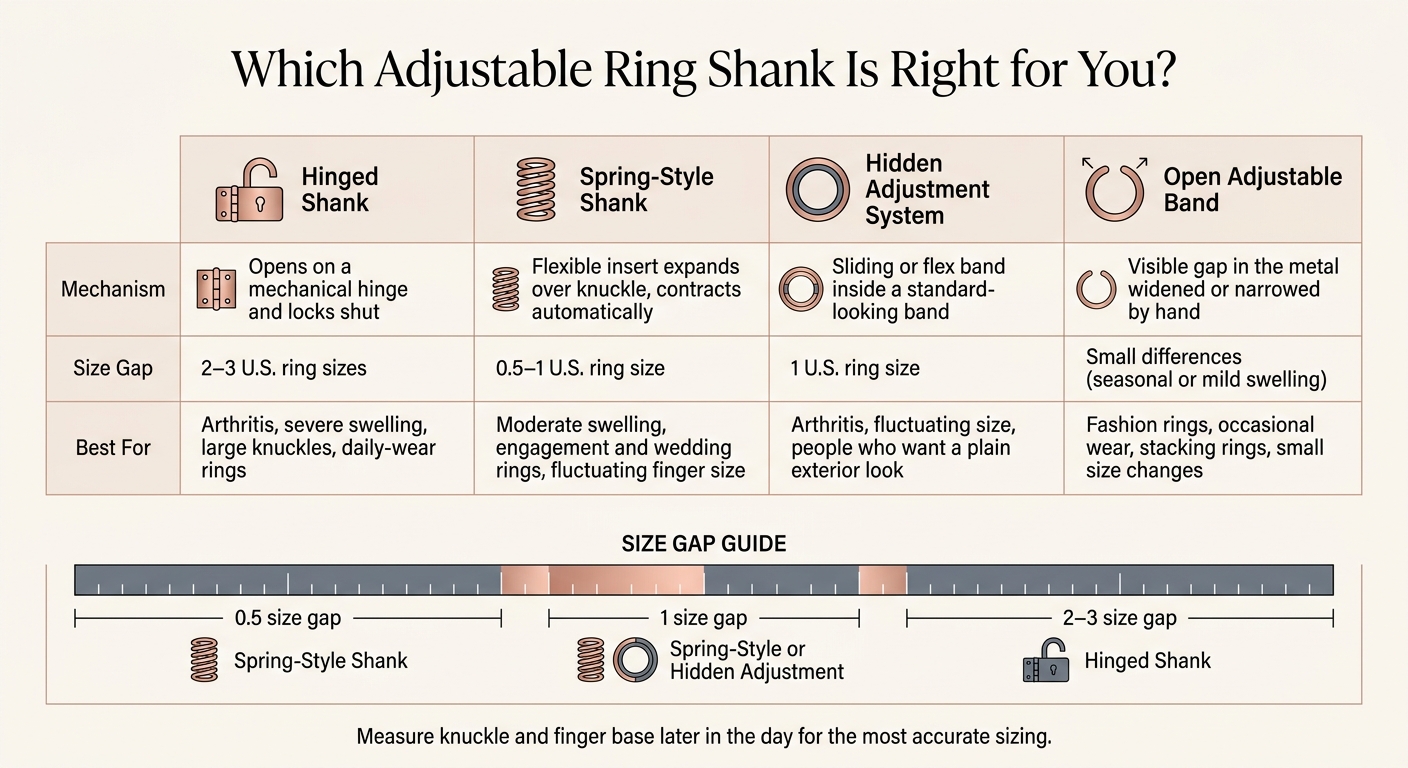
Adjustable Ring Shank Types: Which One Fits Your Knuckle?
Measure Both the Knuckle and the Base of the Finger
First, confirm that the ring needs to pass over a larger knuckle. Then pick the shank based on the size gap.
Measure the widest part of the knuckle and the base of the finger where the ring will rest. Do both measurements later in the day, since fingers often get a bit larger from normal swelling. After that, convert each measurement to a U.S. ring size with a standard sizing chart. The difference between those two sizes points you to the right shank style.
Here’s the simple rule of thumb:
- A half-size gap may work with a spring-style shank.
- A one-size gap may work with a spring-style shank or a hidden adjustment system.
- A two- to three-size gap usually means a hinged shank is the better choice.
Adjustable Shank Styles Compared
Match the shank style to the gap between your knuckle measurement and the base of your finger.
| Shank Style | Mechanism | Best For |
|---|---|---|
| Hinged Shank | Mechanical hinge and latch | Severe swelling, arthritis, daily-wear rings |
| Spring-Style Shank | Flexible insert or internal spring tension | Moderate knuckle difference, engagement and wedding rings |
| Hidden Adjustment System | Sliding or flex band | Arthritis, fluctuating size, looks like a standard band from the outside |
| Open Adjustable Band | Gap in the metal | Fashion rings, occasional wear, small size differences |
When Satinski May Be a Good Fit
If you want an adjustable ring without a visible opening, a hidden adjustment system makes sense. It gives you flexibility while keeping the outside look close to a standard band.
Satinski’s adjustable rings use a hidden adjustment system designed to help rings fit over larger knuckles and handle changing finger sizes, while still looking like a standard band from the outside. The line includes adjustable engagement rings, wedding bands, and stacking rings in sterling silver and 18K gold, made to flex across U.S. sizes 5–9.
Who Benefits Most and Key Takeaways
Best for Arthritis, Large Knuckles, and Changing Finger Size
Once you’ve picked the style, the next step is making sure it fits the wearer’s finger size and day-to-day life. This is where adjustable shanks can make a big difference.
They tend to work best for people dealing with arthritis, large knuckles, past joint injuries, or finger sizes that shift with swelling, heat, or hormones. That matters because a ring can feel fine one day and frustrating the next. An adjustable design helps the ring get over the knuckle, then sit more securely where it should.
Care, Checkups, and the Main Points to Remember
After you choose the right style, a little routine care helps keep the mechanism working smoothly. Clean the ring gently with mild soap and warm water. Then check the hinge or spring for looseness or rough movement. If the ring starts to feel stiff or uneven, it’s a sign to take a closer look.
Frequent forcing or repeated adjustment can weaken the mechanism over time. In plain terms, these rings are built to move, but they still need a gentle touch.
The main advantage is simple: the ring clears the knuckle, then stays secure at the base.
FAQs
How do I know which adjustable shank type I need?
Think about your day-to-day life and how your fingers change from one day to the next. If your ring size shifts with temperature, activity, or conditions like arthritis, it helps to pick a ring that stays easy to wear and simple to adjust.
Most Satinski adjustable rings fit a range of US sizes 5–9. If you want the option that looks most like a standard ring, go with a hidden adjustment mechanism. It keeps the ring’s classic appearance and lets you resize it at home with the provided tool.
Can an adjustable shank work for arthritis or severe knuckle swelling?
Yes. Adjustable shanks are made for fingers where the knuckle is larger than the base.
If swelling from arthritis is more severe, hinged styles can open wide enough to go over the joint, then lock once they're in place. Open-shank styles can be widened to move past swollen areas, then gently tightened for a better fit at the base.
Do adjustable shanks need special care or checkups?
No. Adjustable shanks don’t need professional checkups or specialized maintenance to keep working, and you can adjust them at home when needed.
For everyday wear, treat the ring gently, keep it away from harsh chemicals, and store it properly when you’re not wearing it. Clean it with a soft cloth and, if needed, use a polishing solution made for jewelry.


