

Losing Weight on GLP-1? Here's What Happens to Your Ring Size
Yes - if you lose weight on a GLP-1, your ring size can change. Rings often get loose as fingers slim down, and that can happen before you expect it. In many cases, a loss of 20 to 40 pounds may change fit by about 1/4 to 1/2 size, while 50+ pounds can lead to a change of 1 to 2 sizes.
Here’s the short version:
- Loose rings are easier to lose during hand washing, swimming, cold weather, or lotion use
- Daily swelling can confuse the fit, since fingers can shift by up to half a size
- Check more than once, ideally in the late afternoon or evening
- Use a temporary fix first if you’re still losing weight
- Wait 1 to 3 months after your weight levels off before permanent resizing
- Some rings, like eternity bands, tension-set rings, titanium, and tungsten, may not be resizable
If I were dealing with this, I’d treat a spinning ring as a warning sign, measure my finger at home, use a low-cost adjuster or wear the ring on a chain, and wait until my weight stays steady before paying for resize work. That’s the main takeaway: protect the ring now, then resize later if the loose fit sticks.
Signs Your Ring Size Has Changed
Fit Changes You May Start to Notice
One of the easiest ways to tell is the shake test. Hold your hand flat and give it a gentle shake. If the ring slides or spins on its own, it’s too loose.
A ring that fits well should feel snug as it passes over the knuckle. If it slips over the joint without much effort, there’s a good chance your size has changed.
You might also spot smaller day-to-day clues. The ring may spin more than it used to, and your fingers may look slimmer, with tendons and veins standing out more than before.
Normal Daily Finger Changes Versus a True Size Change
A loose ring doesn’t always mean you need a new size. Finger size shifts during the day because of temperature, hydration, sodium, and exercise. Those swings can change ring fit by as much as half a size.
What matters most is how long it lasts. Short-term changes usually go away within a few hours or by the next morning. A true size change tends to stick around for weeks or months.
For a better read, check the fit a few times over several weeks. It’s best to do that in the late afternoon or evening, when fingers are usually at their largest. If the ring still feels loose after repeated checks, measure it at home.
If you’re still losing weight, keep checking the fit until things level out. And if the looseness lasts more than a day or two, measure your ring size next.
sbb-itb-9da40c1
How to Check Your Ring Size at Home
If your ring has started spinning or slipping, measure it before it slips off.
Using a String, Paper Strip, or Printable Ring Sizer
Wrap a non-stretchy string or a thin paper strip around the base of your finger. Mark where the ends overlap, then measure that length in millimeters. It also helps to measure your knuckle. If your knuckle is larger than the base of your finger, size for the widest part.
For the best reading, measure in the late afternoon or evening, when fingers are usually at their largest. Cold hands can make fingers measure up to half a size smaller, so let your hands come to room temperature before you start.
| US Ring Size | Inside Diameter (mm) | Inside Circumference (mm) |
|---|---|---|
| 5 | 15.7 | 49.3 |
| 6 | 16.5 | 51.8 |
| 7 | 17.3 | 54.4 |
| 8 | 18.1 | 56.9 |
| 9 | 18.9 | 59.5 |
| 10 | 19.8 | 62.1 |
Use the chart as a guide, then compare your result with a ring that still fits well.
Measuring a Ring That Currently Fits Well
If you have a ring that used to fit perfectly, that can give you a good reference point. Use a ruler with millimeter markings and measure the inside diameter straight across the center of the inner opening. Then match that number to the chart above.
A ring that fits well should move over the knuckle with slight resistance and sit at the base of your finger without constant spinning or sliding.
If the ring now slips on more easily, your size may have changed. Losing 20–40 lbs often changes ring size by about 1/4 to 1/2 size, and losing 50+ lbs can change it by 1 to 2 sizes. Comfort-fit bands also tend to feel about a quarter size larger than flat-inside bands.
If the fit has changed, the next step is deciding between a temporary fix, resizing, or an adjustable ring.
What to Do When a Ring Feels Too Loose
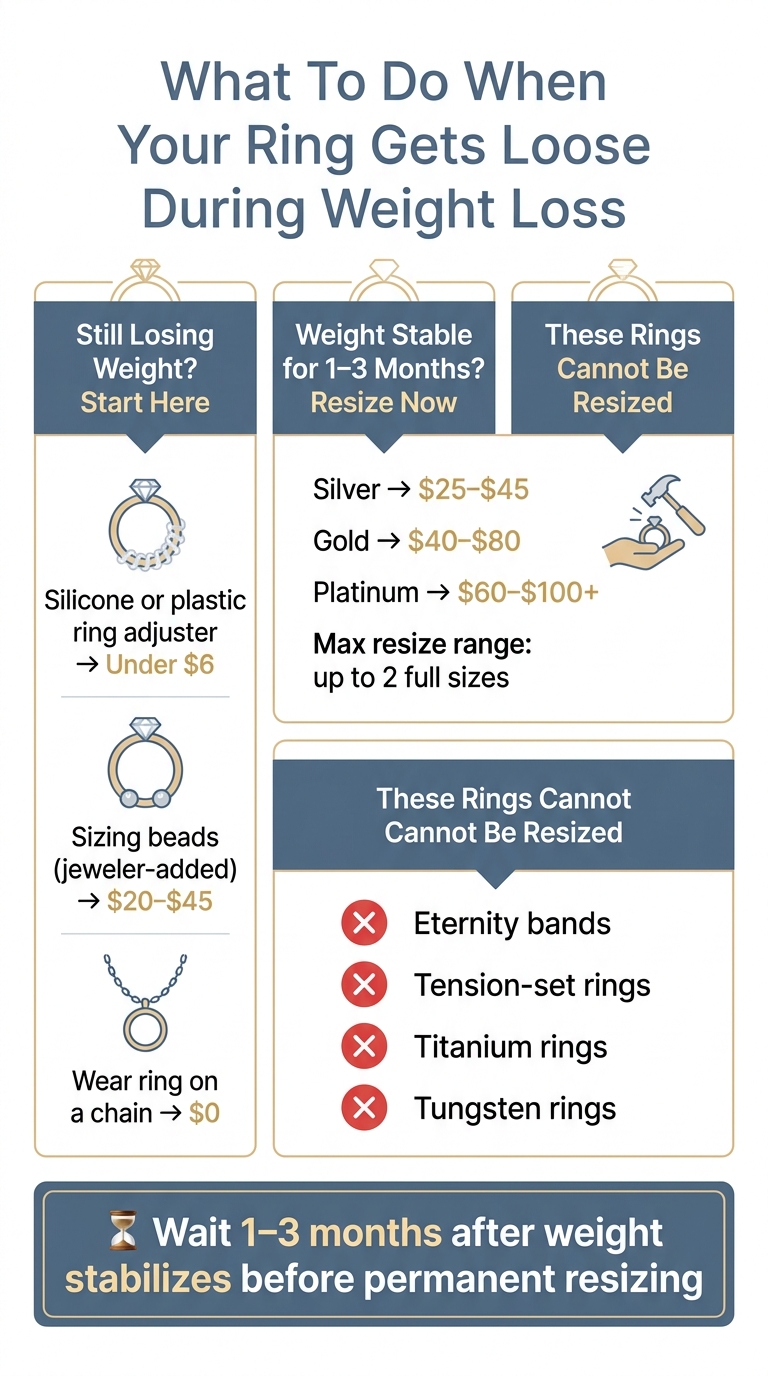
Ring Size Changes & Fixes During GLP-1 Weight Loss
Short-Term Fixes During Active Weight Loss
If your ring spins or slides off with very little effort, treat it like it could fall off at any time. Hold off on permanent resizing until your weight has stayed about the same for 1 to 3 months.
A simple short-term fix is a silicone or plastic ring adjuster. It makes the inside of the band smaller, usually costs under $6, won’t harm the metal, and you can take it off whenever you want. If the ring feels very loose, wearing it on a chain is the safer move until your size settles.
If you want something less visible, a jeweler can add sizing beads. These are two small metal balls soldered inside the band, usually for about $20 to $45. They help keep the ring in place while still allowing it to go over your knuckle.
| Option | Approx. Cost |
|---|---|
| Silicone or plastic adjuster | Under $6 |
| Sizing beads | $20–$45 |
| Wearing on a chain | - |
Go with the lightest fix that keeps the ring secure for now, then check the fit again once your weight levels off.
When to Have a Ring Professionally Resized
Professional resizing makes the most sense after your weight has stayed stable for 1 to 3 months. If you do it too early, there’s a good chance you’ll end up paying for another resize later.
In most cases, resizing costs about $25 to $45 for silver, $40 to $80 for gold, and $60 to $100+ for platinum. Most plain metal bands can be resized up or down by as much as 2 full sizes before the ring’s structure or look starts to change.
There are limits, though. If the change is beyond that range, or the ring is an eternity band, a tension-set ring, or made from titanium or tungsten, resizing may not be possible at all. A jeweler can tell you if your ring is a good fit for resizing before any work starts. Until then, stick with a temporary fix that keeps it secure.
When an Adjustable Ring Is the Better Long-Term Option
If your ring size is still changing - or you think it may keep changing - an adjustable ring can save a lot of hassle. Hinged shanks and other adjustable designs can stay comfortable across a range of sizes without repeated trips to the jeweler.
This can work well for engagement rings, wedding bands, and everyday rings when your finger size hasn’t settled yet.
The path here is pretty simple: use a temporary fix now, resize once your weight is stable, or choose an adjustable ring if size changes are likely to continue. If your size keeps shifting, the next step is making sure the ring stays safe during day-to-day wear.
How to Protect Your Rings While Your Size Is Still Changing
Daily Habits That Lower the Risk of Loss or Damage
If your ring size is still shifting, a few simple habits can save you from losing a ring or damaging it.
Keep using the shake test. If the ring spins freely or starts sliding toward your knuckle, it’s too loose to wear safely.
It also helps to take rings off before swimming, showering, or washing dishes. Water and soap make loose rings much easier to lose. A ring can slip off fast when your hands are cold, wet, or soapy. Winter is an even bigger risk, since rings that are already borderline tend to slide off more easily.
If a ring feels risky to wear, put it in a dedicated jewelry box right away. Don’t leave it on a counter or near a sink drain, where it can disappear in a second.
Once your weight has stayed steady, it’s time to move from short-term protection to a permanent fix. Keep checking the fit until your weight stabilizes, then switch to resizing or an adjustable ring.
FAQs
Can GLP-1 weight loss change ring size quickly?
Yes. GLP-1 weight loss can change finger size fast, which can make rings feel loose, spin around, or even slip off as fat in the fingers decreases.
There isn’t a set formula. Some people notice a change after losing 10–15 pounds, while others drop one to two ring sizes. To protect your jewelry, use temporary ring adjusters for now and wait until your weight has been stable for 1–3 months before getting a ring professionally resized.
How do I know if my ring is too loose?
Try a simple shake test: hold your hand out and check whether the ring slides or spins freely. It may be too loose if it keeps spinning, slips off with almost no resistance, or still feels loose when your hands are warm.
If you can take it off without it going over your knuckle, it’s likely too large. Fit can change with temperature, hydration, and daily activity, so look for these signs more than once before you resize.
When should I resize my ring after losing weight?
Resize your ring only after your weight has stayed the same for 1 to 3 months. If you resize it while you're still losing weight, there's a good chance you'll need to resize it again later.
For now, go with a temporary fix like ring-size adjusters, ring guards, or sizing beads. If your ring starts spinning or sliding, that's a clear sign the fit has changed and a temporary fix makes sense.


